

BugNet by Bruce Brown Mountain In The Clouds by Bruce Brown


Astonisher.com logo

The History of the Corporation
Volume One
by Bruce Brown
BF Communications Inc. 2003

IT'S FUNNY how a little thing like a trip to the library can change your life.

That's what happened to me in 1973 when I walked into the University District Branch of the Seattle Public Library looking for a general history of the corporation.

I expected to find a half-dozen different flavors -- ranging from Marxist attacks to capitalist apologies -- but there were none. I left the library empty-handed that afternoon, and thus began my pursuit of the invisible, conceptual creatures that rule the world today.

Thirty years later, in 2003, I published the first comprehensive history of the rise of the modern corporation, from the oldest surviving corporation -- the Benedictine Order of the Catholic Church, founded circa 529 A.D. -- through the Dark Ages, when corporations first ruled human beings.

If you want to understand the modern world -- how power works and why it flows in the cultural channels it does -- you need to understand the modern corporation. And if you want to understand the modern corporation, you need to read this book.

There are a zillion books that look at a zillion brief moments in corporate history, but The History of the Corporation is the first book to stand back at look at the big picture from the beginning.

Care to take a peek? The History of the Corporation, Volume One by Bruce Brown is available here on the Web at astonisher.com.

Click here for the Introduction and linked Table of Contents, or click here to search this online excerpt from the book.

You can also purchase the complete book at the astonisher.com store.

-- B.B.

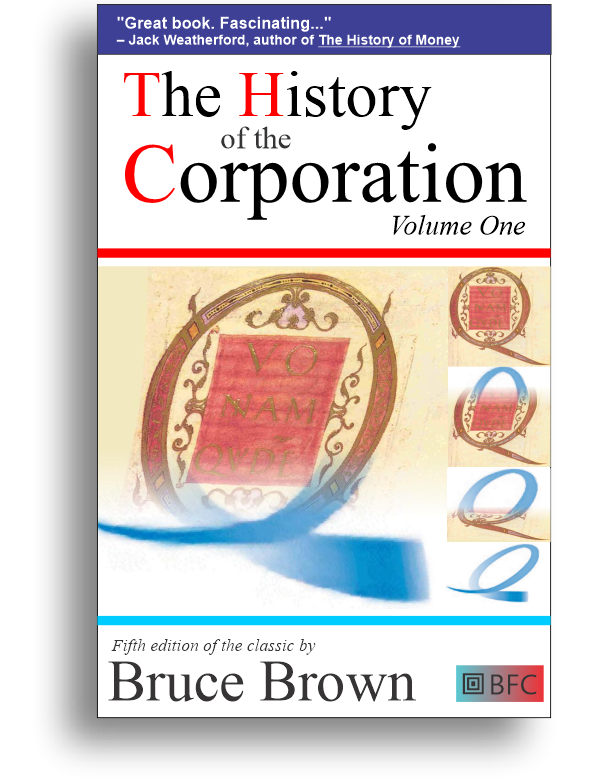
Cover thumbnail of The History of the Corporation by Bruce Brown
First paperback edition from BF Communica-
tions Inc.

Malcolm J. Brown and Bruce Brown in Sumas, July 1988

Malcolm J. Brown, Emeritus Professor and author of The Politics of Irish Literature, with Bruce Brown in July 1988. Father and son talked about "the corporation book" almost daily during this period.


"Great book. Fascinating..."
-- Jack Weatherford, author of The History of Money

The History of the Corporation
by Bruce Brown

* READ free excerpts on astonisher.com
* BUY the complete book at the astonisher.com store


The History of the Corporation by Bruce Brown

Introduction

A THOUSAND YEARS from now, our time will be remembered as the Second Dominion of the Corporation.

During the early 20th century, enterprises bearing imprimaturs like Corp., Ltd., AG and S.A. gained control of the vast physical wealth in what used to be called the Free World.

Then with the advent of new economic policies in the Soviet Union and China during the late 20th and early 21st centuries, the corporate conquest neared completion. Virtually the entire planet had become organized and regimented -- in short ruled -- by corporations.

This accomplishment is beyond the power of any individual or any other type of organization in human history. It not only overshadows the authority of the world's social, political and religious forces, it transcends them, so that all people may find utility in its embrace.

Nowhere is the rise of the modern corporation more apparent than in the United States, which possessed only seven chartered business corporations at the time of Independence. The first significant American industrial corporation, the Boston Manufacturing Company, was not established until 1813.

Unfettered by restrictive laws or limited resources, however, American business corporations soon outstripped their European counterparts. In less than a century, advanced corporate forms like J.P. Morgan's U.S. Steel and John D. Rockefeller's Standard Oil dominated the vital, productive heart of American industry.

Corporations grew larger in America than ever before on earth, and this gigantism remained a prominent feature of American corporations throughout the 20th century. In 1991, eight of the world's ten leading corporations were American, including the world's largest, General Motors. A decade later, four of the world's five largest corporations were American, including the largest in terms of gross revenue, Wal-Mart.

Mere size, however, can't convey the corporate flowering witnessed in America and the rest of the world over the last 100 years. Equally impressive is their diversity. They weave cloth, fabricate microprocessors, baptize babies, provide insurance, promote frauds, educate philosophers, sell cigarettes, save whales, launder money, make garbage, and finally haul it all away and bury it.

Corporations are, in fact, involved in virtually every type of human activity today, legal and otherwise. The reason is that the corporation is not comprised of an array of job-specific skills, but rather a means of organizing any human activity. While corporations exist as small as one person, (such as most Catholic bishoprics in the U.S., which are corporations sole), the real genius of the entity lies in its ability to employ large numbers of people in complex enterprises.

At times corporations function commercially, at other times governmentally or religiously. Even among farmers, the last American bastion of individualism and family enterprise, the corporation has made great inroads. Many family farms are now structured as corporations for tax purposes, and in the richest portions of the nation's greatest agricultural producer, California, corporate farming has predominated since the 1970s.

Because the most powerful American corporations are of recent origin, it is easy to think of the corporation as a modern phenomenon, but actually they are very ancient -- so ancient that their actual point of origin is lost in legend of Numa Pompilius and beyond. The oldest surviving business corporation in the world is probably Sweden's Stora Kopperberg, which was founded in 1288 and is now known as StoraEnso. The oldest surviving corporation of any sort is the Benedictine Order of the Catholic Church, which was founded around 529 A.D.

Many aspects of modern corporate life are actually artifacts of the ancient past. The first corporate convention on record, for instance, was held by the Cistercian monks in the early 12th century. Even the pants that modern business executives wear -- either figuratively or literally -- are derived from the dress of Venetian corporados who adopted the customs of the Moslem East, scandalizing sixteenth century Europe and giving birth to the comic Venetian businessman, Pantalone, in Italian commedia dell' arte.

Similarly, former U.S. Treasury Secretary William Simon and associates were employing a hoary gambit when they bought the Gibson Greeting Card division of RCA in 1982 with $1 million of their own money, and $79 million borrowed against Gibson Greeting's own assets. Upon selling Gibson Greeting eighteen months later, Simon reportedly pocketed $66 million on an investment of $330,000. For awhile -- before the fall of Drexel Burnham Lambert and the others dragged down by leveraged buyout (LBO) debt -- it seemed like LBOs might remake the American financial landscape.

Table of Contents
"Q Morph" from the cover of The History of the Corporation by Bruce Brown

Astonisher.com is pleased to present The History of the Corporation, Volume One by Bruce Brown.

Here is the Table of Contents for the entire book, which covers 1,000 years from the birth of the first modern corporation through the the First Dominion of the corporation.

The TOC is linked to all of the Introduction, Afterword and chapters 1, 2 and 3, as well as excerpts from the remaining chapters.

If you would like to purchase The History of the Corporation, Volume One, please visit the Astonisher.com Store.

The History of the Corporation
Volume One
by Bruce Brown
Introduction
Ch. 1 Ch. 2 Ch. 3
Ch. 4 Ch. 5 Ch. 6
Ch. 7 Ch. 8 Ch. 9
Ch. 10 Ch. 11 Ch. 12
Afterword

About the Author: Bruce Brown is the author of eight books, including Mountain in the Clouds, an environmental classic, and The Windows 95 Bug Collection, which was put on display in the Smithsonian Institution in Washington, DC.
He has done investigative reporting for the New York Times (the Karen Silkwood story), foreign correspondence for Atlantic Monthly (baseball in Cuba), and book reviews for the Washington Post Book World, as well as script-writing for PBS-TV (The Miracle Planet).
He is also a successful businessman and CEO, having created BugNet and built it into the world’s largest supplier of PC bug fixes before it was acquired by a Fortune 500 company at the height of the dot com boom.

Already Made Up Your Mind?
CLICK BUTTON to buy The History of the Corporation in the Adobe Acrobat PDF e-book in the fast, convenient Download Edition for just $29.95, with your credit card and PayPal for complete security and the fastest service...
CLICK BUTTON to buy The History of the Corporation in the Adobe Acrobat PDF e-book CD-ROM Library Edition for just $39.95, with your credit card and PayPal for complete security and the fastest service...
Pay with your personal check!

CLICK BUTTON to buy The History of the Corporation in either Adobe Acrobat PDF e-book edition with your personal check...

About the Q-morph: to understand modern corporations, you have to understand where they are coming from, literally. All modern for-profit corporations (like Quest, whose blue Q logo is a common sight in 21st century America) are descendants of the oldest surviving corporation, the Benedictine Order of the Catholic Church (which produced the illuminated Q,during the 9th century).

In those heady days, a great deal was written about this marvelous advance in modern corporate practice. Actually, however, there are records of LBOs as far back as the thirteenth century when the Dominican bishop Thomas of Cantimpre complained of the ill effects of borrowing against the assets of a corporation to acquire control of it. "I am ashamed to record what I have seen," he wrote. "The abbot of this house [Anchin], who scarce knew the first elements of spiritual rule, attained to the elevation ... at so great an expense of money that he left his abbey in debt to the extent of more than 10,000 lire."

In addition to LBOs, the merchant guildsmen of Renaissance Italy employed compound interest, double entry bookkeeping, sinking funds, and expense accounts. Even the word company reflects actuarial refinement. It is derived from the French, com panis, meaning "with bread." This referred to a common device employed to dodge medieval usury laws; namely that a passive investor shared the risk of the venture as if he was a member of the family -- i.e., "shared the bread" -- of the people actively involved in the business, and therefore had "earned" his usurious interest or dividend.

While the etymology of company stresses the illicit aspects of the corporation, the word corporation itself stresses the higher aspirations of the entity. Derived from the Latin corparæ, it means to make corporal, or physically embody. For the first half millennia after the fall of Rome, the world's most powerful corporations were all trying to embody the Christian God. The idea took hold so strongly that by 1534 St. Thomas More could speak of Jesus Christ as the ultimate corporation: "He [Jesus] doth...incorporate all christen folke and hys owne bodye together in one corporacyon mistical."

A century later, Roger Williams, Freethinker and founder of Rhode Island, likened the church to a "company of East India or Turkey merchants," while English philosopher Thomas Hobbes saw those same joint stock companies as lesser -- possibly parasitic -- creatures within the larger creature of the state. In Leviathan he wrote, "Corporations... are many lesser commonwealths in the bowels of a greater, like worms in the entrails of a natural man."

God, demon, servant, master, parasite or provider -- what exactly is the corporation? A good starting point is probably Chief Justice John Marshall's definition in the 1819 Dartmouth College case: "A corporation is an artificial being, invisible, intangible, and existing only in the contemplation of the law," Marshall wrote. "Among the most important [of its qualities] are immortality, and if the expression be allowed, individuality; properties by which a perpetual succession of many persons may be considered the same, and may act as a single individual..."

In a general sense, this definition fits every corporation from St. Benedict's to Michael Milken's. All are invisible, for although they may be mighty, they have no form unto themselves; all are individual, with identities and personalities distinct from their numberless human workers; and all can outlive and replace those same workers, just as the higher animals replace their individual constituent cells as they die or lose their effectiveness. Although corporations are themselves not made of flesh and blood, they display qualities of biological life so strongly that both Hobbes and Marshall remarked upon it.

Some modern writers, like W. David Kubiak, have argued that corporations actually constitute an entirely new class of being. Kubiak notes that corporations "appear to fulfill all the definitional requirements of a complex 'organism.' All of them, for example, share basic organizational processes, structures and energy needs: generate psychic membranes that divide their membership from outsiders; take in and process information and nourishment from the environment; specialize, control and outlive their human/cellular constituents: can reproduce, spawning subsidiary bodies..."

The main human attribute that corporations lack is a soul, as Roger Manwood, chief baron of the Exchequer, noted as early as 1592. Since the corporations themselves, and not their souls, were immortal, they were not held accountable to the moral standards that applied to individual people. "Corporations cannot commit treason, nor be outlawed," wrote the great English legalist Edward Coke, "for they have no soul." Or as English lawyer Howel Walsh put it, "a corporation cannot blush." Thus the corporations' moral inadequacy amounted to a significant legal advantage, one of many they have accrued.

In fact, special dispensations, exemptions, and privileges of every kind imaginable are the life's blood of the corporation. Corporate members enjoyed various privileges during Roman times, such as curial immunity, and organizational privileges are evident as early as 628 A.D. in the ecclesiastic orders of the Catholic Church, the first great corporations of the post-Roman era. Modern English and French law traces the secular corporation to the concept of "franchise," which is the French Norman word for privilege.

Over the centuries, these privileges have been nurtured, entrenched, and expanded. You can get some idea of this corporate favoritism when you realize that no American corporation was indicted -- let alone convicted -- for murder until 1978. Criminal law is really a sidelight, though. The place where corporations enjoy their biggest advantage is tax law. During the height of the Reagan era, 50 of the largest business corporations in America avoided paying any federal income tax. In many ways, modern corporations are analogous to the aristocracy of the ancien regime.

The power of the modern corporation is awesome, but so too was the power of many corporations that have vanished into history, leaving behind only museums full of broken ornaments. In fact, the great medieval corporations dominated society and its physical wealth much the way the modern corporations dominate our own. This was the First Dominion of the Corporation, when powerful religious orders, secular guilds and merchant societas became the dominant social force in Europe. In the false dawn before the Black Death, corporations like the Knights of the Hospital of St. John even began to take the form of nations and claim territory.

The First Dominion of the Corporation lasted more than half a millennium, propelling Europe to ascendancy over the Moslem East, proselytizing the globe and producing the Renaissance before meeting a savage end during the French Revolution. By then, popular sentiment identified the great ossified religious corporations with many of the more prominent ills of society. The fury the people felt against these corporations -- especially the religious orders of the Catholic Church -- was so extreme that France's greatest monastery, the abbey of Cluny, was torn apart stone by stone, until nothing was left standing.

Viewing the bits of Cluny that remain today in the Hotel de Cluny in Paris, one can not help wondering if our own corporate colossi are headed for a similar end. Or has the modern corporation evolved sufficiently to avoid the pitfalls of the past? Certainly the similarities between old and new are striking in many respects, from surface cultural characteristics such as the rise of a human managerial elite to deeper structural qualities such as corporate control of almost all physical human wealth.

Walter Rathenau, a powerful industrialist and head of Germany's Allgemeine Elektrizitatsgesellschaft, wrote in 1916, "the enterprise [joint stock company] takes on an objective existence, such as in earlier days was embodied only in state and church, in a municipal corporation, in the life of a guild or religious order... as if it belonged to no one."

Yet corporations cannot exist without the human beings who made them. Mankind and the corporation are wed like Pygmalion and Galatea. The corporation gives mankind the most powerful form of social organization ever known, claiming in return the capacity to act in the physical world.

But even as they act on the corporation's behalf, people reveal the invisible presence which directs them. Human beings serve as the screen upon which the corporation's essential form is projected, like some sort of distorted silhouette glimpsed amid the flames of shifting human passions.

The lives of Totila, St. Francis, Marco Polo, Savonarola, Lorenzo de' Medici, Mynheer Dirckszoon, John Law, Jay Cook, T. Boone Pickens, Mother Teresa -- and billions of others -- are united in this larger corporate life, be it "mistical" or otherwise.

The aim of this book is to portray the fundamental form of the corporation, revealing something which can't be seen with the naked eye, yet rules most people's lives.

Next chapter...

"The History of the Corporation, Volume One" © Copyright 2003 Bruce Brown
Jacket illustration and design by Running Dog.


New CD-ROM LIBRARY EDITION
cover thumbnail of The History of the Corporation by Bruce Brown

"Great book. Fascinating..."
-- Jack Weatherford,
author of
The History of Money

The History of the Corporation
by Bruce Brown

* READ free excerpts on astonisher.com
* BUY the complete book at the astonisher.com store

"An environtmental classic..."
Moutnain in the Clouds by Bruce Brown: 25th Anniversary

Mountain in the Clouds
by Bruce Brown

* READ free excerpts on astonisher.com
* BUY the complete book at the astonisher.com store


© Copyright 1973 - 2012 by Bruce Brown
and BF Communications Inc.

Astonisher and Astonisher.com
are trademarks of BF Communications Inc.

BF Communications Inc.
P.O. Box 393
Sumas, WA 98295 USA
(360) 927-3234

Website by Running Dog

Astonisher.com Most Read

1. The History of the Corporation
2. Heart-stopping Sturgeon
3. Who Killed Custer?
4. White Cow Bull at the Little Bighorn, #1
5. Windows 7 / XP Wireless Network Bible
6. Conversations With Crazy Horse
7. Dr. Whacko's Guide To Slow-pitch Softball
8. Bogus Crazy Horse Photos
9. GoLive / Dreamweaver Migration Bible
10.
Crazy Horse In Action

"Mass extinction of Web Sites Looms..." by Bruce Brown

"Vernon Louis Parrington" by Bruce Brown

Obama has jobs for young Americans!

"The Histroy of hte Corporation" by Bruce Brown

"Who Killed Custer" by Bruce Brown Audio Book cover

Mountain in the Clouds by Bruce Brown

Sarah Palin: The kind of change America wants!

Dr. Whacko's Guide to Slow-Pitch Softball by Bruce Brown

WWCHD? What would Crazy Horse do?

"The Digital Rip Van Winkle Returns" by Bruce Brown

"Silkwood: The Finale" by Bruce Brown

Astonisher.com Forums on LikiWiki.com

Content on this page requires a newer version of Adobe Flash Player.

Get Adobe Flash player