|
||||||
Bruce Brown's 100 Voices... The Sioux scoop the Americans too
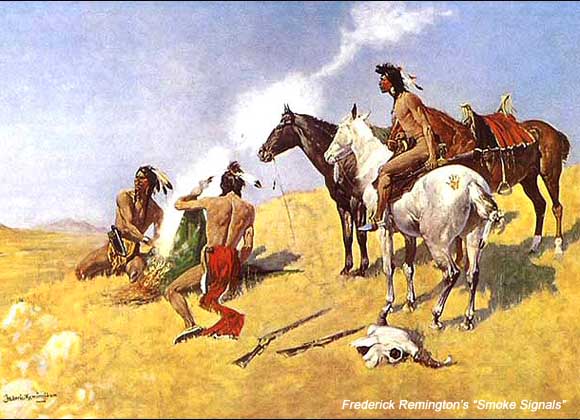
by T.R. Porter ON THE AFTERNOON of June 25th, 1876, Gen. Crook, the famous Indian fighter, was in camp somewhere in northern Wyoming about a hundred miles south of the Bighorn Country. With him were his command of soldiers and a number of Indian scouts. General Crook had always had the respect and confidence of the Indians, even when he was fighting them hardest. He always kept faith with them, and never broke his word nor a promise made them. Frequently the General stopped in at the tent wherein his Indian scouts lived, and talked with the chief of scouts. In fact, so thoroughly did the Indians trust Crook that they made him a member of the Soldier Lodge. The Soldier Lodge in Indian life corresponds to the highest degree of Masonry among white men. In war time the members of this lodge took charge of the campaign and waged the conflicts. In time of peace the Soldier Lodge was the most powerful institution among the Red Men. Secrets of the lodge were no more betrayed than are secrets of Masonry. Few -- a very few -- white men have ever been initiated into this innermost circle of Indian life. Gen. Crook was one of these. Thomas H. Tibbles of Omaha, for forty years a member of the Omaha Tribe, was another. On the afternoon of June 25th, 1876, Gen. Crook, in camp a hundred miles south of the Little Bighorn, walked down among the tents of his soldiers. The men were enjoying a rest, after a hard ride, and were sitting around, laughing, talking and joking. Finally the General came to the big tent occupied by his Indian scouts. Every Indian was silent. They were sitting around, "grumpy" and sullen. Gen. Crook spoke to one of them. His only answer was a grunt. He spoke to another and received no answer at all. The General walked to his quarters. Then he ordered the chief of Indian scouts sent to him. "What's the matter with you fellows?" inquired the General. But the Indian wouldn't talk. Gen. Crook could get absolutely nothing out of him. So the Indian was dismissed. Crook thought the matter over for some time. He knew that something was wrong with the Indians, but he could not figure out just what it was. The Indians were worried. So was Crook. Finally Gen. Crook sent for the chief scout again. When he came the General had a long talk with him. He finally demanded in the name of the mysteries of the Soldier Lodge, to which the Indian also belonged, to know what was the trouble. Then the Indian gave in. "Yellow Hair Custer and all his soldiers, every one, were killed on the Little Bighorn this morning," was the startling information the Indian gave Crook. When Crook asked for details, the Indian could not, or would not, give them. He only insisted that a battle had occurred between the white soldiers and the Sioux, and that the soldiers, to the last man, had been killed. Gen. Crook, having spent many years on the frontier among the Indians, knew that the Red Men had mysterious ways of communicating with each other, and when his scout solemnly assured him, on the word of a Soldier Lodge brother, that the Custer command had been wiped out, he believed the report. In after years he told the incident to Thomas H. Tibbles, another Soldier Lodge White Man, and Tibbles told it to me. However, Gen. Crook told the same story so many times that there is no doubt as to its authenticity. As to how these Indians, a hundred miles distant from the battle, knew of the affair within a very few hours after the firing ceased, neither Crook, Tibbles, nor any other White Man has ever been able to discover. But that they knew the whole story there can be no doubt. [Note: The eye-witness account of Seventh Cavalry survivor William O. Taylor has the answer to this riddle. Taylor noted, "Late in the afternoon of the 25th, and again on the 26th while we were besieged on the bluffs, two or three smoke signals were plainly seen for a long time on the hills west of the Indian village. They did not attract much attention from our command as no one seemed to understand their meaning. To us they were simply "Indian signals" of some kind. They were, in appearance, very high and straight pillars of smoke, varying at times in depth or intensity of color, sometimes being quite light and then again very dark. It was not until long afterwards that the true import of these signals became known to us... "Incredible though it may seem, it is doubtless a fact that the defeat of a large body of soldiers on the Greasy-Grass, [Little Bighorn] was known to the Agency Indians on the Missouri river and elsewhere many days before the whites had any inkling of Custer's defeat."] The Custer Battle Book by Herbert Coffeen, A Reflection Book, Carlton Press, Inc., New York, 1964 p 40 - 42
Here is the first news account of the Battle of the Battle of the Little Bighorn, which appeared in the Helena Herald on July 4, 1876, along with Crow scout Curley's crucial first account of the battle, which appeared in the Helena Herald on July 15, 1876. Here's W.A. Graham's account of how Helena beat Bozeman with the news; here's the New York Times' coverage of the battle; and here's T.R. Porter's account of how the Sioux also scooped the Americans. |
|
|||||