|
||||||||||||
Bruce Brown's 100 Voices... Foolish Elk's Story of the Battle
CRAZY HORSE ENCOUNTERS GENERAL CROOKS [SIC] His First Test As A Leader
Although the young warrior had met and engaged several bodies of troops and Indian enemies none of them had been equal to the size and strength of the forces that his scouts observed moving up the Bozeman Trail from Fort Laramie, and who under the command of General Crooks, were reported to have just crossed the Wyoming border headed north. Crow Scouts Routed On the morning of June 17th, 1876 several Crow scouts were detected lurking at the bend of the river apparently on a reconnaisance maneuver to ascertain the strength of the fighting Sioux. Always on the alert, and warned in advance that the troops were on the march, Crazy Horse and his followers had decided to engage the detachment in spite of its undoubted strength. So when the Crow scouts were observed they were immediately routed in an action that was to pave the way for the major battle the termination of which was to see Crazy Horse in possession of unquestioned prestige as a military strategist of no small stature. From the statements of some of those who took part in the battle the routed Crows were reported to have told Crooks that every nook and ravine adjoining the village was alive with Lakotas who were amply armed and ready for action. "This report" remarked an old warrior "was not exaggerated for we were well armed and prepared to protect our village at all costs." Indians Prepare For Coming Battle Doleful death songs rang out in the still morning air and, in addition, the village crier haunted the scene urging all able bodied braves to arm themselves and to join in the general defense. "While these preparations were in the process of being carried out" declared Thunder Hawk, an eye witness, "the blare of a trumpet could be heard over the range of hills to the east indicating that military maneuvers of some kind were about to be staged. Soon after this our braves proceeded to move into a wooded ravine facing the direction from which they believed the attack would be most likely to come." Soldiers Attacked From Three Sides "As the soldiers, emerged into view from a narrow gap the Sioux war-cry 'Hokahe -- Lets go' was sounded by Crazy Horse. At this signal to charge, the river bottom actualy trembled under the pounding of thousands of hoofs as our warriors dashed out from their hidden posts to meet the enemy. The attack was not staged in one mass but relayed in formations, a style of fighting initiated by Crazy Horse and sometimes successful in encircling troops." "As the first group attacked the foremost van of the enemy another was held in check and as, soon as the leading body had become engaged a second group was dispatched from a right angle. The troops were now being pressed on both sides and with telling blows." "While these two attacks were being stressed with savage fury, the third, and last group was released and, arriving from the left flank, succeeded in almost encircling the detachment. The Army Commander, realizing that he was in a precarious position and almost trapped, saw the necessity for retreat, and not being wholly a novice in the art of Indian warfare, succeeded in executing a serious of defense maneuvers that enabled him to retire in the direction of his unguarded supply wagons where the action was terminated." So ended the battle of the Rosebud in which an American General suffered defeat at the hands of an Indian Chief. In his retreat General Crooks was not harassed by the victors as he had no doubt expected to be and for the very good reason, that, in addition to being amply satisfied at the turn of events the Indians were also extremely relieved that their women and children had not been subjected to the indiscriminate ferociousness that sometimes distinguished attacks on Indian villages. Victory Dance Held That night preparations for a triumphant tribal victory dance took place under the supervision of the Dog Soldiers, a society composed of young braves, who in addition to their other duties, were expected to make arrangements for all special events. A huge bonfire was lighted and soared skyward widely illuminating the surrounding area. Throughout the excitement and growing hilarity, Crazy Horse, tired out from the test he had been forced to undergo, relaxed in his tent and pondered upon the events that had taken place. As he sat in the less extensive glow of his own camp-fire Gall of the Hunkpahpabs and Spotted Calf entered. When the customary greetings had been given Gall informed him of the merrymaking that was going on outside and expressed surprise at the. fact that he was not present. "This night following our great victory," Gall continued, "our braves are enthralled to a state of rejoicing, why not join them? For after all, this is your day for you led our braves to a complete victory." "I am glad that you feel that way," Crazy Horse replied, "But as to my taking part in the celebration I would rather be left alone for I can vision still other troubles ahead and battles to be fought. To cope with these problems one must forget yesterday and plan for tomorrow, so go and enjoy yourself, but likewise advise your respective bands to be ready for tomorrow for we are going to break camp and move toward the Big Horn River. I have decided to make this move for I have learned that more troops are coming from the North." Custer's Conqueror by William J. Bordeaux, Smith & Company 1944 p 53 - 59
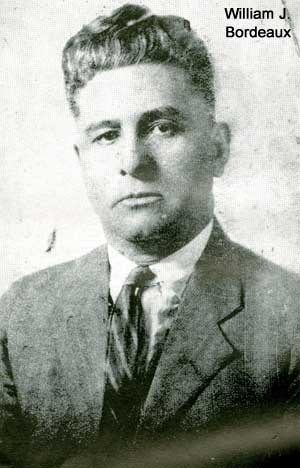
Born in 1884, William J. Bordeaux was the son of a white trader and a Brule Sioux mother, and a registered member of the Brule band of the Teton Sioux. He was not an eye-witness to the events he writes about, but like 100 Voices' other Indian chroniclers (Ohiyesa, John Stands In Timber, Bird Horse and Pretty Shield), Bordeaux had fluent, native access to some important participants whose information is not avialble elsewhere.
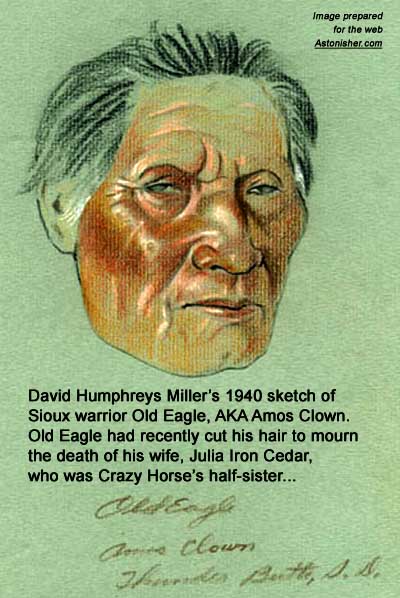
Furthermore, Bordeaux interviewed Crazy Horse's sister, Julia Iron Cedar or Mrs. Amos Clown, which makes his comments on Crazy Horse particularly important. For instance, Bordeaux records Crazy Horse's prediction that the Americans were lying and wouldn't honor the commitments they made to the Sioux in the treaty of 1868, which was true as it turned out. Improbably, William J. Bordeaux was also one of the most astute Indian observers of Crazy Horse's military innovations, describing how Crazy Horse very cleverly attacked a line of Custer's men head on and "slashed at them from both sides" at the Little Bighorn, thereby minimizing the Bluecoats' defensive firepower, and how at the Rosebud, he attacked Crook in encircling waves, a technique Crazy Horse developed to isolate and destroy portions of the American force piecemeal. See Sioux & Cheyenne Military Tactics during the American Wars of Imperial Conquest on the High Plains for more info. Similarly, Bordeaux's tantilizingly brief picture of Crazy Horse in action on the Powder River -- where he tersely yet wryly asks his sub-commanders, "how about it?" -- provides an almost Socratic picture of Crazy Horse in the commander's role. It isn't hard to imagine his eager young accolytes like Good Weasel and Kicking Bear and Little Big Man vying to provide the smartest -- effectively lethal -- answer to their mentor. -- Bruce Brown
|
|
|||||||||||




 THE NEXT DAY the combined bands moved west from the forks of the Powder river to the headwaters of the Rosebud.