 |


| Home * Books * Journalism * Graphic Arts * Video * Store |
At Play In Harm's Way
Why grown men throw themselves off cliffs on bikes, and other Paleolithic mysteries revealed...
Originally posted June 2003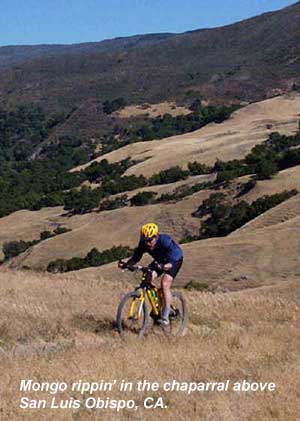 LOOKING DOWN this lifeless, rocky chute, across the dry creek bed to the maximum security high wall of rock on the other side, most reasonable people would probably hear a voice in their head saying, "Whoa!
"Seriously, man! Don't even think about trying to ride your bike through that shit. Get off and walk. Better look for a few handholds on the way down too."
With its tortured rock walls, loose slopes of sharp scree, and meandering arroyos sunk so deep in shadow you can't see the bottom, this place has the possibility of physical pain written all over it. Living things don't do well here.
But I don't see it that way. For me, it's a jazz moment in what today will be four hours of improvisation on the theme of What Trail, a wonderfully sinuous stretch of single track which is as well known to the riders here as Round Midnight is to sax players at New York after hours sessions.
We -- my riding companions and I -- are competitive, but that's not really the point. This morning we are like a Paleolithic band on the hunt. We vie for the lead, but we also share it, and for the good riders there is plenty of game to go around.
What we're hunting for out in this rocky wilderness is a sort of personal probability vortex, a kind of moving wrinkle in time where fleeting combinations of line, speed and vector force are alchemized with the heart of the rider to make the unlikely, sometimes even the impossible, happen.
And so as I came careening down What Trail, I got my first glimpse of this dry creek crossing just about exactly two seconds before I launched myself over the edge of the cliff into it at speed. Here's what I saw in those two seconds.
The first thing I noticed was the rest of my group, who had stopped on the far side to watch me. None of these guys knew me. I'm an out-of-towner who just hooked up with them to ride today. They're all 10 to 20 years younger than I am -- a lawyer, a bike shop geek (the bike world equivalent of a ski bum), a manager at the municipal water treatment facility, a sports video distributor -- and all were riding bikes that cost more than the per capita annual income of your average Third World country.
We'd been on the trail for nearly two hours at this point -- we'd started out from a quiet residential neighborhood out the outskirts of San Luis Obispo, CA, early on a Sunday morning in June, sprinted for an hour and a half up trails to the top of West Cuesta Ridge, a vertical half mile above town, and then turned down a sketchy track called the What Trail, from the cry "what trail?" frequently heard when it disappears into the rocky slope.
Crossing this dry creek canyon was the toughest challenge we'd seen so far on What Trail, and my new friends wanted to see how good a technical rider I was. Each of them had cleaned it before me the way regular patrons at a Thai restaurant polish off a favorite delicacy. Now the question was, would I get pud Thai or humble pie?
The second thing I noticed as my eyes flicked from the down slope of the drop to the dusty creek bed to the twisting rock climb on the other side, was that the path before me was steep, but relatively smooth with no ledges, stair steps or loose debris on top. If you had the courage to launch it, all you had to do to get down the drop was take your hands off the brakes and let 'em roll.
I also immediately compared it to my own personal Rogues Gallery of similar situations, and judged this offender to be a little like one I know on Galbraith Mt. in Bellingham, WA -- the Big Drop on Bob's Trail -- except this one was easier because both the drop and the outrun are smooth, allowing me to attain maximum speed as I raced at the rock wall on the far side.
Clap your hands together once. That's how long all these calculations took, and now I'm suddenly dropping down the face and shifting my rear derailleur into a higher gear so I can get even more speed. The feeling is much like you get on a roller coaster -- your stomach comes up when you start to fall at the top and then your guts compress at the bottom -- except that there are no safety restraints here, no Department of Labor and Industries inspections, no bored attendants to help you in and out of your seat.
Flying across the dry creek bed, I simultaneously shifted both my front and rear derailleurs into lower gears and got back on the bike to take most of my weight off the front wheel. The instant the front of the bike started to jump up the rock wall, though, I threw myself forward over the handlebars, jammed the point of my saddle into the crack in butt (a technique known in mountain biking as "butt cracking") and poured the power to the pedals so that I seem to pop to the top of the rock wall like a diving duck popping up to the surface of a lake: to the uninitiated, I just suddenly seemed to "appear" at the top.
But I wasn't through it yet! The exit at the top of the rock wall was a hard left where the trail was sliding into a deep side arroyo, leaving a loose, trailless side-slope as the only way to skirt the meandering, dozen-foot deep cleft in the rock looming on the left. So without even thinking, I steered my bike straight up the steepest part of the side slope. I needed a burst of reserve power to do this because it is the most physically taxing path you can steer, but it was also the only rideable path, so steer it I must.
As I hit the crest and could glide back down onto something that could be called a "trail," one of my companions, Sterling, the sports video guy, called out, "Bruce, you're an artist." As I came to a brief stop with the group, he reminisced with Edwin about another rider who had careened into the rock wall on the right and then fallen into the dry arroyo on the left. "It was ugly," Edwin agreed. "He needed help getting his bike out and had to walk a fair ways back."
"You'll know if it's broken," Sterling said in a voice that satirized the smug tone of physicians who say that "this will hurt me more than it hurts you." Then he punctuated his quip with a wild, high scream of raw anguish which rang out across the sunny landscape like something out of the Jurassic.
And with that, we were off again, plunging down, down, down through the ghostly, silvered remains of a rare Sargant Cypress forest that burned in the early '90s. "It was arson," Sterling called over his shoulder as he hurtled across a series of rock knobs. "The fire was set by an out-of-work contractor. He thought he could stir up some business that way." "Shoulda tossed him in the fire," muttered Edwin, the attorney, following Sterling's line like an echo.
At the end of What, we shot out onto an old cat track, one of hundreds that were punched into the mountains around San Luis Obispo by Mercury prospectors in the early 20th century. The mines all failed, but the tracks in the rock persist, providing the bulk of the San Luis Obispo trail system. Edwin, whom I originally took for a naturalist, pointed out local flora like the cypress and various native flowers like the showy yellow monkey flower, a native mallow whose dreamy violet blooms look like something out of Georgia O'Keefe, and a wild yellow lily called Mariposa Obispoensis.
WE TOOK our only real break, where we actually got off our bikes, at Doughi Springs, an oasis-like pool of cool, clear water where large, red-legged frogs lolled around on the sauvignon-colored bottom, and a yellow-stripped snake made for safety on the algae and lily pads along the edge. Dean also graciously called my attention to the poison oak that dotted the slopes around us. Once alerted, I saw the low, unobtrusive bush with glossy, red-tinged leaves all around me as I strolled through the long grass.
Back on our bikes again, the guys in the lead -- Sterling, Eric and Dean -- actually picked up the pace as we passed the three hour mark. We had dropped far enough now to reach the edge of the chaparral, where stately oaks and eucalyptus are scattered across rolling, golden grassland. Perhaps my eye stayed for a second to the beautiful scene before me, perhaps I was going little too fast trying to catch up with the leaders, but suddenly, without the slightest warning of any kind, I found myself in the middle of a full scale Red Alert.
Deep into the pocket of a high speed, sweeping left-hand turn, I steered just a hair too sharp to the left and the front tire washed out on me, meaning it stopped tracking and started to skid, at which point the rear end swung around I found myself going 20 mph in a sideways skid. The only thing you can do to regain control in a situation like this is to steer back the other way and try to straighten it out. So -- still skidding -- I steered toward the right -- but I over-corrected and the front end washed out again, throwing me into a skid the other way.
Think about this for a moment. Put yourself there. You're suddenly skidding sideways down a gravel road on your bike at 20 mph or more, totally out of control. The gravel is all golf ball-sized rock with sharp edges and there's a cliff on the right. Your last hope maneuver is to take your hands off the brakes and steer the other way -- the way you don't want to go -- toward the cliff. You go for it, but you over correct and instantly find yourself skidding the other way, still out of control and still headed for the edge. Now what?! What are your chances of coming through this in one piece?
Time's up. In fact, time's up so fast you really don't have time to think. All you can do is react, and my reaction was a very, very dangerous move. In the middle of an out of control, high speed skid, I came forward on the bike. Normally, this is the last thing you want to do because it increases the chance of getting thrown over the handlebars, which was in fact a serious risk at that moment. But I absolutely had to get the bike back under control -- everything else in the universe was secondary at that moment -- and throwing my weight forward gave the front tire more bite.
So I jerked forward over the bars and threw one leg out sideways, fully parallel with the blurring ground, like some sort of crazy catamaran on the crest of an imaginary Tsunami. Fortunately I didn't go over the bars, and as quickly as it began, the crisis was over. The bike straightened out under me again, I got both feet on the pedals, and in an instant I was gone around the corner and down the next traverse with all my skin improbably still attached.
"Did you get a shot of adrenaline from that?" yelled Edwin, who'd been riding behind me and seen the whole thing. "I bet you got a double shot on the rocks. I'd already given up on you before you lost it the second time." The whole thing was over in less time than it takes you to draw a single breath -- bam-bam, just like that, two instantaneous reflex moves which either hurled you tumbling across the sharp rock to deep lacerations and possibly broken bones, or a deep, sucking sigh on the wind as you hurtled on. "Do I get extra style points for having my leg straight out sideways?" I called back to Edwin.
He couldn't see it, but my eyes were wide and my attention was totally focused on this place, this time, this moment. The dusty blue eucalyptus trees, the red clay roofs of San Luis Obispo below, the distant glassy glitter of the sun on the Pacific beyond Bishop's Rock, all were as vivid as an acid vision, burned with exquisite clarity and detail into my consciousness, not with lysergic acid, but with the chemical force of a double-punch adrenaline rush.
The wind smelled sweetly of wild, wind-dried flowers, and unlike some of my species, I had strong recent evidence that I was alive.
-- Bruce Brown
June 2003
P.S. Here's a late breaking development, five years after it was written and rejected by Outside Magazine, "At Play In Harm's Way" was mentioned first among "Best Mountain Bike Essays/Articles" on mtbr.com...
| Home * Books * Journalism * Graphic Arts * Video * Store |
© Copyright 1973 - 2020 by Bruce Brown and BF Communications Inc.
and BF Communications Inc.
Astonisher and Astonisher.com
are trademarks of BF Communications Inc.
BF Communications Inc.
P.O. Box 393
Sumas, WA 98295 USA
(360) 927-3234
Website by Running Dog 