|
|||||||||||
Bruce Brown's 100 Voices... Kingsley M. Bray's Narrative of the Battle
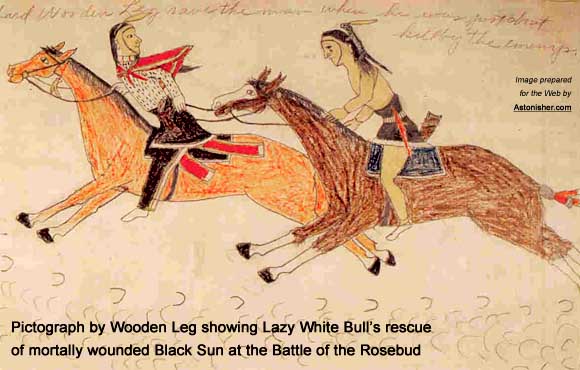
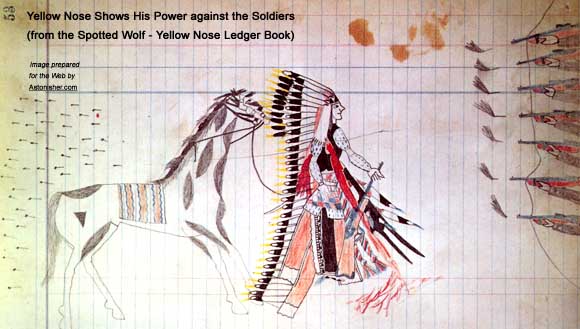
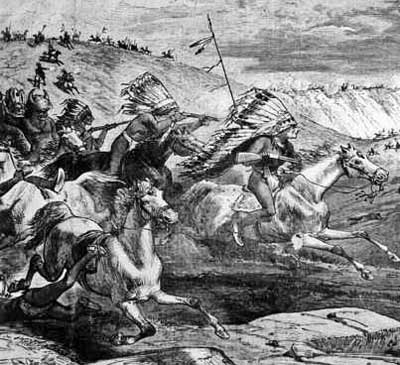
MEANWHILE, CROOK'S COMMAND, on the march before dawn, had halted to eat breakfast beside the Rosebud ten miles upstream. Men settled to coffee and cards while the Indian scouts reconnoitered the northern bluffs. Convinced of the proximity of the enemy, the Crows were restive, but Crook was skeptical until he heard distant shots, as his outriders met Crazy Horse's scouts -- a pause, then more shots sounded closer. Barely had Crook assessed the threat from his right, downstream, when more scouts galloped down the hills. "Heap Sioux!" they cried, as a line of painted warriors -- the Wolf Mountains contingent -- swept into the valley from upstream and raced straight at the left of Crook's halted line Amid wild confusion, officers hurried to rally their men, but many acknowledged that their position would have been overrun if not for the superb courage of the Crows and Shoshones. The general was able to dress skirmish lines, but for twenty minutes the battle teetered in the balance. Crook's allies gradually forced the Cheyennes and Lakotas back onto the hills. Even as the general hurried men to seize the blufftops, however, more warriors poured across the hills on his right, opening a new phase of the battle. Crazy Horse and his warriors had streamed up the Rosebud toward the sound of the guns. A westward bend in the creek obscured the action, but with a mounting barrage sounding to their right, Crazy Horse's followers sliced up a side canyon onto the tableland to survey the battleground. From the valley bottom, units of cavalry and dismounted troopers were deploying uphill along a broad front. Atop the slopes to the west, hundreds of Crows and Shoshones were galloping in pursuit of the retreating first assault, and many Lakota ponies were bleeding or dropping from exhaustion. Forced to abandon any ambush plan, Crazy Horse had to think on his feet. A more mobile battle was possible, such as he had envisaged in the aftermath of the Bozeman Trail campaigning. First priority was to save their comrades, and the new arrivals poured a charge downhill through a gap in the bluffs. In these minutes, two actions stamped their imprint on Indian memories of the Battle of the Rosebud. In one not redounding to Oglala honor, Jack Red Cloud's pony was shot from under him. Fleeing uphill, Jack was quirted by Crow scouts. By contrast, a Cheyenne maiden riding to assist her brother won immortal honor when his horse was also brought down. Ignoring a closing line of enemy scouts, Buffalo Calf Road Woman galloped through the gap, hauled her brother across her pony's withers, then whipped uphill amid a hail of lead from Crook's right. From the boulders and crevices above the east slope of the gap, dismounted warriors poured heavy fire into this dangerous unit, pinning down the bluecoat line until Captain Anson Mills's determined cavalry countercharge swept uphill and secured the rocks. Crazy Horse and his comrades ordered disengagement, the Indian line unraveling to re-form atop a bluff one mile west. Many Cheyennes infiltrated a long ridge extending from the bluffs into the valley bottom, commanding Crook's left. Sensing the advantage, Crook ordered Mills to reprise his charge and take the peak. Crazy Horse, implementing his own fallback strategy -- "to lead detachments in pursuit of his people, and turning quickly cut them to pieces in detail," according to campaign diarist John G. Bourke -- urged retreat, and the Indian resistance again melted away. As Crazy Horse's warriors regrouped on a conical hill three quarters of a mile northwest, staccato mirror flashes signaled the presence of a strategic leader, one that newsman observer John E Finerty surmised was Crazy Horse. Crazy Horse's men opened a desultory fire on Mills's six companies. They galloped across the ridge, slapping their buttocks in derisive provocation. Mills dismounted his men and took up skirmish lines around the hill crest, where Crook hurried to establish his headquarters, joined by his infantry and civilian auxiliaries. 26 Simultaneously with Mills's action, Lieutenant Colonel William B. Royall launched a second cavalry charge, countering the growing presence along the high ridge on Crook's left. In a series of stirring charges, Royall's five companies pushed the warriors back, then regrouped along the contested ridge. "In the Rosebud fight the soldiers first got the Sioux and Cheyennes on the run," Short Bull said of the first half of the engagement. 17 After almost two hours of action, the Battle of the Rosebud seemed over. "This was a pitiful long stretched-out battle," remembered one Hunkpapa youth. With fatigue setting in, the war chiefs rallied their followers. From the conical peak, Sitting Bull harangued," Steady men! Remember how to hold a gun! Brace up, now! Brace up!" Crazy Horse rode among the warriors, holding aloft his Winchester and calling for courage: "Hold on, my friends! Be strong! Remember the helpless! This is a good day to die!." He saw that Royall's charge had dangerously extended Crook's line across a mile of broken terrain. The strategy he had formulated over ten years, of isolating troop units and breaking them piecemeal, was beginning to crystallize. Sensing the key to the battle, Crazy Horse called for renewed pressure on Royall. Oglala subordinates -- Bad Heart Bull, Black Deer, Kicking Bear -- echoed the war chief's resolve. Akicita Good Weasel, shadowing his war chief over the field, added coercive persuasion to Crazy Horse's words. "When these five commenced to rally their men," recalled Short Bull, "that was as far as the soldiers got."28
On the bluffs, Crazy Horse observed Mills's departure with grim satisfaction. While Crook's command regrouped to fill the line, he and his war leaders ordered a charge to stampede the horses picketed in the valley, with sharpshooters pinning down the troops. Warriors started the herd, but fire from the southern heights forced them to abandon it. Once more, the Crows and Shoshones responded magnificently, pushing back the enemy in a flanking charge that, if supported, could have secured the field. Instead, as the auxiliaries topped the western bluff, their pursuit came to a halt-and a precipitate reverse downhill. While Crook continued to consolidate his hold on the center of the field, pressure mounted on Royall, still isolated across the coulee. As many as five hundred warriors were swarming over the ridge, encircling the blue skirmish lines. Every fourth trooper fell out as a horse holder while his comrades formed a segmented skirmish line stretched along the ridge. Each time Royall attempted a withdrawal, warriors poured charge after charge against his position. Zigzag lines of riders rippled across the field, striking obliquely at an unprotected flank, dissolving into the rolling terrain, levering their Winchester and Henry repeaters from the saddle. The desperate troopers threw back a blistering fire, but Crazy Horse would not give ground. In some of the hardest fighting army veterans had seen since the Civil War, Crazy Horse pressed Royall downhill, away from Crook's support. From the headquarters hill, Crook detailed two infantry companies to support Royall. Throughout the battle, Crazy Horse's men had given the infantry a wide berth, testimony to the foot soldiers' deadly accuracy. As the "walk-a-heaps" deployed, the warriors redoubled their assault on Royall's line. Warriors tore through the position of Captain Peter D. Vroom, leaping from their ponies to fight hand to hand, killing five troopers outright. To prevent the infantry deployment from uniting Crook's divided command, Crazy Horse and the other war leaders atop the bluffs poured in a broad charge that pressed everywhere along Crook's lines. Part swept down the coulee at Royall. Another raced for Crook's headquarters position. Chanting in unison, warriors led by Crazy Horse swept around the north side of Crook's ridgetop defenses. Guide Bat Pourier vividly remembered the war chief's presence and his miraculous survival of a hail of bullets -- "they couldn't even hit his horse."29 With the Cheyennes taking the river-ward side of the ridge, the charge swept on, tangling in hand-to-hand combat with the desperate defenders, pressing to envelop the center. Only the timely deployment of Crook's reserve companies, exposing the Lakota assault to a withering crossfire, dissipated the charge. Many warriors veered downhill toward Royall. Taunting Crook, one party raced down the coulee, crossed his morning bivouac, and galloped around the Rosebud bend to reappear along the northern bluffs. Vividly assured of imminent encirclement, Crook sent a courier to recall Mills and consolidate the command. The beleaguered Royall ordered his men to mount. Taking advantage of the moment of critical imbalance -- the kicamnayan tactic of the Thunder Beings -- Crazy Horse unleashed a final charge from the northwest. In a riot of dust, panicked horseflesh, gunfire, whoops, and curses, the lines collided. Some bluecoats were unhorsed by lance thrusts and swinging knife clubs. Panic gripped the soldiers. One trooper surrendered his pistol, only to be clubbed down. Another, one foot in his stirrup, was clubbed to the ground and his revolver wrested away by another warrior. As he crawled, stunned, the first rider shot him dead. Cavalry mounts spun away as their riders were forced into desperate close-quarters struggle. Warriors raced in to kill and coup. Troopers ran in panic, dropping carbines in their flight. The prospect of utter rout loomed. Only when the infantry relief opened a bull-throated volley from their Long Tom rifles did Royall manage to extricate his crippled battalion. With many troopers doubled up, he managed the sudden dash to Crook. Crazy Horse's men melted back onto the bluffs, persistently hemming the general's north front. After the rush of action, a stalemate of sniping ensued. Then, about 2:30, dust across the tableland signaled the return of Mills at the Indians' rear, cutting the angle of the creek. For the warriors it was enough. "It was a [hot] day like this," recalled young Iron Hawk, "and they announced they should quit and go back and take care of their women."30 Knowing that Crook had been fought to a standstill, Crazy Horse had no wish for further casualties. At least eight warriors were dead, and many more seriously wounded. He detailed scouts to shadow Crook and led a final triumphant charge down the coulee. As it melted back into the hills, the Battle of the Rosebud was over. A stunned command was left to regroup. At least nine troopers lay dead. Twenty-three were wounded, most from Royall's mauled skirmish line, whose dire predicament would foreshadow the fate of another command barely one week later. One Indian scout was killed and seven of his comrades wounded. Crook withdrew to his Goose Creek base camp. His Indian auxiliaries decamped for home, anxious to block Lakota reprisals. Crook claimed a victory for holding the field in a battle of the Indians' own choosing, but for six weeks, his command was demoralized by the strength, verve, and conviction of the Indian force. Crook's role in Sheridan's pincer campaign had been neutralized. Crazy Horse had fought with accustomed dash -- na hel ake Tasunke Witko lila wohitika, summed up Black Twin's son Thunder Tail: "and there again Crazy Horse was very brave."31 The new armament, particularly Winchesters and Henrys, had been critical to warrior confidence. If proportionate to their deployment in the Custer battle, the guns were probably in the hands of fewer than one hundred warriors, but the men used them with stunning effect. Unlike the flintlocks of old, the new sixteen-shot shock weapons transformed set-piece charges into deadly blows. Instead of loosely circling enemy positions, warriors could strike the soldiers headon or smash into the flanks of company lines, unraveling whole units. Once army units were isolated, the command structure that was its chief asset broke down. Unlike Indian warriors, who would fight desperately but coolly to the end, or else independently disengage to fight again, troops stripped of command cohesion panicked. This, Crazy Horse knew, was what he must build on. The battle had been a laboratory for the new tactics. Unlike the campaigning along the Bozeman Trail, the Great Sioux War saw huge armies on the offensive. Lakotas were faced not with besieged forts, tiny patrols, or trapped detachments, but with whole regiments marching openly through their hunting grounds.As the first phase of the Rosebud demonstrated, the old decoy tactic, relying on massed warriors in fixed positions, was unworkable in this mobile warfare. Instead, Crazy Horse and his comrades had perfected -- literally on the hoof -- a more elastic tactic, retreating to draw out units, stretching troop lines until critical pressure could snap their strained connections. The battle had not gone all their way. Crook's men fought with solid professionalism, and his Indian auxiliaries with a resolve that saved the day at least once for the embattled general.Yet, despite being significantly outnumbered, the Lakotas and Cheyennes had bested the Big Horn and Yellowstone Expedition. It was a victory of which High Backbone would have been proud.
Three days after the battle, the last of Crazy Horse's scouts returned from Goose Creek to assure him that Crook did not intend to test again the courage of the Northern Nation. Still, Crazy Horse was reluctant to be drawn into the victory celebrations. He remained convinced that this was not the victory promised in Sitting Bull's visions-the victory over the dust storm from the east, the soldiers falling upside down into the village. Until that challenge was overcome, he could not rest. In the week following the Battle of the Rosebud, camps rode into the village daily, leaving the trail from the Rosebud scratched and overlain with hoofprints and travois tracks, until the village comprised about one thousand lodges.32 About June 20 a party arrived from Spotted Tail Agency. They had seen Terry's Dakota column marching west along Heart River three weeks earlier. For two days, Hollow Horn Bear had followed the troops as they negotiated the Badlands. Combined with Hunkpapa reports of a new steamboat landing on the Yellowstone, stacked with supplies and forage, the news led Crazy Horse and the chiefs to conclude that while Gibbon's Montana column pegged the Yellowstone, the Dakota column would be outfitted to push against the Northern Nation from the east. At last the dusty whirl of prophecy was hardening into fact.33 With buffalo dispersing south, decisions had to be made about meat. Briefly, the councils favored a move toward the mountains, defying Crook at Goose Creek. Then scouts sighted concentrations of pronghorn antelope northwest, grazing the flats across the Bighorn, and the councils decided to move down the Little Bighorn two short days' travel.The move was risky, nearer any army movements based from the Yellowstone. In the atmosphere of uncertainty, holy men in both the Sans Arc and Cheyenne circles announced predictions of imminent attack, but early on June 24, the village decamped. After crossing the Little Bighorn to the west bank, the great procession of six thousand people moved eight miles down the bottomland. Warriors flanked the clustered line of striding elders, packed travois, and grandmothers striking recalcitrant pack dogs to their duty. Mothers marshaled their families; groups of maidens astride pacing ponies struck attitudes for the brash youths shadowing warrior idols or riding in noisy gangs of cousins... Crazy Horse: A Lakota Life by Kingsley M. Bray, University of Oklahoma Press, Norman, OK, 2006 p 205 - 207
Englishman Kingsley M. Bray's Crazy Horse: A Lakota Life is the best of the new Crazy Horse biographies. A stylish and evocative narrative writer, Bray has probably made his biggest contribution to Crazy Horse studies by somewhat untangling the meaning and sequence of Crazy Horse's visions. Where Mari Sandoz's seminal biography, Crazy Horse: Strange Man of the Oglala, portrays Crazy Horse's first vision as a gift of the Sky Powers in the guise of Thunder, Bray portrays it as a gift of the Earth Powers in the guise of Water. In other words, it was not the gift of Thunder, it was power over Thunder -- a subtle but important distinction which sets the stage for another of Bray's realizations, that through his dream visions Crazy Horse ultimately achieved the power of all the elements, as the Sioux conceived them, making him the most complete mujahidin of his era.
|
|
||||||||||




 Like Crazy Horse, Crook perceived a defining moment. He hurried couriers to recall Royall. With Indians developing around his left front, the general wished to consolidate his command and advance obliquely right, where scout intelligence and fierce resistance-indicated that the enemy village was located. Moreover, the wide coulee separating Royall from the headquarters position was a potential avenue for attack. Repeated couriers ordered Royall to close the gap, but mounting pressure from the heights slowed disengagement. Crook still viewed the Indian maneuvers as more irritant than threat. He detailed Mills to push speedily down Rosebud Creek with eight companies and seize the (nonexistent) village. The Indian allies would flank his movement, and the whole command would follow as soon as Royall disengaged.