|
|||||||||||||||||||||||||||||
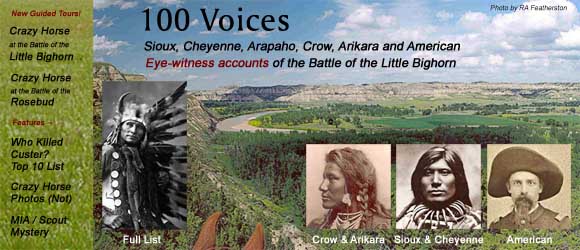
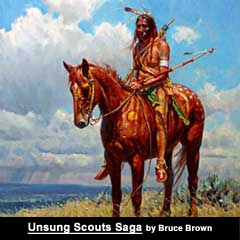
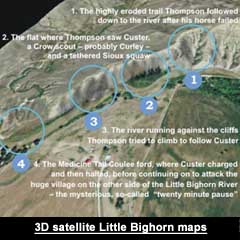
A Note on 100 Voices... By Bruce Brown 100 VOICES is the largest and most complete collection of eye-witness accounts of the battles of the Little Bighorn and Rosebud available anywhere, in any form. I originally assembled it while researching my novel, Conversations With Crazy Horse, but it has truly taken on a life of its own and fostered research and discussion in ways I never imagined. By offering just about the entire eye-witness record of the battle in one place for the first time, and making it all globally searchable for the first time, 100 Voices set in motion a revolution in Little Bighorn studies when it appeared in the summer of 2007. The first results of this came in 2007 with Who Killed Custer? and The Twisted Saga of the Seventh Cavalry's Unsung Scouts, which demolished two pillars of the Americans' version of the story by simply citing the eye-witness record. I didn't consciously set out to make a revolution here, but I did consciously want to get back to what the men who fought in the battle and survived actually said about the Little Bighorn. Early in my Little Bighorn studies, I was struck by how the story the Americans like to tell themselves about the battle -- the Accepted Consensus View of the Battle -- really doesn't resemble what the survivors (most of whom were Indians) actually said about the battle very much. Over the last 135 years, the victorious Americans have essentially turned the Battle of the Little Bighorn into something very different than it really was from the accounts of the men and women who were there. Not surprisingly, the Americans' rewriting of their own history has produced something MUCH more flattering to the Americans than the eye-witness reality. 100 Voices cuts through the self-serving matrix of lies, distortions and omissions that the Americans have built around the Little Bighorn story, and gives it to you straight, in the words of the eye-witness survivors -- Sioux, Cheyenne, Arapaho, Crow, Arikara and American. Here is the whole story for the first time, including Medal of Honor winner Peter Thompson's account of apparently catching George A. Custer and Curley mid-rape on the first flat upriver from the ford at Medicine Tail Coulee minutes before Custer's delayed attack there. Then there are all those Seventh Cavalry suicides. And White Cow Bull. And Monaseetah. And Chat-ka. And Pretty Shield. And Deeds. And Walks With The Stars. Etc., etc., etc... There are deeper implications here for contemporary America as well. For instance, I myself am struck by the similarities between America's illegal, immoral, atrocity-laced wars of invasion against the indigenous people of North America in the 19th century, and America's illegal, immoral, atrocity-laced wars of invasion against the indigenous peoples of Iraq and Afghanistan in the 21st century. I am also struck by the fact that America's long record of hideous atrocities against native peoples -- spanning centuries and continents -- has been creating mujahidin for centuries, for Sitting Bull and Crazy Horse were as much a holy warriors against America as the suicide bombers in Kabul and Baghdad today. Seems to me this is a little blemish that America might want to eventually take a look at and correct -- before it disappears into the dustbin of history, to be remembered only as a nation unworthy of democracy. -- Bruce Brown
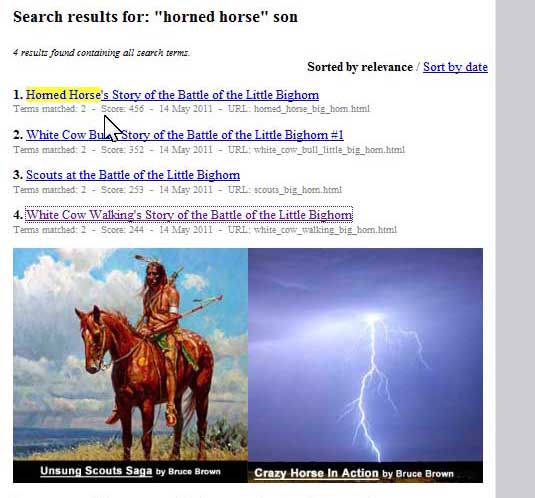
A Further Note on 100 Voices... By Bruce Brown I spent the last several days making a few changes to 100 Voices. Among the upgrades -- I improved the "Crazy Horse In Action" navigation and added a nifty new search of 100 Voices (see screenshot above). -- Bruce Brown
© Copyright 1973 - 2020 by Bruce Brown and BF Communications Inc. Astonisher, Astonisher.com, Conversations With Crazy Horse, 100 Voices, Who Killed Custer? and The Winter Count of Crazy Horse's Life are trademarks of BF Communications Inc. BF Communications Inc. Website by Running Dog |
|
||||||||||||||||||||||||||||