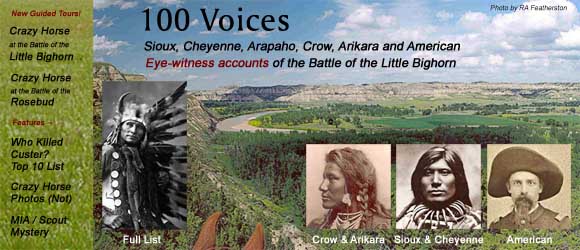

Sioux eagle feather warbonnet. From the collection of David T. Vernon, which is now permanently displayed at the Colter Bay Visitor Center in Grand Teton National Park.
David Humphreys Miller wrote of the head gear of the Sioux and Cheyenne at the Battle of the Little Bighorn:
About fifteen Cheyennes wore eagle-feather war bonnets, of which ten had long trails, while some forty Sioux wore similar feathered headgear. In every war bonnet worn, each feather represented a brave deed performed in battle. (Crown bonnets consisted of about thirty such feathers, but trail bonnets, which might have as many as a hundred, never had fewer than seventy.) Unless all feathers were earned by the wearer, other warriors might snatch the bonnet off his head. Several Sioux and one Cheyenne wore headdresses made from the mane and horns of buffalo bulls. One Sioux had a bearskin headdress, and Sun Bear, a Cheyenne, wore a war bonnet with a single buffalo horn projecting from its center.
The Spirit of Native America: Beauty & Mysticism in American Art by Anna Lee Walters, Chronicle Books, San Francisco 1989, p 81
Custer's Fall: The Indian Side of the Story by David Humphreys Miller, University of Nebraska Press, Lincoln, NE 1957 p 215 - 252

| New CD-ROM LIBRARY EDITION |
|
|
 |
"Great book. Fascinating..."
-- Jack Weatherford,
author of
The History of Money
|
The History of the Corporation
by Bruce Brown
* READ free excerpts on astonisher.com
* BUY the complete book at the astonisher.com store
|
|
|
© Copyright 1973 - 2020 by Bruce Brown and BF Communications Inc.
Astonisher, Astonisher.com, Conversations With Crazy Horse, 100 Voices, Who Killed Custer? and The Winter Count of Crazy Horse's Life are trademarks of BF Communications Inc.
BF Communications Inc.
P.O. Box 393
Sumas, WA 98295 USA
(360) 927-3234
Website by Running Dog  |
|

|