|
||||||||||||
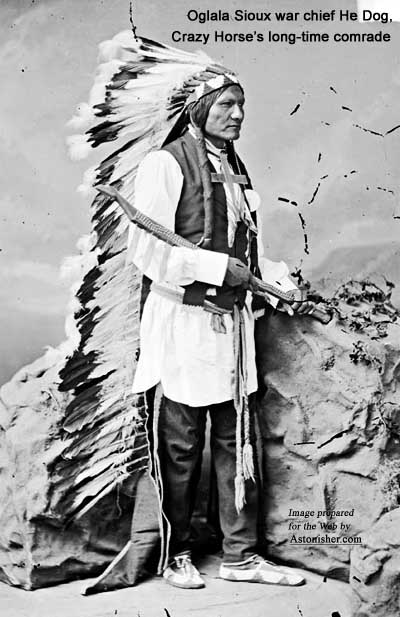
Bruce Brown's 100 Voices... He Dog and Red Feather's
HE DOG, Red Feather, and Whirling were asked if they were in the Custer fight and said they were, all of them. Red Feather (now policeman) said he attacked Reno and went up to the hill where he saw the pack mules, and came back toward the village. Part way, he met with broken leg and helped to fix his leg. Just then word was brought that soldiers were going to attack the lower end of the village, and he went there and took part in the fight. He Dog left the Hunkpapa village and went to "X" on the map and fought there with Custer. The alarm was given first that soldiers were coming below, by women who had been out on the north side of the river (Greasy Grass = Little Big Horn), digging turnups. They could see the dust and were certain they were soldiers. There was great confusion everywhere, and most of the women and children stampeded to the bluff, marked "ridge" on the map. Custer was coming from the north, across the dry creek (Custer Creek), and He Dog was among those who attacked him near the dry creek. Custer never got near the river. [Note: He Dog changed his story on this point. In an earlier account of the battle, he said Custer's men rode to the river at Medicine Tail Coulee and fired across at the Indian village, which is what actually happened, according to the overwhelming eye-witness evidence. See Astonisher.com's "Who Killed Custer -- Top Ten List" for more info.] The troops were in line of small columns, and they made six companies and were galloping. They stopped along the ridge, the side of the ridge away from the river, and the Sioux on opposite side of same ridge, as far apart as to that flagpole (40 yards).
One soldier with a stocking-legged horse got away, around the big body of Indians, toward the north. He had a very fast horse and was pursued until they were about to give up the chase, when he shot himself with his revolver and the horse was caught. (This was thought to have been Harrington. He Dog says he [the soldier] was beating the horse with the revolver and was yelling away. He fired backward now and then. He thinks the revolver went off accidently in the beating of the horse; on the other hand, they say that this was his last cartridge.) [Note: It is remotely possible that this suicide could also have been Custer himself. For more info on American suicides, see Who Killed Custer -- The Eye-witness Answer.] He Dog says it was about two hours from Reno's attack until all was over. The next day a man had a telescope and saw troops coming up the river. He Dog had a glass and saw them also. Lame Deer went through all the villages, urging them to move away. They did so. He Dog went to his lodge. His family had run off, leaving the lodge standing. He followed them up and overtook some wounded men and told them the soldiers (Terry) had gone into camp. They [the Indians] went up Greasy Grass Creek (Little Horn) to the mountains and staid [sic] there two weeks; then over to Tongue River and staid there two weeks. While there, some Cheyennes chased some soldiers into the mountains and got all their horses. (Sibley, 2nd Cav[alry], and Frank Grouard.) Bat lost his horse there-he will tell you about it.
Talking afterward, He Dog asked why Custer attacked without sending someone to talk to them first, and confirmed what the Minneconjou, Feather Earring, at Poplar River said last summer -- that they could have been led into the agency without a fight, by some fearless messenger, saying, we, e.g. Crazy Horse and himself, went in when Red Cloud came out and told them to come in the next spring.16 The Indian view of the matter is that they were living on their own ground, making their living hunting buffalo as they had always done. The soldiers came out and attacked them (Little Powder), then again on the Rosebud, and the third time on the Little Horn. Those Santees and other Indians had come out to hunt buffalo and not to fight, and the Sioux only fought when attacked. He Dog had a conference some time ago with an officer [acquainted] with Mrs. [Elizabeth B.] Custer, and [He Dog] wanted to know what they were after -- were they trying to get paid for [the] killing [of] these soldiers? It was explained that all with Custer had been killed and no one could tell what happened. There were many disputes in consequence, and Mrs. Custer was only trying to settle some of these disputes. He Dog said he had told the officer if he wanted to know the cause of that trouble, he would have to look in Washington, Custer did not come out himself; someone there gave him orders and he had to come; that Washington was the place all those troubles started. He Dog said there were 2000 lodges. When asked if Custer and Reno had kept together and charged down on the village from up the Little Horn bottom, would they in his opinion have succeeded, he replied that there were too many Sioux there. They could not have succeeded no matter what they did. He Dog stated that he and Crazy Horse moved down to Fort Robinson from the Powder when Red Cloud had come out and told them to come in to the Agency. There was an officer and some scouts [who] came out to them not far from Hat Creek, and Crazy Horse would not speak to him, and he returned. Lt. Clark met him near the Agency and Crazy Horse shook hands with him. He Dog dressed Clark in his war clothes -warbonnet, war shirt, and pipe. He pointed the pipe to the sun and made the Indian prayer: "I gave him my war clothes, my gun, and my horse in token that I would fight no more." Lakota Recollections of the Custer Fight: New Sources of Indian - Military History, compiled and edited by Richard G. Hardorff, The Arthur Clark Co., Spokane, WA, 1991, p 74 -79
A long-time friend and ally of Crazy Horse's, He Dog was Short Bull's brother and Amos Bad Heart Bull's uncle. He Dog also gave a more lengthy account of the battle a decade earlier to Walter Mason Camp proxy William Berger. Red Feather was Black Shawl Woman's brother, and thus Crazy Horse's brother-in-law. He Dog surrendered with Crazy Horse at Ft. Robinson, NE, on May 6, 1877, but Red Feather's name is not on the surrender ledger. For more information on Crazy Horse's surrender, please see the Crazy Horse Surrender Ledger.
|
|
|||||||||||




 Pine Ridge Agency
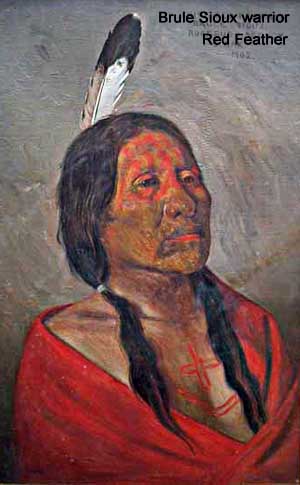 While He Dog was talking in words, Red Feather was behind the interpreter, making signs that the Indians were scared. They had killed a lot of soldiers and were running off so they would not have to account for it. He Dog said he did not know Custer had been killed for two weeks when a Missouri River Sioux brought out the news. He and Red Feather agreed that the Sioux thought the soldiers with Reno and Custer were Crook's command, and they did not know anything about Custer being in that country until afterward. They say Custer never got any nearer to the river than the monument. Only a few soldiers who broke away were killed below toward the river.