|
||||||||
Bruce Brown's 100 Voices...
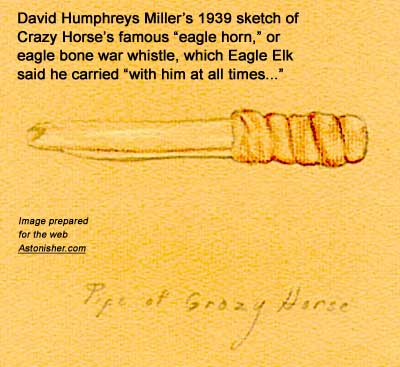
The Sioux and Cheyenne -- ALTHOUGH AMERICANS often had the impression that Sioux and Cheyenne warriors fought like some sort of wild, undisciplined "swarm of bees" -- and Indians like Sioux war chief Kill Eagle were happy to feed this this misconception -- the leading Sioux and Cheyenne war chiefs actually commanded their men closely. At the Battle of the Little Bighorn, George Herendeen said, "I saw five chiefs, and each one carried a flag for their men to rally around. Some of the flags were red, others yellow, white and blue, and one a black flag. All the chiefs handled their warriors splendidly." The red banner that Herendeen witnessed here may possibly have been Crazy Horse's guidon (banner used to mark the position of the commander on the field), for Crazy Horse employed a red banner during the Powder River campaign of 1865, according to Kingsley Bray (Crazy Horse: A Lakota Life, pp 87-89). At the Battle of the Rosebud, John Finerty described how Crazy Horse directed his men by mirror flash from high ground, and at the Battle of Wolf Mt., Nelson Miles's men heard Crazy Horse's "eagle horn" -- a war whistle made of the leg bone of an eagle -- screaming above the incoming blizzard moments before the Indians' last ferocious attack in what proved to be Crazy Horse's last battle.
For instance, John Siverston noted the Indians' use of eagle horns: "We could not see the Indians, but they were signaling all the time to each other with their little bone whistles." Sioux war chief Crow King described how the Indian commanders used audible signals to direct their men, as did Charles DeRudio, who recalled, "we heard the powerful voice of a savage crying out, making the same sound four times, and after these two signals, we saw 200 or more savages leave the bluffs and ford the river, evidently leaving the ground." Another time, Peter Thompson recalled, "The silence was suddenly broken by a loud command given by a hostile chief, which was followed by a terrific volley and a great many of our horses and mules passed over the range." William O. Taylor also spoke of the Indian leaders apparently using auditory signals to command their troops. On the morning of June 26, he recalled that "about three o'clock just as it was growing light there came two rifle shots from a low ridge in our front. This may have been the Indians' signal to open fire, for in less time than it takes to write about it a perfect shower of bullets followed from all along their line." The Sioux and Cheyenne even used captured bugles to signal among themselves and confuse the Americans, which worked like a charm, according to Peter Thompson, John Ryan, William O. Taylor and an anonymous wounded survivor. The bugling heard from the Indian side fueled American speculation that there was a white man with the Indians, but Kill Eagle and John Stands In Timber said the buglers were Indian. See Mysteries of the Little Bighorn for more info. * * * RECALLING Crazy Horse's hair-raising opening charge at the Battle of the Rosebud -- which caught the Americans resting, some with their saddle girths loosened, just as Crazy Horse had literally caught Custer napping on the Powder River in 1873 -- Mills said, "The Indians came not in a line but in flocks or herds like buffalo, and they piled upon us until I think there must have been one thousand or fifteen hundred in our immediate front." This organic style of attack was not some sort of haphazard accident; it was all part of a deadly design. Crazy Horse had developed this style of attack to isolate enemy elements so they could be destroyed piecemeal. "The attack was not staged in one mass but relayed in formations," observed William Bordeaux, who added that this was "a style of fighting initiated by Crazy Horse and sometimes successful in encircling troops." After his initial charge was repulsed by the Americans at the Rosebud, Crazy Horse played cat and mouse with Gen.George Crook -- "The Sioux ponies always outdistanced our grain-fed American horses..." recalled Henry Lemly -- until he exposed the Americans' flank, which he promptly cut to pieces in the manner described by Mills and Bordeaux. Another Rosebud survivor, Anson Mills, described how Crazy Horse's warriors "overwhelmed them [Crooks' Third Cavalry], charging bodily and rapidly through the soldiers, knocking them from their horses with lances and knives, dismounting and killing them, cutting the arms of several off at the elbows in the midst of the fight and carrying them away." Troops commanded by Guy V. Henry heroically rescued the over-extended Third Cavalry, but in the process they too suffered grievous casualties. Henry himself was struck by "a bullet which passed through both cheek bones, broke the bridge of his nose, and destroyed the optic nerve in one eye..."
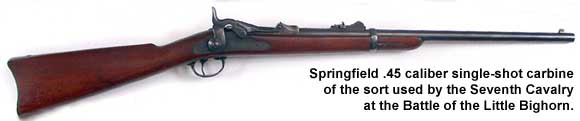
THE SIOUX AND CHEYENNE were aware of the shell ejection problems that plagued rifles used by Americans troops in the 1860s and 1870s, including the Springfield .45 caliber single-action carbine with which the Seventh Cavalry was equipped at the Little Bighorn. The problem, according to Seventh Cavalry survivor Charles Windolf, was that the spent cartridges sometimes wouldn't eject from the gun, especially once it had been fired a number of times. "But when fired rapidly the breech became foul and the greasy cartridges often jammed and could not be removed by the extractor," recalled Windolf. "This meant that the empty shell had to be forced out by the blade of a hunting knife." Peter Thompson experienced the problem at the outset of the Custer fight, but lived to tell the tale. After firing at an Indian in Medicine Tail Coulee and missing, he recalled, "I threw open the breech lock of my carbine to throw the shell out, but it was stuck fast. Being afraid that the Indian would escape, I worked at it in a desperate manner and finally got it out far enough to use my thumb nail, which proved affective. The cartridge was very dirty, a nice predicament for a man to be in when at close quarters with an enemy." Others were not so lucky. Here is Red Feather's description of the death of a American officer in the Custer fight because the "cartridges stuck in the [officer's] gun because it was too smoked from shooting." And Rain In The Face, one of the few who correctly recalled that the Seventh Cavalry troopers were NOT carrying sabers that day (despite being depicted that way in many American illustrations of the battle), also recalled, "Their guns wouldn't shoot but once -- the thing wouldn't throw out the empty cartridge shells." Asked "what were the causes of Custer's defeat," Edward Godfrey cited "the defective extraction of the empty cartridge-shells from the carbines" as one of the three principal reasons for the Seventh Cavalry's comeupance in his exhaustive 1892 Century magazine article on the Battle of the Little Bighorn. To counter this problem and conserve ammunition during the Seige of the Greasy Grass, Godfrey said, "we forbade our men, except well-known good shots, to fire without orders." It appears that Crazy Horse and the Cheyenne war chief Roman Nose were among the first to systematically exploit the Americans' shell ejection failure problem. Eagle Elk recalled an incident from the Powder River campaign of 1865: "Then Crazy Horse came along. He said, "Just keep away for a little while. These soldiers like to shoot. I am going to give them a chance to do all the shooting they want to do. You draw back and I will make them shoot." After Crazy Horse returned safely to the Indian lines, Roman Nose repeated the daring, rifle-warming ride. Again at the battle of Arrow Creek on August 14, 1872, Crazy Horse used the same ploy, going out alone and slowly riding back and forth along the length of the American line. He was followed this time by Sitting Bull, who went closer to the Americans' guns, sat down and pulled out his pipe, motioning for some of his warriors to join him. Two Hunkpapas, Lazy White Bull and Gets The Best Of, nervously joined him, according to The Life and Death of Crazy Horse by Russell Freedman (pp 87-92). "Our hearts beat rapidly, and we smoked as fast as we could," Lazy White Bull recalled. "All around us the bullets were kicking up the dust, and we could hear the bullets whining overhead. But Sitting Bull was not afraid. He just sat there quietly, looking around as if he were at home in his tent, and smoked peacefully." Finally Sitting Bull put away his pipe, stood up, and strolled away. At the Battle of the Little Bighorn, Billy Garnett said Crazy Horse spoke again of letting the Americans get their guns hot in the speech he gave to his warriors just before leading them into battle against Reno. According to Garnett, Crazy Horse said "he wanted Reno's men to get their guns hot so they would not work so well." * * * FOOLISH ELK'S eye-witness account of the Battle of the Little Bighorn describes another tactic Crazy Horse used to neutralize the Americans' skirmish line formation, robbing it of its concentrated firepower. To accomplish this, Crazy Horse led a charge late in the Custer fight that hit a portion of an American skirmish line head on, and then split and "slashed at it from both sides" as the warriors rode the length of the Bluecoats' line. The Sioux and Cheyenne were horse cultures and they preferred to fight on horseback where their splendid horsemanship could have full play (as in Crazy Horse's slaughter of the Third Cavalry at the Battle of the Rosebud cited above), but that wasn't always the case. Crazy Horse, in particularly, was noted for using his men as mounted light infantry when the situation favored it. At the Battle of the Rosebud, Henry Lemly noted how "as we advanced, they [Crazy Horse's warriors] retired successively to ridges in their rear and, throwing themselves prone upon the ground, reopened fire while their well-trained ponies grazed or stood fast at the extremity of their lariats, upon the reverse of the slope." General Nelson Miles, who faced Crazy Horse at the Battle of Wolf Mt., remarked on the same thing. A professional soldier and experienced Indian fighter, General Nelson Miles noted that the Battle of Wolf Mt. "was unlike any other Indian fight I ever witnessed, it was fought on ground... [T]hey [Crazy Horse's troops] fought entirely dismounted, not a single rifle being fired on horseback."
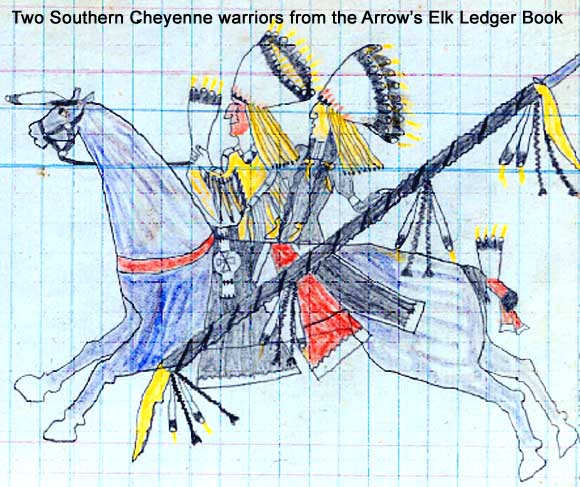
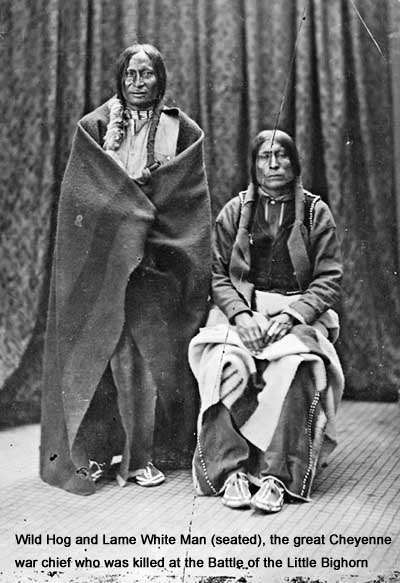
Realizing that Reno's men would have to expose themselves to Indian fire to get water, Hunkpapa war chief Gall stationed his marksmen there along the creek that was their only source of water. The deadly sniping of the Americans' water volunteers by the Sioux provided some of the most heroic moments of the battle for the Americans. Here is Medal of Honor winner Peter Thompson's account of the dangerous water detail. Peter Thompson's eye-witness account of the Battle of the Little Bighorn also describes the Cheyenne using a "stationary wheel" to turn a kind of living Gattling gun against the Americans. Thompson said the Indian warriors rode in a circle, firing as they came closest to the soldiers and then reloading as they circled around the outer part of the wheel away from the firing point. Rain In The Face may have been speaking of the same maneuver when he told Ohiyesa, "one body [of Sioux and Cheyenne] moved continually in a circle, while the other rode directly into and through the troops." Based on Cheyenne descriptions of the war chiefs who commanded the early action against Custer's decapitated command, the stationary wheel that Thompson saw could have been the work of Cheyenne war chiefs, Contrary Big Belly, Comes In Sight and/or Lame White Man. 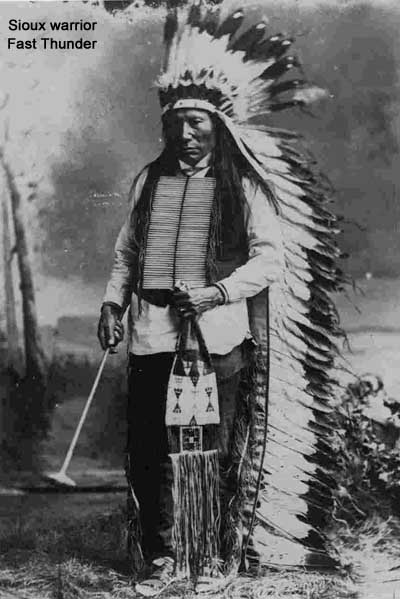 This cavalry manuever had long been a part of the Sioux and Cheyenne arsenal. In Crazy Horse: A Lakota Life, Kingsley Bray describes the Sioux using a similar technique at the Wagon Box Fight a decade before during Red Cloud's War: This cavalry manuever had long been a part of the Sioux and Cheyenne arsenal. In Crazy Horse: A Lakota Life, Kingsley Bray describes the Sioux using a similar technique at the Wagon Box Fight a decade before during Red Cloud's War:
Riding in a circle formation that buzz-sawed closer with each pass, individual warriors charged to within yards of the corral -- none nearer than Crazy Horse's cousin Fast Thunder, reckoned the bravest warrior in the battle. The effect of this tactic would be very different than the "Indians circling the wagons" maneuver so often depicted in American "Wild West" movies. If you ride around the wagon trail in a circle, your fire power is scattered and your exposure to enemy fire is constant. If you ride in a circle that turns continuous rifle fire at the contact point, your fire is concentrated to the maximum, and your exposure to enemy fire is minimized. Clever. And lethal. * * * EDWARD PIGFORD'S eye-witness account of the Battle of the Little Bighorn "Says one ruse the Indians got up to draw fire of soldiers on Reno hill was a stuffed dummy in buckskin tied on a pony and the pony lashed up and driven over the ridge toward the soldiers and then turned loose. As the pony ran around, the soldiers for quite a while poured shots at him and his rider at long range." During the Siege of the Greasy Grass, Edward Godfrey also recalled how the Indians "resorted to the old ruse of raising a hat and blouse, or a blanket, on a stick to draw our fire." * * *
* * * ANOTHER unusual feature of the Sioux, Cheyenne and Crow was their deployment of both women warriors, girl warriors and transvestite warriors. Although not numerous, these "irregulars" had considerable impact. Moving Robe, a renowned Hunkpapa Sioux woman warrior, holds down Number 15 on Astonisher.com's "Who Killed Custer -- Top 10 List," and Buffalo Calf Road Woman, a famous Cheyenne woman warrior, was such a force at the Battle of the Rosebud that the Cheyenne named the battle for her. Instead of the "Battle of the Rosebud," the Cheyenne called the great joint Sioux / Cheyenne victory of June 17, 1876, "Where the girl saved her brother (Kse-e se-wo-is-tan-i-we-i-tat-an-e)." See Women Warriors for more info. * * * THE AMERICAN soldiers who fought at the battles of the Rosebud and the Little Bighorn paid their adversaries the highest praise in military terms. "The [Sioux and Cheyenne] Indians are the best light cavalry in the world," said Marcus Reno after the Battle of the Little Bighorn. "I have seen pretty nearly all of them, and I do not except even the Cossacks." After the Battle of the Rosebud, Anson Mills struck a similar note. Declared Mills, "The [Sioux and Cheyenne] Indians proved then and there that they were the best cavalry soldiers on earth..." -- Bruce Brown
|
|
|||||||



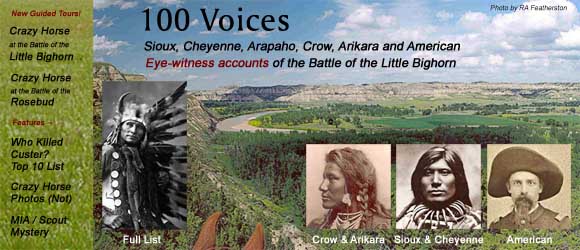

 BUT CRAZY HORSE and Sitting Bull and Roman Nose were not the only dangerous commanders among the Sioux and Cheyenne.