|
||||||||||||
Bruce Brown's 100 Voices... 'A Long And Proud Tradition...'
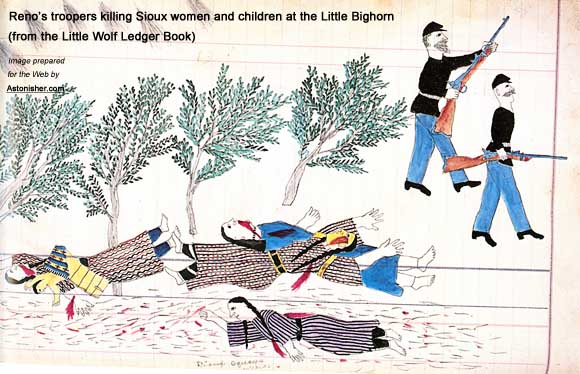
THIS DETAIL FROM a pictograph by Cheyenne warrior Little Wolf shows Major Marcus Reno's troopers killing Sioux women and children at the outset of the Battle of the Little Bighorn. It is captioned "Sioux squaws killed." Although it depicts the actual murder of Sioux women and children by the U.S. Army, some of the details shown here may be inaccurate -- Reno's men were still mounted in the early stages of the engagement, and the murder of the Sioux women and children may have been committed by the Army's Indian scouts. Among those murdered were the wives and children of powerful Hunkpapa Sioux war chief Gall, who recalled, "When Reno made his attack at the upper end he killed my two squaws and three children, which made my heart bad. I then fought with the hatchet." Seventh Cavalry scout George Herendeen attributed the murder of the Sioux women to the U.S. Army's Arikara scouts, and Arikara scout Strikes Two may have circumspectly referred to these murders when he said he and several of other Arikara and Sioux scouts had a "little skirmish" at the very beginning of the Reno fight. Arikara scouts Little Sioux, Red Star, and Boy Chief tried to get in on the fun too. Near the beginning of the Reno fight, Little Sioux recalled pursuing a group a Sioux women and children with the intention of murdering them when Little Sioux and the other scouts were distracted by some good looking horses, and decided to chase them instead.
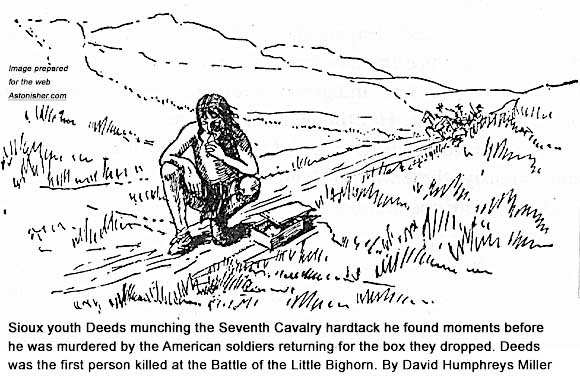
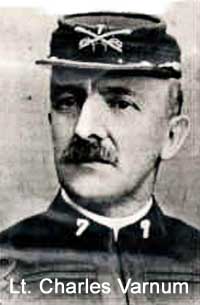
The Battle of the Little Bighorn opened when Quartermaster Sgt. Hearst murdered an unarmed Sioux boy named Deeds, who was out looking for a lost horse on the morning of June 25, 1876. Here are Drags The Ropeand Little Soldier's eye-witness account of the Americans' murder of Deeds, confirmed by the eye-witness account of Daniel Kanipe. Then, as the 112 Seventh Cavalry troopers under Reno were charging to attack the unsuspecting Indian village on the Little Bighorn, Lt. Charles Varnum yelled out to his men, offering a "furlough to the man who gets the first scalp," according to the eye-witness account of John Ryan. Moments later, when Reno's troops hit the village, they set fire to the Indians' lodges and shot at One Bull, the man Sitting Bull hurriedly dispatched to ask the American attackers for parley, before they were driven back in what turned into a deadly rout for the Americans. All this happened before George Custer's men were actively engaged in the fight. See Who Killed Custer -- The Eye-witness Answer for more info.
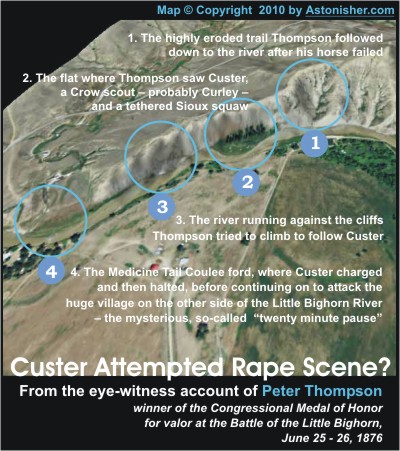
See Who Killed Custer - Part 11 "War Crime Time" for more info on what Thompson and Watson saw at the river. * * * NOR WERE murder and attempted rape the only war crimes committed by the Americans. Daniel Kanipe recalled that while they were riding into battle Custer ordered his men to desecrate the grave of Old She Bear, who had died of wounds received at the Battle of the Rosebud eight days before. In fact, the American invaders made a practice of desecrating the graves of the free Sioux and Cheyenne. Arikara scouts Red Bear, Young Hawk, Soldier and Red Star recalled that a few days before the battle Custer also ordered Sioux graves destroyed at the mouth of the Tongue River. Speaking of this incident, Medal of Honor winner Stan Roy recalled, "we came across low ground with Indian graves in trees. G troop men tore them down and robbed them and threw bones into Yellowstone. Some of the men told McIntosh that G troop might be sorry for this..." Isaiah Dorman used flesh from these Sioux corpses as fishing bait, which may at least partly explain why Dorman was so hideously tortured by the Sioux at the Battle of the Little Bighorn. * * * VIEWED FROM THE PERSPECTIVE of the 21st century, it is interesting to see that American soldiers have been killing innocent women and children for centuries -- this is not just a feature of America's wars of invasion in Viet Nam and Iraq and Afghanistan -- a realization that neatly turns contemporary American "Power of Pride" patriotism on its ear. What exactly does America have to be proud of -- then or now? By any objective measure, the shame of America is deep, maybe even as deep Americans' ignorance of their own history. -- Bruce Brown People of the Sacred Mountain, Volume 2, by Father Peter John Powell, Harper & Row, New York, NY 1981 p 968 - 969 Custer's Fall: The Indian Side of the Story by David Humphreys Miller, University of Nebraska Press, Lincoln, NE 1957
|
|
|||||||||||




 THE SEVENTH CAVALRY'S Indian scouts weren't the only ones committing war crimes, though. In fact, it was American soldiers -- not their Indian mercenaries -- who led the way.