|


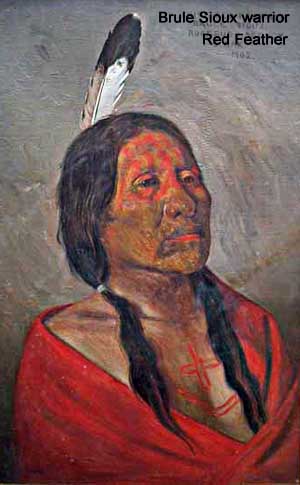
Red Feather's Story of
Crazy Horse's Surrender
A Brule Sioux's account of the surrender of Crazy Horse
|
Interview at Pine Ridge, South Dakota, July 8, 1930; Mrs. Annie Rowland, interpreter.
|
Note |
RED FEATHER'S ACCOUNT
What is the date by your calendar? Write it down that I am telling you the story of Crazy Horse on July 8, 1930. I will tell you the true facts about Crazy Horse because I am a Catholic now and it is a part of my religion to tell the truth.
"Black Beard" made a treaty with the Indians. In this treaty boundaries were set to the country of the Dakotas. The Indians all stayed together inside these boundaries. The white people kept sending to Crazy Horse to leave his country and come in to the agency, but he wanted to keep his own land. The Indians always stayed inside these boundaries, and they are still inside them. So are a lot of white people.
Some Indians who were staying at the agency kept coming out to Crazy Horse to ask him to come in to the agency. One of these Indians was named Keeps-the-Sword [AKA Sword, the elder], the other Spotted Tail.
Crazy Horse and another chief named He Dog were camping on the Powder River. Keeps-the-Sword and Spotted Tail took tobacco out to them and killed a lot of buffaloes. They told Crazy Horse that the agent wanted him. If he would go in to the agency, the agent would issue rations, blankets, and clothing, and then allow him to go back home. Crazy Horse didn't want to go. He didn't answer them for a long time. He told them to go over to the other Indians (He Dog's band), and he would do the same as the others did. These others were camping in the White Mountains (Big Horn Mountains). Crazy Horse did not take the tobacco; he sent it over to the others.
After they took it over, they had a big council of all the chiefs of both bands. The man that took the tobacco said the agent sent them; that is why they came. One old man named Iron Hawk spoke first and answered, "You see all the people here are in rags; they all need clothing; we might as well go in." Crazy Horse said whatever all the rest decided to do, he would do. So they all agreed to go in. They promised to go over, get the rations and the clothing, and return west of the Black Hills again.
The Nebraska Indian Wars Reader edited by R. Eli Paul, University of Nebraska Press, Lincoln, NE 1998, p 196 - 198
|
| NOTE: |
|
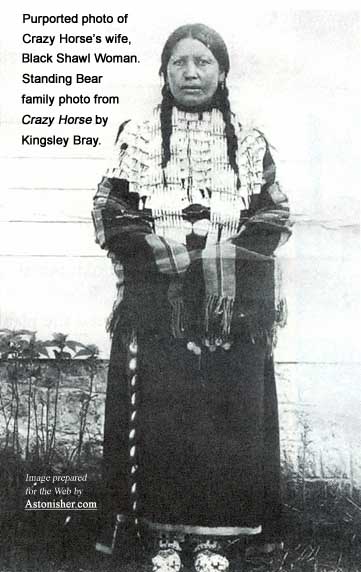
| Red Feather was Black Shawl Woman's brother, and thus Crazy Horse's brother-in-law (Standing Bear family photo from Crazy Horse: A Lakota Life by Kingsley M. Bray).
Personally, I doubt the authenticity of this photo. Black Shawl Woman died shortly after Crazy Horse in 1877, while the building behind this woman looks like it was built around 1900.
Here is Red Feather's account of the Battle of the Little Bighorn.
|
 |
|

| New CD-ROM LIBRARY EDITION |
|
|
 |
"Great book. Fascinating..."
-- Jack Weatherford,
author of
The History of Money
|
The History of the Corporation
by Bruce Brown
* READ free excerpts on astonisher.com
* BUY the complete book at the astonisher.com store
|
|
|
© Copyright 1973 - 2008 by Bruce Brown and BF Communications Inc.
Astonisher, Astonisher.com, Conversations With Crazy Horse and 100 Voices
are trademarks of BF Communications Inc.
BF Communications Inc.
P.O. Box 393
Sumas, WA 98295 USA
(360) 927-3234
Website by Running Dog 
|
|
Table of Contents
|

Portrait of Crazy Horse by Bruce Brown
Astonisher.com is pleased to present Conversations With Crazy Horse by Bruce Brown.
Here is the Table of Contents for the book, which is linked to all of chapters 1, 2, 3 and 4.
About the Author: Bruce Brown is the author of eight books, including Mountain in the Clouds, an environmental classic, and The Windows 95 Bug Collection, which was put on display in the Smithsonian Institution in Washington, DC.
He has done investigative reporting for the New York Times (the Karen Silkwood story), foreign correspondence for Atlantic Monthly (baseball in Cuba), and book reviews for the Washington Post Book World, as well as script-writing for PBS-TV (The Miracle Planet).
He is also a successful businessman and CEO, having created BugNet and built it into the world's largest supplier of PC bug fixes before it was acquired by a Fortune 500 company at the height of the dot com boom.
Bonus! Click here for 100 Voices, the world's largest collection of eyewitness accounts of the Battle of the Little Bighorn...
|
|
|
|
| An Important Note...
The information in this section of Conversations With Crazy Horse Source Materials is excerpted from the following book(s). For more information -- and a good read -- please consult the complete book.
And if you purchase the book(s) through the Amazon.com links below, you help support this free Astonisher.com American history study resource. Nothing reads like a book!
|
|
|
|