This is a FREE EXCERPT from
Bruce Brown's 100 Voices...
Hump's Story of the Battle
A Minneconjou Sioux's account of the Battle of the Little Bighorn
From the Leavenworth Weekly Times, Thursday, August 18, 1881. |
Note |
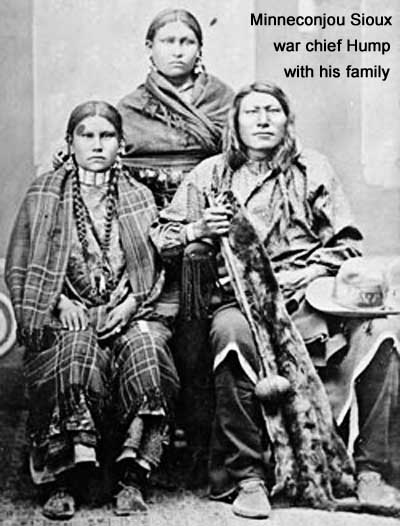 THE SUN was about at meridian when the fight began. That was the first we knew that the white warriors were coming. They attacked the Uncpapas first. They were at the upper end of our camp. The Minnecongoes, Sans-Arcs and Cheyennes were near the center of the camp, but nearer the end of the camp furthest from where the attack was made. The charge was from the upper end of the camp. The Indians gave way slowly, retreating until they got their horses and got mounted. Just as soon as they got sufficient force-for our warriors were rushing to help them as fast as they could-they drove the white warriors back, and they retreated. These were Reno's men. I had a horse that I could not manage. He was not mine, and was not well broke; so I went to where the horses were, and the women and the old men and boys were gathering them together, and caught a horse that I could manage better, and when I had caught him and mounted, the other party of white warriors (Custer's forces) charged. The Indians had by that time all got together, and it seemed, the way Custer came, that he started to cut off our retreat, not appearing to know where Reno was, or that he had retreated. When the Indians charged on the long-haired chief and his men, the long-haired chief and his men became confused, and they retreated slowly, but it was no time at all before the Indians had the long-haired chief and his men surrounded. Then our chiefs gave the "Hi-yi-yi" yell, and all the Indians joined, and they they whipped each other's horses, and they made such short work of killing them, that no man could give any correct account of it. The first charge the Indians made they never slacked up or stopped. They made a finish of it. The Indians and whites were so mixed up that you could hardly tell anything about it. THE SUN was about at meridian when the fight began. That was the first we knew that the white warriors were coming. They attacked the Uncpapas first. They were at the upper end of our camp. The Minnecongoes, Sans-Arcs and Cheyennes were near the center of the camp, but nearer the end of the camp furthest from where the attack was made. The charge was from the upper end of the camp. The Indians gave way slowly, retreating until they got their horses and got mounted. Just as soon as they got sufficient force-for our warriors were rushing to help them as fast as they could-they drove the white warriors back, and they retreated. These were Reno's men. I had a horse that I could not manage. He was not mine, and was not well broke; so I went to where the horses were, and the women and the old men and boys were gathering them together, and caught a horse that I could manage better, and when I had caught him and mounted, the other party of white warriors (Custer's forces) charged. The Indians had by that time all got together, and it seemed, the way Custer came, that he started to cut off our retreat, not appearing to know where Reno was, or that he had retreated. When the Indians charged on the long-haired chief and his men, the long-haired chief and his men became confused, and they retreated slowly, but it was no time at all before the Indians had the long-haired chief and his men surrounded. Then our chiefs gave the "Hi-yi-yi" yell, and all the Indians joined, and they they whipped each other's horses, and they made such short work of killing them, that no man could give any correct account of it. The first charge the Indians made they never slacked up or stopped. They made a finish of it. The Indians and whites were so mixed up that you could hardly tell anything about it.
The first dash the Indians made my horse was shot from under me and I was wounded -- shot above the knee, and the ball came out at the hip (here the interpreter said that he had seen the scar), and I fell and lay right there. The rest of the Indians kept on on horseback, and I did not get in the final fight. It was a clear day. There was no storm nor thunder nor lightning. The report was that it was the long-haired chief that came to fight us, but that was all that we knew.
I know that Sitting Bull was in the fight, but on account of my wound I did not know anything he did. Every able-bodied Indian there took part in the fight, as far as I could tell. Those that did not join in the fight it was because they could not find room to get in. There were a good many agency Indians in our camp. They all took part in the fight, same as the hostiles. The agency Indians had come out, and all made report to us that Long-Hair was coming to fight us. So the Indians all got together that he might not strike small parties, and not for the purpose of fighting or counciling with Long-Hair what he was coming for, but they were getting ready to be strong to defend themselves.
The Custer Myth: A Source Book of Custerania, written and compiled by Colonel W.A. Graham, The Stackpole Co., Harrisburg, PA 1953, p 78 - 79
NOTE: Hump was the brother of Iron Thunder.
© Copyright 1973 - 2020 by Bruce Brown and BF Communications Inc.
Astonisher, Astonisher.com, Conversations With Crazy Horse, 100 Voices, Who Killed Custer?, The Winter Count of Crazy Horse's Life, and Mysteries of the Little Bighorn are trademarks of BF Communications Inc.
BF Communications Inc.
P.O. Box 393
Sumas, WA 98295
(360) 927-3234
Website by Running Dog  |
|
|





|