|
||||||||||||
Bruce Brown's 100 Voices... Ice Bear's Story of the Battle
Custer rode down to the river bank and formed a line of battle and charged, and then they stopped and fell back up the hill, but he met Indians coming from above and from all sides, and again formed a line. It was here that they were killed. From the men and from the horses of Reno's command, the Indians had obtained many guns and many cartridges which enabled them to fight Custer successfully. If it had not been for this, they could not have killed them so quickly. It was about eleven o'clock when they attacked Reno, and one o'clock when Custer's force had all been killed. The men of Custer's force had not used many of their cartridges, some had ten cartridges used from their belts and some twenty, but all their saddle pockets were full. Lakota and Cheyenne: Indian Views of the Great Sioux War, 1876-1877 by Jerome A. Greene, University of Oklahoma Press 1994, p 59 - 61
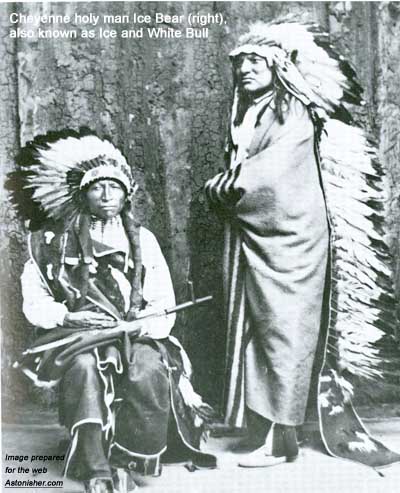
The Northern Cheyenne holy man and warrior Ice Bear -- also known as Ice or White Bull -- later scouted for the U.S. Army against the Sioux, and purportedly scalped Lame Deer after the Minneconjou Sioux Chief was murdered by American troops moments after shaking General Nelson Miles hand on May 7, 1877. Ice Bear's only son, Noisy Walking or Thunder Walking, was one of the cadre of young Cheyenne and Sioux "suicide warriors" who died at the Battle of the Little Big Horn. Here is Cheyenne warrior Wooden Leg's account of Noisy Walking's death. In his later years, after the Indian wars had ended, Ice Bear became a leading Cheyenne medicine man. * * * In his long and distinguished career, George Bird Grinnell was a naturalist with George Custer's 1874 Black Hills expedition, founded of the Audubon Society and was the author of The Fighting Cheyenne. Although not a Cheyenne, or an eye-witness to the battle of the Little Bighorn, George Bird Grinnell shares a crucial quality with the other Sioux, Cheyenne and Crow chroniclers included in 100 Voices. Like Ohiyesa, John Stands In Timber, William Bordeaux, Pretty Shield, Bird Horse and David Humphreys Miller, Grinnell had unique access to important particpants in the Battle of the Little Bighorn. What you see in The Fighting Cheyenne is an intelligent, well-informed and sympathetic telling of the Cheyenne story. Here is Grinnell's chapter on the Battle of the Little Bighorn from The Fighting Cheyenne, and here is his account of Little Horse stripping the corpse of an officer, probably Thomas Custer.
|
|
|||||||||||




 RENO CHARGED the camp from below and got in among the lodges of