|
||||||||||||
Bruce Brown's 100 Voices... Curley's Last Story of the Battle
CURLEY'S LAST STORY FROM A letter from Russell White Bear to Fred Dustin, dated Dec. 1, 1938, written in response to his request for information concerning Crow scouts at the Battle of the Little Big Horn: "A few days before Curley passed away, I visited him and said `Curley, I have interpreted for you a number of times. I am not clear yet on your stories -- tell me for the last time if you were with Custer up to the time when the gray horse troop separated from the main command.
"Mitch Bouyer remained with Custer's men when Reno separated to go to the valley. We rode to the north fork of Reno Creek and crossed it, going to the hill, turning westward on the ridgewe could see nothing of the valley where the village was located -- Custer's troops were not hurrying -- they rode at a walk -- probably because they were going up a grade. When we reached the ridge the soldiers kept marching on the east side of Reno Hill and going down on the west side of the ridge -- down a ravine, running northward. At this point Custer and two other soldiers besides Bouyer and I rode over to a high point that overlooks the Little Big Horn valley to see what was going on -- we could see dust rising everywhere down the valley. Reno's men were riding toward the Indians -- Custer nor any of us dismounted. Custer made a brief survey of the situation and turned and rode to his command. He did not ask Bouyer or me about the country we rode following the creek (ravine? F. D.) as you know -- we were all the time going away from the valley. We finally came out at the Creek --Medicine Tail Creek -- and seeing we were a long ways away from the valley -- Custer -- turning left, rode down Medicine Tail. After riding awhile, he halted the command -- then the gray horse troop left us and started down the creek -- when we turned north-crossing Medicine Tail Creek going on the hills north of the creek -- here the command halted again -- Custer wrote a message and handed to a young man on a sorrel-roan horse who galloped away. [Note: This was John Martin with Custer's last order for Benteen.] Bouyer called me to him. He said -- 'Curley you better leave us here' he said. 'You ride back over the trail a ways and then go to one of the high points' -- pointing eastward over to the high ridge east of the Custer Hill -- 'watch awhile and see if the Sioux are besting us and you make your way back to Terry and tell him we are all killed.' Curley immediately turned back -- done as he was instructed. He climbed to the high point [and] with glasses he watched the battle awhile and then rode away. As he was riding alone he came to a horse without a rider, and looking around he found a dead Sioux -- he stripped off his equipments and went away. The dead Sioux was killed by Goes Ahead."
The Custer Myth: A Source Book of Custerania, written and compiled by Colonel W.A. Graham, The Stackpole Co., Harrisburg, PA 1953, p 18 - 19
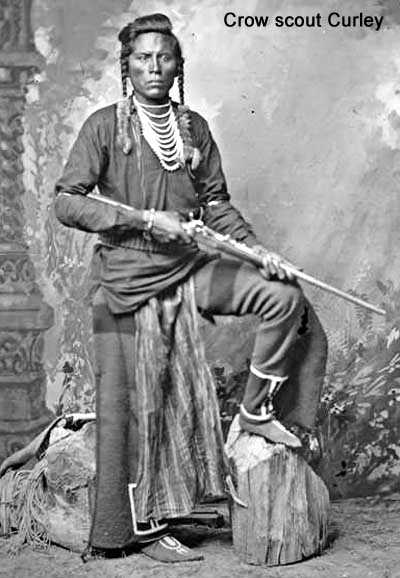
He achieved wide notoriety among white Americans for flagging down the river boat Far West at the mouth of the Little Bighorn River on June 28, 1876 with the first report of Custer's annihilation. Among Native Americans, however, he was sometimes regarded as a headline grabber (e.g., White Man Runs Him) and a coward (e.g., Gall). Curley told his story many times, and for a century and a half he has been a source of confusion near the center of the central mystery of the Little Bighorn -- what happened at Medicine Tail Coulee. Curley was evasive and vague all the rest of his life about what he was doing at the river when saw Custer's attack falter at Medicine Tail Coulee, but the eye-witness account of Peter Thompson may provide the answer. Just before Custer's attack, Thompson saw a Crow scout at the river with a Sioux squaw on a tether. All Custer's Crow scouts were at the river just before the beginning of the Custer fight, but Curley is most likely the one Thompson caught in the middle of an attempted war crime because he was alone at the river at that moment, and White Cow Bull saw the other three Crow scouts on the bluffs at the Medicine Tail Coulee ford when the Americans first charged to the river, so White Man Runs Him, Goes Ahead and Hairy Mocassin have a solid alibi. Exactly what George Custer was doing there with Curley on the secluded flat by the river with a tethered squaw is another matter. Was Custer rescuer or rapist? See Peter Thompson's eye-witness account of the battle and Who Killed Custer -- Part 11 "War Crime Time" for more info. * * * Despite the problems with Curley's testimony, his first account of what happened on June 25, 1876 -- published in the Helena Daily Herald a scant 21 days later -- is one of the cornerstone eye-witness documents of the Little Bighorn which all students of the battle must study and absorb. Curley also contributed one of the indelible descriptions of the battle to the literature of the Little Bighorn: "Curley says the firing was more rapid than anything he had ever conceived of, being a continuous roll, like (as he expressed it), The Snapping of the Threads in the Tearing of a Blanket.'" See Who Killed Custer -- Part 14 "A Whirlwind" for more info. Here are 1876, 1916 and 1938 accounts of the battle by Curley, as well as a 1919 "joint" account and interview with White Man Runs Him. -- Bruce Brown
|
|
|||||||||||




 Curley replied: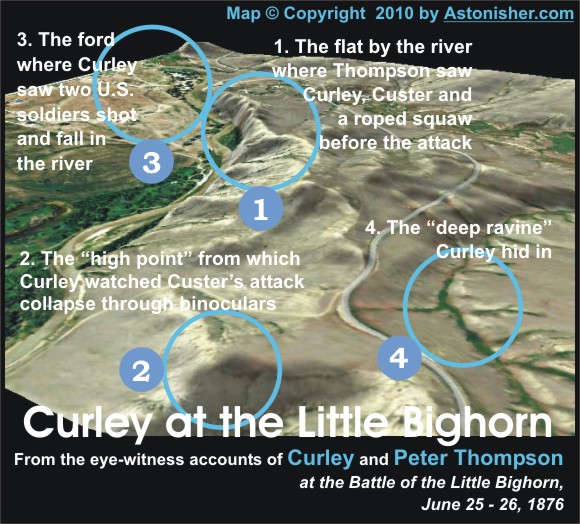
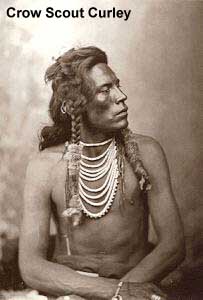 NINETEEN YEAR-OLD Crow scout Curley was one of