 |
||
|
||


100 Voices: Full List * Crow/Arikara * Sioux/Cheyenne * American * Rosebud Guided Tours: Crazy Horse at the Little Bighorn * Crazy Horse at the Rosebud Features: Who Killed Custer? * Who Killed Custer? Audio Book Features: Crazy Horse Surrender Ledger * Winter Count of Crazy Horse's Life Features: Bogus Crazy Horse Photos * Unsung 7th Cavalry Scouts Saga Features: Indian Battlefield Tactics * Woman Warriors * Little Bighorn Maps Features: U.S. Medal of Honor Winners * U.S. Atrocities * Indian Atrocities Features: Little Bighorn Mysteries * Virtual Museum |
Bruce Brown's 100 Voices...
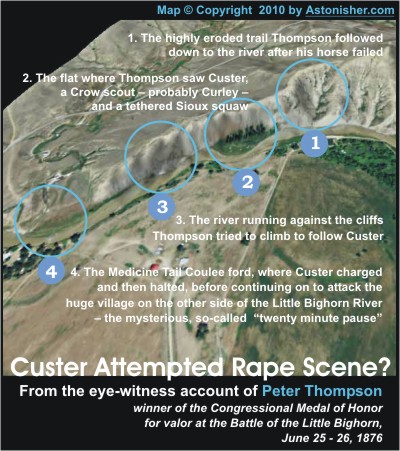
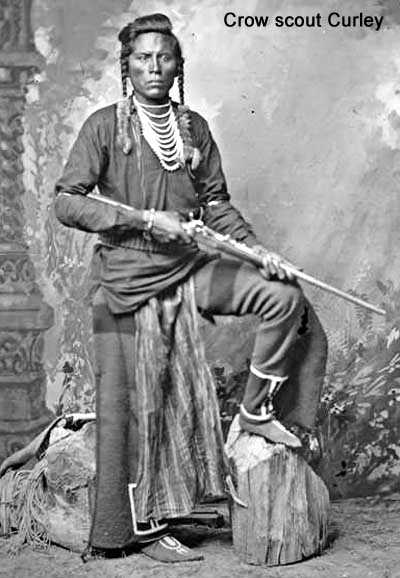
He achieved wide notoriety among white Americans for flagging down the river boat Far West at the mouth of the Little Bighorn River on June 28, 1876 with the first report of Custer's annihilation. Among Native Americans, however, he was sometimes regarded as a headline grabber (e.g., White Man Runs Him) and a coward (e.g., Gall). Curley told his story many times, and for a century and a half he has been a source of confusion near the center of the central mystery of the Little Bighorn -- what happened at Medicine Tail Coulee. Curley was evasive and vague all the rest of his life about what he was doing at the river when saw Custer's attack falter at Medicine Tail Coulee, but the eye-witness account of Peter Thompson may provide the answer. Just before Custer's attack, Thompson saw a Crow scout at the river with a Sioux squaw on a tether. All Custer's Crow scouts were at the river just before the beginning of the Custer fight, but Curley is most likely the one Thompson caught in the middle of an attempted war crime because he was alone at the river at that moment, and White Cow Bull saw the other three Crow scouts on the bluffs at the Medicine Tail Coulee ford when the Americans first charged to the river, so White Man Runs Him, Goes Ahead and Hairy Mocassin have a solid alibi. Exactly what George Custer was doing there with Curley on the secluded flat by the river with a tethered squaw is another matter. Was Custer rescuer or rapist? See Peter Thompson's eye-witness account of the battle and Who Killed Custer -- Part 11 "War Crime Time" for more info. * * * Despite the problems with Curley's testimony, his first account of what happened on June 25, 1876 -- published in the Helena Daily Herald a scant 21 days later -- is one of the cornerstone eye-witness documents of the Little Bighorn which all students of the battle must study and absorb. Curley also contributed one of the indelible descriptions of the battle to the literature of the Little Bighorn: "Curley says the firing was more rapid than anything he had ever conceived of, being a continuous roll, like (as he expressed it), The Snapping of the Threads in the Tearing of a Blanket.'" See Who Killed Custer -- Part 14 "A Whirlwind" for more info. Here are 1876, 1916 and 1938 accounts of the battle by Curley, as well as a 1919 "joint" account and interview with White Man Runs Him. -- Bruce Brown |
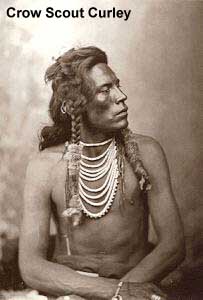 NINETEEN YEAR-OLD Crow scout Curley was one of
 |
Curley's Story of the Battle #1 |
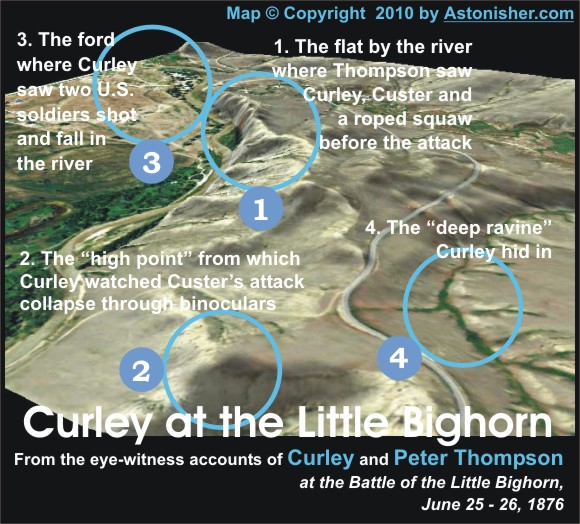
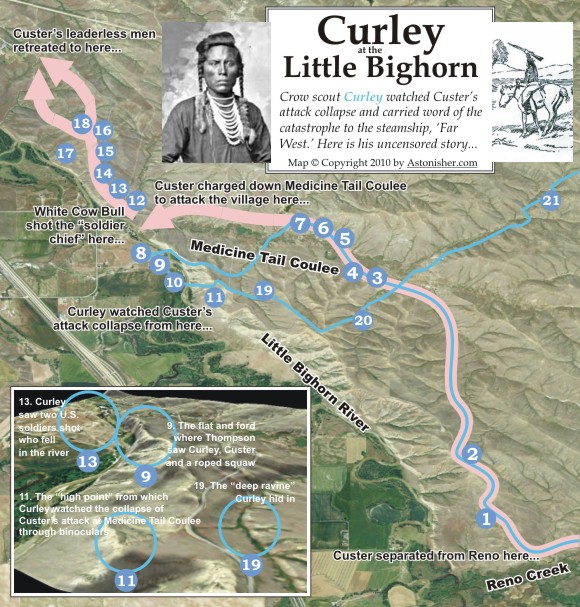
The Eye-witness Chronology For a century and a half, Crow scout Curley has been a source of confusion near the very center of the Little Bighorn saga. Here for the first time is a map tracing his steps that fateful day, and revealing his full, uncensored story... 1. Curley rode with Custer and Bouyer to the top of a hill and looked down on the village for the first time... |
THE VALLEY OF DEATH PARTICULARS OF THE MASSACRE OF CUSTER'S COMMAND THE UNWRITTEN CHAPTER "CURLEY," A CROW SCOUT, THE ONLY SURVIVOR OF THE BATTLE, TELLS THE STORY NOT UNTIL THEIR AMMUNITION WAS GONE WERE OUR TROOPS BUTCHERED. A LARGE NUMBER OF INDIANS KILLED
Custer's Battlefield About 9 o'clock, a scout reported to Lieut. Bradley that he saw an object which looked like a dead horse. The Lieutenant found it to be a dead cavalry horse, and, going a few yards further on, to the brow of a hill, looking into the valley below, a terrible scene was presented to view. It was literally strewn with the dead of the gallant Seventh Cavalry. Lieut. Bradley rode hurriedly over the field, and in a few minutes time counted one hundred and ninety-seven dead bodies. Custer fell upon the highest point of the field; and around him, within a space of five rods square, lay forty-two men and thirty-one horses. The dead soldiers all lay within a circle embracing only a few hundred yards square. The Lieutenant immediately reported to Gibbon, which was the first intelligence of the battle received. A few moments later a scout arrived from Reno's command, asking for assistance, and Terry and Gibbon pushed forward to the rescue. "Curley" Not a single survivor of Custer's command was found, and even up to the time General Terry made out his official report to General Sheridan it was supposed that the last soul had perished. But when the command returned to the Yellowstone they found there a Crow scout named "Curley," who, as verified by Major Reno, rode out with Custer on that fatal day. He alone escaped, and his account of the battle we give below. It is interesting, as being the only story of the fight ever to be looked for from one who was an actual participant on Custer's side. Curley being, in all human probability the only survivor of his command: [Note: This is not true. Actually, there were four more Seventh Cavalry troopers who left Custer's command after Curley, and lived. See Bruce Brown's Commentary on Peter Thompson for more info.] Custer, with his five companies, after separating from Reno and his seven companies, moved to the right around the base of a high hill overlooking the valley of the Little Horn through a ravine just wide enough to admit his column of fours. There were no signs of the presence of Indians in the hills on that side (the right bank) of the Little Horn, and the column moved steadily on until it rounded the hill and came in sight of the village lying in the valley below them. Custer appeared very much elated, and ordered the bugles to sound a charge, and moved on at the head of his column, waving his hat to encourage his men. When they neared the river, the Indians, concealed in the undergrowth on the opposite side of the river, opened fire on the troops, which checked the advance. Here a portion of the command were dismounted and thrown forward to the river, and returned the fire of the Indians. During this time the warriors were seen riding out of the village by hundreds, and deploying across his front to his left, as if with the intention of crossing the stream on his right, while the women and children were seen hastening out of the village in large numbers in the opposite direction.
|
|
 LIET. JAS. H. Bradley, of the 7th infantry, who commanded the scouts under Gibbon on the recent march from the Yellowstone to the Little Horn and return, arrived in this city last night and left for Fort Shaw this morning. He left the command one week ago today, in camp near Fort Pease, and everything was quiet. Our reporter interviewed Lieut. Bradley, who very kindly gave us a description of the Little Horn disaster, but more particularly the account of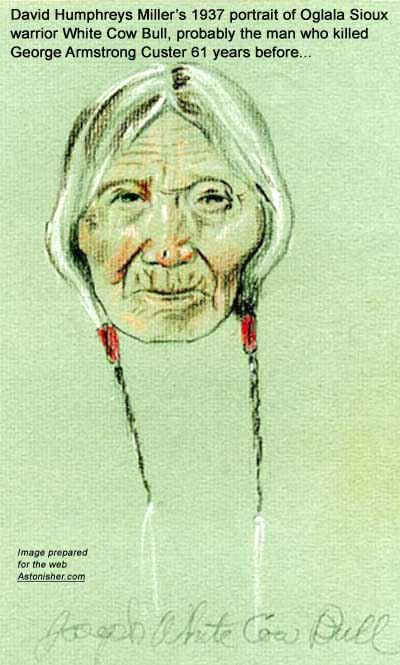





Of the Incidents of the Fight on other parts of the field than his own, Curley is not well informed, as he was himself concealed in a deep ravine, from which but a small part of the field was visible. The fight appears to have begun, from Curley's description of the situation of the sun, about 2:30 or 3 o'clock p. m., and continued without intermission until nearly sunset. [Note: Curley is refering to the combined Reno and Custer fights here; Kill Eagle said the day's fighting went from "about noon... until near sunset."] The Indians had completely surrounded the command, leaving their horses in ravines well to the rear, themselves pressing forward to attack on foot. Confident in the great superiority of their numbers, they made several charges on all points of Custer's line; but the troops held their position firmly, and delivered a heavy fire, and every time drove them back. Curley says the firing was more rapid than anything he had ever conceived of, being a continuous roll, like (as he expressed it), "The Snapping of the Threads in the Tearing of a Blanket." The troops expended all the ammunition in their belts, and then sought their horses for the reserve ammunition carried in their saddle pockets. As long as their ammunition held out, the troops, though losing considerably in the fight, maintained their position in spite of all the efforts of the Sioux. [Note: this was not true. As with Curley's apparent indication that Custer was alive and erect at the end, this was instance where Curley told the Americans what they wanted to hear, not something he knew to be true. In fact, all the Sioux and Cheyenne observers agreed that Indians captured significant ammounts of unexpended ammunition from the Seventh cavalry soldiers, many of whom seemed "drunk" or crazy to the Indians.] From the weakening of their fire towards the close of the afternoon the Indians appeared to believe that their ammunition was about exhausted, and they made a in the course of which the last of the command was destroyed, the men being shot, where they laid in their positions in the line, at such close quarters that many were killed with arrows. Curley says that Custer remained alive through the greater part of the engagement, animating his men to determined resistance; but about an hour before the close of the fight received a mortal wound. [Note: students of the Little Bighorn have misinterpreted this statement from the very beginning. Since the Custer fight lasted about "an hour," as He Dog and George Herendeen noted, what Curley is saying here is that Custer was killed at the very beginning of the Custer fight, about the time he tried to lead his men across the Little Bighorn and attack the Indian village, as White Cow Bull described. See Who Killed Custer -- The Eye-Witness Answer for more info.] Curley says the field was thickly strewn with the dead bodies of the Sioux who fell in the attack -- their number considerably more than the force of soldiers engaged. He is satisfied that their loss will exceed 300 killed, beside an immense number wounded. Curley accomplished his escape by drawing his blanket about him in the manner of the Sioux, and passing through an interval which had been made in their line as they scattered over the field in their final charge. He says they must have seen him, as he was in plain view, but was probably mistaken by the Sioux for one of their own number or one of their allied Arapahoes or Cheyennes. In most particulars the account given by Curley of the fight is confirmed by the position of the trail made by Custer in his movements, and the general evidence of the battlefield. Only one discrepancy is noted, which relates to the time when the fight came to an end. Officers of Reno's command, who late in the afternoon, from high points surveyed the country in anxious expectation of Custer's appearance, and commanded a view of the field where he had fought, say that no fighting was going on at that time -- between five and six o'clock. It is evident, therefore, that the last of Custer's command was destroyed at an earlier hour in the day than Curley relates. The Custer Myth: A Source Book of Custerania, written and compiled by Colonel W.A. Graham, The Stackpole Co., Harrisburg, PA 1953, p 10
Along with the accounts of White Cow Bull and Peter Thompson, this is one of the three cornerstone eye-witness accounts of the Battle of the Little Bighorn -- because they (along with the other three Crow scouts) were there at Medicine Tail Coulee at the fateful, moment when Custer and his men tried to charge across the Little Bighorn River and attack the huge free Sioux and Cheyenne village on the other side.
|