|
||||||||||||
Bruce Brown's 100 Voices... Curley's Story of the Battle, #3
"What I am going to tell is just short. I don't know much about it, but I will tell you all I know. I was never where most of the soldiers were; I was always with Custer's outfit. I knew the Chief with the long whiskers and I knew Custer's brother. I also knew the one who called the bugle. "We met the camp before ten o'clock in the morning. Just before we got to the camp there was one band went one way and the other band went the other way. I don't know anything about the other band because they were away across the river. "On my side I have told you all I know. The bugler got killed in the camp. Some of them got killed in the river. They (the Sioux) would not let the soldiers cross the river. There were too many of the Sioux. The soldiers got down to the ground by the river but could not get across, so turned and ran back up the hill. The soldiers did not know much about fighting. Those white people know more about fighting than the soldiers did. All the soldiers were killed before ten o'clock.
The Custer Battle Book by Herbert Coffeen, A Reflection Book, Carlton Press, Inc., New York, 1964 p 50
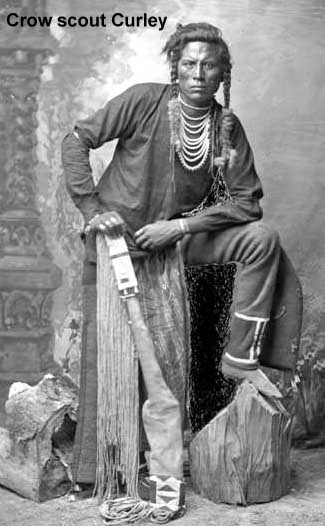
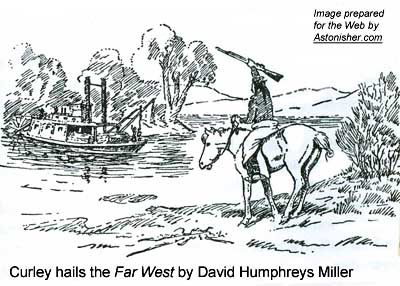
He achieved wide notoriety among white Americans for flagging down the river boat Far West at the mouth of the Little Bighorn River on June 28, 1876 with the first report of Custer's annihilation. Among Native Americans, however, he was sometimes regarded as a headline grabber (e.g., White Man Runs Him) and a coward (e.g., Gall). Curley told his story many times, and for a century and a half he has been a source of confusion near the center of the central mystery of the Little Bighorn -- what happened at Medicine Tail Coulee. Curley was evasive and vague all the rest of his life about what he was doing at the river when saw Custer's attack falter at Medicine Tail Coulee, but the eye-witness account of Peter Thompson may provide the answer. Just before Custer's attack, Thompson saw a Crow scout at the river with a Sioux squaw on a tether. All Custer's Crow scouts were at the river just before the beginning of the Custer fight, but Curley is most likely the one Thompson caught in the middle of an attempted war crime because he was alone at the river at that moment, and White Cow Bull saw the other three Crow scouts on the bluffs at the Medicine Tail Coulee ford when the Americans first charged to the river, so White Man Runs Him, Goes Ahead and Hairy Mocassin have a solid alibi. Exactly what George Custer was doing there with Curley on the secluded flat by the river with a tethered squaw is another matter. Was Custer rescuer or rapist? See Peter Thompson's eye-witness account of the battle and Who Killed Custer -- Part 11 "War Crime Time" for more info. * * * Despite the problems with Curley's testimony, his first account of what happened on June 25, 1876 -- published in the Helena Daily Herald a scant 21 days later -- is one of the cornerstone eye-witness documents of the Little Bighorn which all students of the battle must study and absorb. Curley also contributed one of the indelible descriptions of the battle to the literature of the Little Bighorn: "Curley says the firing was more rapid than anything he had ever conceived of, being a continuous roll, like (as he expressed it), The Snapping of the Threads in the Tearing of a Blanket.'" See Who Killed Custer -- Part 14 "A Whirlwind" for more info. Here are 1876, 1916 and 1938 accounts of the battle by Curley, as well as a 1919 "joint" account and interview with White Man Runs Him. -- Bruce Brown
|
|
|||||||||||




 CURLEY'S STATEMENT
 "Just before they got all the soldiers killed, and there were just a few of them left, my horse was a pretty good runner and he ran off. I was just a young fellow and Custer told me to run off and I did run off. I was only sixteen or seventeen and didn't know much about fighting at that time. If I had been older when they had the war I might have done something and if I had been older I wouldn't have run off; I would have stayed there and got killed.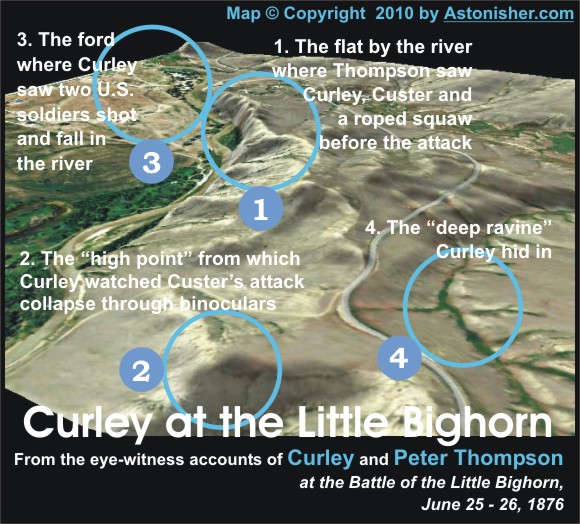
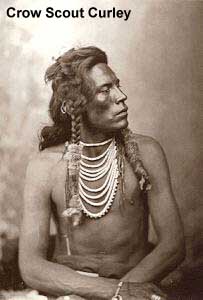 NINETEEN YEAR-OLD Crow scout Curley was one of