|
||||||||||||
Bruce Brown's 100 Voices... John Martin's Story of the Battle, #1
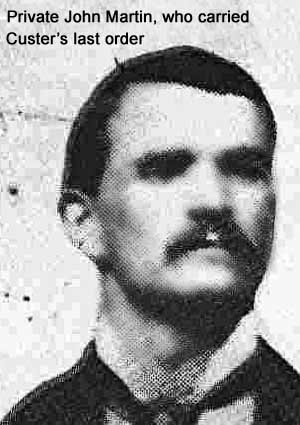
THE STORY OF PRIVATE MARTIN, ONE OF CUSTER'S LAST MESSENGERS
Martin says these were the only orderlies Custer had that day and that he is certain about it. Martin says that 1st Lieut. James A. Nowlan (Henry J. Nowlan) was regimental quartermaster but was left back with the wagon train at Powder River. Martin says at mouth of Rosebud Mitch Bouyer told Terry where Sitting Bull's camp was located. Then officers desired Bouyer to conduct them to the village, and Bouyer said he had previously been with Sitting Bull and that Bull had offered 100 ponies for his head and that he would go along, and the Indians would kill him if they could get him; and Custer said in that case the whole command would meet the same fate. Did not see Indians on ridge ... when Custer separated from Reno. Says that before Custer reached high ridge he marched in columns of twos with gray horses in center of column.3 His description of route agrees with Curley and Knipe [Sgt. Daniel Kanipe] exactly. Martin says Custer's trail passed along where Reno retreated to. Then Custer halted command on the high ridge about 10 minutes, and officers looked at village through glasses. Saw children and dogs playing among the tepees but no warriors or horses except few loose ponies grazing around. There was then a discussion among the officers as to where the warriors might be and someone suggested that they might be buffalo hunting, recalling that they had seen skinned buffalo along the trail on June 24. Custer now made a speech to his men saying, "We will go down and make a crossing and capture the village." The whole command then pulled off their hats and cheered. And the consensus of opinion seemed to be among the officers that if this could be done the Indians would have to surrender when they would return, in order not to fire upon their women and children. [Note: it appears that this is when Danel Kanipe left Custer with his last order for Benteen. Martin, who carried the same order in written form, left Custer a few minutes later, as he recounts below. Neither Martin nor Kanipe were the last Seventh Cavalry survivor to see Custer alive, though. That honor belongs to Peter Thompson.]
Martin now rode fast and met Benteen on Benteen Creek and came back with him. Martin says when he gave message to Benteen, Benteen asked: "Where is General Custer?" Martin said: "About 3 miles from here." Benteen said, "Is [Custer] being attacked or not?" and Martin said: "Yes, [he] is being attacked" and said no more. Martin is positive that he did not tell Benteen ... that Indians were "skiddaddling.". . . Ask Martin if when he returned and did not see Reno if he saw any Indians where he afterwards learned Reno to be. No - saw neither Indians nor Reno nor any fighting. Martin says when Benteen got up Reno came up without any hat and said: "For God's sake, Benteen, halt your command and wait until I can organize my men." After Martin got to Reno Heights did Benteen or Reno consult him as to direction of Custer? No, Martin says. No. Benteen had the heel of his boot shot off on the hill. He turned around and looked at it and said: "Pretty close call -- try again." Martin says he certainly saw 4 Crows with Reno on the hill during the two days [Note: Martin is referring to Crow scouts. See "The Twisted Sage Of The 7th Cavalry's Unsung Scouts" for more info]. Martin says careful search was made of whole country for dead men down to river - that detachments were sent out and that Serg. Butler was found in this way. Martin saw Serg. Butler of L Troop and says his horse was dead with him. Does not think he could have been carrying message because Butler was not an orderly that day. Martin saw the heap of dead men in deep gully between Custer and the river. Says that one of the first sergeants with whom some of the men had left their pay for safe keeping had about $500 in paper money torn up and scattered all over his body. Martin says on Custer battlefield there were not half as many dead horses as dead men. Martin says that one of Cooke's sideburns was scalped off, skin and all [Note: Cooke was scalped by Cheyenne warrior Wooden Leg], and this corroborates what others have said. Martin describes Custer's wounds as do Tom O'Neill and Hammon. He also describes Tom Custer's wounds as did Hammon. Keogh had a gold chain and Agnus Dei Catholic emblem on his neck which the Indians had not taken and Benteen secured this. Martin saw the dead Indians in the brush on river bank in village. Says there was a big pile but did not count them. Martin says horse Comanche followed the troops down to boat of his own accord when wounded were taken down and was not led. When found, they thought he would die and not worth while to take away. Martin says that when Genl. Terry came up on the 27th, Terry took him to the spot where Martin started back from Custer with the message and Martin described the ground and incidents to him precisely Walter Mason Camp's Notes: 1. Camp MSS, field notes, John Martin, folder 3, Lilly Library, Indiana University. John Martin (Giovanni Martini) was born in Italy in January 1853 and came to the United States in 1873. He enlisted as a trumpeter and was assigned to Company H. He carried the last message from Lieutenant Colonel George Custer to Captain Frederick Benteen and was in the hilltop fight. He reenlisted and served in the 3rd Artillery for thirteen years Ad transferred to the 4th Artillery. He was promoted from trumpeter to sergeant in 1900. He participated in the Black Hills expedition in 1874, the Sioux campaign in 1876, the Nez Perce campaign in 1877, and the Spanish-American War. He retired as a sergeant on January 4, 1904, and resided in New York City until he died on December 24, 1922. He was buried in Cypress Hills Cemetery, New York City. 2. Henry Voss was chief trumpeter and William H. Sharrow was sergeant major of the regiment. Both were killed with the Custer column. Henry C. Dose was a trumpeter in Company G and was killed with the Custer column. There were two brothers, Alex and Charles H. Bishop in the 7th Cavalry, but neither was in Company C. Martin may have been referring to Charles H. Bischoff, but Bischoff was on detached service at Yellowstone Depot. The trumpeter in Company C was William Kramer, who was killed on June 25, probably with the Custer column. 3. Custer never left his command to ride to the high point to wave his hat, as is sometimes reported. [Note: Camp is incorrect here. Eye-witness White Man Runs Him said, "Custer turned around as he reached the top of the hill and waved his hat, and the soldiers at the bottom of the hill waved their hats and shouted."] When Custer was on the high point his whole command was there with him, sitting on their horses. As soon as the command left this high point everybody passed out of sight from Reno's position and went down the hollow toward Dry Creek. I do not remember seeing Mitch Bouyer or the Crow scouts at this time. They might have been somewhere in the vicinity and I did not see them. (Camp MSS, field notes, John Martin, folder 3, Lilly Library.) 4. Did Custer follow the bottom South Coulee all the way and make turn into Medicine Tail or cut across the hill and save some of the distance? He doesn't seem to think Custer cut across the hill. No, Custer followed coulee all the way. (Ibid.) 5. Martin says he met Boston Custer after his horse was hit and that Boston Custer called attention to the fact that his horse was limping. (Ibid.) Martin saw Serg. Butler of L Troop and says his horse was dead with him. Does not think he could have been carrying message because Butler was not an orderly that day. Martin saw the heap of dead men in deep gully between Custer and the river. Says that one of the first sergeants with whom some of the men had left their pay for safe keeping had about $500 in paper money torn up and scattered all over his body. Martin says on Custer battlefield there were not half as many dead horses as dead men. Martin says that one of Cooke's sideburns was scalped off, skin and all, and this corroborates what others have said. Martin describes Custer's wounds as do Tom O'Neill and Hammon. He also describes Tom Custer's wounds as did Hammon. Keogh had a gold chain and Agnus Dei Catholic emblem on his neck which the Indians had not taken and Benteen secured this. Martin saw the dead Indians in the brush on river bank in village. Says there was a big pile but did not count them. Martin says horse Comanche followed the troops down to boat of his own accord when wounded were taken down and was not led. When found, they thought he would die and not worth while to take away. Martin says that when Genl. Terry came up on the 27th, Terry took him to the spot where Martin started back from Custer with the message and Martin described the ground and incidents to him precisely. Custer in '76: Walter Camp's Notes on the Custer Fight, edited by Kenneth Hammer, Brigham Young University Press 1976 p 99 - 102
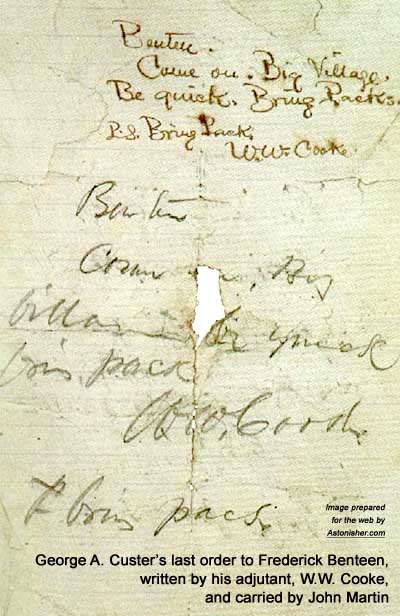
As the Battle of the Little Bighorn was rushing to climax, Col. George A. Custer sent the same message to Capt. Frederick Benteen, his best battlefield commander, and Capt. Thomas McDougall, who commanded the Seventh Cavalry's extra ammunition packs, via two different couriers. With Trumpeter Giovanni Martini [AKA John Martin] he sent Benteen the famous "come on. big village" note penned by Lt. W.W. Cooke, the regimental adjutant. [Martin's note was written because his command of English was sketchy. Here is Charles Windolf's description of Martin and Kanipe.] And a few minutes earlier, he sent the same message in verbal form to McDougall and Benteen via Sgt. Daniel Kanipe. Both Martini and Kanipe got through, and as a result both survived the battle. Here is Benteen's account of receiving Martin's message, plus an image of the original in the hand of Lt. W.W. Cooke. Martin and Kanipe are frequently described as the "last Seventh Cavalry troopers to see Custer alive" (or words to this effect) because they carried Custer's last order to Benteen, and thus were the last men to get out alive that day. But actually, the "last Seventh Cavalry trooper to see Custer alive" was not John Martin or Dan Kanipe. According to the eye-witness record, it was Peter Thompson. Medal of Honor-winner Thompson's horse gave out just before the battle, and while he was trying to rejoin Reno, Thompson caught a glimpse of Custer at the river, away from his command and in the midst of some kinky business with a tethered squaw, something that American historians have not wanted to talk about for over 100 years. See Peter Thompson's account of the battle and Who Killed Custer -- The Eye-Witness Answer for more info. * * * Here's Charles Windolf's description of meeting Martin on the trail that afternoon... "We hadn't gone on very much farther before we saw a second figure in uniform riding towards us. He was Trumpeter Martini [Giovanni Martini, or John Martin] of my company, who had been assigned that morning as special orderly trumpeter to General Custer. I learned afterwards that he had a message from Custer to Benteen, that had been scribbled out on a field order pad and signed by Lieutenant Cooke the Adjutant. It read: "Benteen, come on. Big village. Be quick. Bring packs. P. S. Bring pack, W. W. Cooke." "Martini was a salty little Italian who had been a drummer boy with Garibaldi in the fight for Italian independence. Captain Keogh, an Irishman commanding Troop "I," who was riding this day with Custer, had also fought with Garibaldi. "I knew Martini very well because he belonged to H. We used to tease him a lot but we never did after this fight. He proved that he was plenty man. His horse was spouting blood from a bullet wound in his right hip but Martini didn't know anything about it. Benteen ordered him to rejoin his company. I always figured that Benteen thought that since Sergeant Kanipe had already taken word back to Captain McDougall to bring on the pack train as fast as they could come, there was no use sending more word to him. Anyway, Martini's horse was played out and it was all that he could do to keep up with us." * * * Here is another account of the battle by John Martin. -- Bruce Brown
|
|
|||||||||||




 TRUMPETER MARTIN, Orderly for