Chapter Ten
Mr. Shook
LIKE WHIPPED schoolboys," most of the leaders of the crushed Young Ireland movement were well chastened by defeat. "Most of them," said John O'Leary, "had had enough of the fighting policy for the time being, and some for their natural lives." But a remnant was not inclined either to surrender like Smith O'Brien or to wait with Mitchel for some "pure" opportunity by and by. Not long after Ballingarry these men began to turn over in their minds how to strike the next blow. All the mistakes leading to the late deplored military fiasco they analyzed soberly, hoping to turn in a better performance next time around. With no special acrimony against anyone they dissected the fall of O'Connell and the imperfections of their recent Young Ireland generals. They then turned their energies to steer an adjusted course, and thereby created the theory and practice of Fenianism and the potent structure of the Irish Republican Brotherhood (IRB).
The founder of Fenianism was James Stephens (not to be confused with his namesake, the poet). He was the young Kilkenny clubman we have already seen serving as Smith O'Brien's impatient aide in the field at Killenaule. After Ballingarry he escaped wounded through the police cordon in Tipperary and fled to France, arriving there in the turmoil of the short-lived Second Republic. Taking up the role that sociologists call "participant observer," he familiarized himself with the French brand of insurrection. Just when Gavan Duffy set out to disinfect the Nation of its French taint, Stephens was studying Blanquiste methods on the Parisian barricades. He stayed in Paris nearly a decade, supporting himself by giving English lessons and by literary work, writing feuilletons for the Paris newspapers and translating Dickens into the tongue he had just imperfectly acquired.
The multiple disasters suffered by Irish nationalism since the flood tide of O'Connell's Repeal movement had not deflated Stephens' enthusiasm. From headquarters in a Parisian boardinghouse* he began to assemble a nucleus for a new Irish movement. He found a disciple in John O'Mahony, the Young Irelander who had wanted to rescue Smith O'Brien and Terence Bellew MacManus from Clonmel jail. There too he recruited John O'Leary, a boyhood friend who had come to the old boardinghouse to visit a Tipperary cousin among the exiles.
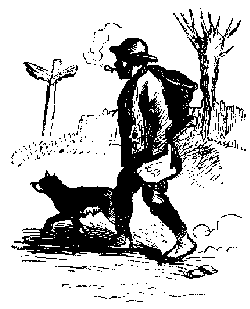
In 1856 Stephens slipped back into Ireland and went to work. Disguised as a beggarman, he set out on a long romantic excursion, mostly afoot, exploring every part of Ireland, talking with hundreds of country people along the way, surveying the field in preparation for applying his Parisian revolutionary education. A Bandon nationalist gave the mysterious wanderer the Gaelic name seabhac, "the hawk," and he became known as "Mr. Shook." He found the country both dead and alive. Passing Limerick, he stopped for a short visit with Smith O'Brien and was told that the Irish case was hopeless, that "the respectable people" were "indifferent if not hostile" to the nationalist cause, and that the clergy were an insurmountable obstacle. O'Brien repeated his familiar belief that the people would have risen in '48 "if the priests had not influenced them." Perhaps, said Stephens; but one need not put the blame on others for one's own shortcomings: "Had the leaders come to us in anything like numbers and shown a determined front worthy of the cause they held dear, the priests would have shrunk back.... "
Except at the top, Mr. Shook found that the country's political health was not bad. The national sentiment, he concluded, was not a corpse on the dissecting table as Duffy had just announced, but alive and secretly waiting for the next episode to commence: "My three thousand mile walk through Ireland convinced me of one thing-the possibility of organizing a proper movement for the independence of my native land. I found, of course, many circumstances to discourage me throughout my tour: the hostility of the aristocracy, the apathy of the farmers, the pigheadedness of the bourgeoisie: but the laborers and tradesmen were on the right track, and the sons of the peasants were very sympathetic."
Two such hard-to-please witnesses as Michael Davitt and John Devoy have ranked Stephens among the very greatest of all Irish leaders, worthy to stand beside Tone, O'Connell, and Davis. He had a gift for moving men. Though Patrick Pearse called him "cold and enigmatical," Stephens exuded confidence not only toward Ireland but also toward his own judgments, a trait that produced a daring and resourceful leader, though dogmatic and uncharitable, too.
He is often set in contrast to John O'Leary. No doubt about it, O'Leary was different, in personality at least; for while all of the other Fenians were enthusiasts, he was not. When he first encountered Stephens in Paris, several years after Lalor's insurrection, O'Leary was still a nationalist in the long view, but the immediate outlook seemed to him totally hopeless. With several-hundred a year inherited from his merchant father, he had been sauntering comfortably about since 1849, enjoying his pleasant Bohemian friendships. Theoretically he was a medical student, but he had not bothered to take a degree. More seriously he was a bibliophile, collecting books from here and there, in Dublin, in London, and eventually in Paris, where he surrendered to Stephens' irresistible persuasiveness with "unbounded trust," as his sister Ellen reported. But not without scrutiny. His lifetime discipline was to ask himself daily, what do I really know? An enemy described him not unfairly as "reserved, sententious, almost cynical; keenly observant, sharply critical, full of restrained passion. " A hypersensitive care for veracity loaded his speech with caveats and his prose style with the rhetorical device the French call expoliation, the nervous mannerism that corrects all its assertions with a qualifying afterthought, "or perhaps I should say . . .," a habit of speech parodied in the "Eumaeus" chapter of Ulysses.
|
|
Table of Contents
|
|
Astonisher.com is pleased to offer The Politics of Irish Literature by Malcolm Brown, complete and free for your personal use.
Praise for
The Politics of Irish Literature |
 |
|
"This brilliant study of the intersection of politics and literature in Ireland amounts to a dazzling portrait gallery. Reading it one feels about one the breath, warmth, and passions of the dead all come alive again."
-- Sean O'Faolain in the Manchester Guardian
"Mr. Brown's masterpiece has made me want to hire a nearby housetop and recite whol chunks to every passerby..."
-- Michael Foote in the London Evening Standard
"The author of the best book on George Moore now gives us what is in all likelihood the best book on the politics of modern Irish literature."
-- Virginia Quarterly Review
|
|
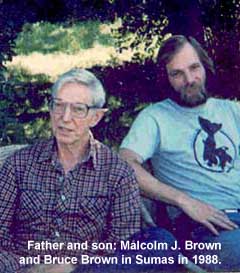
University of Washington Professor Malcolm J. Brown (1910 - 1992) walking in the garden with his grandaughter Laurel Brown, Seattle, WA, July 1986.
|
Additional reading -- Malcolm Brown's George Moore: A Reconsideration, also here on astonisher.com.
|
|
|
But the contrast between Stephens and O'Leary was superficial, merely a contrast of temperaments. Concerning Irish nationalism, their beliefs were identical and shared with all other Fenians. Twice O'Leary formulated the Fenians' credo: at first officially as an editor in 1864-65, and again without essential emendation thirty years later. The two pronouncements serve as a convenient map of the Fenians' ideology. Since their beliefs are commonly misunderstood, largely through Yeats's misapplications, they need to be set out schematically.
II
The first premise of all Fenians was that Ireland was saturated with separatist sentiment, the inevitable end product of the disasters of English rule. Irish disaffection, they believed, had never disappeared and never would disappear short of independence. Sometimes it exploded; otherwise it was just waiting to explode. O'Leary never indulged in gratuitous enthusiasm, and his certainty of the strength of the popular Irish nationalist sentiment represented his most solemn and cautious judgment: ". . . it is the experience of what is now a pretty long life with me that the Fenian spirit is ever present in Ireland, and needs at any time but a little organization to make it burst into renewed activity."
Activated by such a theory, Fenianism was flagrantly illegal, and its foremost enemy was the constabulary. Stephens therefore sketched out a conspiratorial organization resembling the Ribbon lodges and the Carbonari. The larger unit of his secret structure was a "center "commanded by a "head center" who maintained contact with nine subordinates called "As." In the ideal plan, each "A" had contact in turn with nine "Bs," each "B" with nine "Cs," and so on down to the "Ds," the privates of the Fenian army. The sum of all these constituted one full center. To cover all Ireland Stephens envisioned many dozens of centers, all directly responsible to himself. Any one member knew only the one man above him and no more than nine others of his own rank or below. Exposure of any part of the organization would therefore leave the main structure intact, a dismembered starfish. Long after the main body had disappeared, some of the fragments did continue to function, and it was one of these surviving cells that Yeats joined briefly at the turn of the century. To bind the organization together ceremonially, members took some form of an oath in which they usually promised to obey their superiors-except where such obedience would be "contrary to the law of God" - and swore to "preserve inviolate" the confidences with which they had been entrusted.
III
The Fenians "believed in violence." The root of all their behavior was their certainty that England would never surrender dominion over Ireland unless confronted with superior Irish force, ultimately military. The two terms "Fenian" and "physical force" were synonymous, and the notion of many literary commentators that O'Leary belonged to some genteel verbal branch of ethical culture overlooks his essential harsh activism. "England, in the case of Ireland, never yields to any other argument save that of force, in some of its varying forms," he said; ". . . we could get from England nothing but what we could wring from her." O'Connell's nonviolence was in O'Leary's opinion "a doctrine of which it is hard to say whether it is the more foolish or the more base."8 Yet, Fenians were never lovers of violence qua violence in the hysterical manner of Mitchel, who perpetually cried out: "In God's name, let the storm burst!" They saw in bloodshed no poetic or mystical value, no "lonely impulse of delight . . . somewhere among the clouds above." They thought it simply an ugly pragmatic necessity to the pursuit of Irish goals.
Though committed to physical force as a general principle, the Fenians thought Ballingarry disgraceful altogether. Stephens had been out there, and he could never afterward temper his sarcasm toward those clumsy bunglers, the "rhetorical revolutionaries" of 1848. The people themselves he never doubted, and he located his ultimate authority in the silent will of the Irish mass. O'Leary too, though often stereotyped as an autocrat, honored the populist ideal. "The leaders, naturally, `cave in' often," he observed, "but the people never." But neither man saw any point in calling together sprawling musters of patriot hordes who first worked themselves into a martial frenzy and then disbanded and all went home. And they believed that Mitchel had been wrong to suppose in 1848 that the nation could propel itself into battle spontaneously, however intense the crisis. Mitchel's reckless trust in spontaneity had echoed Thomas Davis' innocence:
- The troops live not on earth could stand
- The headlong charge of Tipperary**
This sort of irresponsible talk Stephens would not countenance. "The headlong charge of Tipperary," to be sure; but Meagher had harangued thousands of cheering Tipperary peasants by moonlight on Slievenamon, and where were those same spontaneous fighting men when they were summoned to Ballingarry two weeks later?
The fatal flaw in the 1848 insurrection, Stephens decided, was amateurism. Before the nation could be polarized into a fighting force, it would have to be activated and guided by a disciplined and professional leadership, that is, by Fenians, the "true men" foretold in Young Ireland's fighting songs. Fenian recruiting was therefore selective, and Yeats thought he remembered hearing O'Leary suggest that the fewer their numbers the better, as though he were on the membership committee of the Kildare Street Club. A more cogent purpose of the exclusiveness was explained by O'Leary's friend, Thomas C. Luby: "Far better it were, in a struggle for freedom, to have but 300 true men, on whom you could rely for support to the last drop of their blood-who, if called upon, would conquer or die with you, like the three hundred unforgotten heroes who perished with Leonidas at Thermopylae; better a thousand times such a small band than 50,000 doubters or shams." It was thought wise to disburden the organization of "tea-table revolutionists, who join a cause while danger is remote, who love at once to frighten and fascinate weak girls by tall talk, but who sing small when danger drops on them."" When these amateurs had departed, so the theory held, those who remained would be refined into an elite, not weakened by their diminished numbers, but strengthened by the abandonment of the illusion of forces they did not possess. Goodbye therefore to "drawingroom rebels."
IV
Theoretically, Fenian militance strained toward a "pure" nationalism devoid of class orientation. Fenians did not take up Young Ireland's refrain about a combination of all classes because they liked to avoid talking of classes at all. O'Leary was far more spartan than Davis in demanding that every single Irish grievance-except just the one-be set aside. A catalogue was drawn up to list all the peripheral demands being urged by one or another Irish group: extension of the franchise, "manufacture-movements," sugar beet cultivation, conciliation of the aristocracy, and so on. All were equally futile, it was said: a hostile Britain stood astride every road toward the amelioration of Ireland's condition. "Let national independence once be reached through manhood's road, the only way it can be reached, and all other blessings will follow as natural results; from narrower regeneration schemes nothing worth having will arise." This position was so forcibly stated and so often reiterated that the inference might easily be drawn that Fenianism not only wanted all grievances postponed, but actually scorned them as such, a thought that later ossified into a fossil and embedded itself in Yeats's attitudes.
As for agrarian grievances, the Fenians thought the peasants' needs no more urgent than anybody else's. This doctrinaire decision to desert the agrarian struggle crippled the rural strength of Fenianism and was undoubtedly a mistake in tactics. It was made in painful bewilderment over the changing rural picture. Since 1847 great numbers of small peasants had taken flight overseas, ten thousand per month, year after year. The neighboring peasants who survived had all the while been accumulating the little plots of land left behind by the fleeing. The "agrarian problem" that Fenianism tabled for the duration was no longer confined strictly to dispossession and starvation. There was now an augmented class of strong farmers and acquisitive "middlemen" who had exterminated their fellow peasants below them and were now turning their thoughts toward exterminating the landlords above. The decision to bypass the agrarian issue was made in part with these "boors in broadcloth" in mind; and the Fenian press did not hesitate to attack them openly as enemies of nationalism, sense, and decency. "As a class," said Kickham, "those men of bullocks are about the worst men in Ireland. They appear to have no more souls than the brutes which they fatten for the tables of our English masters." Naturally, these strictures bore no relevance to the main body of the peasantry, still living on the ragged edge of starvation. But Stephens, Kickham, and O'Leary were not quite sure that the agrarian demands were what was wanted for them, either. The agrarian ideal of a whole nation of strong farmers seemed very foolish. Irish peasants in the mass would always be marginal, they thought, and was heaven to be stormed for no better purpose than to fix Mickey Moran permanently on his miserable ten acres of hillside and bog? Therefore, let the peasants wait for independence like everybody else, and in the meantime be silent.
The classless ideal of Fenianism naturally betrays the lurking bourgeois. Unfortunately for Stephens, the respectability for which he prepared a place had never turned up. Besides the missing peasants, the other faces absent from the movement were the men of substance, middle-class men of the type of Sheil, Woulfe, Davis, Dillon' and Duffy. They did not relish the risk, O'Leary said.
- The middle class, I believe, in Ireland and elsewhere, to be distinctly the lowest class morally-that is, the class influenced by the lowest motives. The prudential virtues it has in abundance; but a regard for your own stomach and skin, or even for the stomachs and skins of your relatives and immediate surroundings, though, no doubt, a more or less commendable thing in itself, is not the stuff of which patriots are made. Your average bourgeois may make a very good sort of agitator, for here he can be shown, or at least convinced, that his mere material interests are concerned, and that he may serve them with little or no material risk. A rebel, however, you can rarely make him, for here the risk is certain and immediate, and the advantage, if material advantage there should be, doubtful and distant.
Thus it was that Fenianism, for all its disdain of class, was actually a class organization. By elimination, the "true men" of Ireland had to be found, so Stephens learned, in the bottom strata of the culture, among Tone's "highly respectable class of the community, the men of no property." The gentility were amused by the readiness with which the Fenian brotherhood welcomed laborers and servant girls, O'Leary said. "Let our critics then get such comfort as they can from my confession that our movement was mainly one of the masses, not against the classes, but unfortunately without them." la The most numerous Fenian recruits were the "men in the workshops," skilled craftsmen and factory workmen, ranging from poor shoemakers in garrets to superintendents of great engineering works. These artisans turned out to be not only the most militant people about, and the "most intelligent," but very nearly "the most cultivated," too. But if the nationalist impulse was generated only at the bottom, it could seep upward. "It is the people who have kept the national faith alive," he said. "Instead of being imbued with the spirit of patriotism by the upper classes, the people impart to them the little of patriotism these upper classes possess." Unfortunately, his famous disciple was not listening when he said that.
Relieved from the "timid breath" of the "merchant and clerk" - Yeats's paraphrase of O'Leary's strictures against the Catholic middle classes-the Fenian cadre was more businesslike than anything Irish nationalism had seen since 1798. O'Connell's strength had consisted of sheer raw numbers, part-time enthusiasts who paid their farthing a week to the parish priest and strolled off casually to the monster meetings to listen to the oratory. Davis had had no organized following at all, just the Nation's subscription list and the Eighty-two Club. The Confederate clubs of 1848 were broad-based but undisciplined. Stephens' conspiracy in contrast possessed a popular base, discipline, mobility, initiative, and numbers. As events proved, these assets were insufficient.
V
A violent breach with the clergy followed naturally from Stephens' projects. If Archbishop Cullen was unable to live in the same country with so gentle a coreligionist as Gavan Duffy, he would certainly not tolerate an "infidel Jacobin" like Stephens. In spite of the rule against the intrusion of sectarianism into Irish nationalism, the Fenians found that collision was unavoidable, for the clergy pressed to the attack with characteristic tenacity and vigor, always startling in its scurrilous inventiveness.
Unless the Fenians were prepared to go out of business, they had to defend themselves against their clerical critics. Their standard tactic was to isolate selected priests and bishops and attack them without restraint, but strictly on political issues. Archbishop Cullen had innocently handed them a weapon when he withdrew the clergy in 1854 from the tenant-right movement. The Fenians now took him at his word and spread his own ideal, "No priests in politics" (a sentiment to which Simon Dedalus adverted repeatedly in Joyce's Christmas-dinner feud). It was a rude slogan but hardly Jacobin, for it suggested approval of the clergy's influence in all spheres except politics. It left a peculiar mark upon the Irish nationalist laity, who fell into the habit of mingling clericalism with anticlericalism, of boldly assaulting Church functionaries (such as "Billy the Lip") without implicating the generalized ideal of Irish piety. In time, the dextrous double attitude became a commonplace of Irish literature: witness Frank O'Connor, Sean O'Faolain, Peadar O'Donnell, and occasionally even Joyce. O'Leary himself rounded out a lifetime of battle against the clergy by returning to the Church just in time to expire in a state of grace.
An alternate line of Fenian defense aimed to outdo the clergy by offering a brand of piety of their own. One outspoken Fenian called "Pagan" O'Leary actually proposed that the Holy Trinity be dispensed with and replaced by a pantheon of the old Gaelic gods and heroes. As a prophet, he was handicapped by a conspicuous hollow in the front of his skull, the result of a kick from a horse; and his idea did not immediately prosper. But neither did it disappear. Unwittingly echoing old "Pagan," Yeats, George Russell, and Joyce were prepared to claim in a later time that their own special brand of immateriality was loftier and more noble than anybody's.
The most impressive Fenian counterpoise to the clergy's spirituality was the ideal of self-immolation. John O'Leary wrote:
- There is a word which should be engraven upon the hearts of all men who struggle for freedom-and that word is self-sacrifice. Not by men who love ease, money, health, or even reputation more than country can it ever be hoped that independence will be won. Pain, poverty, disease, and obloquy have ever been the lot of many of the noblest and purest spirits that have appeared on this earth, and any and all of these must be faced if we mean that Ireland should be free. . . . to a small number of men in any country, is given . . . large capacity for action and endurance. But the humblest among us can aid in the great work, if only he be willing to immolate self. Time, labor, money, in greater or lesser degree, all men can give, and those the country demands from all; for time, labor, and money must be largely expended before we can ask that great sacrifice - life.
On rereading this declaration thirty years afterward, O'Leary conceded that the phrasing could perhaps have been a bit less "high strung in its pitch," but on the general principle he stood his ground.
His personal interest in the formal code of self-sacrifice seems to have been in part aesthetic. There was a lack of taste, he thought, in a person who assumed the honors that fell to heroism and then complained of their cost. His well-known words to Yeats, that nobody ought to "cry in public," arose in this context, and when his own turn to pay came around, he was glad that he had borne his pain in silence and dignity.
Beyond taste, he proclaimed the redemptive paradox, the sainthood of the patriotic battle casualty. As an Irish poetic idea it was not original, for the theme of patriotic immolation had already been delineated by Tom Moore. Fenianism turned it from a sentiment of the drawing room into action in the streets.
VI
The enmity of the clergy, an inconvenience for any Irish political movement, had the unexpected result of strengthening Fenian power. O'Connell and Duffy had let the clergy do their organizing for them, but the Fenians got no free help. Forced to do everything for themselves, they emerged considerably stronger. Their task not only demanded "rooted men," but found them. Stephens himself was one of the sort, and his head centers had the same gifts. The chief of recruiting in the British regiments, John Devoy, worked with such success that at one time every fourth soldier in the imperial garrison was under Fenian orders. In Munster, Stephens found Kickham, gifted with the common touch and famous for his courage and rectitude. To the west, where "Connaught lay in slumber deep," he assigned Edward Duffy, a melancholic somewhat suggestive of Joyce's "Michael Furey," a saintly consumptive who wore out his life and died in Fenian service.
The most picturesque of Stephens' grass-roots organizers turned up in west Cork. In the late I850s anyone scanning the bleak Irish scene for some spark of nationalism would have found his eye drawn to Skibbereen and Bantry. There under Stephens' tutelage a young red-haired giant named Jeremiah O'Donovan (O'Donovan Rossa to us) had organized the neighbor youths into the Phoenix National and Literary Society. By day they intoxicated themselves on the Spirit of the Nation and in the dark of the evening practiced mock military exercises on the hillside.
Stephens concluded that a corps of full-time organizers like the west Cork men might spread the reborn movement throughout all Ireland, provided somebody chipped in to support them while they were "on their keeping." Famished Skibbereen could spare no money for the purpose, nor all Ireland either. But there was a chance that money might be collected among the Irish émigrés in America. John O'Mahony, now in New York, had recently raised eighty pounds and sent it by courier to Ireland to help launch the new society. Stephens sent him a message that if the Americans would guarantee a regular contribution of a hundred pounds a month for a war chest, he would undertake to organize Ireland for insurrection.
VII
American Fenianism was thus envisaged as the indispensable paymaster for the shock troops at home. While Stephens' projects expanded, the Fenians overseas set about to organize Irish-Americans into a mass auxiliary modeled after O'Connell's peasant agitations, a transplant that blended nicely with native American backwoods political manners. American Fenianism took vigorous root. It soon became a fixture in urban American politics, developing a new mutation altered radically in ambition, if not in vocabulary or accent.
The generous pledge of money was readily forthcoming from America, but not the money itself. O'Mahony was a selfless patriot but not much of a money raiser, and the Fenian command had to take to commuting between Ireland and New York, bringing home funds in driblets to pay for sporadic bursts of organizing activity. From the Dublin point of view, the story of American Fenianism was summed up in St. Paul's perennial complaint: "The collections are not coming in!"
O'Leary, too, sailed in pursuit of some of those "rascally dollars." He boarded ship incognito, a secret agent on a dangerous mission. On the other side, a brass band greeted him at the Battery pier, and he was paraded up Broadway and compelled to make a speech. The Irish-Americans overwhelmed him with picnics and oratory, and in Pittsburgh he listened to a sworn brother deliver as his own composition one of Meagher's best-known oratorical warwhoops. His American adventure forced him to disagree with the opinion of the poet Horace that men who cross seas change only their climate, not their dispositions; yet it pleased him that Irishmen "still, thank God, leave their country with the hatred of England lying deep in their souls." Still, the cash he came for was skimpy.
VIII
While the Fenians' leaders were beating the American bushes for money, their mother chapter in west Cork came to grief. The secret society turned out to be not particularly secret. Early in 1858, a Skibbereen schoolteacher named Daniel Sullivan confessed his membership to the parish priest. The sinner was invited to step into the parlor to repeat his statement outside the secrecy of the confessional. The word was then passed up to the Castle and to the bishop of Kerry, Dr. David Moriarty, who instructed all the priests of the diocese to denounce the new society from the altar. To support that frontal attack, he conceived a flank diversion through a partnership with the Nation, hitherto the unsullied emblem of Irish militance and the brave lay adversary of ultramontanism.
Duffy had been three years in Australia by this time, and the Nation had just been purchased by Alexander M. Sullivan, a young man of many talents and good impulses, spokesman for a new breed of middle-class Catholic nationalists that had mutated since 1848. He was a west Cork man (with the westerner's pale blue eyes and black curly hair), the son of a Bantry house painter. He had sensed an Irish parliamentary opportunity opening up in the slow British drift toward liberalization of the voting franchise and so, gathering about him three brothers-Donal, Denis, and T. D. (who emerged from Joyce's naming machine as "T. Deum") - besides some cousins, in-laws, descendants, and friends, he created a powerful new clan of politicians, later called "the Bantry band." From 1858 onward they were to be found in the midst of every important episode of Irish history. Sullivan lined up his clan on the moral force side of Irish politics and set himself and the new Nation against any future dalliance in military adventure. Without neglecting the old Nation's tradition of fraternity with the nationalist clergy, he was also anxious to bargain with the ultramontanists.
Sullivan soon collided with Stephens. In the summer of 1858 he journeyed home to Bantry for a holiday of yachting on the bay. Stephens' footprints he found everywhere in west Cork and Kerry, and his secrets were everybody's excited talk. Fenianism had won over the youth in the coastal towns and was "creeping inwards." The editor of the new Nation was himself sought out by Stephens and invited to join up, an invitation declined with no hard feelings on either side. Sullivan was next sought out, as he tells us, by Bishop Moriarty, His Lordship bearing private information from Dublin Castle that the government was preparing to arrest the Phoenix Society members. Moriarty intimated that if the Nation would cause the conspiracy to evaporate before the police could act, there would be a blessed prevention of unnecessary scandal and suffering. It was to give substance to the bishop's logic, Sullivan said, that he composed a long three-column a certain secret society? Supposing Smith O'Brien did belong, what answer was he permitted in honor to make? Worse yet, the Nation's editorial attack had served as the tip-off to the police. It was the government's hunting dog which pointed the police to their game. Stephens coined the phrase "felon-setter" and fixed it in permanent Irish usage to denote any "firm but friendly remonstrance" - such as denunciation from the altar-that proved serviceable to the police. The charge was false; for as Sullivan proved, two other Dublin newspapers had mentioned the Phoenix Society before the Nation's attack. The Fenians were not pacified. Whether or not he was the first, his attack still carried an unmistakable tone of mischiefmongering, particularly misplaced in the Nation, they said. They concluded that he had succumbed to the insidious temptation of impugning in public the motives of the spearhead of his own party in order to commend himself to the enemy. He was henceforth known to all Fenians as "A. M. Sullivan-Goulah," a despicable name borrowed from the government's Skibbereen informer.
The Fenians' hatred of Sullivan, energetically requited, became one of the permanent givens of Irish politics. It survived as one of the miscellaneous hatreds behind the Civil War of 1922-23, sixty years after the "friendly remonstrance." Stephens, O'Leary, and Rossa bore their contempt for Sullivan to the grave, and only John Devoy, softened by extreme old age, brought himself around to pronounce the full formula of forgiveness: "God rest the souls of the Sullivans." Understandably, the old animosity was inherited by Yeats and enlivened by aesthetic considerations. But as we shall see, time was to play interesting tricks with Yeats's testamentary obligation to disdain the Sullivans.
Like O'Connell, Sullivan proposed to drive physical force outside the moral pale in Irish politics. Unlike O'Connell, he failed. The Fenian word of mouth proved more potent than the Nation's pen. Sullivan gave ground, frightened into silence. The Nation reported that he had been selected for assassination, but the Fenians laughed at that, for plainly his assassination never took place. With his retreat, physical force stood as an alternative, silent or vocal, to every Irish constitutional move. Its moral stature was never again assailable in Irish nationalist politics, and the argument against it was confined to the consideration of the ordinary logic of expedience.
"The Politics of Irish Literature" © Copyright 1973 Malcolm Brown
* By odd chance it was the same dingy establishment that Balzac had used for his model of la maison Vauquer.
** We owe the discovery of these unfortunate lines to Yeats's search.
| New CD-ROM LIBRARY EDITION |
|
|
 |
"Great book. Fascinating..."
-- Jack Weatherford,
author of
The History of Money
|
The History of the Corporation
by Bruce Brown
* READ free excerpts on astonisher.com
* BUY the complete book at the astonisher.com store
|
|
|
© Copyright 1973 - 2008 by Bruce Brown
and BF Communications Inc.
Astonisher and Astonisher.com
are trademarks of BF Communications Inc.
BF Communications Inc.
P.O. Box 393
Sumas, WA 98295 USA
(360) 927-3234
Website by Running Dog 
|