Chapter Six
Black '47
DAVIS DIED on September 16, 1845. Three days earlier the British horticultural press had taken its first notice of the alarming appearance in Ireland of the "potato murrain" or potato rot. In a few weeks the blight had spread all over Ireland, destroying about half of the 1845 potato harvest. Potatoes were the only source of carbohydrates for the Irish small peasants and cottiers, and without them they would starve. Thus began the Irish famine, one of the major peacetime disasters of modern history. It found the native leadership weakened by the split between Old and Young Ireland; and worse troubles lay ahead.
Davis' sudden death was a staggering blow to the Young Irelanders. Their deference to his judgment was absolute and their affection for him pure adulation. Among them he had no rivals, only disciples. For a moment they were not sure they could carry on without him. But events in the three years after his death were to move at an even dizzier pace than in the three years preceding, and the survivors were not allowed much time for weeping. Young men unknown to Davis knocked to ask admission, and the living cast about to replace the dead. Three of Davis' lieutenants -- Gavan Duffy, John Mitchel, and Smith O'Brien -- were the presumptive heirs to his leadership, each representing a single facet of his own many-sided personality. With fine poise and sweetness of temper, Davis had made harmony among them. But his survivors could not. On top of all its other woes, Young Ireland had now to contend with its own internal disintegration.
Gavan Duffy took over the Nation. He represented the practical side of Davis' character, the voice that said, "Arigna must be pierced with shafts." He was clear-headed, efficient, and prudent; he kept his shop so that his shop might keep him. He made a financial success of every activity he undertook, including radicalism, as O'Connell sarcastically reminded him. These qualities permeated his prose style, which was forcible, lucid, and fair-minded. But he was more timid than Davis and more awed by respectability. His printer's style sheet required a deferential capital for "the People," but as has been noted, he was one of the sources for the dilution of Davis' original agrarian radicalism. One of his poems, "The Muster of the North," contains the lines:
- The Green alone shall stream above our native field and flood
The spotless Green, save where its folds are gemmed with Saxon blood!
To this poem he appended a footnote for disclaimer: "The ballad here printed is not meant as an apology for these excesses." He often used the word "excess," and he shared all of O'Connell's fears of "democratic excess." Duffy's prudential reflexes were made clear in a leading article he wrote immediately after Davis' funeral. Starting off from the familiar jacquerie threat, long used by Davis to penetrate the after-the-hunt drowsiness of the Protestant gentry, he diverged into a bold new idea of his own concerning the Young Irelanders' proper historical function: in the coming revolution they would be the referee. He had long been convinced that "Ireland will not be redeemed by the Aristocracy-it cannot be redeemed by the Peasantry,"' leaving the name of the redeemer an easy riddle to answer. Recently he had been studying Lamartine's L'Histoire des Girondins, a proper guide to sobriety "a la veille d'une revolution."According to the French analogy, either a peasant revolution or an aristocratic counterrevolution would shortly be attempted in Ireland. "Out of such a crisis," said Duffy, "sprung the great French Revolution." But there was a third way, by which both "excesses" could be avoided. Righteous and temperate young men might intercede as mediators. "Such fiery young men, disciplined in the strictest probity, as those who chastised the courtly tyranny with the one hand, and beat back the murderous mob tyranny of the Marats and Robespierres with the other, would stand between the lords and the tillers of the land, and arbitrate justice without violence." Young Ireland, in short, should constitute itself the Irish Gironde, with Duffy for its Brissot.
In exact contrast to Duffy was John Mitchel, volcanic and irreconcilable, representing the angry Davis who had put the Manual of Artillery on his bookshelf beside his Thierry and Beranger. His father was an Ulster Presbyterian minister who had defected to Unitarianism, so that he had Calvinist nurture but no home in any of the three great Irish sectarian families. He was a newcomer to the Nation. While the early Young Irelanders were theorizing about Irish agrarian grievance, he was gaining a concrete intimacy with it in the legal defense of peasants charged with stealing the landlords' seaweeds and limestone. Of all the Young Irelanders, he had the best knowledge of the condition of Ireland when he came to join the Nation just before Davis' death. He had read Carlyle fervently, absorbing both his thought and his style. He considered The French Revolution "the profoundest book that English literature ever produced"; and after the two men became friends, Carlyle's talk seemed to him "like the speech of Paul or Chrysostom." When he first began to write for Young Ireland, Davis had to order him to delete his distressing Carlylean mannerisms. Following this necessary stylistic surgery, he became the most incisive and fearless writer among the Young Irelanders.
|
|
Table of Contents
|
|
Astonisher.com is pleased to offer The Politics of Irish Literature by Malcolm Brown, complete and free for your personal use.
Praise for
The Politics of Irish Literature |
 |
|
"This brilliant study of the intersection of politics and literature in Ireland amounts to a dazzling portrait gallery. Reading it one feels about one the breath, warmth, and passions of the dead all come alive again."
-- Sean O'Faolain in the Manchester Guardian
"Mr. Brown's masterpiece has made me want to hire a nearby housetop and recite whole chunks to every passerby..."
-- Michael Foote in the London Evening Standard
"The author of the best book on George Moore now gives us what is in all likelihood the best book on the politics of modern Irish literature."
-- Virginia Quarterly Review
|
|
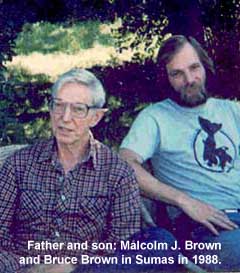
University of Washington Professor Malcolm J. Brown (1910 - 1992) with his son, Bruce Brown, in Sumas, WA, July 1988.
|
Additional reading -- Malcolm Brown's George Moore: A Reconsideration. Also see Bruce Brown's commentary on The History of the Corporation for Malcolm Brown's contribution to that work.
|
|
|

Mitchel's private verbal impulses were, like Duffy's, released by Davis' death. A Tory newspaper had remarked that the Irish railways under construction would increase the mobile striking power of the British garrison, since troops could soon move to the most remote glen in Kerry or Donegal within six hours. Mitchel replied in an unsigned editorial known in Irish history as "the railway article." Since the domestic military attributes of railways had been broached, he said, the subject might profitably be pursued. There were two ways of looking at this matter. "The materials of railways, good hammered iron and wooden sleepers -- need we point out that such things may be of use in other lines than assisting locomotion." He advised the Repeal wardens to study the interesting tactical possibilities of railway cuts. Andreas Hofer, the anti-Napoleonic Tyrolese patriot, could not have asked for a finer setting for ambush than a railway cut: "Imagine a few hundred men lying in wait upon such a spot with masses of rock and trunks of trees ready to roll down-and a train or two advancing with a regiment of infantry, and the engine panting near and nearer, till the polished studs of brass on its front are distinguishable and its name maybe nearly read; `Now -- in the name of the Father, and of the Son, and of the Holy Ghost! -- now.' " No doubt about it, Mitchel knew how to make himself heard. Pietists were horrified at this blasphemy, and Mitchel had to show that he had merely quoted good Catholic Hofer's own words. O'Connell was furious at the Nation's presuming to instruct his wardens to flout the principle of moral force. Acting perhaps at O'Connell's instigation," the government began legal action against the Nation; and Duffy, as editor, was forced to bear once again, as at the time of the state trials, the legal burdens of somebody else's incendiarism.
Smith O'Brien, the last of the three heirs, represented Davis' precious case of nationalism in the Protestant aristocracy. He had chosen the popular Irish side as a deliberate act of honor, "though free to refuse." He is thus the beau ideal of Yeatsian sociology and of Yeatsian mask-psychology, but no example of Yeatsian gaiety. One finds no other figure in Irish history quite so painfully torn by irreconcilable scruples. In going over to the Repeal Association, and in his more courageous affiliation with Young Ireland, he had not solved his dilemma or eased the pain of his stark public agonizing between caution and recklessness. Still, he had wealth, social position, a spartan fairness, and a seat in Parliament. He was the automatic first choice for leader in all of Young Ireland's political adventures.
Davis' cultural nationalism had no heir. Duffy, it is true, had made himself Young Ireland's foremost expert on folk balladry and had edited its semiofficial collection, which in time ran to fifty reprintings. He also carried forward Davis' literary spirituality. Here is a characteristic sentence out of the Nation: "Beside a library, how poor are all the greatest deeds of man -- his constitution, brigade, factory, man-of-war, cathedral -- how poor are all miracles in comparison." These words resound like Davis' own, but appear actually in Duffy's book review of one of the posthumous Davis anthologies. Yet Duffy lacked Davis' prime enthusiasm, and he took over cultural nationalism as though it were merely another of the Nation's assets, like the printing plant and the subscription list. The temperamental Mangan was reinforced by a poetry machine operated by Miss Jane Elgee -- later to be Lady Wilde --a young patrician who signed herself "Speranza" and discovered a rhyme for the word "sunlight" (it was "dunlight"). Other literary activity was reduced to nostalgic reprintings from the grand year 1843, plus occasional genteel appreciations of classic English poets, always a safe enterprise. Davis' cultural campaign was dead with Davis. A succession of screaming practical crises swept down upon Young Ireland, and for a long time to come Irish nationalist literature was to be more in the seed than the flower. Apostolic literary zeal would not be known again in Ireland until John O'Leary took it up afresh forty years later.
II
The developing famine was the new excitement of the hour. Within two weeks of Davis' death, murmurs of alarm were heard in Conciliation Hall. An elderly nationalist told of his recollection of past Irish famines: "'...there was no use in mincing the matter,' he said, 'they had famine at their door' (hear, hear). He knew that the poor would divide their last morsel with each other till they had nothing to divide. . . . The landlords saw all this, yet did not come forward." O'Connell, always happy to embarrass Peel, gathered a committee of Dublin dignitaries and led them to the Castle to wait upon the Tory lord lieutenant, the "cold, curt, and monosyllabic" Lord Heytesbury. The delegation bore a memorial written by O'Connell respectfully beseeching the government to act quickly to forestall suffering and death, a last voice of sanity before madness overwhelmed the Irish scene. It pressed the government to take certain immediate steps: to halt the export of Irish grain and livestock and the distillation of spirits, to establish emergency food distribution centers, to organize public works projects, and to rescind the tariff on American cornmeal imports to Ireland. At the next meeting of the association, O'Connell in fine anecdotal form described the Castle audience and quoted the lord lieutenant's words, read from a prepared statement, as he dismissed the delegation: "My Lord Mayor and gentlemen-It can scarcely be necessary for me to assure you that the state of the potato crop has for some time occupied, and still occupies, the most anxious attention of the government." Said O'Connell, "Much obliged to him for nothing (laughter)."
Peel winced at his old enemy's barbs, and his first reaction to the oncoming famine was naturally to introduce a fresh Irish coercion bill. After that, he prepared a relief program that followed in several respects O'Connell's proposals to Lord Heytesbury. The first demand, to halt Irish food exports, was unthinkable not only for Peel but for O'Connell as well, and soon afterward it was dropped. Peel met the second and third demands forthrightly. He organized foreign food purchases, food depots, and public works projects with all deliberate speed. For temporary relief of immediate hunger under only partial potato crop failure, this part of Peel's program was timely, and it saved many from death in the early months of 1846. Yet there were dangers in the scheme, too. The public works projects were "unproductive," that is, useless on principle. The finances were left to the voluntary impulses of landlord committees, whose private contributions formed the base for matching funds from the treasury. In making each district responsible for "its own" destitute peasants, Peel's relief measures, in giving every landlord fresh reason to pray that his tenants would depart from his sight forever, increased the pressure toward clearances. And by confusing emergency relief with charity, Peel guaranteed the insufficiency of response that accompanies any levy based on passing the hat, while at the same time inciting in the donors a maudlin self-congratulation by which they read their niggardliness as heroic benevolence, in the manner of Yeats's Countess Cathleen.
O'Connell's fourth demand, the emergency remission of the tariff on Irish food imports, brought a response from Peel violently disproportionate to the occasion. Contrary to all Tory morality, Peel shocked the country in December 1845 by announcing himself opposed to continuing the Corn Laws, the government bounty on agricultural produce. He explained his conversion as necessitated by the Irish potato failure, arguing that Irish hardship would be lessened if the price of American cornmeal imports could be reduced by the removal of the Corn Law customs duty. This is one of history's most inventive non sequiturs. Those Irish peasants in danger of starvation ordinarily bought no agricultural produce; they only sold it. Corn Law repeal could only bring about a general deflation of food prices on the English market. Ireland as an exporter of food would have found it disadvantageous at any time, but in the shadow of the famine it could prove disastrous. When Corn Law repeal was finally carried in mid-1846, the price of Irish grain and livestock fell, the peasant brought home less cash from the market, his resources for rent payment were diminished, and his likelihood of hunger and eviction was increased.
For a month or so the coming of the hunger brought the old prancing, fire-eating, O'Connell back for one last performance. He poured out his scorn upon the Duke of Cambridge for his words of advice to the hungry Irish. If O'Connell's quotation is accurate, the royal duke had said that "rotten potatoes and sea weed, or even grass, properly mixed, afforded a very wholesome and nutritious food. They all knew that Irishmen could live upon anything, and there was plenty of grass in the field, even though the potato crop should fail." O'Connell warned that it was not inconceivable for the English to attempt to "starve the Irish nation," for Edmund Spenser, "with his vividness of poetic imagination," had proposed just this policy for Ireland. "If it should be attempted," he added, "I do not hesitate to assert that it would be the duty of every man to die with arms in his hands." The stenographer then inserted a parenthesis: "The entire meeting here rose and cheered with utmost enthusiasm for several minutes." This was in January 1846. But as the winter deepened, he grew meek and confused and sounded increasingly senile.
In the spring of 1846 hunger began to find its first victims, and gusts of unrest stirred in the countryside. O'Connell's stock of impoverished oratorical effects poured out by rote: "My advice is tranquility and endurance amongst the people. . . . Let there be loud voices but unwilling arms." He reawakened the now-empty echoes of past glory: "Is there no remedy? Is there no hope? Must we then despair? Despair? No, no-a thousand times no-there shall be no despair. There is hope. There is a remedy. . . . Hurrah with us for the Repeal!" In his country's agony, he had defaulted his leadership.
On the famine issues the Nation followed O'Connell's lead as long as it could. It applauded when he annihilated the Duke of Cambridge in the grand old style. But while he grew more bland and dissociated, its own language grew more harsh. It seized upon all of his militant leads, just when he was anxious that they should be forgotten. It was especially taken by the first demand of his Heytesbury memorandum-prohibition of Irish food exports during the emergency-and by his warning of a possible English attempt to starve the nation. By April 1846, when O'Connell's daily counsel was for tranquillityand endurance, the Nation had become extremelyalarmed at the state of the country. There had been a few deaths already, and hunger was spreading from the cottiers into the mass of the small peasantry. It foresaw "thousands on thousands waiting for typhus." And as sinister as the growing death lists were the reports of numerous clearances by the landlords.
III
On the heel of the first frightening winter, Mangan's dormant poetic imagination suddenly came to life. One Saturday in April 1846 the Nation published his poem "Siberia." The solemn gloom of the verse took on added power from its setting among the accounts of "families in caves," "suicide to escape beggary," "mills and stores ransacked," "Limerick counting their deaths," and the terrifying prognostication, "worse is coming."
Mangan then followed up with a series of lamentations: for Sir Maurice Fitzgerald, for Patrick Sarsfield, for Banba, for Innisfail, for Timoleague. In their midst appeared two poems derived from Ferguson's prose translations in the Hardiman critique twelve years earlier. One was "O'Hussey's Ode to the Maguire,"* which was rejected by both Dublin University Magazine and Duffy, presumably for the unchristian morality in its last four lines:
- Hugh marched forth to the fight -- I grieved to see him.so depart;
And lo! to-night he wanders frozen, rain-drenched, sad, betrayed --
But the memory of the lime-white mansions his right hand hath laid
In ashes warms the hero's heart!
Mangan's second poem from Ferguson was based on the prose translation of the anonymous "Roiseen dubh." He had already written a couple of very flat and embarrassing versions based on Ferguson's interpretation. Now he dropped the lovesick priest, removed the breasts, and went for the nationalist allegory. The result was printed in the Nation on May 30, 1846. The last stanza said:
- O! the Erne shall run red
With redundance of blood,
The earth shall rock beneath our tread,
And flames wrap hill and wood,
And gun-peal, and slogan cry,
Wake many a glen serene,
Ere you shall fade, ere you shall die,
My Dark Rosaleen!
My own Rosaleen!
The Judgment Hour must first be nigh,
Ere you can fade, ere you can die,
My Dark Rosaleen!
More than one cautious critic has ventured to call this a perfect lyric; and thus it must be said that an outcry of anger against a high season of perfidy, criminal folly, and mass death had created the highest poetic accomplishment of Young Ireland.
In that same infamous month, William Carleton began serial publication of a famine novel called The Black Prophet, based on his recollections of the 1817 famine in Ulster. Like his earlier story, "Tubber Derg," the novel concerned itself with the suffering that lay behind the mortality statistics. Carleton depicted the hunger in a series of powerful vignettes: one took place in an extortionist mealmonger's warehouse; another showed a conference among the members of a proud peasant's family where the awful choice to "go out" (that is, to beg on the roads) was finally made; and another occurred in a pestilential cabin where a neighbor burst open the door to discover the entire family dead or dying. But beyond communicating the raw feel of human pain, Carleton's peasant brain had trouble seizing the meaning of the catastrophe. His wisdom followed the outlines of O'Connell's intellectual bankruptcy, but also included a querulous assault against "politicians," meaning presumably O'Connell himself, but Young Ireland no less; for with this novel he had left the Nation and returned to his old home in Dublin University Magazine, whose special brand of economics he once again embraced without visible effort.
IV
Young and Old Ireland were now hopelessly divided and groping for some casus belli. It was found in the old issue of the Whig alliance. A section of the Tories under Disraeli split away from Peel, and as the spring of 1846 wore on, the Whigs sensed victory in the breeze. O'Connell then bethought himself once more of the joys of an alliance with Whigs in power. He began secret negotiations with the Whigs' leader, Lord John Russell, the celebrated author of the Reform Act of 1832 (and the grandfather of the famous English Russell of our own time).
The Young Irelanders read O'Connell's mind and set themselves the task of spoiling his dream of a new Whig love feast. They forced themselves to swallow their fears of the great man and to move into open battle. The Nation warned its readers to beware of "pretended Irishmen, luke-warm, milk-and-water, deaf small-beer lovers of their country. . . . They will buy you, and they will sell you at a small profit." Each week came another leading article: "Beware of the Whigs," "Look Out for the Whigs." O'Brien sent in a letter advising the utmost caution against the Whigs. In mid-June 1846, with Peel's hours as prime minister near their end, the Evening Mail quoted O'Connell as saying privately to Lord John Russell: "All he [O'Connell] ever wanted was a real Union -- the same laws, the same franchises, etc." This was almost certainly an accurate quotation, and the Nation wrote with clever insolence that it had "no authority from Mr. O'Connell to contradict this; yet do we unhesitatingly pronounce it an audacious lie." Thomas Meagher (pronounced "marr"), a post-Davis Young Ireland recruit with a knack for florid oratorical effects, came to the next association meeting and delivered a savage attack against Whig place hunting and by implication against O'Connell himself, whose backstairs politics he placed in contrast to those of Davis, "our guide and prophet." Attacked in his own fortress by a virtual stranger, a "juvenile," O'Connell could not allow Meagher to go unanswered.
A week later Peel's ministry fell and the Whigs came in. With his friend Russell now safely in power, O'Connell had leisure at last to chastise the juveniles, and he crossed over to Dublin to direct the association in cleansing itself. In a tense meeting he rose to speak high praise of the new prime minister. Lord John Russell had personally conveyed his sympathy with "the misery in which the people of Ireland are," and had made him a solemn promise of "the most comprehensive measures of relief."14 He next turned to the attack upon Young Ireland. He moved a resolution to define the association's theoretical position against violence, denouncing violence at all times, in all places, under all conditions whatsoever. He then returned to Westminster, leaving the association to tear itself apart in snarling over the meaning of the word "nonviolence."
The resolution was senseless, and it could not have been accepted without humiliation. But it was so phrased that it could not be rejected either, without seeming to make an equally senseless call for an immediate '98 insurrection. The Young Irelanders' debate struggled unsuccessfully to escape from the trap. In due course the motion was put to a vote and carried, and then the bickering took up the scholastic question, Do we now condemn George Washington and the Belgians of 1830? This went on for a couple of weeks until Meagher, frenzied by his own oratory, proclaimed that he for one would never, never "stigmatize" the sword-"no, my lord, for at its blow a giant nation sprang from the waters of the Atlantic and by its redeeming magic the fettered colony became a daring, free republic." He was interrupted by John O'Connell, who ruled that such talk was offensive to the principle of nonviolence. Thereupon the Young Irelanders with Smith O'Brien at their head all stood up and walked out of Conciliation Hall.
V
During the week of the split the potato blight returned. This second attack of the blight in 1846 found the peasants' reserves spent under the hardships of the previous winter and spring, their few possessions sold for food, their bodies wasted by months of hunger while waiting for the new crop. This time the crop loss was total and absolute. It was not long before word spread that an unspeakable disaster was at hand. People were really dying all right (as Freud said in the autumn months of 1914) and not just one here and there, but in very large numbers.
The Repeal party did "get a little something" from its bargain with Russell, for O'Connell became the dispenser of Irish political patronage. But on important issues of statecraft his opinions were not solicited. Russell had no time for the complaints of the toothless Irish dragon. The Whigs' "most comprehensive measures of relief," the promise of which had been cited to overawe the juveniles, were now unveiled. Russell led off with the closure of the food depots and the stoppage of government food importations. "Private enterprise" would take over these functions. The instantaneous result was famine shortage and famine prices. Later, Russell reneged in part, setting up free soup kitchens and restoring some of the cornmeal depots, which then sold food at slightly more than open-market prices in order not to hamper the private enterprise of the mealmongers. After a brief pause Russell's next comprehensive relief measure was the closure of Peel's work projects. The three retrenchments, falling in the first weeks of the failure of the new potato crop, gave the countryside a foretaste of what the laws of political economy held in store.
After long delay Russell came forward with a new works projects scheme, even more useless than Peel's, to be financed through a new arrangement called the Labor Rate Act. Under the Tories the government had matched local funds. Under the more sound fiscal wisdom of the Whigs, landlords in the stricken districts were required to pay all, "in order to alleviate the exorbitant demands," according to Sir George Nicholls, commissioner of the Irish Poor Law. Half was to be raised by current local rates, half was advanced as a treasury loan to the district, to be repaid in ten years through taxation. This arrangement confronted many landlords with a choice between ruthless clearances-if they dared-or bankruptcy. A third choice, to defy the Labor Rate Act, was only theoretical, since the British army that stood behind the tax collector was the same that prevented agrarian uprisings. A final Whig relief measure was "taskwork." The busywork on Russell's superuseless relief projects was paid by the piece at less than the going wage in order to equalize the economic rewards with the peasants' actual expenditure of enthusiasm and calories. All these innovations were interesting as such, but by far the most arresting difference to be observed now that the Whigs were in, clear even to the nonexpert, was that people were dying faster than ever.
The enormity of the famine that now commenced has always been difficult to communicate. In struggling to illuminate the "mere data," eyewitnesses found themselves baffled by the inadequacies of ordinary language. "Indescribable," "unbelievable," "language would fail to give an adequate idea," "I defy anyone to exaggerate," "no coloring can deepen the blackness of the truth," and so on-these frantic protestations appear in all firsthand accounts. Carleton himself protested, not quite accurately, that his own words were powerless to describe the famine terror. For the less gifted, the language by which ordinary experience is grasped and shared was inadequate. There was little dramatic heightening and no "tragic joy." But sheer iteration will in time reward the earnest searcher with a sort of comprehension. Through three terrifying winters the killing processes never paused. Beginning in October 1846 the Dublin newspapers filled their "State of the Country" columns with a regular predictable quota of horrors clipped from the county weeklies, an interminable budget of black, swollen, and naked corpses, heightened now and then with the extra terrors of cannibalism, bodies devoured by dogs and crows, and whole villages given the last rites of the Church en masse. At the average rate of ten thousand deaths each week, less in summer and more in winter, the famine toll accumulated, last week, this week, next week, on and on, hopelessly and seemingly without possible end.
VI
In the face of disaster O'Connell's old-time pugnacity found only one target, Young Ireland. The Repeal Association, dying as he was, revived for a few weeks after the split, as the pious hurried to pay their dues in gratitude for the Liberator's great casting-out of the godless juveniles. Thereafter it sank heavily, still cursing the ungrateful young men whose discomfiture O'Connell watched with as much glee as the times could allow. He called them "the literary Repeal Association, as it were," and predicted that they would meet with less success than their models, "Voltaire, Rousseau, and the other infidel French writers." Their isolation delighted him. "What chance has Young Ireland of getting a bishop?" he asked. "They boast of having two clergymen with them." Although Archbishop MacHale sympathized privately with the secessionists, other bishops let fall their blessings on O'Connell's holy war. Bishop Higgins sent in a letter which was read to the members: "The Nation . . . is in my mind the most dangerous publication that has ever appeared in Ireland. . . . [it] appears to me, to my clergy, and to our flocks to tend directly to the overthrow of the Catholic faith and morals. . . . Do these persons already forget that all their importance, if any they possess, is entirely owing to your superhuman and unbounded influence?" O'Connell regaled his dwindling remnant with realistic descriptions of the ingenious contrivances used by the Protestant yeomen to execute the 1798 insurrectionists taken prisoner: "Ah, these Young Irelanders have cruel hearts, to endeavor to excite the people to an insurrection of that kind."
These little revenges were small help for his larger pain. He moved through the awful scene dazed and helpless. He interpreted the famine as "an act of God," hence he spent a good deal of time in prayer. He wore out his ebbing vitality in spasmodic charity drives, hoping to save a random life here and there, and to his closest friend he wrote that the times "are indeed more awful than you have any notion of. All our thoughts are engrossed with the two topics-endeavoring to keep the people from outbreaks, and endeavoring to get food for them." The first endeavor was rather more successful than the second.
In December 1846 O'Connell's failing health forced him to withdraw from the association, leaving John O'Connell in command. Early in the new year, "the black '47," he made a last feeble, begging speech in the House of Commons. A few weeks later he left England for the Continent in a futile search for health, crawling off to die like the famine victims in Kerry. In May 1847 he died in Genoa en route to Rome, where his heart was sent for repose after removal from his body.
VII
In the jargon of our time, O'Connell was hypercharged with charisma, so that it is futile to try to appraise him without superlatives, good or bad. The historian Lecky thought him the most skilled political organizer in all history. Gladstone called him "the greatest popular leader the world has ever known." Remembering that this witness was a member of Peel's cabinet at the time of the monster meetings, one can grant that he might well say so. But remembering also that he was not a neutral observer -- nor Lecky either -- one will set his suspicions on the alert. Lecky's and Gladstone's unbridled language was undoubtedly compounded in part out of genuine gratitude to O'Connell for having said the word at Clontarf that dissolved his frightful thundercloud into the Sunday morning mists. From the Irish point of view, this same act would not necessarily be greatness but, in Davis' embittered language, cowardice, betrayal, and embezzlement of "the starving peasant's mite." Irishmen could hardly be expected to applaud the kind of world-shaking greatness that gave them the famine and the political catastrophes of the 1840s, and generally speaking they have not done so with any clear éclat. Prior to the destruction of Nelson's Pillar, they allowed O'Connell only the second-best monument in downtown Dublin. They do not celebrate his birthday, and in recent years they were hard pressed to find money to preserve his old home in west Kerry. Ireland has an oversupply of shrines already, and what is Darrynane House but the emblem of an impostor Moses?
Stephen Dedalus fixed this view of O'Connell's niche in Irish history unforgettably: "Gone with the wind. Hosts at Mullaghmast and Tara of the kings. Miles of ears of porches.** The tribune's words howled and scattered to the four winds. A people sheltered within his voice. Dead noise. Akasic records of all that ever anywhere wherever was. Love and laud him: me no more." This vignette fits into the mosaic of Joyce's "Aeolus," the god of winds, and the obvious purpose is to portray O'Connell as a wind-making machine of such "haystack- and roof-leveling" force that it left behind it a wasteland-in short, as the archetypal misleader and demagogue.
But Joyce's sketch is still not a satisfactory likeness, and if we turn to Balzac for a foreigner's impartial view, we find a judgment very much like Gladstone's. He called O'Connell the "embodiment of a people" and set him equal to Napoleon and Cuvier as one of the three giants of his age, suggesting that if O'Connell's wonderful mechanism came to nothing, it still made the model for another mobilization that might come to something. The "advanced men" of Irish nationalism often arrived at some such conclusion as that, and John Mitchel's last thoughtful words on the subject produced the arresting adjective string: "wonderful, mighty, jovial, and mean old man," the leader who, if he did nothing else, broke forever the spell of the long servility of the Irish people.
Yeats offers us a judgment different from all of these. "The Great Comedian" and "the old rascal" are the familiar phrases from the poems; and from the prose we derive "common," "vulgar," "bragging," and "looselipped." A caricature presents O'Connell as a "grin through a horsecollar." He serves Yeats as a stereotype of the ignoble, to be set for comparison against Emmet, then Davis, then Parnell. A Yeatsist disciple uses the killing phrase, "the so-called liberator." Back of all this acerbity hovers the thought of the demagogue, but with quite a different content than Joyce put into his portrait. Yeats's hatred of O'Connell was not stimulated by the same scenes that had goaded Young Ireland into fury, nor by O'Leary's contempt for moral force, not by Joyce's implied charge that he had twice deserted his battle post of duty, betraying those who "sheltered within his voice" into the hands of their enemy. Yeats's animus had a special source, and in an unguarded moment he told us what it was: "When at the Clare Election, he conquered the patriots of a previous generation by a slanderous rhetoric, he prepared for Committee Room No. 15 and all that followed." In other words, O'Connell had turned the Catholic "multitudes" loose to prey upon their Protestant betters; or more precisely, he had stolen the Catholic vote from its rightful owners and smashed the political hegemony of the descendants of James Fitzgerald and John Beresford, the "patriots of a previous generation," members of the oligarchy that Wolfe Tone thought necessary, even at the cost of his own life, "to strip of its plumage and its tinsel." But these acts of O'Connell's were just those that Balzac thought sublime, and somebody has to be wrong.
VIII
In the first months of the split the Young Irelanders were equally as demoralized as O'Connell. To discount their isolation they consoled themselves with the thought that whatever had been lost, they were still in possession of Davis' spiritual empire: "You have still the Press - you have still schools - you have the Repeal reading room - you have a literature half made - a growing intellect, and nascent machinery of thought. You have songs to melt or stir you-history to store your memory, and nerve your heart-and records, still unchronicled, but the more vivid to your imagination, of your own mighty outbursts in '43." On its fourth anniversary, in October 1846, the Nation announced once again that "a soul has come to Ireland." Be that as it might, the Young Irelanders were now on the outside looking in, cut off from the mass of their suffering and dying fellow countrymen.
The nadir of Young Ireland's despair fell in the first weeks of 1847. The Nation could no longer hide the emptiness of its slogans, yet they flowed on, listlessly. Peasant proprietorship came back to feeble life for a few weeks, reclamation of the bogs had its turn, and like O'Connell when he had nothing to say, it occasionally demanded the instantaneous Repeal of the Union. As always, it waited expectantly for the patriotic conversion of the Protestant gentry. Its tone was alternately abject and hysterical as the ghastly reports from the country accumulated. "What is to be done?" it asked of the new year of 1847. "Such is the startling, the appalling question which every lover of his country asks himself, and which every thinker is striving to answer; and rapidly it is becoming still more appalling, still more startling. Scarcity has ripened into famine, and disease and crime are stalking in its footprints. Every day's account is big with misery, and scenes of woe at which the heart sickens are in thousands of habitations. What is to be done? Alas! alas! our greatest calamity is that we can do nothing."
"We can do nothing" -- this bewitchment was broken in a burst. As soon as the dying Liberator left the country, the secessionists set up a rival organization of their own called the Irish Confederation, and in the following months they were busy opening up its operations. As a matter of course Smith O'Brien became its chairman, in order not to frighten away the landed gentry. It appeared to differ from O'Connell's association only in the vigor with which it castigated Whig place-hunting. A number of local Confederation clubs were chartered, named after national heroes -- the St. Patrick Club, the Davis Club, and the like. Most of the clubs were located in Dublin and the larger towns, and great areas of Ireland had none at all. Next, the Confederation laid plans to contest elections in selected districts where its strength was concentrated. Its first campaign, a by-election in Galway in March 1847, was encouraging, losing to the incumbent attorney general by only six votes. When Russell dissolved Parliament in the late spring, the Confederates looked forward hopefully to establishing themselves as an Irish political fixture. Once again they were to learn painfully the price of political wisdom.
The issue of the Nation that carried the news of O'Connell's death was for the second time in the newspaper's history set up in heavy black rulings for mourning. Even after more than a century the reader may still be touched to see the doleful black borders framing the columns that reported the universal disaster. That same week at Skibbereen, the most malignant pesthole in Ireland, three thousand petty criminal cases awaited trial -- mostly for theft of food -- seventy persons there were sentenced to transportation, and sixty-five ejectments were ordered by the court. That same week at Cork, Father Mathew provided free interment for 27'7 corpses, not counting the ninety from the workhouse. And so on. But most of this issue was devoted to eulogy. Next week the black rulings remained and the eulogies continued. Among them was a note of discord, a letter from Father John Kenyon of Templederry, county Tipperary, one of Young Ireland's "two clergymen." He wished to dissent from the polite view of O'Connell's achievement: "O'Connell has boasted that he guided us, and his toadies have vouched every word he told us for fifty years. Well, then, let us look about and calculate our obligations for the service. . . . [We are brought] to such an abyss of physical and moral degradation, as no race of mankind were ever plunged in since the creation. We are a nation of beggars-mean, shameless, lying beggars." Capitalizing quickly on this ill-timed breach of the etiquette of the wake, John O'Connell circulated the priest's letter as evidence that his father had been "murdered" by the ingratitude of the Irish Confederation. Meanwhile the funeral was postponed, and postponed again, and all the while the Nation stayed in journalistic crepe. Then the news came that there would be no funeral soon. John O'Connell had ordered the corpse placed in a preservative and kept overseas for three months until the general elections. Then a grand orgy of mourning would finish off Young Ireland.
As a result, when the Confederates ventured out into the country to seek votes, they were met everywhere with brickbats and clubs and by mobs shouting "Murderers!" and "Up Old Ireland!" The late Liberator's nonviolence principle, it was noted grimly, applied only to the English. "We had not found the gentry antagonists half so angry and prejudiced as the populace," said Duffy. "They would have stoned us at Cork, butchered us at Belfast, and made a bonfire of a Confederate meeting at Kilkenny. We had won the intellectual artisans who read and thought, and the young men in the towns universally, but certainly not the peasantry." Duffy's list omitted the ugliest of the riots, in Limerick, when Smith O'Brien and Mitchel were almost murdered, an incident recorded in Thackeray's unfunny jingle, "The Battle of Limerick." A friendly letter from a rural reader sympathized with the Confederates' problem: "It is very hard to know the Irish peasantry. Citizens seldom do. The Confederates knew no more of Ireland than the Cockneys do. There is a great want of candor among us. Except the priests, every man's hand is against us. We have, therefore, acquired the habit of hiding our opinions even from each other. One fact is certain, we love Ireland and would serve her if we could see how." All in all the general elections of 1847 were an unmitigated calamity for the Irish Confederation. O'Connell had spoken truly when he said, "There is no such party as that styled `Young Ireland.' "
IX
After these humiliations, a last hope still remained: Would the wisdom and statesmanship of the landed gentry not save the day? An Irish council of peers and gentry was cajoled by Young Ireland into leaving behind "the rustle of their planted hills" to gather in Dublin, there to decide upon a patriotic program for the crisis. The Nation lived in suspense while the great landlords deliberated; for did the gathering not remind one of 1782 or even 1789? It repeatedly pointed out the glories latent in the first of these memories and the dangers in the second-unless the delegates came around to Repeal before the uprisings were scheduled to commence. The landlords actually did complain against England, and especially against the Labor Rate Act, which promised their financial ruin. Duffy said later without intended irony that the council at the outset had contemplated becoming Federalist and might have willingly been pushed into "something more," that is, Repeal, "if they could be protected against democracy and priests." No such assurance being forthcoming, the sole accomplishment of the gentry's debates was a resolution demanding a new Irish coercion act.
X
This plea for coercion the prime minister heard and heeded. Lord John Russell had other plans too, new "comprehensive measures of relief." In mid-summer 1847 the work projects were abruptly abandoned altogether, leaving Ireland dotted to this day with roads that end unexpectedly in the middle of the bog. The emergency soup kitchens were locked up and dismantled. Famine relief was henceforth to be confined to breaking rocks in the workhouses. When the workhouses were full, together with their various emergency annexes, there would be outdoor relief on the local poor law rates. Since the local districts were bankrupt, a fact perfectly understood by everybody, the new measures guaranteed that the famine would continue.
The other novelty of the 1847 relief law was a stringent means test requiring applicants to divest themselves of all tenant holdings of more than one quarter-acre before admission to relief. This clause forced peasant clearances on a national rather than a piecemeal scale; and relieved the evicting landlords and "middlemen" from the hazards of assassination under the old-fashioned system of legal ejectment, cabin by cabin. The means test was named the "Gregory clause" after its author, member for Dublin, Sir William Gregory of Coole Park, county Galway-the future husband in his old age of a young neighbor girl, Augusta Persse, known to us as Lady Gregory. Sir William's autobiography, edited by Lady Gregory, devotes a page or two of comment to the incident, quoting with approval the opinion of the Dublin University Magazine that the Gregory clause had put an end to the two paramount hardships of the famine, namely, "the absorption by undeserving persons of a large portion of the public funds"*** and a poor rate that "in many cases" had risen above "the yearly rent of the land." Sir William added that only nine of the hundred-odd Irish members had voted against the Gregory clause, and that O'Connell's son had voted for it. "Old Archbishop MacHale never forgave me on account of it," he said. "But it pulled up suddenly the country from falling into the open pit of pauperism on the verge of which it stood. Though I got an evil reputation in consequence, those who really understood the condition of the county have always regarded this clause as its salvation." Sir William's imperturbability should be kept in mind when interpreting Yeats's acid lines about those ungrateful farmers who carried off the stonework of some great manor house to "patch the pig pen."
With unabated virulence the famine began its third year's run. There was a blessed respite from the potato rot but still nothing to eat. Over a large part of Ireland no seed potatoes were to be had for planting. The government was aware of the shortage long in advance but had done nothing. The peasants had often been forced to boil up the seed potatoes for food, or else were occupied on the public works at planting time and dared not leave for fear of not being rehired afterward. Potato plantings in 1847 were one-fifth of the usual. Hunger was once again the prospect for the new year. Could such things be? They could. What next?
"The Politics of Irish Literature" © Copyright 1973 Malcolm Brown
* Ferguson had admired O'Hussey for his "Homeric" quality. Half a century later James Joyce, more old-fashioned, admired him because there was no other passage in English literature "in which the spirit of revenge has been joined to such heights of melody," and because a poet like Mangan "sums up in himself the soul of a country and an era." Joyce, Critical Writings, ed. Ellsworth Mason and Richard Ellmann (New York: Viking Press, 1959), P. 184.
** ". . . in the porches of mine ear did pour/ The leperous distilment." Hamlet, act i, sc. 5, lines 63-64
*** This cornerstone of aristocratic sociology found its way into The Countess Cathleen, where Teigue is (1) actually starving, and (2) pretending to starve in order to cadge from the countess.
| New CD-ROM LIBRARY EDITION |
|
|
 |
"Great book. Fascinating..."
-- Jack Weatherford,
author of
The History of Money
|
The History of the Corporation
by Bruce Brown
* READ free excerpts on astonisher.com
* BUY the complete book at the astonisher.com store
|
|
|
© Copyright 1973 - 2012 by Bruce Brown
and BF Communications Inc.
Astonisher and Astonisher.com
are trademarks of BF Communications Inc.
BF Communications Inc.
P.O. Box 393
Sumas, WA 98295 USA (360) 927-3234
Website by Running Dog  |