100 Voices from the Little Bighorn: eye-witness accounts of the Battle of the Little Bighorn Windows 7 / Windows XP Wireless Home Network Bible by Bruce Brown
Biesbol en Cuba! Astonisher.com Free (Thought) Banners


Astonisher.com logo
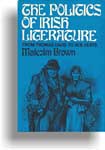
cover thumbnail of Malcolm J. Broiwn's "The Politics of Irish Literature"

"Mr. Brown's masterpiece..."
-- Michael Foote in the London Evening Standard

The Poltics of Irish Literature
by Malcolm Brown

* READ the complete book free on astonisher.com


The Politics of Irish Literature
From Thomas Davis to W.B. Yeats

by Malcolm Brown

Chapter Thirteen
'The Year for Action'

THE POLICE RAIDS on the Irish People failed to catch James Stephens. The most-wanted Fenian bird had flown past those nets. It was generally supposed that he would appear next morning at the head of his men on barricades in College Green, and A. M. Sullivan informed his brother that they would certainly see the signal for a rising "ere twenty-four hours." The Dublin garrison was called out at three in the morning, while artillery and more infantry rushed in from the Cork and Fermoy garrisons. But there was no insurrection that morning nor in the morning that followed. Meanwhile Stephens could not be apprehended. Police searched trains and ships, questioned travelers, investigated every oddity of garment or facial ornament that suggested a disguise. All their leads led nowhere, and they concluded that he must have escaped to America.

All the while Stephens was not exactly under the nose of the police, as the saying is, but was approximately so, being only an easy stroll from Dublin Castle. He was living quietly in Fairfield House, Sandymount, without false whiskers or nun's habit, but simply as himself, though he went under the name of "Mr. Herbert," a keen horticultural enthusiast who was sometimes seen by the neighbors puttering about his greenhouse. On the day after the raids he sent off a letter to O'Mahony in New York reporting correctly that "the enemy is in a rage, and striking like a madman. Like a madman, for, as far as I can yet see, he is much in the dark."' He had outsmarted the police, but his exploit had not solved any of his own crushing problems.

Stephens' followers groped in the same dark as his enemy. His membership was awaiting some sort of instructions. The letter to New York reported "They sent a party in search of me, in order to know what should be done." All he could tell them was just to go home. He had often called Smith O'Brien a clumsy amateur; now in his own first crisis he found professionalism harder than he had supposed. His army had been reduced back to polyps by the sudden disappearance of the solitary center of intelligence and command. Sullivan might think that insurrection was inevitable, but Stephens knew it was impossible. "Had we been prepared," he wrote O'Mahony, "last night would have marked an epoch in our history. But we were not prepared. . . ."

Stephens stayed in hiding in Sandymount for nearly two months. The proven elusiveness of the mysterious revolutionist caught the fancy of many Irishmen who had avoided all previous traffic with Fenianism. Weird rumors and alarms succeeded one another. Rumor said that Stephens scorned arrest because there was no jail in Ireland strong enough to hold him. Rumor said that O'Leary, Luby, Rossa, and the other prisoners had nothing to fear, for they would soon be wearing the ermine and the wig, while judge and prosecutor would be cringing in the dock. Then the police discovered the hiding place. They surrounded Fairfield House at dawn on November 11, 1865, and captured Stephens in his nightshirt, together with Kickham, Edward Duffy (the tubercular head center for Connaught), two thousand pounds in cash, and large siege stores of food and drink.

A few days after capture, Stephens was brought under heavy guard to the Castle Yard for arraignment before a magistrate. The streets were full of curious Dubliners trying to get a glimpse of the modern Eamonn an Chnuic inside the Sassenachs' prison van. The nobs and their ladies from the Viceregal Lodge had reserved seats in the courtroom for a close but safe view of their quarry. Stephens listened to the clerk read his incriminating Clonmel letter, and at the phrase that 1865 must be the year of action he commented loudly, to the surprise of his distinguished listeners, "So it may be." Asked if he would enter a plea, he declined because, he said, to do so would recognize British law in Ireland: "Now I deliberately and conscientiously repudiate the existence of that law in Ireland. I defy and despise any punishment it can inflict on me. I have spoken."2 This little speech was as close as Stephens would ever come to adding his chapter to the impressive genre of Irish jail literature. For his great state trial for treason, which was to scotch the rebellion and send its indispensable leader to prison, never came to pass.

II

Richmond jail was strong enough to hold Stephens exactly two weeks. Among the sworn Fenians in Dublin was a jailer named Daniel Byrne, whose duty it was to patrol the Richmond corridors after midnight. He had a friend, John Breslin, working in the prison hospital as a pharmacist, who was allowed free access to all parts of the jail in order to report on the illness of prisoners and to deliver medicine to the cells. His dispensary duties brought him to Stephens' cell for consultation unusually often. Their subject was not the prisoner's health, but the architecture of the building. Between Stephens and his freedom stood the locked door of his cell, at the end of the main corridor a locked door giving on the stairs that led outside, an inner prison wall, and a very high outside wall. There were also the regular patrols of the night, and as an extra precaution the warden had put a jailbird in the cell between Stephens and Kickham and provided him with a gong that he was commanded to ring if he heard anything peculiar happening next door. All these difficulties seemed surmountable. The problem of the locked doors was to be solved by making a beeswax imprint of the master keys, from which a Fenian locksmith could file passkeys. The inner wall was to be scaled by a ladder that Byrne would leave negligently nearby. The outer wall required friends on the outside with a rope ladder, one end to be anchored outside, the other end to be tossed on signal over the wall to Stephens.

Table of Contents
The Politics of Irish Literature by Malcolm Brown

Astonisher.com is pleased to offer The Politics of Irish Literature by Malcolm Brown, complete and free for your personal use.

The Politics of
Irish Literature

From Thomas Davis to W.B. Yeats
by Malcolm Brown
Part I: The Peculiar Irish Setting
1. History and Poetry: Some Irish Paradoxes
2. Thomas Davis' Ireland
Part II: Young Ireland
3. O'Connell and Davis in Partnership
4. The Nation's First Year
5. The Retreat from Clontarf
6. Black '47
7. '48 and Insurrection
8. Beside the Sickbed: Carlyle, Duffy, Dr. Cullen
9. John Mitchel after '48
Part III: Fenianism
10. Mr. Shook
11. Fenianism Mobilizes
12. O'Leary and the Irish People
13. "The Year for Action"
14. The Agony of Fenianism
Part IV: Home Rule
15. The Ballot Box Once More: Isaac Butt
16. Parnell and Davitt
17. The Land War in Mayo
18. After Kilmainham: Bakhuninism in Phoenix Park
19. After Kilmainham: Davitt and Standish O'Grady Take Stock
20. The Irish Party in Maneuver
21. Enter: W. B. Yeats
22. Catastrophe
23. Poetry Defends the Gap: Yeats and Hyde
24. Literary Parnellism

Praise for
The Politics of Irish Literature
cover thumbnail for "The Politics of Irish Literature" by Malcolm Brown

"This brilliant study of the intersection of politics and literature in Ireland amounts to a dazzling portrait gallery. Reading it one feels about one the breath, warmth, and passions of the dead all come alive again."
-- Sean O'Faolain in the Manchester Guardian

"Mr. Brown's masterpiece has made me want to hire a nearby housetop and recite whol chunks to every passerby..."
-- Michael Foote in the London Evening Standard

"The author of the best book on George Moore now gives us what is in all likelihood the best book on the politics of modern Irish literature."
-- Virginia Quarterly Review

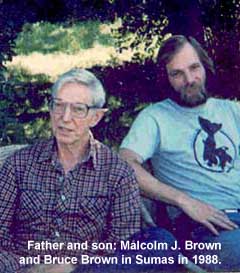
Professor Malcolm J. Brown walking in the garden with his grandaughter Laurel Brown, Seattle, WA, July 1986

University of Washington Professor Malcolm J. Brown (1910 - 1992) walking in the garden with his grandaughter Laurel Brown, Seattle, WA, July 1986.

Additional reading -- Malcolm Brown's George Moore: A Reconsideration, also here on astonisher.com.

Every dangerous Irish adventure in modern history intermingled a generous measure of audacity and poise with a residue of bungling. The Fenian who was assigned to bring the beeswax did not respond, and Breslin was forced to run the risk of exposure by buying it himself. Then the keys would not fit. Finally the keys were ready and the rendezvous time set for the dozen-odd outside men, led by John Devoy and Thomas Kelly, the American stand-in for Stephens. That night Byrne treated his fellow patrols to extra porter and, as he hoped, they fell asleep leaning back in their chairs in the corridor. At one in the morning Breslin and Byrne came with the keys and let Stephens out of his cell. The jailbird adjoining, hearing him leave, was too frightened to ring the gong. Then out the locked corridor door by the second pass key, down the steps and into the foreyard. The ladder was there, but when it was put against the inner wall it turned out to be four feet too short to reach the top. Stephens was hidden in an empty sentry box while Breslin and Byrne went back into the jail hospital and brought out two tables. These were placed one on the other with the ladder on top. Stephens climbed up and jumped over, alone now, into the outer court. He threw a bit of gravel over the outer wall; a piece of sod flew back over to him and a duck quacked for reply. His friends were there all right. Nearby they had met a policeman sheltering himself from the cold drizzle under a tree by the canal; but they had given him a friendly stiff drink from a flask of whisky and he had gone his way. They threw the rope ladder over the wall and soon Stephens' head appeared at the top. He looked down; it was eighteen feet to the ground. Nothing for it but to jump. The men below tried to break his fall and were knocked flat in the mud. But the deed was done and one of Devoy's men said to him, "John, we have tonight witnessed the greatest event in history."

At four in the morning Byrne "discovered" the ladder and tables and gave the alarm. As the news broke over the city at breakfast time, the Fenians were unable to disguise their pleasure. A. M. Sullivan remembered afterward that those who had taken the oath exposed their secret to the world by their frank and happy brilliance of eye. The anti-Fenians were also easy to spot. The ones with the hangdog look were the plainclothes detectives; the haggard faces belonged to the Castle officialdom.

The Castle was thrown into total confusion by Stephens' newest disappearance. The very foundation of the state, the bridewell itself, was honeycombed with secret treason. The officials sacked the jail warden, but since he was clearly not the guilty party, they pursued other suspects, especially Byrne. Finding a Fenian oath and pamphlets in his desk, they arrested him; but after two juries failed to convict him, they allowed him to leave the country. Breslin they did not suspect, and he quietly resigned and emigrated a year later, giving a full account of the exploit as soon as he was safely out of reach in America. For Stephens himself they once more looked everywhere. They mobilized the troops and raided houses where he was reported seen, searched the ships in the harbor, and posted placards offering two thousand pounds reward. Neither diligence nor remorse could bring back the twice-flown prisoner; and Stephens was never again to be apprehended, though he remained in Ireland for several months longer.

The more cynical segment of Dubliners argued that the government officials could not conceivably be as stupid as they appeared, and therefore the escape had been made with their connivance for some sinister purpose that would in time reveal itself. Stephens' defiance when arraigned in magistrate court was cited as clinching proof: no wonder he was so selfassured, when his escape was prearranged. Another segment of native Dublin responded to the escape with the most intense delight. All witnesses reported that in surprise, excitement, and popular identification with the object of a hue and cry, Stephens' jailbreak was one of the high emotional peaks of Irish history. The moment did have its solemn side; people reminded themselves that this meant civil war. But the imprisonment of a patriot outlaw was a serious matter, too, and for Stephens to have vanished not once but twice gave to the whole exploit an irresistible picaresque charm.

The Richmond jailbreak appears as such only the one time in Irish literature, in the Ulysses leitmotiv of "the man that got away James Stephens." Joyce's interest centered on the accretion of mystery mixed with imposture that grew about the legend itself. "The" man that got away James Stephens, if there must be but one, was John Breslin, long since absorbed into the New York Irish community and dead fifteen years before Joyce's time. But directly involved were a dozen or so other Fenians, the muster of the rescue squad outside Richmond wall. As time passed, this number apparently tended to enlarge, since there was enough secrecy about the affair to encourage bogus claimants to insinuate their way into painless heroism. "The" man thus floats about Joyce's Dublin as a sort of an impostor ghost, embodied first in "the citizen," as cognate with Ireland's champion shot-putter and green chauvinist, and finally alighting upon Mr. Bloom in one of his comic fantasies of mock-heroic grandeur. But Joyce found no place in his structure for any of the more common Dublin responses to the escape. Naturally, he had no sympathy with Dublin Castle. Neither could he see his way to allow the Irish populace - "cute as a fox," in Stephen Dedalus' words - its modest recompense of laughter at the Castle outwitted.

III

Stephens in hiding still held to his assertion that 1865 would be the year for action. His organization was intact, for the loss of the Irish People and its staff was not catastrophic. Moreover, the procurement of arms had finally begun. During the summer Colonel Ricard O. Burke, an American Fenian recently demobilized from the Army of the Potomac, had been sent to England to set up a secret purchasing agency for arms. A polyglot of great resourcefulness, he had assumed various poses and Latin-American aliases and got access to the small-arms factories in Birmingham; and he had already taken delivery on two thousand Enfield rifles, which had been shipped to Liverpool and cached there until needed. He had negotiated large additional contracts for arms to be delivered as soon as more funds arrived from America.

At this critical moment the Fenian movement in America split open and began to disintegrate. The American Fenian Senate had fallen under the control of one Colonel William Roberts, a wealthy dry goods merchant. He distrusted Stephens increasingly, and Stephens retorted in kind with recrimination against the senate's parsimony and amateur generalship far from the field of battle. Simultaneously, the relations between Colonel Roberts and O'Mahony also grew more acrimonious. The senate had assumed most of O'Mahony's functions at the Chicago convention in 1863, and at a convention held in Philadelphia in October 1865 most of his remaining powers were taken away, leaving him not much more than the title of president.

O'Mahony's friction with the senate was probably attributable to a hidden source in his own office .4 He had for a political confidant a voluble master of blarney named "Red Jim" MacDermott, a veteran of the Papal Brigade, which Irishmen organized to save Pio Nono from his democratic enemies. O'Leary and Stephens independently of each other had spotted MacDermott as a possible informer and an undeniable "blackguard." O'Mahony refused to listen to their warnings, and as it turned out, he really was an informer, though the fact was not proved until nearly twenty years later. "Red Jim" was probably the one referred to in Darcy M'Gee's Wexford speech as anxious to sell the membership lists to the Castle. He was a gifted agent provocateur; moreover, achieving rare heights of secret-police versatility, he was an accomplished disrupter, carrying malicious tales between O'Mahony and Roberts until their mutual hatred was beyond the cure of any peacemaker. In a bitter reminder of these services, Joyce in Ulysses placed him beside the great seventeenth-century Gaelic chieftain, Hugh O'Donnell. In the catalogue of Irish heroes and mock heroes, "Red Hugh" and "Red Jim" paired off as the Siamese twins of Joycean history.

The immediate occasion of the American split was rather petty. O'Mahony, as president of the Fenian Brotherhood, had signed some Fenian warbonds that were supposed to have been signed by somebody else. Hearing of this breach, the senate met in emergency session and fired him from the presidency on December 2, 1865, one week after Stephens' escape from Richmond jail. O'Mahony thereupon pronounced himself the true head of American Fenianism and appealed to Dublin for support. Stephens felt called upon to bring out the heavy artillery of his authority to blast the American dissidents. He wrote O'Mahony a letter that was broadcast through the Irish-American community, characterizing the senators-that is, the holders of his American purse strings-as knaves, cowards, and traitors: "To break with treason and baseness of all kinds, to brand it, smash it-was the policy, and I rejoice at your having made it yours. The manhood of Ireland rejoices at it with me. . . . Cut and hack the rotten branches around you without pity."

The American split naturally brought the flow of dollars into the Irish revolution to a dead halt. The moment chosen by Roberts for his break with O'Mahony could not have fallen at a more sensitive time, since it disrupted the purchase of arms in Birmingham just as Colonel Burke had made a successful opening. Without cash, that door was shut. In the last weeks of December 1865, the year of action, Stephens' Irish centers were still without arms, and without any prospect of arms.

IV

Stephens now showed symptoms of advanced demoralization as his great strength of will began to falter. His short imprisonment had disturbed him, too. Like O'Connell, another illustrious inmate of Richmond jail, he was not quite as self-assured when he came out as when he went in. In the last days of 1865, driven by the logic of the situation to make some kind of explanation to his members, he called in all the head centers one or two at a time and put a peculiar, ambiguous question to them: Could they restrain their members from precipitate action for four weeks or so? Thus he broke the news of his inability to keep his long-promised date, but at the same time kept their enthusiasm up and drew the sting from his confession of failure. But so stated, the postponement bore a date of expiration, and he was soon back in the same embarrassment again.

The four weeks had passed without any new signs of action. John Devoy, who was in command of all the centers in the garrison regiments, reported to Stephens that a couple of the army units were threatening to start something on their own if he did not give the word. Just then, the British army command caught its first astonished glimpse into the spread of Fenian recruitment among the troops. On February 17, 1866, Lord John Russell, newly returned as prime minister, suspended habeas corpus, rushing the bill through both houses during a single sitting and securing the royal assent the same evening in order to take maximum advantage of surprise. The next morning the police began mass arrests of all outspoken nationalists, together with a swarm of English, Scots, and American Fenians who had gathered in Ireland in large numbers, disguised not very deceptively as tourists. Unless Stephens acted quickly, he would in a very short time have left no organization with which to act.

With his key men disappearing hourly as police caught them on the streets and in their lodging houses, Stephens summoned an unofficial war council of eight advisers, a concession to organizational democracy unprecedented for him. It met on February 2o and 21, 1866, across from the Kildare Street Club in a house belonging to a Mrs. Butler, a society seamstress, subsequently to be ruined when the word of the meeting leaked out and her aristocratic clientele cut her cold. Present at the meeting were Stephens; Thomas Kelly, the American; a second American officer; and the head centers for Athlone, Cork, Limerick, and Ulster; besides John Devoy, whom Patrick Pearse called "the greatest of the Fenians," a twenty-threeyear-old military veteran from the French Foreign Legion .

The question debated in Mrs. Butler's dressmaking shop was strictly practical: Were there any avenues open that offered a chance of success for a military assault? The men present understood perfectly that the success of any bold stroke could never by the nature of things be guaranteed. They understood, too, that to do nothing might be equally dangerous. The discussion therefore confined itself to weighing the reasonable probability against the stubborn fact. Nobody delivered any speeches, said Devoy.

An inventory showed that in all Ireland the Fenians could field only eighteen hundred rifles, most of them in Dublin. But thirty thousand rifles were stored in each of the four provincial army arsenals, and Devoy thought them possibly accessible to Fenian raiders striking by surprise with available forces. The Dublin arsenal at Pigeon House was particularly tempting. This information excited everybody except Stephens. His determination not to fight, though silent, was apparent as the evening wore on, deadening the council until the meeting broke off from fatigue, to meet again after a few hours' sleep.

When the war council reconvened, the atmosphere was more skeptical: how could sixteen hundred Fenians seize a Dublin defended by six thousand regular soldiers? Devoy offered a different arithmetic. The Dublin garrison contained sixteen hundred sworn Fenians, besides another two thousand sympathetic Irishmen. If all these went over to the attack, the score would be fifty-two hundred attackers against twenty-four hundred defenders. Devoy proposed opening the insurrection in the southwest part of the city at Richmond barracks, where two-thirds of the garrison were sworn Fenians and success seemed certain. With the men and rifles picked up at Richmond they could then move toward the heart of the city, gathering momentum as they overwhelmed the barracks along the way, first Island Bridge, then Portobello, then Beggars Bush, until they had sufficient men and rifles to attack the Pigeon House arsenal and the Castle. Kelly and the second American officer were dubious: what if the Fenians in the Dublin garrison would not come over? Devoy was the only man present who knew what they could be expected to do, but the Americans could not be convinced. They thought there should be simultaneous attacks at Richmond and Pigeon House. If they could get the two thousand rifles that Colonel Burke had stored in Liverpool, it would be possible. But that would take several days, and every hour was precious. On that conditional note the meeting trailed off without taking any vote. The result, said Devoy, was that "the last chance for a Rising in that year was thrown away." The most terrible military weapon, the mutiny of Irish troops in the British army, which even Smith O'Brien believed a virtual certainty in 1848, was never to be put to a test in Irish history.

The following day Devoy was arrested. By the end of the week, three thousand Fenians were locked up in jail. Stephens fled the country. It was rumored that he drove secretly through the heart of Dublin disguised as a grand man, lording it in his coach-and-four with liveried grooms before and behind, and that at dusk, when the coach stopped beside the sea beyond Malahide, he was rowed out to a charcoal boat riding at anchor awaiting him. This was A. M. Sullivan's version, romantic enough, said O'Leary, for a police spy's weekly report. Actually, he walked down the landing steps of the Dublin quays into a dory at nine in the evening.

V

Two weeks later Stephens turned up in Paris, en route by leisurely stages to New York to heal the American split. He sent a letter ahead to O'Mahony outlining his intention toward the schismatics : "All these scandals are nearly at an end and only await my appearance, yonder, to die outright, and be forever forgotten. Tell all those dear to us that I go to the States to do such work as shall quicken their frames with joy. I know no such thing as doubt and difficulties must go down before me. . . . I pledge my word that every Irishman who stands in our way shall go down." Father William D'Arcy, the scholar who discovered this document, observes that Stephens was "never one to underestimate his powers." But the Americans were more intractable than expected and wholly absorbed in imaginative projects of their own devising.

For, after the American split, the senate faction had come to the conclusion that it ought to open the battle of Dublin by an attack against Canada, anticipating the Joycean theory that the shortest way to Tara is via Holyhead. Their thought was that if they could seize control of any Canadian seaboard territory, they could use it as a base to fit out Fenian privateers and make holiday hunting down English commerce on the high seas. British Columbia first suggested itself. Then Quebec seemed more convenient. Later they decided to conquer Canada as a whole with a pincers movement from Detroit on the west and Vermont on the east. They received either encouragement or indifferent assent from Secretary Seward's office, for when they began to accumulate rifles and cannon for their highly advertised project, they met with no legal obstacles.

O'Mahony was forgotten in the excitement of preparations for the Canadian war. Then one of his lieutenants designed a new kind of a Canadian venture. In the hope of winning back his accustomed place at the center of Irish-American affairs, O'Mahony, too, rushed into the Canadian game. The possession of Campobello Island-a few hundred yards offshore from Eastport and Lubec, Maine-was in dispute between the United States and England. Therefore O'Mahony assumed it to be a free fish belonging to nobody and available to the Fenians for a homeland and naval base if they cared to occupy it. The prime advantage of the scheme was its speed. The grand strategy of the senate would need all summer to conquer Canada, but the seizure of Campobello could be accomplished next week. The O'Mahony Fenians owned a war-surplus steamship, the Ocean Spray. They loaded it with guns and sent it forth by sea toward Passamaquoddy Bay, while troops dressed as civilians converged by railroad on Eastport and Lubec. Kept in touch with the project through reports from "Red Jim" MacDermott, the British embassy protested to Washington against this overt act of war. If Secretary Seward ever had looked favorably on the adventure, he did so no longer. General George Meade of Gettysburg fame was ordered to Eastport to break up the Fenian assault, an assignment accomplished in a few hours by seizing the Ocean Spray and arresting the leaders. The troops then straggled back toward New York, where they found the senate Fenians en fete over their ignominy in the great "Eastport fizzle."

It seems not to have occurred to the senate faction that if Secretary Seward had blocked the Canadian adventure of the O'Mahony Fenians, he would do the same for them. On May 31, 1866, six weeks after the collapse at Campobello, with one army poised at Ogdensburg, New York, a second army opened the invasion by striking across the Niagara River from North Buffalo to Fort Erie, Ontario. Two days later, at a place called Limestone Ridge, the invaders clashed with the enemy, a volunteer company of Toronto college boys called "The Queen's Own." After a three-hour battle in which six Fenians and twelve Canadians were killed, The Queen's Own fled, leaving the Fenians in possession of the field of battle. At that moment an American naval gunboat arrived and anchored in the middle of the Niagara River, blocking any further passage of supplies and reinforcements into Canada and forcing the invaders to retreat back to the American shore. At the same time General Meade reached Ogdensburg and once again busied himself with the arrest of leaders and seizure of supplies. By June 3, 1866, the foremost military problem of the hour had become the question of who would pay the railroad fares home for seven thousand stranded Fenian soldiers.

VI

Stephens landed in New York just after the first and just before the second of these miserable adventures. His initial act was to listen to O'Mahony's mea culpa for squandering the organization's treasury at Campobello, to receive his resignation from office, and to succeed him as president. He called a great mass rally at Jones Wood, where he pledged "war in Ireland and nowhere else" and promised that "as surely as I address you today, we shall take the field in Ireland this very year." He set out on a speaking tour, reiterating his theme at every lecture stop: "We fight for freedom on Irish soil this very year."" He found himself a general, Gustave Paul Cluseret, a French socialist who had fought with Garibaldi, Fremont, and McClellan, and who would later command the army of the Paris Commune. When Stephens described the Irish as a whole race of men organized by himself into squads, platoons, companies, regiments, and battalions, Cluseret had never before heard of the like. He was attracted by the military potential of such a people. But they had no arms to fight with, Stephens hastened to explain, though this lack would shortly be remedied by aid from America. He guaranteed to supply the arms needed. On that understanding, Cluseret offered to serve as military commander of a striking force of ten thousand men, thought to be sufficient to conquer the country from the British defensive force estimated to be three times greater.

Once more, Stephens was incapable of the performance he had promised. The senate faction was now addicted to schism beyond hope of reformation. Their summer picnics in 1866 featured sham battle re-enactments of the victory at Limestone Ridge, half the picnickers dressing up to represent the hapless Queen's Own. When they held their convention at Troy in September 1866, they showed no interest in unity with Stephens or in Irish insurrection, but spoke of Mexico as the stage for their next patriotic military exploit. Impotence and wounded vanity dissolved all their prime energies into flatulence. "We swear, we swear it to you by the bitter memory of Ireland's woes," said their official organ, "by the gibbets heavy with the martyred bodies of her patriots, by the blood of the braves who fell at Limestone Ridge, by the hopes of her kinsmen waiting, in felon cells, for the roar of the strife that will set them free,-that once again, if you but do your duty to your native land, we will follow the gleam of our unconquered standard to vengeance, victory and liberty."

Stephens' peacemaking consisted in heaping insult upon the senate faction at every opportunity, hoping to separate Roberts from his rank and file. This tactic appears to have had effect, producing backsliders in some quantity. They did not join with Stephens, though; they simply fell away. During the senate's Troy convention, Stephens came to the realization that the unity of the two wings was not to be expected and that, as a result, no more American money would be forthcoming to buy arms. In September 1866 he wrote a friend in Ireland: "It is a question of money with me as well as you. For want of money I have been unable to take the necessary action. For the last month, especially, I could, with the necessary means, have done work to cheer and astound you. But my action has been hampered so that I have been barely able to keep the office open. . . . Sometime this year I shall be again on Irish soil. You can easily understand my reason for not saying what time, but you shall know it ere long."

These were overly familiar turns of phrase, and Stephens' lieutenants became restless and suspicious. General Cluseret described the rising tension: "Stephens, who as it would seem, by no means deceived himself about his material resources, began to blow cold, as he had hitherto blown hot. . . . the moment they [his followers] imagined they saw symptoms of coldness in him . . . they became indignant and enraged." On December 15, 1866, he called his staff together to announce his decision to postpone action, and in his words: ". . . I found that matters were even worse than my apprehensions-we had nothing like what I promised and expected, and the little we had we could not forward." He then proposed to immolate himself in expiation for his failure, "to go to Ireland by the next boat, even though I should be taken and hanged." His staff protested against this proposal, urging that if he were lost, all were lost. Two days later, though, the staff met again and curtly stripped him of his command, putting Kelly in his place. "Colonel Kelly and his backers got up the cry that I had abandoned the cause in despair," said Stephens, "or through cowardice shrunk from the struggle, frightened by the powers I had created." Kelly's public statement was essentially the same, that "Stephens was literally a coward, that he shrank from directing the elements he evoked."

One of Kelly's backers, an impetuous Confederate veteran of Morgan's Raiders named Captain John MacCafferty, put a pistol to Stephens' head and offered to dispose of him then and there. He was restrained, and Stephens was even kept on in charge of nonmilitary Fenian affairs. When the new directory, with Kelly in command, sailed from New York for Ireland on January 12, 1867, Stephens was appointed to go along. But he missed the sailing; and the procrastinator, formerly "the Captain," standing friendless on a Brooklyn pier, closed his accounts with the Irish revolution which he had done more than any other man to make.

Next chapter...

"The Politics of Irish Literature" © Copyright 1973 Malcolm Brown


New CD-ROM LIBRARY EDITION
cover thumbnail of The History of the Corporation by Bruce Brown

"Great book. Fascinating..."
-- Jack Weatherford,
author of
The History of Money

The History of the Corporation
by Bruce Brown

* READ free excerpts on astonisher.com
* BUY the complete book at the astonisher.com store

"An environtmental classic..."
Moutnain in the Clouds by Bruce Brown: 25th Anniversary

Mountain in the Clouds
by Bruce Brown

* READ free excerpts on astonisher.com
* BUY the complete book at the astonisher.com store


© Copyright 1973 - 2010 by Bruce Brown
and BF Communications Inc.

Astonisher and Astonisher.com
are trademarks of BF Communications Inc.

BF Communications Inc.
P.O. Box 393
Sumas, WA 98295 USA
(360) 927-3234

Website by Running Dog

Astonisher.com Most Read

1. The History of the Corporation
2. Heart-stopping Sturgeon
3. Who Killed Custer?
4. White Cow Bull at the Little Bighorn, #1
5. Windows 7 / XP Wireless Network Bible
6. Conversations With Crazy Horse
7. Dr. Whacko's Guide To Slow-pitch Softball
8. Bogus Crazy Horse Photos
9. GoLive / Dreamweaver Migration Bible
10.
Crazy Horse In Action

Obama has jobs for young Americans!

Windows 7 / Windows XP Wireless Home Network Bible by Bruce Brown

100 Voices from the Little Bighorn: eye-witness accounts of the Battle of the Little Bighorn

"What happens when an Apple goes to bed with a Dell?" by Bruce Brown

Sarah Palin: The kind of change America wants!

"Who Killed Custer -- The Eye-Witness Answer" by Bruce Brown

"Vernon Louis Parrington" by Bruce Brown

Content on this page requires a newer version of Adobe Flash Player.

Get Adobe Flash player

Dr. Whacko's Guide to Slow-Pitch Softball by Bruce Brown

"Opal Whiteley" by Bruce Brown

"The Digital Rip Van Winkle Returns" by Bruce Brown

America Today by Running Dog

Astonisher.com Forums on LikiWiki.com