Chapter Three
O'Connell and Davis in Partnership
A MOMENTOUS episode in Irish literature was a public quarrel that took place in 1845 between Thomas Davis, a poet, and Daniel O'Connell, the political leader of Ireland. The tacit partnership of these two, which preceded their quarrel, was still more momentous. When the two great nationalists were working in amity, they generated a force so explosive that they frightened everybody, themselves not least.
The O'Connells were ancient Catholic landowners who had by an oversight escaped dispossession under the English plantations and the Penal Laws. Their vast lands at Darrynane were infertile but picturesque, bounded by the Atlantic cliffs of Kerry that mark the extreme western limits of Europe. Daniel was the son of a mere shopkeeper, a fact from which his aristocratic enemies derived some satisfaction. But thanks to boundless energy and a precocious wit, he was singled out for favorite by a wealthy uncle called "Old Hunting Cap," the captain of the clan, a landowner and smuggler. He inherited his uncle's great property, and along with it, a certain complacency toward the Providence by which worldly favors are bestowed. In later years a foreign journalist who was invited to stay for dinner at Darrynane sat down at table with more than one hundred cousins, menials, and guests, with the old man presiding loquaciously at the head like a Scots Highland chief (but less bibulous, says Lecky). Another journalist visitor, a spy from the Times, found the Darrynane medieval tenantry living in up-to-date squalor.
O'Connell was among the first Catholics to be called to the Irish bar after the second relaxation of the Penal Laws in 1793. While still a youth, he established himself as the most brilliant Irish advocate of the age, displaying an expert command of law and a skill in swaying juries that Irishmen came to think supernatural. Where the Englishman's law was the hereditary enemy and the crown prosecutor a stock villain, his sensational acquittals for the defendant made him automatically a folk hero. The next step from law into politics was natural. Ireland demanded a fighter, and now his pugnacity came to the fore. The O'Connell political headquarters was kept busy negotiating affairs of honor with numerous dignitaries whom he had insulted, among them Benjamin Disraeli and Sir Robert Peel; and one of his challengers, a Protestant alderman named D'Esterre, was killed by O'Connell's bullet. His detractors have made much of the scurrility of his tongue, and Yeats once blamed it for all the sorrows of Ireland. Without doubt he was guilty of verbal intemperance, but his angriest and most vituperative words could not match the vilification to which his enemies subjected him every day of his life for half a century.
One of his political talents was a humorous, palavering manner, a habit for which his somber contemporaries used the term "undue levity." The Irish word game was his special pleasure. He invented the nickname "Orange Peel" to deflate the redoubtable Sir Robert. It was his opinion that the lord chancellor, Sir Edward Sugden, bore a name that one must hesitate "to give to a pig." Here again Yeats blushed at the vulgarity, quite unnecessarily. Behind the plain, stark tragedy of insurgence there lurks a more intimate comic face, arising from enthusiastic social motion uninhibited by guidelines. In a later time Frank O'Connor and Peadar O'Donnell would catch the comic energy of a political resurgence, though the richest formulation belongs to O'Casey's reminiscences and constitutes his particular glory. O'Connell's subversive horseplay did set him apart from Irishmen who wore the long face, from Davis, Smith O'Brien, Parnell, Devoy, Arthur Griffith, de Valera, and, surprisingly, from James Joyce, whose depiction of this special flavor in Irish history is uniformly sour and unimaginative. But it put him in the happy company of Swift, Wolfe Tone, "Big Jim" Larkin, Michael Collins, and the rest of the Irish pantheon who were not born humorless, including W. B. Yeats himself.
The stenographic reports of O'Connell's Irish speeches often had to use the parenthesis "prolonged laughter." More often the notation was "hear, hear." As an orator he was demonstrably one of the most effective in world history. His voice was said to have had an extraordinarily arresting quality, pleasing to the ear and capable of both sweet nuance and a rasping, bellowing roar which could penetrate to the fringes of an assembly of a million people. His oratorical rhetoric was not florid, but was blunt, lucid, sarcastic, and devoid of genteel ornament. "Mr. O'Connell advanced to the front of the platform and thanked his listeners for their applause" -- this was the newspapers' ritual introduction to the verbatim reports of his speeches. He then proceeded in careless ease, circling discursively about the topic of the day, rather like an ordinary citizen thinking out loud:
- The enemies of Repeal talked about agitation, forsooth, preventing the influx of English capital. A more absurd idea never entered the mind of man (hear, hear). But he denied that any rational dispassionate man could entertain it for a moment. It was a mere miserable pretence, the fallacy of which must be evident even to those who use it. He asserted distinctly that not one shilling of English capital was kept out of this country by agitation. If English capital was to be kept out of countries where agitation existed, how did it come that it had found its way in such enormous quantities to the States of South America, where not only agitation but actual revolution might be said to be the order of the day (hear, hear)? It was well known that in Buenos Ayres alone, where bloodshed and confusion prevailed to a frightful extent, English capital was invested to the amount of several millions (hear, hear). It was all a mockery therefore to pretend that English capitalists would not come over here, because the Irish people peaceably and constitutionally agitated to have their wrongs redressed. Why did they not come when we were tranquil and noiseless (hear, hear)?
This style does not sound very intoxicating, yet multitudes of listeners found it so. Often it touched the Irish throng with warmth and immediacy, voicing their deepest and most passionate longings. O'Connell spoke to Irishmen, said Sean O'Faolain, in "the secret language of fellowship in 'helotry." After a century and a half of stupefaction, his countrymen roused to life to cheer their vindicator, the pure Celt who defied the Protestant Ascendancy in its inner sanctum, disdaining its rage against his "ruffian," "blackguard" impudence. The intimacy and authority of his rapport with the Irish people became the ideal of all subsequent Irish leaders-political or cultural-though none ever recaptured the old Liberator's magic touch.
|
|
Table of Contents
|
|
Astonisher.com is pleased to offer The Politics of Irish Literature by Malcolm Brown, complete and free for your personal use.
Praise for
The Politics of Irish Literature |
 |
|
"This brilliant study of the intersection of politics and literature in Ireland amounts to a dazzling portrait gallery. Reading it one feels about one the breath, warmth, and passions of the dead all come alive again."
-- Sean O'Faolain in the Manchester Guardian
"Mr. Brown's masterpiece has made me want to hire a nearby housetop and recite whol chunks to every passerby..."
-- Michael Foote in the London Evening Standard
"The author of the best book on George Moore now gives us what is in all likelihood the best book on the politics of modern Irish literature."
-- Virginia Quarterly Review
|
|
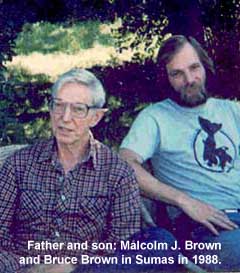
University of Washington Professor Malcolm J. Brown (1910 - 1992) walking in the garden with his grandaughter Laurel Brown, Seattle, WA, July 1986.
|
Additional reading -- Malcolm Brown's George Moore: A Reconsideration, also here on astonisher.com.
|
|
|
O'Connell's purposes required more than air passing through the larynx. He also had a rare talent for organization. Tirelessly experimental, he formed and dissolved an intricate procession of clubs, committees, councils, and associations, ranging up and down the scale of the Irish social classes in order to seek out dormant attitudes at each level. The list seemed almost endless, but one of his ideas, conceived during the Emancipation campaign, turned out to have special value. This was the "Catholic rent," a tiny weekly sum collected from all the people responsive to his appeal. Out of an insignificant farthing a week rose not only a war chest, but also a formidable machinery for bringing about contact between membership and leadership and generating a feeling of participation mystique among all the countless sprawling atoms.
O'Connell found the perfect organizational cadre for his agitations already at hand in the Catholic clergy. "It is a blessed consolation," he said, "patriotism and religion run in the same channel." The rent was ordinarily collected at the church door after Mass, often by the parish priest, though if the treasury was quite full, paid officials took charge. What an organization it was: a full-time agitator and dues collector, armed with supernatural authority, promoting a popular cause, working in intimate contact with the people in every townland of Ireland. O'Connell freely granted that the Church had organized his victories by legwork at the parish level: "the Catholic clergy . . . here is the secret of my success." It was not an organization to be taken lightly. His first rent scheme had forced Emancipation upon the Duke of Wellington, that dreadful Irish peer whose Dublin birth O'Connell said was like "a tiger cub dropped in a fold." In the pride of his power for political organization, he had the pleasure of calling Wellington a "screaming coward" and a "stunted sergeant"; and he was one of the few mortals ever to feel the Iron Duke bend under his pressure. A peaceable agitation had done such damage to a haughty opposition. What then might be its potential?
These were the glories of O'Connell's organizations. But there were problems, too. His success aroused an equally close-marshaled Orange opposition, for the Belfast Calvinists were themselves not amateurs in the political craft. More serious, an organization built upon the clergy was necessarily bound in by the political outlook of the Church. Most of the priests were happy to go along with the excitement day by day, yet disapproved the logic latent in the forces O'Connell stirred into motion. And his own outlook was not different from theirs. The clergy, he said, "entered unreservedly into my views"; and it could have been added, he also into theirs, from necessity as well as free choice.
Of all the things he hated, he hated revolution the most. He had all the normal reflexes of any landlord. He remembered with detestation the revolutionary French peasantry, ces feroces soldats, marching against landed property and the Church, a scene he witnessed as a seminarian at Douay in 1793. He had fled back across the Channel from France on the same day that Louis XVI was guillotined.* Though he owed his law career to Wolfe Tone, he hated the man's work and his memory nonetheless. He had joined the loyal Dublin militia in the Emmet disturbances of 1803 in fear of a peasant rising, observing that if the "miscreants" won, "they would rob and they would murder." He praised the Protestant yeoman terror in 1798, but he read its warning to Catholics clearly, too. There was also the merest touch of the toady in his make-up. The word "Loyal" was not prefixed to the title of his Repeal Association for comic effect. It was long remembered with embarrassment that he had presented Caesar's crown of laurel to George IV, that besotted monarch who disgusted everybody, and Irishmen most of all. At Victoria's coronation, his excessive gestures of deference, his smirkings and bowings, made him the second most conspicuous person present, much like Yeats performing his singular crab dance in the Swedish court as recounted in "The Bounty of Sweden."
O'Connell's political object was to arouse the Irish peasantry just so much and no more-a touchy proceeding, for once set in motion they might stampede. Against the contingency of a runaway he took three precautions beyond his dalliance with the clergy. First, he kept all phases of his agitations under his personal surveillance, delegating no responsibility, not even the most trivial. Second, he took pains to isolate his followers from radical movements abroad, above all from French republicans and English Chartists. His ideological quarantine was a prime specimen of Irish particularism, which asserted that Irishmen possessed a unique spirituality likely to be contaminated by any foreign influence other than, of course, the Roman. O'Connell's third precaution against Irish militance was to limit all political action to "moral force," or as it is now called, "nonviolence," his foremost lasting contribution to the political arts. As long as his followers stopped short of fisticuffs, he let them run on as boisterous as you please; but upon the text "Shed thou no blood" he stood as immovable as Portia: "Not for all the universe contains would I, in the struggle for what I conceive my country's cause, consent to the effusion of a single drop of blood, except my own."
In taking all these precautions to hold his followers in check, O'Connell faced the danger that they might not budge at all. His political program was often less than exciting, and there were anticlimaxes from past exploits to live down, too. His great Emancipation victory had brought neither instantaneous nor delayed miracles. In exchange for the right of Catholics to sit in Parliament, the forty-shilling franchise was now withdrawn. The new property qualifications, to which O'Connell assented, had disenfranchised the very men who carried Emancipation for him in Clare; and the poor Irish, who had hitherto been forced to vote for somebody they did not want, were now unable to vote at all and hence were politically as impotent after Emancipation as before.
After 1829, while nouveau riche Catholic merchants and gentry went to sit at Westminster, the Irish peasants found their life still unchanged. Ribbon disturbances flared again in Munster, and pauperism spread in the towns. Having made Melbourne the prime minister, O'Connell's lieutenants were able to bask in the Whig sunshine. Stephen Woulfe became first baron of the exchequer and Richard Lalor Sheil the master of the mint. But still the peasants waited; "the lash went on." And so when O'Connell at the age of sixty-five announced his plan for a new association to agitate for the Repeal of the Union, he was answered by an embarrassing silence. For many months he struggled to bring in members, but only a random person here and there responded.
II
O'Connell's most notable early recruit was Thomas Davis, a Protestant barrister, then only twenty-six years old and fated to die young five years later. He was the precise antithesis of the loud and hearty O'Connell. Shyness and introversion gave him a false air of arrogance. In a public setting he was not noticed, and fellow students at Trinity College could not place him in later years. Abstinent and too frail for rigorous exercise, he was cut off from all convivial pastimes. But in his library or among friends he was transformed into a man of compelling social force, "the greatest and best of his generation," capable of massive intellectual labor. He resembled young William Ewart Gladstone or Arthur Henry Hallam in his evangelical lust for work, as well as in a solemnity uncommon in one so youthful. He belonged to a familiar nineteenth-century type, a generous and talented young man of the middle class, armed with a strong sense of rectitude and purpose and driven by a conviction, not unfounded, of limitless personal capability.
Davis left Trinity College a materialist, a utilitarian, a believer in progress through universal education -- that is to say, a Benthamite. To the end of his life he remained one, with one important adjustment. Like John Stuart Mill, he found a lack of emotional sustenance in the doctrinaire Benthamite diet and fell into an adolescent mental crisis. Like Mill, he made the same saving discovery of poetry. His awakening came not through Wordsworth, however, but through another romantic call with a different message, Irish nationalism. Soon after college, probably on a trip to the Continent he is known to have made, he read the post-Napoleonic French historians. Jules Michelet could hardly have been overlooked by any intellectual of the times, and Davis read and emulated him as a matter of course. Those stiff saffron-robed pre-Conquest Gaels with their charming barbarisms ofgeasa and fosterage, stock figures in the future Irish literary movement, came ultimately through Davis out of Michelet's medieval pageantry. Passing beyond Michelet, Davis found his true guiding star in another distinguished French historian of the time, Augustin Thierry, whom he repeatedly exalted above "any other historian that ever lived." In Thierry the full splendor of Irish nationalism was revealed to him, not by analogy with France as in Michelet, but in its explicit Irish setting.
Thanks to the ancient national enmity of France toward England, Frenchmen had always watched Ireland from afar as a potential ally and they traditionally commiserated with the Irish people. In the course of writing a history of the Normans, Thierry became involved in a study of the English conquest of Ireland. His Gallic sympathy for the Irish against the Saxons, their "conquerors and oppressors," grew into an impassioned partisanship.
He came to the conclusion that the Irishman's "unconquerable obstinacy never to despair" in seeking to repossess his nationality "was perhaps the greatest example that a people had ever given," more glorious than even that of the Jews under the captivity. The supreme statement of Irish history, past, present, and future, Thierry found to reside in -- of all places -- Irish songs "inspires par la muse de l'independance. Ces chants retentissent encore dans les villages et sur les bords des lacs, accompannes du son de la harpe, instrument revere comme eux. C'est la que sont enregistres les malheurs de l'Irlande et les crimes de ses oppresseurs" (". . . inspired by the muse of independence. These songs resound still in the villages and on the shores of the lakes, accompanied by the sound of the harp, instrument revered like them. There are recorded the sorrows of Ireland and the crimes of its oppressors").
Thierry especially admired the songs of Tom Moore, several of which he translated into French, and he believed that "Forget Not the Field Where They Perished" was the quintessential utterance of the Irish soul. Davis himself knew well enough that Thierry's harps twanging on the shores of Irish lakes were a hallucination out of Alphonse de Lamartine. What Thierry believed already accomplished was in fact not even begun. But Davis resolved that it would be, immediately, and would correspond exactly to Thierry's specifications.
Instead of damping down Davis' Benthamite predilections in the normal romantic manner, Thierry set them afire. He decided that great utilitarian victories could be won if rational principles could be coupled to the force of passionate drives. Patrick Pearse, looking back on Davis' accomplishment three-quarters of a century afterward, saw it as a new definition of Irish patriotism: "nationality is a spirituality." Davis would have certainly assented, but only if the definition could include the full list of the good things of life -- "science, industry, skill," plus "all the studies and accomplishments of peace and war."
III
Returned to Dublin from his year abroad, Davis published in a Dublin newspaper in 1841 an important essay called "Udalism and Feudalism," an optimistic survey of Ireland's economic potential. Anticipating Carlyle's Past and Present, which appeared two years later, the essay began with an attack on the "scientific" English analysis of the Irish peasant economy. His awkward word "udalism" took for its ideal an agrarian society like "cold and rocky" but prosperous Norway. He envisioned Norway as a happy land, dominated by a thoughtful and busy middle class-somewhat more poetical, perhaps, than the actual burghers of Christiania-and resting upon a sturdy landowning peasantry; he had evidently read his Cobbett well. His thought thus ran into direct collision with laissez faire dogmatists, whom he correctly suspected of harboring intolerable schemes for the country's future. Was it not irrefutable that Irish lands must be cleared by eviction, amalgamation of tenancies, and emigration in order to relieve Irish "overpopulation"? But proper logic, as Davis argued, did not terminate at the quod erat demonstrandum that the Malthusian solution to the Irish agrarian problem must proceed forthwith, but rather started from the given that this solution was above all others unthinkable. Ireland had no redundant population, he said; and citing Switzerland and Denmark as evidence, he argued that Ireland could support twenty-five million, three times its 1840 population and seven times its population in the twentieth century.
O'Connell's agrarianism was a niggardly half-measure, stopping short with an apologetic plea to extend to Ulster tenant right. "Udalism and Feudalism" went well beyond O'Connell and advocated "peasant proprietorship" for Ireland. Davis cited France and Holland as models of prosperity built on peasant ownership of small farms, and he quoted from Herodotus " `Who was the happiest of men?' said Croesus to Solon. 'Tellos,' answered the sage; `he was an Attic yeoman; he lived a good neighbor and a good farmer, till his children had grown up strong and comely, and honest, and then he died fighting for Athens.'"
The rudimentary good sense of Davis' agrarianism, which sounds so moderate today, was not appreciated in 1842, when peasant proprietorship was considered tantamount to bloody revolution. How could land that belonged to landlords suddenly belong to peasants, unless the peasants rose up and seized it? Davis' essay made no open call to arms, but it hinted of dangerous sympathies. He quoted Gustave de Beaumont's opinion that the Irish aristocracy "is nothing but an obstacle which men should hasten to remove." He praised the Comte de Mirabeau and Georges Danton for transforming the French peasantry into a landowning class and applauded Jean Sismondi's opinion that the Irish social order "must be changed from top to bottom." Even Ribbonism he found to have its desperate virtues. Listing the succession of Irish peasant guerrilla bands-the "levellers, and hearts of oak, right boys, white boys, terry aults, ribbonmen"-who had spontaneously taken up arms against the Irish landlords, he asked: "Who shall judge them?"
IV
Laissez faire had, in Davis' opinion, nothing to offer the Irish countryside, nor the Irish towns, either. He deplored the results of that policy in England the blighted factory landscape; the reformed English poor law, that "prison for poverty"; the shoddy and poisonous merchandise poured out from the factories; the "sickly faces, the vicious and despairing looks" seen in the black Lancashire cities; the mill hands exiled from "the field, the hill, the corn, the lowing herd, the bleating lamb, the whistling plow-boy, the village church." He cried: "Oh, no! oh, no! ask us not to copy English vice, and darkness, and misery, and impiety; give us the worst wigwam in Ireland and a dry potato rather than Anglicize us."
This plea sounded as though Davis were warming up to one of those sentimental sermons, compulsive among the later Irish patriots, about the superiority of the Irish spirit over the disgusting materialism of the Saxon. His point, however, was the opposite. While "Udalism and Feudalism" denounced the human suffering brought on by industrialization, Davis had no complaints whatever to offer against its attendant benefits. "Some invention which should bring the might of machinery in a wholesome and cheap form to the cabin" seemed to him the most sensible long-term industrial objective. To his taste, English political economy was not "too materialistic" for Ireland; it was not materialistic enough. He noted that the English factory owners had shown no mercy in reducing their own fellow countrymen to the beastly degradation he had seen in Lancashire. What misery would their factories not bring over to Ireland, then, to a people whom they despised as aliens inside their commonwealth? Irishmen must therefore beware the English aim to "assimilate Ireland to England." Here Davis departed from the usual conclusion: Ireland must not assimilate to England, he said; Ireland must assimilate to Ireland instead, that is, must be industrialized by Irish entrepreneurs. He surveyed this prospect in a dialogue with himself, one-half representing a visionary man of progress, the other a timid man of prudence. Suppose, he said, Irishmen should attempt to establish factories:
- What will you make? Soft goods? Manchester is ready to sell them to all the world at three per cent profit on her capital, and cannot. Or hardware? Birmingham is canting her stores, and can hardly get bidders. Have you coals? No. Have you capital to pay wages? Have you hereditary skill, the shipping, the command of the markets that England has? No. What have you then? Cheap labor, water-power, harbors, and position for trade. All well and good; but are you serious in thinking water-power can compete with steam, and naked hands with the overflowing capital of England? Look, you say, to Germany competing with England. But how has Germany been able to do so? Thus: she had water-power and coals in abundance; she had labor as cheap as Ireland, and yet she long failed, and England gorged her markets. How then did she succeed? Come to the point! Thus, sir, thus; she had national government. She did as Ireland did when we had national government. She imposed duties or prohibitions on English goods. She was willing to pay a little dearer to her own manufacturer than to foreigners. The German farmer paid a little more for clothes, and furniture, and utensils; but he was saved twice as much, which he should have given in poor tax. And now comes the German's reward (if manufacturing success be desirable); Germany has trained artisans, great factories, the home market a monopoly, and she therefore begins to undersell England. Why not imitate her? you say.
So: the secret gift of Thierry's "muse de l'independance" on the shores of Irish lakes is cheap labor and import duties? Davis' formula was almost too candid. As for import duties, the mere mention of them not only panicked Englishmen, but also failed to capture the imagination of Irishmen. Years later Arthur Griffith would also observe that nobody stood up to cheer when he announced in a scolding voice that patriotism enjoined the duty "to pay if necessary an enhanced price for Irish goods." Rationality alone was not the vehicle to carry this project. But suppose it were presented as an emotion, a passion, a mystique?
V
Such were Davis' thoughts when he made his move and presented himself at the Corn Exchange to enroll in O'Connell's Repeal Association. In keeping with the axiom that the Protestant opposition must be split, O'Connell welcomed him as a prize defector and immediately elevated him to the association's executive board. In keeping with the companion axiom, that religious sectarianism must be silenced, Davis carefully publicized his abhorrence of Orange bigotry, declared "a love for all sects," and asserted that the correct religious attitude for Ireland was a "haughty impartiality." For many months he silently studied O'Connell and the workings of his stalled Repeal mechanism. Then in the spring of 1842 he decided that he might carve out a place in the nationalist movement for his own ideas through an independent weekly journal, provided he could interest O'Connell in a venture outside his personal control.
He made a partnership with two young middle-class Catholics, Gavan Duffy, already a successful Belfast journalist although even younger than Davis, and John Blake Dillon, a barrister from Connaught. The three arranged to begin publication in the autumn of a new journal to be called the Nation. Around the editorial office they gathered a dozen-odd exceptional young men, the lawyers, doctors, and writers who are known to history as Young Ireland. Charles Trevelyan, a young British treasury official who was later to leave an ugly mark on Ireland's history, went over from London to see if the empire was endangered. He reported back that the Young Irelanders were analogous to les jeunes gens de Paris, and he credited them with supplying O'Connell's party with whatever taste, intellect, and philosophy it possessed. He suspected that the young men were merely sowing their radical wild oats, as many English elder statesmen had done when young and foolish.
O'Connell's explicit assignment for Davis in the Repeal movement was to agitate the Protestants, especially the Protestant middle classes and the "cultivated classes." These groups were said to be essential to O'Connell's success but deaf to his appeals. The Nation was expected to seek them in the byways and the hedges and compel them to come in. Davis and Duffy accepted their assignment eagerly, understanding that it was their prime task. With youthful self-assurance Duffy guaranteed that the Nation would not just split the Protestants in the three provinces of the south and west, but actually sweep them into the movement for Repeal. He conceded, however, that another generation of work would be needed to dissolve the Ulster Orange opposition.
VI
Davis led off with a plea for industrialization, a shift of emphasis away from the agrarianism of "Udalism and Feudalism." Mercantile self-interest he now pressed forward emphatically. He sought out all occasions to commend Benjamin Franklin to Irishmen. He found Ireland's foremost need to be technical education. "Why are we so poor and paltry?" his catechism ran, and the answer was, "From want of industrial education." A generation in advance of T. H. Huxley he attacked the Irish schools for teaching "classical frivolities" instead of "the nature, products, and history, first of their own, then of other countries." Fixing his gaze on Ireland's picturesque scenery, on the "cliffs vast and terrible," and on "dreamily beautiful Killarney," he naturally beheld the spirit whose dwelling is in the light of setting suns. He also saw a vision of future tourists coming in shiploads to help the trade balance of some future separatist Irish exchequer.
A scanty outcrop of coal in the green fields of Roscommon made him as euphoric as any American speculator, and as ready to dream of a vast iron and coal complex rising like mists out of a cow pasture. "Arigna must be pierced with shafts and Bonmahon flaming with smelting houses," he cried. "Our coal must move a thousand engines, our rivers ten thousand wheels." He declared that "we must read books of statistics," startling advice from the grandfather of the Celtic twilight. Davis and his friends were aglow at the prospects, but their contemporaries were unmoved. Davis understood that they must be inoculated with enthusiasm-but how? Cultural nationalism was an answer.
The Nation approached the Protestant lower classes, too, in this businesslike spirit, bearing the same economic arguments against the Union. It pleaded with the Anglican skilled workers of Dublin in the name of naked self-interest "to join our Presbyterian and Catholic countrymen in their holy and gallant efforts to abolish absenteeism, to keep Irish money in Ireland, to bring back trade, to fill our stomachs and clothe our backs, to make us united, rich, free, and honored." The Anglican skilled workers, in reply, commended the Nation for its courtesy. But, as they pointed out, Deuteronomy 28 had said apropos of Catholicism: "Cursed shall thou be in the city and cursed shall thou be in the field; cursed shall be thy basket and thy store." These words "clearly prove to us," they said, that Ireland's national suffering was a just visitation of the wrath of God, "incurred by the national prevalence of false religion." Therefore the question of Repeal or Union turned upon a prior question, "whether is true the Protestant or the Roman Catholic church? Thence another question arises . . . which shall prevail?" Duffy's estimate that the Nation's job would be easy began to sound overoptimistic. Against such monumental bigotry, what might prevail? Again, cultural nationalism was an answer.
VII
Davis' militant agrarianism as set out in "Udalism and Feudalism" was revived by the infant Nation, though only for a moment. The first issue set off a blast:
- We announce the new era -- be this our first news
- When the serf-grinding landlords shall shake in their shoes.
A staff poet supplied indignant verses on the survival of the droit du seigneur among Irish landlords. A subsequent issue reported a Ribbon murder in Limerick. A Mr. Scully had been killed out in the marsh while duck hunting at the supper hour. The Nation reported the crime in detail and closed with editorial interpretation: the late Scully was an exterminator whose "conduct towards his tenantry was well calculated to excite those feelings of hatred with which he was universally regarded." He need not have been surprised when he found retribution at hand; and the fact that he was a Catholic proved that agrarian grievance rather than religious acrimony lay at the source of all rural outrage. The next week the Nation was still on the subject, and the conclusion was drawn that "though the laws of man are against them [Ribbon terrorists], they are justified in the sight of God."
This sort of dangerous talk did not fit the role assigned to Davis in the Repeal movement, and he was soon put under pressure to moderate his opinions. His partner Duffy could not have been in accord with them, for he believed that the success of Irish nationalism required one of two conditions: either England must be in "mortal peril" or Irishmen must be united in a "combination of all classes." Since England was in no danger in 1842, Duffy's rule made the nationalist strategy wholly dependent upon winning the good will of the Irish landlords. In that case, the Nation's affection for Ribbonmen and Danton would injure the movement. Another Young Irelander, Daniel Maddyn, warned Davis of the dangers of agrarian radicalism: "In a civil war, the fanatical and illiterate would at once swamp the party." Davis was able to stand off both Duffy and Maddyn. But a warning that could not be ignored came from O'Connell himself. Through a speech delivered by his son John in the Repeal Association he advised the Nation to divorce itself from its French affections, France being synonymous with atheism, bloodshed, and confiscation.
Davis yielded to the pressure. He had shown a good theoretical grasp of the peasants' situation; yet he lacked any concrete tie with them, and he underestimated the urgency of their crisis. He was soon convinced that the combination of all classes might really be promising. He dreamed of Ireland's problems solved by the self-critical capability of the Protestant landlords:
- Fancy the aristocracy, placed by just laws, or by wise concessions, on terms of friendship with their tenants, securing to these tenants every farthing their industry entitled them to; living among them, promoting agriculture and education by example and instruction; sharing their joys, comforting their sorrows, and ready to stand at their head whenever their country called. Think well on it. Suppose it to exist in your own county, in your own barony and parish. See the life of such a landlord, and of such farmers-so busy, so thoughtful, so happy! How the villages would ring with pleasure and trade, and the fields laugh with contented and cheered labor. Imagine the poor supporting themselves on those waste lands, which our rents and taxes would reclaim, and the workhouse turned into a hospital or a district college. Education and art would prosper; every village [would be] like Italy with its painter of repute. . . .
But John Blake Dillon, the third of the Nation partners, had grown up in Roscommon and was not so sanguine. "A Connaught landlord," he said on reading Davis' bucolic idyl, "sees but one object in Creation, and that is himself. . . ."
The Nation's agrarian militancy faded. The "serf-grinding landlords" were not heard of again; the Ribbonmen were no longer praised. Weekly counsels of patience prevailed. Peasant proprietorship was no longer stressed, and in its place appeared the unexciting phrase "prospective laws" and the planks of O'Connell's timid agrarian program. The old spirit of "Udalism and Feudalism" persisted in only one guise. In pursuing its campaign to bring in the Protestants, the Nation supplemented its other appeals with systematic scaremongering, hinting at the imminence of bloody outbursts "not dreamed of just now" unless nationalism prevailed. Armageddon, it warned, was avoidable only "if the aristocracy aid the People in getting manufactures" and in pursuing the rest of Davis' commercial program for Ireland. These dire prognostications, printed in a public press, were no private message for the eyes of landlords alone, and the peasants who read them in the Nation must have found them fascinating. But otherwise, Davis no longer had much solid sustenance to offer them. Yet peasants too were essential in any combination of all classes. And how might they still be reached? If not substantially, then unsubstantially; and the answer was once again to be: cultural nationalism.
VIII
To give substance to the Nation's program, Davis followed Thierry's lead and turned excitedly to explore the Irish cultural inheritance. He sent out an inquiry for professional advice about how to nationalize the aesthetic vision. A leading Irish painter, unnamed, sent back the warning: "you have lurking hopes that things can be forced." Davis must count painting out. Poetry, though, was another matter, and the painter added:
- You should give Ireland first a decided national school of poetry-that is song -and the other phases of national art will soon show themselves. . . . Some great passion-some earnest and unworldly feeling-some profound state of thought, something that, whilst making this material universe the scene, and its material offspring the actors, shall yet reach at what is far above and beyond it all-something of this kind alone will extricate the lightning flash "from the black cloud that bound it." And would you seek any less than the highest?24 This oracular call, at once urgent and obscure, harmonized with Davis' own bent. He turned to and saw the job done.
The vernacular language of Irish nationalism was not mystical. Its common denominator was plain truculence. Its symbology treasured such trifles as insolent nicknames (a Joycean specialty) or any random derision. O'Connell had raised sarcasm to a national voice, and his saucy epigrams, taunts, and rejoinders, along with those of Swift, Tone, and John Philpot Curran, were a sort of folk poetry recited at cabin hearths. A large repertoire of satiric street ballads expressed a political impudence shading into sedition.
Irish political objectives, too, were essentially utilitarian, worldly, optimistic. The ecstasies of the bursting larder form the lyrical burden of Samuel Ferguson's best-known song, praising "the fair hills of holy Ireland"
- Large and profitable are the stacks upon the ground,
- Uileacan dubh O!
- The butter and the cream do most wondrously abound,
- Uileacan dubh O!
Unhappily, "abound" they did not. They should abound, though, and must. Irishmen were propelled by real grievances and expected real relief. If separation from England were won, prosperity would descend upon them all and ravishments would be forthcoming. That they should have given first thought to such "materialistic" ambitions was hardly peculiar or in need of apology. What ought the homeless, the hungry, and the thwarted to dream about, if not of pigs and potatoes, tenant rights, custom duties, and vacant judgeships? These practical longings paired off appropriately with the militant impulse. Gavan Duffy, taking his words from The Lady of the Lake, thus urged the Irish to "spoil the spoiler" of his spoils and "from the robber rend his prey," or in Napoleon's ethics, enrichez-vous! "Help yourself" might sound like an attractive battle cry, and O'Connell used it freely with a reference at once grandiose and vague. But in the raw it was not the perfect approach. Enrichez-vous! was easily confused with its cousin, chacun pour soi!, which quickly degenerated in turn to sauve qui peut!
The separate elements of the potential Irish nation normally gravitated toward unity, though in a halting way. I have discriminated three strata existing in 1842 with nationalist leanings: the Catholic peasants; the ambitious segment of the middle class, both Catholic and Protestant; and a disaffected landlord here and there. The strata had not yet formed that would dominate Ireland in later times: Joyce's shabby-genteel Dubliners; James Connolly's dockers and Sean O'Casey's knights of the pick and shovel; and the newly propertied farmers, who have been made immortal in Somerville and Ross's story, "The Holy Island." Whether in the simple groupings of 1842 or the more complex groupings of 1904, these were all by circumstance anti-English. But each separate stratum had its own separate ambition, often conflicting with one another. In order to preserve unity and to hold to the strict nationalist objective, it was necessary to find the right bond.
In Davis' cultural nationalism an amorphous idealism provided the inclusive, nonspecific, emotive vessel for gathering all the miscellaneous Irish objectives into one broad nationalist sentiment. The landlord petitioning for a new coercion act and the Ribbonman terrorizing "land grabbers" could now fraternize as fellow patriots-theoretically, that is-to fight for "the old cause that never dies." In this function nebulosity was the first virtue of the symbology.
In its role as the unifier and intensifier of Irish nationalism, Davis' mystique generated an impressive power, even a grandeur, which it had borrowed back from the enormous social force it had itself polarized. If anyone is inclined to doubt this judgment, he is urged to consult the expert appraisals of Gladstone and Lloyd George. And whatever one might think of the bad manners of militant nationalism in general, one must hesitate to judge the Irish mystique harshly, on balance. Winston Churchill, another expert, was not misled into supposing that Irish nationalism shared with the malignant nationalist sarcomas of Europe and Asia any resemblance other than the most trifling. At the beginning of the Second World War his cable to de Valera opened with Davis' own greeting: "A Nation once again!"
IX
Yeats's judgment of Davis makes sport of his ideal of "the good citizen," whose vulgar, measured tread Yeats heard in the crude rhythms of Davis' patriotic verse. The insight was undoubtedly apt. Davis was as engaging a specimen of pure, transparent Buergerlichkeit as one will ever find, especially of its creative phase that commonly appears among backward or distressed peoples. What Yeats did not see was that this same good citizen was also the author of his own ghostly spiritual poetics. For a couple of decades Yeats tried to trace his source to the Irish peasant. But since it did not comfortably belong there, he was forced into a slow realization of error and an attendant painful disenchantment with old Paudeen. "To bring a soul to Ireland" was not a subconscious mission of peasants, but the self-assigned task of Young Ireland, a little group of ambitious and practical-minded intellectual leaders from the solid middle class. Davis was the Irish brother of those European patriots, his contemporaries-Adam Mickiewicz, Pierre Beranger, Giuseppe Mazzini (with whom he. is most often coupled)-who etherealized and ignited nineteenth-century progressive longings wherever they found their fatherland. Did not Joyce categorize the ethereal Tom Moore himself as just a "shopkeeper"?
The most selfless Irish patriot would have to concede that Davis' mystique bore a strain of dissimulation that threatened eventual trouble. The militant wing of the Irish middle class-that is, O'Connell, Davis, Duffy, and, later, Mitchel, Stephens, A. M. Sullivan, Butt, and Parnell proposed to seize possession of Ireland in the name of all the Irish people. Ordinarily their own private objectives were mapped out with some care. But the mechanisms through which their mystical Irish brothers were to share in spoils, as well as in glory, were left in vague outline. The national mystique hinted at universal rewards the leaders were not strictly prepared to deliver. In Davis' day, and even as late as Parnell's, the ambiguity was not crucial. Suppose the leaders could actually have broken England's grip-what then? On s'engage et puffs on voit (you make your move and see what happens): that was Napoleon's best advice to any nineteenth-century adventurer who found himself face to face with this impasse. The Irish leaders accepted such a gentleman's gamble. They were not exactly candid with their junior comrades, but neither were they dishonest. If they could have won, their program from the day of independence onward actually could have improvised itself. Anybody at all in an independent Ireland could have conducted a more sensible government of the country than the actual government of Sir Robert Peel and Lord John Russell, Charles Trevelyan and Charles Wood, though perhaps none could have said explicitly in advance how it might be done.
As time passed, the authority of the middle-class leaders to act as trustees for the whole Irish nation was to become increasingly tainted. They seemed in the process of underripe decay that has been so scrupulously recorded in Dubliners, Hail and Farewell, and Poems Written in Discouragement. Militance gave way before prudent second thoughts, dissimulation grew more habitual, nerves more touchy. Shortly after the turn of the century James Connolly raised the question whether they should not step down and allow their leadership to pass to the rank and file. No chance of that. Eventually the day came when the mystification had to be cleared away, and with it came a murderous collision inside the Irish family. The ambiguity of Davis' mystique was paid for finally in the Civil War of 1921-23. By then, though, its charter pledge-to win independence first had been fulfilled.
"The Politics of Irish Literature" © Copyright 1973 Malcolm Brown
* Lecky informs us that Tone's friends the Sheares brothers crossed on the same day in a contrasting mood, bearing as a treasure a handkerchief dipped in the beheaded king's blood.
| New CD-ROM LIBRARY EDITION |
|
|
 |
"Great book. Fascinating..."
-- Jack Weatherford,
author of
The History of Money
|
The History of the Corporation
by Bruce Brown
* READ free excerpts on astonisher.com
* BUY the complete book at the astonisher.com store
|
|
|
© Copyright 1973 - 2010 by Bruce Brown
and BF Communications Inc.
Astonisher and Astonisher.com
are trademarks of BF Communications Inc.
BF Communications Inc.
P.O. Box 393
Sumas, WA 98295 USA (360) 927-3234
Website by Running Dog  |