"The Histroy of hte Corporation" by Bruce Brown Who Killed Custer? by Bruce Brown
100 Voices from the Little Bighorn: eye-witness accounts of the Battle of the Little Bighorn Temixwten.net - The Museum of the Salish


Astonisher.com logo
cover thumbnail of Malcolm J. Broiwn's "The Politics of Irish Literature"

"Mr. Brown's masterpiece..."
-- Michael Foote in the London Evening Standard

The Politics of Irish Literature
by Malcolm Brown

* READ the complete book free on astonisher.com


The Politics of Irish Literature
From Thomas Davis to W.B. Yeats

by Malcolm Brown

Chapter Eight
Beside the Sickbed:
Carlyle, Duffy, Dr. Cullen

AFTER BALLINGARRY the physical Irish nation lay ruined; politically, it was deader than dead. Seven of the top Confederate leaders were convicts in Van Diemen's Land. Most of the rest were hiding in Paris or New York. Further resistance was out of the question; only a fantastic like Lalor could think of insurrection in such an atmosphere. Young Ireland's seven-year struggle had apparently been swept away as though it had never been. The reading rooms were all gone, and the Irishmen who had been stirred by Davis' cultural nationalism were in the famine grave pits, in America, in the workhouse, in prison. Even temperance was defunct, and Irishmen with personal problems were once more free to drink themselves into stupefaction at pleasure. Bit by bit John O'Connell surrendered the assets of the dead Repeal Association to his creditors: first went the instruments of the brass band, then the library, finally Conciliation Hall itself. Once again Ireland found herself at the nadir of the cycle.

Famine mortality was already subsiding when Lalor's small military adventure took place in the autumn of 1849, though the suffering continued for another two years. A new visitation of the potato rot appeared in 1849, and 1850 brought still another. Then the worst was over, and the toll of the whole calamity could be reckoned in perspective. The precise number of the victims would never be known, but an estimate of the mortality was possible. By extrapolation from earlier censuses one could determine that Ireland had a population of eight and a half million in 1846. But in 1851 only six and a half million persons could be found. Roughly one million of this deficit represented those who had perished directly from starvation or hunger-induced fevers.' This phase was followed by a panic flight, "as if pursued by wild beasts," among the uprooted peasantry. The second million of the missing persons had emigrated, or at any rate they had left Ireland aboard ship-thousands of them, 10 to 12 percent by some estimates, died in passage to America or in quarantine. This exodus of the Irish, beginning with the "black '47," would continue without interruption for one hundred consecutive years.

The famine did not respect class lines, for the typhus, once it became epidemic, could not be contained. But the most savage effects, naturally, were suffered by the peasantry. The 1851 census showed that famine mortality, together with Gregory's quarter-acre clause plus a great new wave of legal ejectments- which grew bolder as peasant resistance collapsed - had eased the landlords' puzzlement over how to clear the land of "redundant population." By 1851 three-fourths of the cottiers' plots had disappeared off the face of the land. Three-fourths of the small tenancies of one to five acres had also disappeared, having been amalgamated into larger farms. About two million rural persons had been violently dislodged to make room for the grazier. Malthus' imperious primary check had undoubtedly made a great deal of solitude in Ireland, and the recurring image used by travelers to project the sensation of the postfamine countryside was its vast emptiness and silence:

We and our bitterness have left no traces On Munster grass and Connemara skies. .

Not quite all the traces were gone, though, for Wilfred Blunt saw the outlines of the old hearths and potato patches all over western Ireland a halfcentury after the famine

How was one to grasp so monstrous a calamity? How was one to interpret it? William Stokes, a doctor during the famine, observed that "nations, as well as individuals, must purchase experience, even though the cost is ruinous." If the famine was the price of wisdom, what was the wisdom that it had purchased-supposing one to be content neither with banalities about the mysterious ways of Providence nor with the self-congratulations of the Malthusians, who saw their sagacity satisfactorily confirmed in the empty countryside?

II

In the summer of 1849 Thomas Carlyle came to Ireland to give this very question his closest attention. "Ireland really is my problem," he told himself, "the breaking point of the huge suppuration which all British and all European society now is."4 As Young Ireland's most distinguished friend abroad, he was presumed likely-within his very peculiar limitations-to be sympathetic to the Irish outlook, if an Englishman could be. Ten years earlier he had declared his good will in Chartism: "England is guilty towards Ireland and reaps at last, in full measure, the fruit of fifteen generations of wrongdoing." Carlyle arrived in Dublin with his benignity intact, for he declined Lord Clarendon's dinner invitation, preferring to put himself in the hands of Young Ireland instead. His warmest Dublin admirer, John Mitchel, was unfortunately some thousands of miles away; but Gavan Daffy had been released from jail just in time to offer him a guided tour of the country, a second-best but tolerable cicerone. The two set out tête-à-tête by train and Irish car to circle the country clockwise from Dublin, stopping along the way to talk with provincial clubmen who had been released from jail at the restoration of habeas corpus.

Table of Contents
The Politics of Irish Literature by Malcolm Brown

Astonisher.com is pleased to offer The Politics of Irish Literature by Malcolm Brown, complete and free for your personal use.

The Politics of
Irish Literature

From Thomas Davis to W.B. Yeats
by Malcolm Brown
Part I: The Peculiar Irish Setting
1. History and Poetry: Some Irish Paradoxes
2. Thomas Davis' Ireland
Part II: Young Ireland
3. O'Connell and Davis in Partnership
4. The Nation's First Year
5. The Retreat from Clontarf
6. Black '47
7. '48 and Insurrection
8. Beside the Sickbed: Carlyle, Duffy, Dr. Cullen
9. John Mitchel after '48
Part III: Fenianism
10. Mr. Shook
11. Fenianism Mobilizes
12. O'Leary and the Irish People
13. "The Year for Action"
14. The Agony of Fenianism
Part IV: Home Rule
15. The Ballot Box Once More: Isaac Butt
16. Parnell and Davitt
17. The Land War in Mayo
18. After Kilmainham: Bakhuninism in Phoenix Park
19. After Kilmainham: Davitt and Standish O'Grady Take Stock
20. The Irish Party in Maneuver
21. Enter: W. B. Yeats
22. Catastrophe
23. Poetry Defends the Gap: Yeats and Hyde
24. Literary Parnellism

Praise for
The Politics of Irish Literature
cover thumbnail for "The Politics of Irish Literature" by Malcolm Brown

"This brilliant study of the intersection of politics and literature in Ireland amounts to a dazzling portrait gallery. Reading it one feels about one the breath, warmth, and passions of the dead all come alive again."
-- Sean O'Faolain in the Manchester Guardian

"Mr. Brown's masterpiece has made me want to hire a nearby housetop and recite whole chunks to every passerby..."
-- Michael Foote in the London Evening Standard

"The author of the best book on George Moore now gives us what is in all likelihood the best book on the politics of modern Irish literature."
-- Virginia Quarterly Review

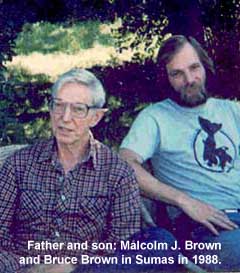
Professor Malcolm J. Brown with his son, Bruce Brown, Sumas, WA, July 1988

University of Washington Professor Malcolm J. Brown (1910 - 1992) with his son, Bruce Brown, in Sumas, WA, July 1988.

Additional reading -- Malcolm Brown's George Moore: A Reconsideration. Also see Bruce Brown's commentary on The History of the Corporation for Malcolm Brown's contribution to that work.

Carlyle's diary of his tour with Duffy recorded a graphic scene of universal devastation, though the wisdom he derived from it proved to be intertwined platitude and hysteria. Other than the clearances, nothing pleased him. When a crone offered him "the dainty of the country," the famous dyspeptic stomach was turned, for he had not been warned that this was the local name for goat's milk laced with poteen. One whole day was spoiled by an "ignorant" boatman singing "obscurely emblematic" songs about "Repale." His sarcasm was provoked by all Irish songs, whether rendered in Duffy's off key voice to speed the miles through Connaught, or in M. J. Barry's lusty choruses while rowing across the Cove of Cork. He pronounced the Killarney echoes "not worth much" and the Giant's Causeway not "worth a mile to travel to see." Clew Bay, highly recommended to him, was for his taste altogether too "dim and shallow." The famine still gripped Ireland at the time of his tour, yet he was incurious about it and placed the word itself inside inverted commas. A funeral on the road annoyed him: "Funeral overtaken by us; the `Irish howl'-totally disappointing, there was no sorrow whatever in the tone of it. A pack of idle women, mounted on the hearse as many as could, and the rest walking; were hoh-hoh-ing with a grief quite evidently hired and not worth hiring."

Discreetly, the famished dead seldom crossed his line of vision, but beggars were everywhere, approaching him at every crossroads with clever simulations of hunger. He was not born yesterday, and divil a halfpenny their tricks ever got from him. Duty led him to inspect every workhouse along the route of the tour. He found them increasingly nauseating as he rode westward, and in Castlebar and Westport, county Mayo, their excesses broke his Caledonian reserve:

Human swinery has here reached its acme, happily: 30,000 paupers in this union, population supposed to be about 60,000. Workhouse proper (I suppose) cannot hold above 3 or 4000 of them, subsidiary workhouses, and outdoor relief the others. Abomination of desolation; what can you make of it! Outdoor quasi-work: 3 or 400 big hulks of fellows tumbling about with shares, picks, and barrows, "levelling" the end of their workhouse hill; at first glance you would think them all working; look nearer, in each shovel there is some ounce or two of mould, and it is all make-believe; 5 or 600 boys and lads, pretending to break stones. Can it be a charity to keep men alive on these terms ? In face of all the twaddle of the earth, shoot a man rather than train him (with heavy expense to his neighbors) to be a deceptive human swine.

Levity apart - if this was levity - Carlyle concluded sagely that there must be "a beginning in checking pauperism," but he knew not how. He wished that Peel were thirty again. It was not Repeal of the Union that Ireland needed, "but repeal from the Devil" instead. England was not opposed to Repeal, and was in fact "heartily desirous" of it, would embrace it "with both hands" were it not that England saw that it "had been forbidden by the laws of Nature." Concerning the new Irishmen, the product of O'Connell's agitations and the Nation's songs, Carlyle expressed his opinion in the boldest image of the diary: "Kildare railway; big blockhead, sitting with his dirty feet on seat opposite, not stirring them for me, who wanted to sit there: `One thing we're all agreed on,' said he `we're very ill governed; Whig, Tory, Radical, Repealer, all admit we're very ill governed!' - I thought to myself `Yes indeed: you govern yourself. He that would govern you well, would probably surprise you much my friend, laying a hearty horsewhip over that back of yours. " Back home in Scotland, he was pleased to recall, one heard no noisy blackguard ignorance of this sort, but instead "silent intrepidity and valor" and a "constant submission to the Divine Will."

Such was the judgment of Dr. Anti-Cant, Ireland's sometime friend, on Irish demos and Irish hunger, the wisdom bought at the cost of a million Irish lives. In brutality, the foremost enemy of English laissez faire could not be discriminated from its devotees, the political economists. Carlyle himself seems to have sensed some lack of penetration in his Irish thoughts. He never developed the notes of the Irish tour; and the publication of the diary itself we owe to Froude, who brought it out the year after Carlyle's death as a boost for Gladstone's 1881 Irish Coercion Bill. The peevishness of Carlyle's last judgment on Ireland did not break his habit of weeping briefly over evicted Irish peasants "dying there in the ditch" whenever he wished to make a piquant contrast against the "humanitarian cant" that insisted upon "pampering West-Indian niggers."

III

Duffy the cicerone and Carlyle the tourist sitting opposite him traded roles occasionally. In Westport Duffy gave way uncharacteristically to Carlyle's own vision and saw before him not "the People" of the Nation's style sheet, but unclean pauperized beasts, "more debased than the Yahoos of Swift, creatures having only a distant and hideous resemblance to human beings." When some old beggarwoman in Westport "shrieked" at him for "a hepney," for one moment he "prayed to God" for a cleansing Noah's flood to inundate the county of Mayo. But only for one moment; then his normal eager non-Carlylean good cheer resumed control.

What worried Duffy more than beggars and workhouse paupers was the silence of the countryside, everywhere "apathetic," "sick," "weary," andanticipating Joyce's much-admired epithet - "paralyzed." Like all other Irish observers of the time, he found language inadequate to describe the actuality: "No words printed in a newspaper or elsewhere will give a man who had not seen it a conception of the fallen condition of the West and South." Northward from Limerick he saw the true scope of the clearances. Clare was a wilderness, Lough Corrib another dead sea. He noted the innumerable dead "stumps" of vanished farms, cabins unroofed and battered down to make sure they would never again be occupied. In Ulster, too, clearances were being pressed forward as audaciously as anywhere else, even in Cuchullain's "Gap of the North." Passing through Connaught, Duffy showed Carlyle the estate of Lord Lucan at Castlebar, hedged and plotted for the habitation of hundreds of peasant families, now all deserted. They met not one solitary soul for miles along the highway. Carlyle wrote in his diary that night: ". . .`cruel monster!' cry all people; but . . . Lord Lucan is moving, at least, if all others lie rotting."" Duffy could not agree. The root of the Irish disaster, he now concluded, lay in the cupidity of landlords: even "the Whigs were not so merciless." He understood for the first time why Mitchel had fought so passionately against the combination of all classes. The beginning of the wisdom he was to extract from the famine was the belief that to find "the lost path," one must start from this proposition: "the land question is to be got settled first, and forthwith."

But what could be done? At first Duffy thought nothing could be done: "I confess that for a space I despaired of Irishmen in Ireland." Like many of his fleeing fellow countrymen, he was tempted to envision a new Ireland reborn in Boston. The seduction was put behind and he concluded, "In this land, or nowhere, the Irish nation must grow up." One of Carlyle's thoughts on the famine was attractive to Duffy's common sense. The great thinker had written in a young Dublin admirer's autograph book: "Fais ton fait!" Irish paralysis had but one cure, the deed: "Do your deed!" Duffy was hardly three months out of jail before he began publication of the Nation again, new and improved. Speranza tuned up and supplied a poem praising the Doctrine of Work, beginning, "Close the starry dream portal." Duffy resurrected Davis' old fixation upon import duties and set up an agitation to "buy Irish," citing pins, toothbrushes, sealing wax, and sickles as proper commodities for home industry. He was himself once again. While in jail Duffy and Thomas Meagher had been locked up together. Taking their daily exercise, the two pondered on their defeat and wondered where they might find a new lever to set Ireland in motion once more. One day Duffy had hit upon what seemed a brilliant idea. "You and I committed a blockhead blunder, my friend," he told Meagher. "We arrayed against us the most vital institution of Irish Ireland, by mere folly." The institution was the Catholic clergy. The clergy had built O'Connell's power, and in postfamine Ireland the clergy alone could "trumpet away the grave-yard sleep of the nation." Meagher was inclined to agree: the future nationalism of Ireland, he replied, would have to be "baptized in the Holy Well." Duffy turned Meagher's phrase over in his mind approvingly. He concluded that henceforth Irish nationalism must avoid the "French tone" so painful to the clergy. Those Parisian verbalisms that Davis had brought into the movement from his reading of Thierry must be left behind in order to construct a holy nationalism. He suggested Hungary for the model, the same decision taken later out of a kindred motive by Arthur Griffith and Sinn Fein.

Duffy now questioned whether Davis' rigorous nonsectarianism had any merit at all. It had made the Catholics suspicious, and at the same time had brought in no Orangemen. What was really needed was more sectarian vigor, not less. Take land reform, for example. In the north the Protestant farmers were now up in arms over a bill in Parliament to equalize Irish tenant rights, not by extending the Ulster custom to the other three provinces, but by abolishing it altogether. Duffy thought a person ought to be able to prevail upon the Ulster preachers to preach land reform as Presbyterianism. Simultaneously, the priests in the south could organize it as a Catholic idea. The leaders of the two sects could then get together and make common cause "by committee."

According to the motto Fais ton fait! Duffy searched out his agrarian priests, his agrarian Orangemen, and two sectarian journalistic allies, Frederick Lucas of the Catholic Tablet and a Protestant, John Gray of the Freeman's Journal. Within one month after the revival of the Nation, Duffy allied himself with two agrarian priests at Callan, county Tipperary, and proclaimed excitedly that there soon would be tenant protective societies "from sea to sea." Blessed by Archbishop MacHale, a Dublin convention launched the Irish Tenant League in August 1850 and formulated the demands that governed the Irish agrarian movement for the next two generations, the so-called Three Fs: free sale of tenant equity (that is, the Ulster tenant right), fixity of tenure, and fair rent.

Though hardly robust, the Tenant League had new sources of strength. Through Duffy's fame it was heir to all the prestige of militant nationalism, and a few priests and preachers were now friendly for the first time. Duffy decided that the league ought to be able to win perhaps a dozen seats in the next parliamentary elections. It seemed unpromising that so insignificant a force could bend the unwieldy House of Commons to its will. It was observed, however, that the balance in the House was extremely delicate between the three great divisions, the Whigs, the Peelites, and the protectionist Tories. No ministry since 1845 had had more than the slimmest hold upon the government. In an impasse, a small bloc of independent members might command a very great price for its votes, provided it was tight-knit and incorruptible. Having watched the ruinous encroachment of placeseeking into O'Connell's empire, Duffy expected that it would reappear as a danger to any new Irish bloc. He and his friends therefore persuaded the Tenant League to require of all parliamentary candidates seeking its endorsement a written pledge to "withhold all support from any cabinet that will not advance [its] principles," that is, the enactment of the Three Fs into law.

IV

In Rome, no less than in Ireland, 1848 was not soon forgotten. A couple of years earlier Pius IX had opened his pontificate by abandoning the repressive policies of his predecessor, Gregory XVI, and had carried out a series of popular political gestures: amnesty for Gregory's political prisoners, a city council for Rome, a committee of lay advisers on the administration of the Papal States. These mild and well-intentioned reforms, pushed forward against the advice of the Gregorian cardinals, earned "Pio Nono" a warm popular reputation. When the 1848 Italian revolution first broke in the streets, he bowed before the liberal storm of the February Days and granted the Papal States a constitution.

But as the months of 1848 passed, the Italian revolution deepened. In the autumn, the papal prime minister was assassinated. During the insurrection that followed, Pius fled Rome, moving down the coast a few miles to Gaeta, under the protection of Naples. There he remained for a year and a half until the armies of Napoleon III restored him to St. Peter's. He was now positively disenchanted. The "Pope of Progress" lost his amiability, and at Gaeta he reverted with a vengeance to the illiberalism of Gregory XVI. To compensate for the forthcoming amputation of his temporal arm, he set about to strengthen the unity and discipline of the hierarchy and to nurture the Rome-oriented, or ultramontane, tendency of the Church. His post-1848 career was eventually crowned with the promulgation of the dogma of papal infallibility, and with the Syllabus Errorum, a point-by-point condemnation of sixty-three aspects of nineteenth-century "modernism." The syllabus of "errors and perversions" stood against all the heresies that gave him pain: Cavour's nationalism; Garibaldi's secret societies, the Carbonari and the Freemasons; and so on down the list-indifferentism, scientism, communism, and as a stinger for Mazzini and the poetic troublemakers, pantheism.

For all his sorrows, the pope in exile at Gaeta still had time to spare for his flock in distant Ireland. In December 1849 an important vacancy occurred with the death of the archbishop of Armagh. The local chapter, in due form, sent Rome and Gaeta three names from whom the new archbishop could be chosen. Passing over the nominees, the pope chose instead his good friend Paul Cullen, the rector of the Irish College in Rome.

Cullen was the son of a Westmeath peasant, origins which seem to have inspired Joyce's rendition of his name as "cardinal scullion." An uncle had been killed and his father's house burned for disloyalty during the rising of '98, but after the Union the family had prospered uncommonly and was no longer attracted to insurrection. The boy was so precocious in piety and learning that he was singled out first for holy orders, then, the height of dreams, for a Vatican career. In 1820 he arrived in Rome a lad of seventeen, in the last years of Pius VII, that well-known face in the middle foreground of the Jacques David painting of Napoleon's coronation. Four pontificates passed and a fifth had begun; and still Cullen was in Rome, seasoned by the Latin atmosphere until he was twice more Italian than Irish when measured by time exposure. Enjoying a growing prestige in the Vatican, he had been Gregory XVI's chief adviser on Irish affairs in the last years of O'Connell's leadership, and his authority grew with the elevation of Pius IX.

There exist a dozen formal biographies of John Cardinal Newman and three of Henry Cardinal Manning; but of Paul Cardinal Cullen, none. In outward appearance he was meek and prosaic; and when bystanders tried to reconcile his seeming lack of force with his obvious possession of very great force, the contradiction suggested some mystery hidden in the depths of personality. His enemies saw not so much mystery as deviousness. The meek demeanor, they concluded, was a façade to strengthen the social efficiency of a very clearheaded and obstinate cleric. Thus Gavan Duffy quoted a Maynooth professor who complained: "He is for narrow views, clandestine manoeuvres. . . ." The Fenians called him "the Kalmuck fox," echoing the clandestine theme and referring also to an oriental cast of features not very visible in his portraits. O'Leary thought "bull-dog" a more apt name. An unassailable authority, after summarizing the copious criticisms of Cullen's character, observed that the scrutiny of his personal papers would "offer comparatively little matter for an apologia."

These traits in no way unfitted Cullen for carrying out the Vatican's post-1848 strategical objectives. Pius IX thought him the one man who could confidently be entrusted with the authority of the Church in times disturbed by Irish heresy and unrest. Armed with the title of primate, and doubly armed with the added title of papal legate, he went home to take command. In 1850, for the first time in thirty years, he set out for Ireland, bearing an assignment to pacify the country by making the most pious people of Europe more pious still.

Like every ambitious new administrator, Cullen naturally found much to deplore in his predecessor. The Irish bishops were inclined to go each his own way, especially the popular and politically adventuresome John MacHale. Laxness of discipline had proved its dangers in the 1848 political crisis by the absence of any single, dominant, clear episcopal voice. The bishops had publicly split on the question of mixed education, an issue which found Cullen and MacHale by accident on the same side, both in strong opposition. But other bishops had cooperated with Peel's colleges, and one of them actually sat upon the "godless" college governing board. These divisions, Cullen thought, must cease.

Cullen found dangerous tendencies also at work among the laity. Gavan Duffy proclaimed his dutiful Catholicism in a clear voice and fathered a nun and two priests-to-be, besides seven more good Catholic offspring, but Cullen spotted him as an enemy of the faith, the most convenient symbol for the entire liberal-literary complex of Young Italy and Mazzini, of Young Ireland and its memory of Davis as "our guide and prophet," of the Nation's songs, of Ballingarry and the other heresies that Pius IX's new political orientation detested. Duffy reported that His Grace always gave the appearance of friendliness toward him; but Cullen's private remarks show that he had despised Duffy from the start "a wicked man, to act with whom, after his conduct in 1848, was impossible until he had fasted fifty years on bread and water."

For Cullen to have harbored fears of Duffy's radicalism was not very discriminating, and his judgment was in general tinged with paranoia. Yet he had a point. While the Nation had cooled off noticeably since Speranza's bacchanal in the week of Ballingarry, it still carried unrepentant echoes of the old defiance. It followed all the doings of Meagher, Mitchel, Smith O'Brien, and the other felons in Van Diemen's Land, and reported their opinions as though it were still the year 1848. Meagher's ten-thousandword letter from overseas describing his week in Tipperary during the insurrection was printed in installments. And when one of the American exiles, Dalton Williams, sent word that he had decided to settle down in Mobile and never return to Ireland, the Nation carried a reminiscence of his deeds of 1848 and reprinted one of his bloodthirsty ballads, once used as court evidence against the Repealers in the state trials:

Let the trumpets ring triumph! The tyrant is slain!
He reels o'er his charger deep-pierced through the brain;
And his myriads are flying, like leaves on the gale
But who shall escape from our hills with the tale?
For the arrows of vengeance are showering like rain,
And choke the strong rivers with islands of slain,
Till thy waves, lordly Shannon, all crimsonly flow,
Like the billows of hell, with the blood of the foe.

Duffy might not be John Mitchel, but as Cullen could see, neither was he ready for fifty years of bread and water. It was distressing to note that the dangerous man was not only back in politics again but using priests for his vote canvassers.

V

Archbishop Cullen, like Duffy, was disinclined to languor. After he had been consecrated at Armagh, he sent out an immediate call to the Irish bishops to gather for the first time in six hundred years in synodical convocation. For meeting place he chose the cathedral of Thurles, in the nesting ground of the Tipperary insurrection of 1848 and ofthe new Tenant League. The synod went into session in the summer of 1850, just at the close of the first Tenant League convention. Newspapermen who journeyed down to Thurles to report the spectacle noted the contrast, soon to grow into an open hostility, between "the firm, vigorous energy of Dr. MacHale . . . and the calm, thoughtful, saintly suavity of Dr. Cullen." They observed that the keynote of the synod was "obey your prelates," and "act with Christian union"; and they learned that the primate would address himselfparticularly to the condemnation of mixed education.

After the synod had been allowed to grow mellow for a month, Cullen rose to speak the authoritative word. He pointed out first that the Irishman's faith was beset by cunning satanic forces. He implored both the shepherds and their flocks to turn their fullest energy to unmasking these subtle enemies. A place where evil worked its mischief was in the Queen's Colleges set up by Peel. Cooperation with the Queen's Colleges must cease, he said, and debate upon the issue was no longer welcome. "All controversy is now at an end-the judge has spoken - THE QUESTION IS DECIDED."

Next he took note of the "temporal afflictions of the People," of "their corporal wants and sufferings," and he enjoined the bishops to "treat them with all possible kindness and compassion." In one paragraph of his address he found strong words to condemn the extermination of the peasantry: "We behold our poor not only crushed and overwhelmed by the awful visitation of Heaven, but frequently the victims of the most ruthless oppression that ever disgraced the annals of humanity. . . . The desolating track of the exterminator is to be traced in too many parts of the country-in those levelled cottages and roofless abodes. . . ." He warned those who had enriched themselves by this inhuman practice that their greed endangered their chances for eternal salvation.

He wished not to be misunderstood, however. In scolding the exterminator he was not condoning vengeful thoughts in the exterminee. To those who had been injured, his best advice was to cherish the blessedness that accompanies the acceptance of the divine will: "Instead . . . of being impelled by the promptings of that sanguinary resentment, which, far from alleviating their sufferings, never fails to aggravate them with tenfold bitterness and intensity, let them [the exterminated peasants] treasure deep in their hearts, and constantly recall to their remembrance, those consoling promises of Jesus Christ, `Blessed are ye poor, for yours is the kingdom of heaven. Blessed are ye that hunger now, for you shall be filled.' "z3

His Grace turned next to the subject of literature, a vehicle of sin and infidelity he considered no less dangerous than the mixed colleges. It had, he said, set about to "unfix the principles" of believers, to spread "antiChristian philosophy." It had "devoted all its reasoning and research to sapping the foundations of faith." It had gained entrance to the heart by Voltairian "flattering the pride of the intellect," and he was compelled to deplore what Yeats-an incongruous comrade-in a later time called:

The ravens of unresting thought; Flying, crying, to and fro.

Cullen particularly warned the bishops of a new literary danger he had observed developing on the Continent, an effort to "taint the purity" of believers through the charms of poetic pleasure. The grossest sensualism was abroad, so depraved that it would have corrupted "even the society of the Pagan world." It had been translated into "your" (that is, into "his") language, he said; it closed in upon the innocent from every side; "and we bitterly lament to state, [it is] occasionally to be seen even in the precincts of the domestic circle, where nothing defiled should be permitted to enter, but whence the anxious vigilance of parental love, as well as its awful responsibility, ought to have been prompt in banishing, with indignation, everything calculated to taint the purity, or unfix the principles, of its youthful charge."

The reader will recognize in these remarks the definitive formulation of clerical puritanism, a celebrated Irish literary topic. Cullen's synodical warning against the literary assault upon Irish purity laid down the precedent that led in due time to Ireland's theater riots. It also gave us, through reaction, The Wanderings of Oisin, "The Fiddler of Dooney," "News for the Delphic Oracle," Hail and Farewell, The Crock of Gold, and "The Man Who Invented Sin," which somewhat even the score.* Cullen's literary puritanism had no conceivable application to nonreading Ireland in that year of David Copperfield and "In Memoriam." It was at most only a farsighted investment in the distant future of literature, when the charge "Filthy!" could finally take its place beside the charge "Infidel!" as a magical weapon in the Irish critical vocabulary.

One is not sure that literature was foremost in Cullen's mind when he spoke. There is indirect evidence that Cullen's interests included the demographic, a well-recognized concern of the Church. One remembers that the etiology of the famine which traced it to overpopulation appealed overwhelmingly to all political quietists. What else could they say? Malthusianism, it should be remembered, was not devoted solely to the prediction of demographic cataclysm but was concerned also with a study of population checks. The preferred check was "moral restraint," a pure Malthusian category and also a theological one. It is sometimes thought to be a hypocrisy, though Cullen's heirs proved it otherwise. Ireland was to achieve the world's highest propensity to celibacy and to postponed marriage (together with an extremely low rate of illegitimacy), driving up the average age of marriage for Irish males until it stood at just under fifty years. Cullen's preachment was so efficacious that the fears of overpopulation were eventually replaced with Father John A. O'Brien's contrary anxiety over "the vanishing Irish."

A second demographic check was emigration, not a painless choice. Irish literature dwells often on the havoc it caused at home, and American literature from Thoreau onward takes note of the Irish immigrant's savage induction into the New World jungle. But certainly it was preferable to starvation, and Cullen found other agreeable things to say in its favor. The famine, he said later, was "a special dispensation of God to disperse the Irish people over every country of the globe" in order that they might everywhere "lift the standard of the Church."

VI

In Ireland the hierarchy was administratively organized by geographical designation. Dr. Browne, for example, was not just a bishop but the bishop of Elphin, "the Dove of Elphin," as O'Connell called him without any thought of constitutional impropriety. It seemed an inevitable arrangement, recommended by common sense. In England, however, the hierarchy was not so designated. Pius IX, trying to put his house in order, decided in 185o that it should be, since the flooding of famine refugees into the Midlands had at last given the English Catholic prelates something to administer. A papal bull announced the reorganization. Just at the close of the Synod of Thurles, the English primate, Cardinal Wiseman, issued a pastoral letter under the enlarged title of "Archbishop of Westminster," using the phrase, "we govern and shall continue to govern the counties of Middlesex, Hertfordshire," and so on. The language was somewhat archaic and ritualistic, the timing not the happiest. Protestant militants in England were still brooding over Peel's Maynooth grants and were further irritated by the progress of the Oxford movement, which had won first Newman and now Manning over to Rome amid noisy publicity. The new papal bull stirred up a violent adverse Protestant reaction in England, with the Times leading the hue and cry in spite of the private opinion of the editor, who told Charles Greville he thought "the whole thing a gross humbug and a pack of nonsense."

The prime minister himself joined in. Lord John Russell was one of those who felt personally hurt by the Tractarian backsliders. In spite of their sound English upbringing in the Thirty-nine Articles, they had descended to the "mummeries of superstition." But a graver consideration for Russell was his disintegrating parliamentary majority. On Guy Fawkes Eve i 85o he sent a letter on "Papal Aggression" to the Anglican bishop of Durham expressing his "alarm" and "indignation" that the pope should assert "a pretension of supremacy over the realm of England, and a claim to sole and undivided sway, which is inconsistent with the Queen's supremacy." In deference to the bigoted mass hysteria he had himself engendered, he followed up with a legislative attack. In February 185 1 he introduced into the House the Ecclesiastical Titles Bill, which would forbid the Catholic bishops from ornamenting themselves with geographical designations on pain of criminal penalties.

Across in Ireland Duffy and his friends in the Tenant League were properly frightened by the rising bigotry. Its effect upon their program to make a "league of the North and South" could only be disastrous. But the delights of Irish sectarianism were never easily resisted, so that Duffy's warnings were scarcely heard. When the Orangemen came into the streets with their big bass drums, hotheaded Catholics also rose to take Russell's bait. His insolence had been all but intolerable, and outrage against his astonishing bill was natural enough. As Duffy feared, the bill was as tempting to opportunist Catholics as to Orangemen.

VII

Rosencrantz and Guildenstern now came forward to the center of the postfamine Irish stage in the persons of a couple of alert adventurers, John Sadleir and William Keogh. They seized upon the opportunity that knocks but once, earning themselves a special ignominy in Irish history. Sadleir was a strong-farmer's son who had risen prodigiously, having organized a chain of savings banks in Tipperary and built a reputation for financial brilliance. A genteel brigand and plunger, he would have been more at home in the company of Jay Gould and Daniel Drew than in the stagnant backwaters of postfamine Ireland.** In 1847 he was elected Whig member for Carlow. Keogh went to the House in the same year, a Peelite member for Athlone, and as late as 1848 he was an unrepentant loyalist. He was a barrister with a knack for platform oratory and an urge to leadership, for he had often heard it said that he resembled Napoleon. He struggled under a hopeless load of debt. "Money is a great object with me," he told a colleague. Both men had discovered that a backbencher was a lonely figure at Westminster, but that anyone commanding a block of votes was somebody else again. Probing the Irish inane in search of some emerging power, Keogh attended the first convention of the Tenant League, while Sadleir made contact with it through his cousin, a Tipperary M.P. Cautious politicians, practicing the art of the possible, they then shied away from the league. They preferred to wait and see, and while they were waiting, the no-popery frenzy broke in England.

The first overt Irish reply to Russell's bill was parliamentary obstruction, as Duffy's scheme for a pledge-bound Irish bloc was put into immediate action in the House of Commons. The original Irish floor leader was George Henry Moore, a member for Mayo, whose ample gifts of astuteness and generosity were inherited only in fragments by his more famous son, the novelist. In spite of Yeats's aspersions on the quality of his blood line, he was one of the most distinguished Irishmen of the century, combining liberal nationalism, great oratorical power, an acid wit, impressive landholdings in west Mayo, and, a not inconsequential item of Irish prestige, the famous racing stable immortalized in his son's novel, Esther Waters. Moore gathered a nucleus of angry Irish members and pledged them to vote against whatever ministry was in power, under all circumstances, in the hope of paralyzing the work of the House of Commons until the Irish demands were met. Twenty members were recruited to Moore's caucus, barely a fifth of the whole Irish delegation, but enough to be heard. There were interesting possibilities in the scheme, attractive to Sadleir and Keogh. They joined up and were such vociferous nuisances in obstructing the House that they won for the little caucus the name, "The Pope's Brass Band."

Back home the pair teamed up with Cullen to organize Catholic indignation committees in the countryside. These coalesced in the summer of 1851 in a great Dublin aggregate mass meeting to establish the Catholic Defense Association, with Cullen in the chair, Keogh in command, and Sadleir on the flank giving support with an ambitious newDublin weekly, the Telegraph, holier than Lucas' Tablet, more patriotic than Duffy's Nation, more respectable than either, and selling for half their price, for he was said to be a financial wizard.

The Ecclesiastical Titles Bill became law, but still Russell could not save his ministry, the same that had long ago promised O'Connell "comprehensive measures of relief." It collapsed in February 1851 and was succeeded by an interim government under Lord Derby pending general elections. The Tenant League organizers, priests in the south and preachers in Ulster, charged out into the country, determined to fight the election on the land question. Sadleir and Keogh now found the Tenant League's political organization attractive and they edged in, though without receiving a hospitable welcome. At a meeting in Cork a Tenant Leaguer accused Keogh to his face of being "not sincere." In excited denial he swore with the awful formula, "so help me God," twice repeated, that "so help me God, no matter who the Minister may be, no matter who the party in power may be, I will neither support that Minister nor that party unless he tomes into power prepared to carry the measures which universal popular Ireland demands."

The election was a triumph for the Tenant League. Virtually all the Irish Whigs were defeated. The strength of the Irish bloc doubled to forty, roughly the number with which Parnell would begin his work in 1880. Duffy himself was elected for New Ross, and on election night his jubilant backers lit bonfires on the hilltops to honor the new M.P. who only three years before had been fighting in the courts for his life. The celebration was premature, a situation not without parallels in other times and places.

The sectarian issue lost the Tenant League its foothold in Ulster. As Duffy had feared, every league candidate lost there. The Ulsterman Sharman Crawford, parliamentary leader of the Irish agrarians, had with a grand gesture given up his seat for Rochdale to stand for Orange Down, and lost. "Shame on the North," said Duffy's leading article. John Stuart Mill, whom Duffy and Lucas invited to come over and stand for election in Ulster as a Tenant Leaguer, was able to congratulate himself that he had stayed at home. In the south, on the other hand, the Tenant League had cashed in nicely on the revulsion against the Ecclesiastical Titles Act. Even if sectarianism had been an unwelcome ally, the tenant movement was now "baptized in the Holy Well."

When the House of Commons reconvened, Lord Derby's ministry was immediately toppled. Lord Aberdeen was called upon to form a new coalition, completed in the closing hours of 1852. The perennial Lord John Russell was back as one of the ministers, also Lord Palmerston. Gladstone was chancellor of the exchequer. But for surprised Irishmen, by far the most interesting names in the new government were those of William Keogh, solicitor general, and John Sadleir, junior lord of the treasury. Lord Aberdeen had let it be known privately that the Ecclesiastical Titles Act was to be henceforth a dead letter, and he had given the place-seekers the places they sought. Instantly the Tenant League's pledge-bound bloc was cut in half and left with nothing but its bold campaign promises for souvenir. And what of those peasants who had voted for the league in spite of threats of eviction? Sauve qui peut!

VIII

Next the Tenant League found itself deprived of its clerical organizers, for as Newman learned from the grapevine, Cullen was "thick with the Government." The curate who had managed Duffy's election victory, Father Doyle of New Ross, was translated to an inferior parish up on the mountainside. Then Father O'Shea and Father Keefe of Callan, the founders of the Tenant League, were threatened with suspension and forbidden from further political activity. The National Council of Bishops meanwhile met to lay down the general guideline, "no priests in politics" - unless a bishop approved. If this interference continued, said Duffy, the game was finished, "for elections could no more be won without the help of the local priests than Charles Edward could have raised the Scottish Highlands without the help of their chiefs."

Duffy concluded that the enigma of Cullen's behavior was not very profound after all. A friend wrote him an explanation that fitted all the parts together to his satisfaction: "Rome returns to her design of treating Ireland as an intrenched camp of Catholicity in the heart of the British Empire, capable of leavening the whole Empire-nay, the whole Anglo-Saxon race - and devotes every nerve to that end. But the first postulate is the pacification of Ireland. Ireland must be thoroughly imperialized, legalized, welded into England. Paul Cullen succeeded Castlereagh." Duffy was ready to surrender. Serving on the House committee that set up home rule for Australia, he had made himself expert on the attractive new colony. He sold the Nation, resigned his seat in the House, and in the autumn of 1855 sailed for Sydney. In his last leading article as editor of the Nation, he squared all his accounts with Cullen and Keogh, leaving behind a blistering indictment. His peroration was long remembered for its piquancy: ". . . there seems to be no more hope for the Irish Cause than for the corpse on the dissectingtable."

Duffy watched from the antipodes the fulfillment of his predictions. About the time of his departure, rumors circulated that Sadleir's banking empire was unsound, and in Duffy's last glimpse of him in the House, he "looked wild, haggard, and repulsive." To postpone disaster he began forging title deeds to use as collateral for loans from the London banks. When he could borrow no more, a run closed his central Tipperary bank. Auditors discovered that its assets were one-tenth its deposits. Sadleir's personal account had been two hundred thousand pounds overdrawn, apparently to buy votes and to subsidize the devout journalism of the Telegraph. Next morning he was found dead on Hampstead Heath, lying like James Steerforth with his head on his arm. Irish nationalists find relish in adding the detail that "a silver tankard smelling strongly of prussic acid was at his side." His brother, also an M.P., fled the country to escape prosecution; and his right bower, Edmund O'Flaherty, another M.P., who had gone into the Aberdeen government as commissioner of income tax and had been described by Keogh in the House as possessing "honor, veracity, and high character," also turned up missing, leaving fifteen thousand pounds of unpaid debts behind him. Keogh himself, however, sailed unharmed through the storm that wrecked his swindling intimates. He had already moved up from solicitor general to attorney general, and in the midst of the Sadleir scandal the government with striking coolness of nerve elevated him to the bench.

With Duffy's departure for Australia, the last of the 1848 leaders was gone. Ireland entered the limbo known to political science as a condition of political vacuum. In the vacuum, Cullen's ultramontane faction expanded comfortably. O'Connell's last regressive stratagem, the Whig alliance - "to get a little something for Ireland," as he used to say-became the pillar of Irish politics. The Whigs had come back into power in early 1855 under Lord Palmerston, a great Ascendancy landlord and therefore given to what Yeats called "sweet laughing eagle thought" and to an agrarian philosophy summed up in his simple proposition, "tenant right is landlord wrong." Palmerston unfortunately preferred Mazzini to Pio Nono, but he was otherwise sound, and Cullen became thicker than ever with the government.

Cullen valued religious pomp, so that new churches were rising all over Ireland as parish committees mobilized to attack two centuries of arrears in the ecclesiastical building program. Otherwise, not one of Catholic Ireland's deprivations had been even confronted, let alone cured. Cardinal Wiseman visited Ireland in 1858 and noted that "religious progress is far in advance of what is considered social improvement " The country could not sustain its own people, so that year after year the tide of human beings moved out of the countryside down to the Galway, Cork, and Dublin docks and went on board ship, bound for other lands. They carried abroad Cullen's mission to the heathens, infidels, and Protestants, but also the deep sensation of having been unforgivably wronged that had stirred their generation of Irish history and made it "remembered forever."

Next chapter...

"The Politics of Irish Literature" © Copyright 1973 Malcolm Brown

* It gave us, further, the more complex reaction of Ulysses, in which Cullen's attitude appears in mirror inversion. With an inflamed sense of sexual sin that would be incomprehensible anywhere in Europe except in the British Isles, Joyce built a major theme of the loathsomeness of the "unclean female loins," surpassing Cullen, St. Kevin, and St. Augustine, whose anatomical discovery Yeats was "not too old" to borrow for his own momentary dip into Joycean matter with the showpiece, "Crazy Jane Talks with the Bishop."

** The boldness of his swindles was captured for literature through Mr. Merdle in - Little Dorrit, for whom he was the life model.


New CD-ROM LIBRARY EDITION
cover thumbnail of The History of the Corporation by Bruce Brown

"Great book. Fascinating..."
-- Jack Weatherford,
author of
The History of Money

The History of the Corporation
by Bruce Brown

* READ free excerpts on astonisher.com
* BUY the complete book at the astonisher.com store

"An environtmental classic..."
Moutnain in the Clouds by Bruce Brown: 25th Anniversary

Mountain in the Clouds
by Bruce Brown

* READ free excerpts on astonisher.com
* BUY the complete book at the astonisher.com store


© Copyright 1973 - 2012 by Bruce Brown
and BF Communications Inc.

Astonisher and Astonisher.com
are trademarks of BF Communications Inc.

BF Communications Inc.
P.O. Box 393
Sumas, WA 98295 USA
(360) 927-3234

Website by Running Dog

Astonisher.com Most Read

1. The History of the Corporation
2. Heart-stopping Sturgeon
3. Who Killed Custer?
4. White Cow Bull at the Little Bighorn, #1
5. Windows 7 / XP Wireless Network Bible
6. Conversations With Crazy Horse
7. Dr. Whacko's Guide To Slow-pitch Softball
8. Bogus Crazy Horse Photos
9. GoLive / Dreamweaver Migration Bible
10.
Crazy Horse In Action

"Vernon Louis Parrington" by Bruce Brown

"Opal Whiteley" by Bruce Brown

Astonisher.com Forums on LikiWiki.com

Temixwten.net - The Museum of the Salish

"The Histroy of hte Corporation" by Bruce Brown

Mountain in the Clouds by Bruce Brown