Chapter Seven
'48 and Insurrection
AS THE YOUNG Ireland Confederates were being pitilessly knocked about in furtherance of their political education, a strange new actor came on the scene: James Fintan Lalor. His collected writings, which can be read through in half an hour, included a dozen or so bold epigrams that made a great reverberation through Dublin's stagnant famine air. He was an original, a deformed, asthmatic recluse, boorish and impossible to work with. Still, he had generated a stock of fresh ideas about the condition of the country. The Nation's nadir, the leading article quoted earlier - "Alas! alas! . . . we can do nothing"-had, he said, "made me ill"; and he had written a letter to Duffy setting forth a less defeatist view of the situation. He had never, he said, been enticed to go on board O'Connell's Repeal ship: "I knew her at once for a leaky collier-smack, with a craven crew to man her, and a sworn dastard and foresworn traitor at the helm." He considered the whole effort of the monster meetings misspent, for no matter how many Irishmen came to hear the oratory, they held no lever that could be applied against England. Besides, Repeal was a secondary issue; a "mightier question" lay in the possession of the land. Because Ireland was a nation of the landless, it was "rotting to a foetid ruin"; but "create the husbandman, and you create the mechanic, the artizan, the manufacturer, the merchant." Unless Ireland was to perish, it must locate some power to set against English power, not necessarily force of arms, but at least a capability to wound. Such a power existed, waiting, in the land-hungry peasantry. Therefore: "unmuzzle the wolf-dog. There is one at this moment in every cabin throughout the land, nearly fit already to be untied-and he will be savage by-and-by."
Lalor's letter seemed too hot to publish, but it was handed around among the Young Irelanders and vigorously debated in private. Anxious like any other editor to publish a readable journal, Duffy was attracted to Lalor's style, but the ideas frightened him. Smith O'Brien agreed with Duffy that it would be wrong to unmuzzle the wolf dog. John Mitchel, on the other hand, liked Lalor's ideas very much. Under their impact he rethought the whole Irish quandary and reached some startling new conclusions. The shabby closing act of the Irish council now convinced him that the landlords' deliberations had perpetrated a fraud, making bogus militant talk to blackmail the English into a new coercion act. He concluded that the combination of all classes, Duffy's and Smith O'Brien's favorite guide to political life, must be scourged out of Young Ireland's program without a moment's delay. He explained his sudden enlightenment:
- I long thought that if only all "ranks and classes," as the phrase runs, could be banded together for the Repeal of the Union, the wrong and injustice would disappear; "Irish noblemen and gentlemen"-the thick-headed individuals before mentioned-would straightway treat their tenants like Christian men, and not like wild beasts, and the tillers of the soil would suddenly acquire a perpetuity in their lands, and sitting, every man of them, under his own vine and fig-tree, would consume the fruits of the earth in peace, with none to make them afraid. It was an agreeable delusion, and the fabulous glories of "Eighty-two" shed a glow over it for a while. But it was a dream: "Irish noblemen and gentlemen" no longer acknowledge Ireland for their country-they are "Britons;" their education, their feelings, and what is more important to them, their interests, are all British. British "laws" eject and distrain for them, British troops preserve "life and property," and chase their surplus tenants. For them judges charge-for them hangmen strangle.
The landlords were not tomorrow's comrades of the bivouac, but today's mortal enemy, inseparable from the other enemy, the English. The need of the moment was ruthless attack and the confiscation of the Irish land:
- Irish landlordism has grown so rotten and hideous a thing, that only its strict alliance, offensive and defensive, with British oligarchy saves it from going down to sudden perdition. So soon as this became clear to my mind, I, for one, desisted from the vain attempt of seducing the English landlord garrison in Ireland to fraternise with Irishmen, and turned upon the garrison itself. I determined to try how many men in Ireland would help me to lay the axe to the root of this rotten and hideous Irish landlordism; that we might see how much would come down along with it.
Simultaneously, Mitchel arrived at a momentous new insight into the sources of the famine. He had been brooding for a long time on the gargantuan confusion in the administration of famine relief. He observed that the muddle went beyond random expectation and enjoyed such fullness of perfection that it seemed to be almost a work of art, a fulfillment of plan. A number of other Irishmen, including the Tory Isaac Butt, had drifted toward the same thought. "Can we wonder," asked Butt, "if the Irish people believe - and believe it they do - that the lives of those who have perished, and who will perish, have been sacrificed by a deliberate compact to the gain of English merchants?" He quickly added, however, "Of any such compact we acquit the ministers." Under the unbearable emotional stresses of late 1847, Mitchel refused to acquit the ministers. Suddenly he thought he saw the entire famine relief operation during the past twenty-four months as a calculated scheme on the part of both Peel and Russell to exterminate the Irish people, not figuratively as in the peasants' metaphor for eviction, but in the stark and literal sense. There was the "act of God," to be sure, the blight fungus. But the famine itself had features that set it apart from any other in all history. First, it had occurred not on the poor backward fringes of civilization, among Australian bushmen, but inside the imperial Union of Great Britain, the workshop of the world, the most advanced nation on earth. Second, it had occurred during years in which most Irish crops except potatoes were bountiful. Even O'Connell had seen the anomaly of ships laden with Irish grain sailing out of Dublin and Cork harbors while Irishmen were famishing; even he had said that Irishmen should die with arms in their hands if starvation should be attempted. Well, Mitchel concluded, such was in fact the case; or in the words of his famous indictment: "The Almighty, indeed, sent the potato blight, but the English created the Famine."
|
|
Table of Contents
|
|
Astonisher.com is pleased to offer The Politics of Irish Literature by Malcolm Brown, complete and free for your personal use.
Praise for
The Politics of Irish Literature |
 |
|
"This brilliant study of the intersection of politics and literature in Ireland amounts to a dazzling portrait gallery. Reading it one feels about one the breath, warmth, and passions of the dead all come alive again."
-- Sean O'Faolain in the Manchester Guardian
"Mr. Brown's masterpiece has made me want to hire a nearby housetop and recite whol chunks to every passerby..."
-- Michael Foote in the London Evening Standard
"The author of the best book on George Moore now gives us what is in all likelihood the best book on the politics of modern Irish literature."
-- Virginia Quarterly Review
|
|
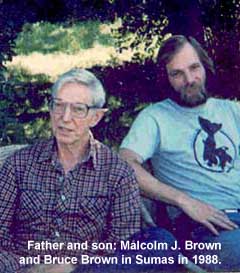
University of Washington Professor Malcolm J. Brown (1910 - 1992) walking in the garden with his grandaughter Laurel Brown, Seattle, WA, July 1986.
|
Additional reading -- Malcolm Brown's George Moore: A Reconsideration, also here on astonisher.com.
|
|
|
The relief apparatus now came under the attack of Mitchel's very considerable satiric powers. He was the first to spotlight the role of Charles Trevelyan, "a Treasury clerk," as the architect of the catastrophe. Learning that it was Trevelyan who entreated the queen to appoint a day of almsgiving for the starving Irish, he wrote: "Keep your alms, ye canting robbers. We spit upon the benevolence that robs us of a pound and flings back a penny in charity; and if the English cared to show their compassion for the Irish, let them take their fangs from our throat." In a later time, John O'Leary's sarcastic intonation of the words "philanthropy" and "humanitarianism"s seems more to echo Mitchel's special bitterness against English evangelicals than to sponsor his famous disciple's universal ethical abstraction, "cast a cold eye." The age-old dialogue between bureaucracy and starvation has never been delineated with more acid disdain than Mitchel's. One of his vignettes described how the lord lieutenant, Lord Clarendon, dispatched agricultural extension agents laden with scientific advice into the blighted area at Mullet. Too late: on arrival they found all their prospective pupils already dead. Another described how a traveler journeying through the dismal wastes of rock and bog in west Mayo came at last to the grandest building for fifty miles around, "rearing its accursed gables and pinnacles of Tudor barbarism, and staring boldly with its detestable mullioned windows, as if to mock those wretches who still cling to liberty and mud cabinsseeming to them, in their perennial half-starvation, like a Temple erected to the Fates, or like the fortress of Giant Despair, whereinto he draws them one by one and devours them there:-the Poor-house." Another described the gala dedication of Dublin's model soup kitchen:
- There, in the esplanade before the "Royal Barracks," was erected the national model soup-kitchen, gaily bedizened, laurelled, and bannered, and fair to see; and in and out, and all around, sauntered parties of our supercilious second-hand "better classes" of the castle-offices, fed on superior rations at the people's expense, and bevies of fair dames, and military officers, braided with public braid, and padded with public padding; and there, too, were the pale and piteous ranks of model-paupers, broken tradesmen, ruined farmers, destitute sempstresses, ranged at a respectful distance till the genteel persons had duly inspected the arrangements-and then marched by policemen to the place allotted them, where they were to feed on the meagre diet with chained spoons-to show the "gentry" how pauper spirit can be broken, and pauper appetite can gulp down its bitter bread and its bitterer shame and wrath together; - and all this time the genteel persons chatted and simpered as pleasantly as if the clothes they wore, and the carriages they drove in, were their own-as if "Royal Barracks," castle, and soup-kitchen, were to last for ever.
Frenzied, "maddened" as he said, Mitchel was driven to the logic of the French marshal of a later time: our position is lost, situation splendid! - we attack. Young Ireland was unarmed, isolated, demolished at the polls, trailed by Castle spies, threatened with imprisonment, and deserted by its allies. Therefore, said Mitchel, it must assault its twin adversaries at once; for since landlordism and the English connection were equivalent to one another, he could "see no way to put an end to either but by destroying both." "A kind of sacred wrath" overwhelmed him and his few friends; and as he said later, "they could endure the horrible scene no longer and resolved to cross the path of the British car of conquest, though it should crush them to atoms. "
II
The original strategy proposed by Mitchel was that of the tithe war. Lalor had already begun to organize the peasantry along that line. In the fall of 1847 he had gathered four thousand peasants in a meeting at Holycross, county Tipperary, and pleaded with them to stand together on the principle that the first claims upon the produce of every Irish tenancy, prior to both rent and poor rates, should be food to maintain life in the farm family and beasts, and seed for the next planting. To enforce this claim he recommended a rent strike supported by intimidation of the buyers of distrained property and violent resistance to ejectment. Mitchel appropriated Lalor's scheme as it stood, adding two more objectives. First he proposed resistance to the collection of the poor rates and boycott of the workhouses as the only escape from the Gregory quarter-acre clause. Duffy thought this proposal insane, arguing that a million or so Irishmen were being kept alive by government relief, stingy though it might be, and that those who refused to take relief on principle would find that the price of their principle was instant starvation. But Mitchel had made a second proposal: to frustrate the export of Irish food by any efficient means-sabotage of grain convoys, destruction of rural bridges, or the rifling of warehouses. This campaign, he hoped, would feed the Irish peasantry, allowing the destruction of the relief system.
Mitchel understood that in carrying out such a program one could not avoid sporadic clashes, but that success would for a time depend upon minimizing violence rather than seeking it out as a paramount objective. However, he spoke a language increasingly inflammatory. He found that before any resistance at all could start, he must counteract the apathy resulting from hunger and from O'Connell's years of preachment against violence. Confederate clubmen out in the country sent in reports that the peasants were conditioned not only to submit, but to die. They said "God's will be done" and went away and died like wounded animals. If they could be awakened out of their "tranquillity," a progression of small fires might spread into a general conflagration, or so he hoped. Eventually he looked to "try the steel" at the head of an armed rebellion of the 1798 mode. He knew that thirty thousand British troops were stationed in Ireland, ten thouand in Dublin alone. But three-fourths of the rank and file of the British garrison consisted of Irish peasant boys, whose disloyalty to their English officers seemed a fair risk in the crisis, especially since these same Irish boys had proved to be the most enthusiastic consumers of his seditious journalism.
After Mitchel's mind was set in its new fixation, events moved very fast. In December 1847 Duffy was no longer able to breathe the brimstone fumes and dismissed him from the Nation's staff - with sadness, one would suppose, since the journal's vitality proved to be as dependent upon Mitchel's pen in 1847 as upon Davis' in 1842. In January 1848 Smith O'Brien decided that Mitchel must also be purged from the Confederation. O'Connell's purification ritual was to be re-enacted in a new setting, but with courtesy.
Smith O'Brien's campaign against Mitchel opened with a resolution defining the Confederation position. It sought "legislative independence" by the sole means of "a combination of creeds and classes." Duffy seconded his thought, referring to the ghastly year just ended as "hopeful" because it brought "one light . . . the first real growth of nationality among the higher classes."" Mitchel, in reply, looked about the hall for converted landlords and found only Smith O'Brien and one other, his own brother-inlaw, John Martin. The Confederates, it seemed, had as many landlords as O'Connell had said Young Ireland had priests, namely, two. Mitchel offered his own program for blocking food exports and boycotting relief, adding that the Confederation must also persuade the peasantry to arm in haste. Michael Doheny answered him with a somber appraisal of their predicament: "How many of them would take the advice? What need we conceal from ourselves the fact-if they were all armed this moment, guided by those they most trust, the great majority of them would use those very arms against us. But even if that were not so, where are your peasantry? - sicklied, hungry, wasted, exiled, or in their graves. If you want to arm, I tell you your best chance-go to Skibbereen, reanimate the corpses that are huddled there and bid them arm." Smith O'Brien's resolution passed, and Mitchel and his followers walked out. Meanwhile the famine raged on, and a priest wrote in from Mayo: "There is not a day that I do not meet hundreds of paupers, the squalor and wretchedness of whose appearance no person can depict."
Taking his cenacle - Mangan the poet and John Kenyon the patriot priest-along with him, Mitchel moved down the street and started a rival weekly, the United Irishman, named in honor of Tone and '98. Tone's famous words appeared on the new journal's banner: "If the men of property will not help us they must fall: we will free ourselves by the aid of that large and respectable class of the community-the men of no property." Free for the first time, Mitchel set out to learn whether the force of his satiric pen could alter the drift of Irish history. He opened fire with a journalistic barrage against Lord Clarendon, the lord lieutenant: "I expect no justice, no courtesy, no indulgence from you; and if you get me within your power I entreat you to show me no mercy, as I, so help me God, would show none to you." He scarified the government, the food exporters, the relief officials, the bigots, the moral force "humbug," the landlords, the English.
III
Mitchel was purged from the Confederation on February 5, 1848. Three weeks later he was back again. The martial ardor of Irish nationalist politics was suddenly reinvigorated by the arrival on February 23 of news of revolution in France. The people of Paris had merely reached a certain level of disgust and, voild, Louis Philippe fled in disguise and the Hotel de Ville was occupied by citizens, at their head Duffy's intellectual mentor, the aristocrat, romantic poet, and historian of the Gironde, Alphonse de Lamartine. In a few weeks Metternich had fled Vienna, and Germany and Italy were in conflagration. Everywhere prospects were looking up for spontaneous uprisings. Mitchel congratulated himself on his foresight. The Confederates sent a delegation to infidel Paris, though Lamartine, under English threat, soon chilled their fraternal advances. Even John O'Connell, passing through Paris in the February Days, was infected with republicanism and made himself available for Irish unity talks. The most extraordinary reaction, however, was Duffy's. The Nation dropped its timidity without transition and-outdistancing Mitchel altogether-it came out next Saturday with a mobilization call for an independent Irish army. "If we are not slaves and braggarts, unworthy of liberty," said Duffy's editorial, "Ireland will be free before the coming summer fades into winter." In the full hearing of Dublin Castle he appointed autumn for the insurrection and briskly transacted other revolutionary military business. He designed a field uniform ("no fripperies"), fixed the size of the army units, and set up a program for systematic fraternizing with the constabulary.
Duffy seemed at first to have caught the revolutionary contagion in an especially virulent form. But a more consistent motive came to light in a frantic letter he hurried off to Limerick, pleading with Smith O'Brien to come back to Dublin to take charge of the headlong movement. The one way of safety ahead, he said, was for the middle classes to stay "in front" of the rising millions; then "a peaceful revolution" could follow from "watching and seizing our opportunity." He had decided for the 1782 modus, in the hope that he could confront Lord John Russell in the autumn, as Grattan had confronted England, with a showy national guard, and could then await like Grattan the delivery of the Renunciation Act by courier from Westminster. "It may be won without a shot being fired," he ventured. The danger he foresaw was the same that O'Connell had faced in all of his agitations, that is, the separation of the leadership from the main body of the peasantry, so often too far behind or too far ahead. "There will be an outburst sooner or later, be sure of that," he wrote Smith O'Brien. "But unless you provide against it, it will be a mere democratic one. . . ." If a rising were attempted and failed, he expected that the English terror of '98 would be repeated. But success would be even worse: "it will mean death and exile to the middle as well as the upper classes . . . [and] you and I will meet on a Jacobin scaffold, ordered for execution as enemies of some new Marat or Robespierre, Mr. James Lalor or Mr. Somebody else [i.e., Mitchel]."
The chances of military success were hardly favorable when one of the three leading revolutionists believed that revolution would be the worst possible outcome of the crisis. But Duffy was not in full control either of events or of his own men. The younger Confederate clubmen talked gaily about the approaching battle, and Smith O'Brien was not at all frightened by Duffy's sans-culotte scare. The misery of his private quandary had long since led him stoically to prepare his neck for the noose: "Neither the scaffold on the one hand nor the infuriated mob on the other shall deter me from pursuing the course which I deem conducive to the interests of Ireland," he wrote Duffy. Negotiations looking toward united military action went on continually, but winter passed into spring and still no common base could be found. The popular tide of defiance continued to rise.
In April 1848 the government made its first countermove, arresting Smith O'Brien, Meagher, and Mitchel on a charge of sedition. The first two came to trial in May. Since the state trials after Clontarf, the Whigs had lacked the nerve to draw up another all-Orange jury. As expected, then, the juries in the trial of Smith O'Brien and Meagher could not reach a verdict. The prisoners were released and charges against Mitchel were dropped. So far, the government was not faring the best, and Mitchel moved on to his next step. On May 13 he published an open call to arms, still with no time or place for the hosting named:
- You little know the history and sore trials and humiliations of this ancient Irish race; ground and trampled first for long ages into the very earth, and then taught-expressly taught-in solemn harangues, and even in sermons, that it was their duty to die, and see their children die before their faces, rather than resist their tyrants, as men ought. . . . But I tell you the light has at length come to them; the flowery spring of this year is the dawning of their day; and before the cornfields of Ireland are white for the reaper our eyes shall see the stn flashing gloriously, if the heavens be kind to us, on a hundred thousand pikes.
IV
That same day, Castle detectives came to Mitchel's home at suppertime and arrested him once again. He was charged under newest coercion measures. There were patriots who were saying that Mitchel's "criminal folly" was advancing the English cause, but the government did not share that opinion. The prosecutor was privileged to challenge prospective jurors without limit, and in the end he found the twelve men who could be trusted to convict.
The Confederate clubmen of Dublin, now largely Mitchelite, soon saw that there would be no hung jury in this trial. They raised the question whether an attempt should not be made to rescue him, either from jail before the trial or in transport. The personal fate of Mitchel was their original concern; then a weightier issue arose. Rescue, it was thought, would "signal insurrection," and the debate turned on the issue of whether a rising should or should not commence "then and there." Meagher believed, like the rank and file in the clubs, that "the ship that carried him away should sail upon a sea of blood." Concluding that the Mitchelites were provocateurs in English pay, Smith O'Brien betook himself to Limerick to avoid the embarrassment of a decision. Duffy was opposed to rescue, arguing that England could crush the country in two weeks merely by blockading the cornmeal ships inbound from New Orleans, that the British garrison in Dublin was too strong to attack directly, that insurrection needed more time to prepare. Those favoring rescue replied that Mitchel was indispensable to the movement; that the rising should start first in Dublin where.the clubs were more reliable, and spread later into the more doubtful countryside; that the British garrison in Dublin, however large, needed to be brought into action to test whether the Irishmen who made up its enlisted ranks would not mutiny. The final decision, in retrospect the most important Young Ireland ever made, was against rescue. The council visited Mitchel in jail to ask him to sign a letter requesting the clubs not to attempt a rescue. Said Mitchel later: "I refused utterly; and perhaps too bitterly."
Mitchel was convicted and sentenced to fourteen years of transportation. When sentence was passed, he addressed the court: "The law has now done its part, and the Queen of England, her crown and government in Ireland are now secure, `pursuant to Act of Parliament.' I have done my part also."18 The next day at noon he was taken by prison van to the North Wall to be put on board a British naval ship, which was waiting with steam up. A crowd had gathered near the quay. They heard the clink of his chains as he passed. Someone shouted, "Farewell, Mitchel!" and he turned and made a formal bow. The crowd saw him stumble and fall as he went on deck, then the ship weighed anchor immediately and moved out of port. It was, all in all, said Mitchel, an interesting week:
- During the same week the poor-houses, hospitals, gaols, and many buildings, taken temporarily for the purpose, were overflowing with starving wretches; and fevered patients were occupying the same bed with famished corpses: but on every day of the same week large cargoes of grain and cattle were leaving every port for England. The Orangemen of the North were holding meetings to avow hostility to Repealers and to "Jezebel," and eagerly crying, "To hell with the Pope!" Thus British policy was in full and successful operation at every point, on the day when I left my country in the fetters of the enemy.
V
The rest of the tale of '48 is quickly told. On the day Mitchel left his country in fetters, the Confederation resolved to act-not to make an insurrection "then and there," but to plan one then and there that would take place as soon as the harvest, such as it was, could be gathered. The air became charged with expectation. Smith O'Brien, Meagher, John O'Mahony, Kevin O'Dougherty, Doheny, and other Confederate leaders went out from Dublin into the country to test the ardor of the peasantry and the provincial townsmen. They were very favorably impressed. Even Cork, slow to form clubs, paraded seven thousand clubmen by moonlight in the city park for Smith O'Brien's review, and Doheny and Meagher found Kilkenny and Tipperary on the point of explosion. A night meeting on the slopes of Slievenamon rivaled O'Connell's monster meetings. When Meagher came down off the mountain, he found the towns along the Suir in feverish turmoil: "It was the Revolution, if we had accepted it. Why it was not accepted, I fear I cannot with sufficient accuracy explain."
The Confederate leaders still moved in confusion. They had no arms, no money, no staff, no council of war, no plan of campaign. The Nation's sedition intermingled hysteria with diffidence. Duffy had recently issued a moderate pronunciamento, "The Creed of the Nation," to counteract Mitchel's inflammatory influence; it was now reprinted. On the agrarian issue Duffy offered the unexciting thought that the "claims of labor" must be placed upon "some solid and satisfactory basis," though not in labor's self-interest, for all revolutions are "intrinsically unselfish." On July 8 the Nation's first leading article bore the chilly title, "What If We Fail?" Yet when Lord Clarendon commenced systematic arrests of the Confederate leadership on July 9, Duffy was at the top of his list. As the police led the prisoner away, a large crowd gathered and someone asked Duffy if he cared to be rescued. He replied, "Certainly not!"
On July 21 Clarendon suspended habeas corpus, proclaimed Dublin and Cork, and ordered all persons therein to surrender their weapons. A young Kilkenny clubman named James Stephens made a speech recommending defiance of the proclamation: "Treasure your arms as you would the apples of your eyes, and bury your arms safely in the hope of a happy resurrection." That was the day the rebels finally got around to electing a council of war and fixing on a battle plan: they would start the rising in Tipperary, where success was now thought certain, in order to lure the British garrison out from Dublin and allow the Dublin clubs to attack the Castle. The Nation since Duffy's arrest had fallen under the editorship of Speranza, who gave the signal for the rising in a manifesto called "Facta Alea Est." Seized by the Ascendancy's old battle dream of the dashing Protestant aristocracy leading the Catholic hordes to glory, she wrote: "One instant to take breath, and then a rising; a rush, a charge from north, south, east, and west upon the English garrison, and the land is ours. . . . Who dares to say he will not follow, when O' B R I E N leads?"
VI
In utter agony but dutiful to the end, Smith O'Brien went into Tipperary to raise an army and begin the war. In his pocket he carried a letter from Duffy which resembled a military order: "You will be the head of the movement, loyally obeyed, and the revolution will be conducted with order and clemency, or the mere anarchist will prevail with the people and our revolution will be a bloody chaos. You have at present Lafayette's place as painted by Lamartine. . . ." His misadventures were so preposterously compounded that they occupy a special niche in military history. He was almost unknown in Tipperary and he made no agrarian appeals whatever. Yet his oratory did gather a large band of peasants and "thirty rust-eaten fowling pieces," besides some pikes. For fear of alienating the landed gentry, he forbade his starving troops to commandeer food and supplies. He also required them to observe the law of trespass in their maneuvers, a unique rule of war remembered in Percy French's great comic song, "Slattery's Mounted Fut." His military objective was to taunt the constabulary into arresting him, "to force the enemy to strike the first blow"; whereupon his troops would counterattack and the war would be on, or as Meagher liked to put it, "then, up with the barricades and invoke the God of battles!" At Killenaule the rebels made a roadblock. An officer of dragoons rode up and demanded to pass. James Stephens, who had followed Smith O'Brien into the field, fixed the officer in the sights of his carbine and was ready to open fire and begin the insurrection, but Dillon stayed his hand and the officer rode on through. More days were spent in wandering about the countryside trying to locate an enemy force that would perpetrate the necessary arrest. Lord Clarendon had ample leisure to prepare his military rebuttal.
Smith O'Brien's incompetence was so striking as to suggest provocation. Agents provocateurs were well known to be employed by the Castle. Carleton's Rody the Rover, published three years earlier, had made a sensational exposure of the device. Just before Smith O'Brien took the field, the Confederates were fascinated by the discovery of one of them in their midst, betrayed by police bumbling, a man named Kirwan who was arrested for inflammatory speeches and publicly brandishing a pike. When police raided his home they found a secret cache of Orange Lodge paraphernalia. Embarrassed, the government hastily recognized him as one of their own and released him. However, the employment of provocateurs and spies benefited the government by creating a widespread public fear that the agents must surely be concealed everywhere. (Joyce's phobia about informers originated in this fear.) Smith O'Brien himself, as we have seen, suspected that the militancy of the Mitchelites was a paid provocation. In turn he fell victim to the hysteria himself. Duffy reported: "Authentic news came to us from without that many of the ignorant populace in Dublin whispered that Smith O'Brien had deliberately betrayed them to make a real insurrection impossible. The police were probably responsible for this invention; but Old Ireland welcomed it."
This bit of historical byplay later took Yeats's fancy as a telling emblem of Irish ignobility. The Dublin mob, he said, had rewarded Smith O'Brien's generosity with the accusation "of being paid by the government to fail"; and it was this beastly ingratitude that had led Goethe to observe that "the Irish always seem to me like a pack of hounds dragging down some noble stag." But remembering that the probable source of the rumor was the Castle, and remembering Smith O'Brien's truly singular behavior in the field (the government owed him a debt of gratitude for service rendered, said Peel, in "making rebellion ridiculous"), and remembering too, Smith O'Brien's haste in making the accusation of paid provocation against Mitchel, one finds difficulty in responding fully to Yeats's invitation to wrath.*
If the generals in Young Ireland's army were inept, the peasant rank and file were hardly better. Enthusiasm they had in abundance, but discipline was beyond them. The troops cheered when Smith O'Brien made a speech, but then they ignored all his orders. One morning, inspection discovered several thousand troops to be without rations. Smith O'Brien sent them home to get some and they never came back. A couple of weeks earlier some of the priests had passed through the ranks blessing the rebels' arms. Dillon told Meagher, "Oh! if you had seen them when the old priest blessed them, you'd have thought they could have swept the country from sea to sea, and done the business with a blow." Then it was found that the priests had suddenly turned about and were ordering the troops to disband. New recruits were demobilized as fast as they were enlisted. Hannibal or Napoleon, said Dillon, could have done no better than Smith O'Brien had they tried to campaign with Tipperary peasants. And where was Father Kenyon, the patriot priest who was to have led his flock directly from Mass into battle as soon as the insurrection began? Rebel leaders read in the newspaper that he had just made a submission to his bishop. A delegation hastened to Templederry to remind him of his pledged word. He greeted them "with irony" and explained that Smith O'Brien's courteous military methods could never succeed; that if they really wanted to fight, they ought to start by seizing hostages and the landlord's silver plate; and that it was unbecoming for a priest to engage in a "bootless struggle."
Whatever the cause, Smith O'Brien's insurrection was the final link of Young Ireland's long chain of disasters. On July 27, 1848, the rebels besieged a squad of constables in a farmhouse at Ballingarry. The constables opened fire and killed two peasants. Then the besiegers wandered away and the leaders scattered. Mass arrests followed quickly. Some of the leaders escaped to America, some to Paris; but most were captured. The war was over, and at a portentous moment, for just then the news broke of another total failure of the potato crop and the start of another year of the famine. There was one afterglow following Ballingarry. In the autumn of 1849 Lalor gathered a few young friends and some peasants to make an attack on police barracks in Tipperary and Waterford. The main event never came off, but a skirmish on the flank killed several constables and attackers. Lalor was arrested and died shortly afterward. His young lieutenants were caught as they scattered on the hillside, but they were not brought to trial. One of them was Thomas C. Luby, later to become a leading Fenian. Another, more famous than Luby, was John O'Leary.
VII
After the police had rounded up the stragglers, a new series of state trials began. Duffy was brought to trial three times but never convicted. He was released in May 1849. Smith O'Brien was unsuccessfully defended by Isaac Butt. Convicted of high treason, he was sentenced to be hanged, drawn, and quartered according to the barbarous formula. When his sentence was commuted to life imprisonment, he declined to accept the commutation, raising an unprecedented legal problem. Once again he was on the losing side; the commutation was forced upon him, and he found himself transported to Van Diemen's Land, toward which Mitchel had earlier set out in fetters. Meagher also received a death sentence commuted to transportation for life, along with Terence Bellew MacManus and Kevin O'Dougherty, who would later achieve immortality in Finnegans Wake because of the happy accident that his middle name happened to be "Izod."
In due time Van Diemen's Land gathered an exclusive little club of Young Ireland felons. All of the convicts-except Smith O'Brien, who was too proud to give parole-were on ticket of leave to move about, live with their families, and occupy themselves as they pleased. They were forbidden to meet one another, but they did meet secretly, finding a picturesque spot to rendezvous at a shepherd's but on Lake Sorel, high in the central Tasmanian mountains. There Mitchel once caught a baby kangaroo, which he took home in his arms, riding on horseback over the mountains, as a pet for his boys. He sent Dublin word of his order of preference for Tasmanians "First, and best, he chose the women; second, the dogs; third, the horses; fourth, the kangaroos; fifth, the men; and sixth, the opossoms and wallabys." But the charms of kangaroos and Tasmanian scenery were found to yield diminishing returns. Whenever the felons gathered at the lake, they had two engrossing topics to discuss. The first was how to escape. With the help of a network of Irish secret agents operating on British ships, all succeeded in slipping away one by one to San Francisco. The second subject was a post-mortem upon Ireland and especially upon their own failure.
"The Politics of Irish Literature" © Copyright 1973 Malcolm Brown
* Yeats's interpretation was enthusiastically endorsed by the liberal English historian, J. L. Hammond. Goethe's remark (made to Eckermann during the Emancipation crisis of 1829) is worth looking up as a curiosity. He thought the trouble in Ireland was that the Catholics were persecuting the Protestants; hence his stag was Protestantism and his dogs were the Irish Catholics. How this Orange Lodge sentiment got transmitted to Weimar is mysterious-through the English ambassador, perhaps?
| New CD-ROM LIBRARY EDITION |
|
|
 |
"Great book. Fascinating..."
-- Jack Weatherford,
author of
The History of Money
|
The History of the Corporation
by Bruce Brown
* READ free excerpts on astonisher.com
* BUY the complete book at the astonisher.com store
|
|
|
© Copyright 1973 - 2010 by Bruce Brown
and BF Communications Inc.
Astonisher and Astonisher.com
are trademarks of BF Communications Inc.
BF Communications Inc.
P.O. Box 393
Sumas, WA 98295 USA (360) 927-3234
Website by Running Dog  |