Chapter Eighteen
After Kilmainham: Bakuninism in Phoenix Park
THE THING is done," said Gladstone of the Kilmainham treaty. So it was; but as with any bargain, some of the adversaries held the annoying thought that if they had tried harder, they could have won more. Chief Secretary Forster argued that Parnell was being lavishly rewarded, and for what? -- for agreeing to obey the law. He handed in his resignation. His replacement was Lord Frederick Cavendish, a relative of Gladstone's, an amiable and unassuming Liberal politician. His father, the Duke of Devonshire, and his brother, Lord Hartington, were disliked in Ireland, the one for making clearances, the other for enforcing coercion; but Cavendish himself was unknown. Lord Spencer replaced Lord Cowper as lord lieutenant. But Forster's coercionist brigadier during the land war, Thomas Burke, continued in his old assignment. At the finish of his role as the nation's jailer in the epoch of coercion, this well-hated civil servant was now to convert into a benevolent "Antiself" for the new era of good feeling.
When the doors of Kilmainham jail opened on May 2, 1882, Parnell walked out to find his own followers, too, very unhappy with the bargain. Their opposition Parnell set about forthrightly to confound. On May 5 he sent Davitt a letter in Portland prison beginning with the chilly salutation, "My dear Sir." It announced that he and Dillon were journeying to Portland on the day following to greet him on his liberation. During the train ride back to London Parnell gave him the new Kilmainham line bluntly:
- We are on the eve of something like Home Rule. Mr. Gladstone had thrown over coercion and Mr. Forster, and the government will legislate further on the land question. The Tory party are going to advocate land purchase, almost on the lines of the Land League programme, and I see no reason why we should not soon obtain all we are looking for in the league movement. The No-Rent Manifesto had failed, and was withdrawn. A frightful condition of things prevailed in Ireland during the last six months, culminating in several brutal murders, moonlighting outrages, and alarming violence generally.
Davitt was as irritated by the news as Forster had been on hearing it from his own chief.
II
Parnell's prime fear was of the Irish "secret societies." In the Kilmainham negotiations Chamberlain had made it clear that any hopes of "something like Home Rule" were contingent upon the restoration of Irish quiescence. Yet the ancient Ribbon reflex was well known to be stubborn. In America the Dynamitard Fenians were vocal and munificent. O'Donovan Rossa and Patrick Ford had caught the fever, collecting a generous "Skirmishing Fund" to finance terror against England on a grand scale. Native Irish terrorist impulses took new reinforcement from emanations of Bakhuninism arising out of Spain and Italy and from the nationalist movement inside the Austrian empire. Anarchist terror assassinated Tsar Alexander II and President Garfield just at the climax of the Irish land war. For the more impatient Irish patriot, there was a timely charm in the thought that he too could "strike a match and blow," following the teaching of "Red Jim" MacDermott's jingle:
- Not a cent for blatherskite,
- But every dollar for dynamite.
On the same Saturday that Parnell greeted Davitt at the gates of Portland prison, the Irish terrorists let their existence be unmistakably known. In Dublin the day had been devoted to festivity honoring the installation of the new reform chief secretary, Lord Frederick Cavendish. Following the ceremony, he left the Castle for his official residence in the compound at the Viceregal Lodge. On his way across Phoenix Park he fell in with the permanent undersecretary, Thomas Burke. The two dismissed their carriages and bodyguards and set out to stroll together arm in arm the quartermile or so home. Along the path they encountered a band of men walking together; and as they passed, one of the men seized Burke and stabbed him to death with a knife held, as one rumor put it, "between the third and fourth fingers." When Cavendish tried to rescue his companion, he too was stabbed to death. As the bodies lay in the grass, one of the band cut their throats. Some of the assailants then climbed into a cab and the others into a jaunting car and fled from the park at top speed in opposite directions, the cab back toward town, the car westward toward Chapelizod. Cards dropped secretly into the mailboxes of newspaper offices announced that the assassinations were the work of "The Invincibles." Two days afterward a printed apologia appeared on the streets signed "Executive of the I.R.B.," but it was immediately disowned by Kickham and O'Leary.*
Parnell, as his biographer tells us, was at first "profoundly moved by the event," then "collapsed utterly." Mrs. O'Shea was with him at Blackheath surburban railway station when he bought the Sunday Observer carrying the news: "I noticed a curious rigidity about his arms. He stood so absolutely still that I was suddenly frightened, horribly, sickeningly afraid -- of I knew not what, and, leaning forward, called out, `King, what is it?"' His first thought was that the object of the assassinations was to ruin him politically, and he said to Davitt, "I am stabbed in the back." He called on Joseph Chamberlain at home and proposed to resign, but was dissuaded. He then wrote a note to Gladstone repeating the offer. "I was much touched," said Gladstone. "He wrote evidently under strong emotion." And he wrote him in reply that his resignation "would do no good; on the contrary would do harm." Put at ease, Parnell, together with Davitt and Dillon, sat down on Sunday afternoon to compose a manifesto "To the Irish People" condemning the murders. A final sentence, appended by A. M. Sullivan to add a tone of sincerity, expressed particular shame over the violation of Irish hospitality in the "cowardly and unprovoked assassination of a friendly stranger," that is, of Cavendish, and trusted that his murderers (and Burke's too, for that matter) would be brought speedily to justice.
|
|
Table of Contents
|
|
Astonisher.com is pleased to offer The Politics of Irish Literature by Malcolm Brown, complete and free for your personal use.
Praise for
The Politics of Irish Literature |
 |
|
"This brilliant study of the intersection of politics and literature in Ireland amounts to a dazzling portrait gallery. Reading it one feels about one the breath, warmth, and passions of the dead all come alive again."
-- Sean O'Faolain in the Manchester Guardian
"Mr. Brown's masterpiece has made me want to hire a nearby housetop and recite whol chunks to every passerby..."
-- Michael Foote in the London Evening Standard
"The author of the best book on George Moore now gives us what is in all likelihood the best book on the politics of modern Irish literature."
-- Virginia Quarterly Review
|
|
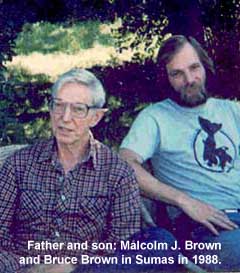
University of Washington Professor Malcolm J. Brown (1910 - 1992) walking in the garden with his grandaughter Laurel Brown, Seattle, WA, July 1986.
|
Additional reading -- Malcolm Brown's George Moore: A Reconsideration, also here on astonisher.com.
|
|
|
Parnell's panic was brief. The assassinations gave no signal for catastrophe. The danger lay in England, and his manifesto to the Irish people was more particularly for Englishmen. The Irish members walking about the London streets were momentarily nervous about the possibility of being lynched in another mass outburst like the Cheshire no-popery riots of 1850. Gladstone let these opportunities pass unexploited, being of a larger mold of statesman than Lord John Russell and Lord Derby, and thinking perhaps also of Parnell's proffered hors d'oeuvre. Englishmen did not come out into the streets in reaction to the Phoenix Park murders, but they did not forget them either.
At the same time Gladstone charged a stiff political price for the murders. He renounced the section of the Kilmainham treaty that promised a rapid relaxation of Irish coercion and shortly introduced a brand new coercion bill far more repressive than the expiring act. It provided not only for arbitrary arrest but also for conviction and imprisonment without jury trial in some types of Irish crimes. But along with his new Crimes Act, he forced through the House under urgent pressure the conciliatory new Rent Arrears Act drafted by Parnell and Healy in Kilmainham. Though strained, the Kilmainham treaty thus survived the Phoenix Park crisis.
III
The Irish reaction to the Phoenix Park murders is difficult to reconstruct. Historians sometimes assert that Dubliners were "angry" and "deeply shocked," conventional phrases not conveniently documented. Forster reported in the House of Commons that Irishmen were "incensed," but not nearly as much as they "ought to be." But he was no longer an eyewitness. Another witness, though very untrustworthy, described Dublin more credibly as "perplexed" and "greatly excited." No doubt the murders were deplored as a lunacy, pointless at best. But after that had been conceded, no nationalist was likely to weep over the demise of Thomas Burke; and while many were sorry for "poor Cavendish," they could console themselves with the reflection that his death, like Sergeant Brett's in the police van at Manchester, was an accident such as one must expect in war. Life was cheap in Ireland, and in 1882 especially so. Any Irishman could have named off a dozen of the year's homicide victims. The affair in Phoenix Park was special because political assassination, unlike agrarian outrage, was hitherto unknown in Ireland and because the social elevation of the victims and the novelty of the bloody details lent to the murders a distinctive fillip. Irishmen did remember the crime vividly, and its extraordinary sequel no less.
Charged with the duty of solving the murder mystery, Director Mallon of the Castle police was for a time baffled. To generate a spirit of healthy rivalry in the detective branch, the Castle appointed a second investigator, John Curran. He was baffled too. Many months passed and still no suspect had been brought to trial. Everybody was speculating about who the culprits might, and especially might not, be. Kickham declared that they were certainly not Old Fenians, but could well be Ribbon Fenians. Davitt was equally certain that they were not, pointing out that the Land League had celebrated the Kilmainham treaty with a triumphal torchlight victory procession not twenty-four hours before the murders. He wondered whether the assassins were even Irishmen: "There is not one instance in the long list of outrages in Ireland where the dagger was used. The shot-gun and the stick have always been the weapons employed."4 If swinging the shillelagh and shooting behind the shrubbery were ruled out, he thought an Irishman would choose next the blackjack, not the foreign bowie knife or stiletto, a morsel of minor particularist wisdom that found its way eventually into the cab-shelter conversation in the "Eumaeus" chapter of Ulysses. But he was inclined finally to think that the culprits must be Irish after all, probably a secret extermination squad of "Emergency Men," organized among the more reckless Ascendancy landlords to make sure there would be no interruption in the continuity of Irish coercion.
Davitt's and Kickham's guesses were off the mark. The Invincibles were not landlords, peasants, Texans, or Sicilians. They were ordinary Dublin "artisans," and not very secretive about their exploit. Confident that witnesses would not be anxious to appear in court against them, they felt tempted to drop dreadful hints into their conversation with friends. Detectives listening in the public houses and operating "after the manner in which the police often receive valuable information"5 were thus able to get some names on a list. One was a twenty-two-year-old stonemason named Joe Brady, a barrel-chested fellow of solemn mien and prodigious strength. Another was a master carpenter named Daniel Curley, a strong family man with numerous children at home. Another was a tavern keeper named Mullet, a hunchback whose physical resemblance to Joseph Biggar, M.P., was not overlooked by the English press. Another was a smalltime building contractor named James Carey, who had started life a hod carrier, achieved a rude respectability, and blossomed into a slum landlord, a town councilor, and a paragon of piety. Mallon arrested these men and many others, but everybody denied everything and all the suspects had to be released.
Immediately there followed a new wave of street assaults, political in motive. A juror who had voted for the guilty verdict in a political trial was set upon by men with knives and a sword cane and left for dead in the gutter. An informer was found murdered. A man was caught in an attempt to shoot an unpopular judge outside the Kildare Street Club. In each case police picked up small bits of new evidence and got fresh names on their list. At last, fishing with the standard police method of simulated omniscience, Inspector Curran hooked one of the minor suspects, a young man named Robert Farrell : "I put certain questions assuming all my suspected facts to have been proved. Farrell appeared to be very much surprised. . . . he was sure that someone had turned traitor and had given us information which had led to my questions. He further said that he did not intend to be left in when others were turning informers, and then made a statement which he signed."s Farrell had not been in on the Phoenix Park affair, having been unable to get off work that day, but his deposition was a full description of Invincible personnel and operations. With his information in hand, police suddenly rearrested the suspects, twenty-seven in all counting Farrell. This was in January 1883, eight months after the crime.
Mallon's next step was to find an approver who had actually been in Phoenix Park. Farrell had identified the two cabbies: the driver of the jaunting car was named Kavanagh, and the driver of the four-wheeled cab, a man named Fitzharris, better known as "Skin-the-Goat." Since the two seemed to be enemies, Mallon told each that the other was about to inform against him unless he informed first. Fitzharris was adamant, qualifying thereby as a genuine Dublin folk hero; but Kavanagh was frightened into giving evidence. He swore that the name of the other driver was "Skin," causing Fitzharris to shout from the dock: "Begone, you scorpion! Don't call me nicknames."' He swore that he had driven Joe Brady and three other Invincibles in his car to Phoenix Park late in the morning on the sixth of May. About sunset, whipping his horse at "furious breakneck speed," he took the same persons away from Phoenix Park on a long semicircuitous route, racing westward on the Palmerston road to Chapelizod and beyond, then south through Inchicore and Roundtown, then back into the city again, past Harolds Cross and Ranelagh, stopping at last at Davis' public house in Leeson Park, where Brady paid him three pounds for his rather full afternoon's service.**
Kavanagh's immortal travelogue from Phoenix Park to Davis' pub completed the structure of evidence ordinarily needed by the government to get guilty verdicts against the prime murder suspects. Mallon was not satisfied at that. The political climate for the Invincible trials now being prepared bore a resemblance to that of the Manchester trials. In both cases "everybody knew" that the accused had really done the deed, right enough. However thickheaded, the Invincibles pursued motives that were undeniably political rather than avaricious, just as at Manchester. The prosecution was thus put on notice to adhere to strictest protocol in the game of winning guilty verdicts. A failure of scrupulosity had won the government case in Manchester, but the victory had backfired in a catastrophic Irish political recoil. The same danger lurked in the Invincible trials. English law wisely stipulated that the testimony of approvers must be independently corroborated by other witnesses, a requirement not always convenient for the Castle detectives to honor without a bit of well-meant perjury here and there, as in the embarrassing conviction of the marine Maguire, the innocent bystander in the Manchester case. Mallon's intention was to buttress his evidence, not only with copious corroborators but above all with more and better approvers.
He considered it urgent to catch a new Invincible witness more weighty than Farrell and Kavanagh. Curley and Carey were two of the choicest suspects, and Mallon began to try pressure on their families. Rumors began to circulate in the Dublin neighborhoods that first the one, then the other was about to turn informer, rumors reaching even as far as the English press. The terrorized wives held anxious jail conferences with their husbands. The Curleys could not be broken, but the Careys showed some promise. Then the hearings featured one of Carey's slum tenants testifying that during the summer he had slipped into an old cockloft where Carey had often been seen to go and found there two very wicked-looking knives. A witness swore that, yes, such knives could possibly have made the fatal wounds. Another witness testified that he had chatted with Carey on a bench in Phoenix Park toward sundown on the sixth of May. Holding these trumps, Mallon drew up a second Kilmainham treaty; and Carey concurred.
IV
A debate now arose in the Castle between Mallon and Curran as to whether Carey's services were acceptable. Curran thought not; let him hang, was his feeling. Tempting rewards for evidence, "blood money," had been posted from the start, though for a long time there were no takers. But as soon as all the suspects had been jailed, witnesses suddenly found their tongues. Curran thought that he had already a redundancy of hanging evidence against all the Invincibles, including Carey, without any need of Mallon's bargain. But Mallon argued a couple of particular uses for Carey, and Curran was overruled by Lord Spencer. "Counsel for the Crown took a different view-I do not say wrongly," said Curran. "They were of opinion that the fact of a man of Carey's position turning . . . [queen's] evidence would be a warning to all who might in future engage in similar conspiracies." Attorney General A. M. Porter underscored the didactic motif: "This case should teach one lesson-that there could be no honor among members of such a society. When, as in this case, the fight was let in, when there was the faintest hint of knowledge known to those outside, the whole miserable union dissolved and the people were only too ready to come forward to save themselves at the expense of the wretched society which they had joined." Disloyalty to Her Majesty and betrayal to the hangman by fellow rebels were, in the government's presentations, an inseparable pair of events.
On February 17, 1883, Carey came into the preliminary-hearing room at Kilmainham, greeted his comrades warmly, then moved over and "took the witness table" instead of entering the dock. As theater, the moment stands with O'Connell's shattering of Davis in Conciliation Hall, or the Richmond jailbreak, or the defendants' speeches at Manchester. Those newspapermen who thought that Dublin was "stunned" and "infuriated" by the assassination itself had fired off their hyperboles prematurely. In the trials that followed, crime and punishment were only the official business; betrayal was the great theme. The prosecution highlighted the star witness' perfidy in the charge, the defense repeated it in the cross-examination. Carey was put on exhibition over and over, always the star actor, always in the one role, a leader who had enticed men into the movement, set them their task, then destroyed them. Led by the same Castle officials who had broken him, a chorus of indignation fixed him in Irish history as "the prince of informers," as the man who saved "his own life at the expense of his accomplices."lo In the unrelenting Irish hue and cry that pursued him, all danger of another Manchester fiasco for the government naturally vanished.
Backed by his impresarios-Attorney General Porter for the prosecution and A. M. Sullivan and his brother Donal for the defense-Carey made a permanent mark on the Irish imagination. It is not surprising that James Joyce, the foremost expert on the Judas theme in Irish history, should have found him an attractive literary morsel. Ulysses formulates Carey's signification with notable insistence. Mr. Bloom is our informant. Carey breaks into Bloom's thoughts three times in the course of his day. The first time, in the "Lotus-Eaters" chapter, Bloom ponders on the ostentatiously pious Carey as a contradiction or "Antiself": "That fellow that turned queen's evidence on the invincibles he used to receive the, Carey was his name, the communion every morning. This very church. . . . Wife and six children at home. And plotting that murder all the time."" Carey's mixture of piety with perfidy was a subject that never became tedious, either, to the Castle officials, who were grateful for all examples of what Mallon's admiring biographer called "the extraordinary mass of contradictions there is to be found in Ireland's wrongdoers."12 The second time Ulysses brings Carey onstage, in the bread-and-butter "Lestrygonians" chapter (p. 161), Mr. Bloom sounds the betrayal note in ifs richest inveracity, straight out of the attorney general's courtroom sermon and A Portrait of the Artist: "Like that Peter or Denis or James Carey that blew the gaff on the invincibles. Member of the corporation too. Egging raw youths on to get in the know. All the time drawing secret service pay from the castle."
But the third time Carey appears in Ulysses, in the "Eumaeus" chapter (p. 626), Mr. Bloom both asserts and blasts his homiletic use, expressing himself (as the chapter requires) in imaginative solecism and platitude:
- [There is always] the offchance of a Dannyman coming forward and turning queen's evidence-or king's now-like Denis or Peter Carey, an idea he utterly repudiated. Quite apart from that, he disliked those careers of wrongdoing and crime on principle. Yet, though such criminal propensities had never been an inmate of his bosom in any shape or form, he certainly did feel, and no denying it (while inwardly remaining what he was), a certain kind of admiration for a man who had actually brandished a knife, cold steel, with the courage of his political convictions though, personally, he would never be a party to any such thing, off the same bat as those love vendettas of the south-have her or swing for her. . . .
- Joyce's psychoanalytic reduction of Irish nationalism to "heroticism" we have seen in operation before. We have already noted, too, that one eyewitness definitively described Dublin's reaction to the Phoenix Park case as "perplexed."
Carey explained at the witness table that the Invincibles consisted of about fifteen members recruited from ex-Fenians, dropouts unable to share O'Leary's low opinion of terrorism. The purpose of the band was "to make history by removing tyrants." The organizer and commandant was called "Number One." The first Number One came from London to set up the shop in December 1881, after Parnell had been a couple of months in jail. The formation of the Invincibles thus added another crosscurrent in the general Irish turbulence during Forster's last months as chief secretary. The original Number One was shortly replaced by Captain MacCafferty, lately in command of the attempted arms raid on Chester Castle. The third, his name unknown to Carey, was tentatively identified by some witnesses as Patrick Tynan, a small shopkeeper in Kingstown. Carey told that the first task of the Invincibles was to "remove" Forster, but he lived a magic life and strolled untouched through twenty-odd ambushes. The final try had been set up on the Kingstown boat train after he had resigned, but he had gone on ahead on an early train. The task then shifted to the removal of Thomas Burke, a project suggested by an observation in the Freeman's Journal that with the change of Irish policy after the Kilmainham treaty, Burke "ought to be removed."
Carey stated that he was not in command on May sixth, however much the government cared to insinuate that he was. He was under orders from Dan Curley, and was scolded once during the afternoon for watching a polo game instead of attending to business. His assignment was to identify Burke when he entered the park. This he did by waving a white handkerchief to alert the killers and sending word up ahead that Burke was the man in the gray suit. He said that the assassins who met Burke and Cavendish on the path were seven, that Joe Brady wielded the knife, and that Burke's companion was unnoticed until he counterattacked Brady with his umbrella, then he too was murdered.
So then the juridical profession took its inning. The accused were tried separately and hanged separately, the same shattering iterative method that was revived for a similar purpose in 1916. The grinding occupied nearly four months. Joe Brady was the first to be convicted. On the morning of his execution, many hundreds gathered spontaneously outside Kilmainham, kneeling in the street to weep and pray; and when the black flag went up, a great keening wail arose from the crowd. Other gatherings were permitted for each execution; but when the mourners organized a mock funeral procession to Glasnevin bearing an empty coffin labeled "Daniel Curley," their demonstration was broken up by the police. After three quick convictions, the fourth trial ended in a hung jury. Two days later the case was retried with the same outcome. In another two days an unprecedented third trial found the defendant guilty. The next to be tried was Skin-theGoat, described in the newspapers as "looking like Father Christmas" with his white whiskers and ruddy nose. His defense lawyer's plea consisted in an invidious comparison between James Carey, who had waved a fatal white handkerchief in Phoenix Park, and the prisoner in the dock, who had merely driven a cab there following his mode of livelihood. Then came a great surprise: the prisoner was found not guilty. The jury panel was by now extremely jumpy. A fine of one hundred pounds was assessed against any man who refused a call to jury duty, and in the fourth trial the fine had to be levied against seventy-six thin-skinned panelists. After five death sentences, five of life imprisonment, and four more of long penal servitude, the government decided that it had made its point, and rested.
V
The Phoenix Park affair seemed closed. But not quite. Emigrating with his family to South Africa in disguise and under an assumed name, Carey was recognized on shipboard by a Donegal peasant named Patrick O'Donnell. With a pistol he shot Carey dead. For that unlawful act he was arrested and shipped back to London for trial. His defense was conducted by A. M. Sullivan, who gave the court a full description of James Carey's failings and a learned argument that under admiralty law it lacked jurisdiction. The jury and court were equally unmoved. O'Donnell was found guilty and hanged. With that, the total cost in lives taken by the Phoenix Park episode reached nine, the score standing at three for the civilians and six for the law. Many Irishmen were ready for a recess. But in the meantime Rossa's and "Red Jim" MacDermott's dynamite war had opened on a large scale in England. "Strike away!" said Rossa. "Keep striking till England is on her knees." English newspapers carried each day two equally sensational Irish columns side by side: one from Liverpool telling of the busy Merseyside projects of the Dynamitards; the other from Dublin on the extermination of the Invincibles by the hangman Marwood, a businesslike personage, familiar to many but admired by few, the model for Joyce's memorable hangman, Horace Rumbold.
And long after that, even, the Phoenix Park actors living and dead still came back to disturb the equanimity of Dubliners. "Like actresses," Mr. Bloom complained, "always farewell-positively last performance, then come up smiling again." Patrick Tynan fled to New York and made a life's career as "the mysterious Number One." The Irish-Americans shunned him as a bore, and his claim, though possibly genuine, was universally disbelieved. The slight injured his self-esteem. He wrote a book that contains much random information and, in addition, twelve appendixes setting forth the documentary evidence for his claim. It also contains purple passages that sound as though they were secretly composed in Dublin Castle to undermine the Irish nationalist movement: "And Mr. Torquemada Curran stroked his beard in his inquisitorial chair in the Castle, and began to dream of a judgeship in the near future. And the detective chief Mallon licked his lips with satisfaction, and purred his song of pleasure at the result of his labours. . . ." The statement is not factually inaccurate, but something is wrong in the tone. Later he wrote another book on the "great Irish Transvaal conspiracy," illustrated with facsimiles proving his own complicity therein. He became another of those dubious Irish hero-claimants, floating in limbo between imposture and honor, like Joyce's ghosts who may (or may not) have "got away James Stephens."
VI
Found not guilty of murder, Skin-the-Goat was rearrested in the courtroom and charged with conspiracy. Under Gladstone's new Crimes Act, he was tried without a jury, convicted, and sentenced to prison for life. After many years his release was won by the Amnesty Association, that branch of Irish nationalism that never lacked for an issue. Joyce exhibits him at length in the "Eumaeus" chapter of Ulysses. He is "said to be" the famous Invincible, but Mr. Bloom "wouldn't vouch for the actual facts" and is forced merely to assume "that he was he." The historical Skin-the-Goat was not deficient in statuesque solidity, but this portrait is, once again, of a man like Tynan who is not quite real. Skin-the-Goat's style of patriotism in Ulysses repeats exactly that of the Fenian, "the citizen," in the earlier "Cyclops" chapter. That Joyce felt compelled to rerun an effect already made suggests that his repellent Irish patriot had passed beyond disciplined artistic control into a gentle phobia.***
VII
The most vividly remembered of the hanged Invincibles was Joe Brady. He was fabulous, a youth of "almost Herculean strength" as the attorney general described him. To some he was a hero, for in staking his life he had had nothing to gain. He knew how to "keep his mouth sealed," he had the bad luck to pick the wrong experiment, and so on. And yet the martyr's crown and the hero's oak-leaf garland looked somewhat grotesque on a cutthroat. Well-intentioned or not, he initiated a long chain of Irish mischief, and his chief accomplishment was his demonstration that every other political methodology was superior to his own. He was dead or alive an equivocation. Joyce's eye caught this trait and found it useful.
Who else but Joyce could have discovered for us that the word "corpse" contains the anagram "cropse"? Like Yeats, he had a literary journeyman's specialized interest in the accumulated store of Irish transfiguration tropes. Indifference on his part would have spared him much pain, for he was unhappy with them all. He too was distressed at the success with which T. D. Sullivan's "God Save Ireland" had swept the popular field, and he gave it the full quota of three satiric barbs that Ulysses allots to the standard patriotic symbols. A rival for national anthem, "The Croppy Boy," a lugubrious song about the yeoman terror of 1798, pleased him no better. Rendered in bass by Ben Dollard in the "Sirens" chapter, it highlights the impromptu lunchtime musicale at the Ormond Hotel bar. ("They know it all by heart," says the nonjuring Mr. Bloom. "The thrill they itch for.") For himself, the ballad brings on, first, a spell of lascivious fantasy (by the formula that Irish nationalism is a type of sexual mischief); then prudential caution ("All the same he must have been a bit of a natural not to see it was a yeoman's cap"); and finally Joyce's unrivaled closure of the subject.
In preparation for Joe Brady's appearance, Ulysses assails Robert Emmet's exalted place in Irish symbology with two savage ironies. Mr. Kernan, the frock-coated drummer in the "Wandering Rocks" chapter, humming "The Croppy Boy," passes down James Street toward St. Catherine's Church and responds parrotlike to the cue of Emmet's place of execution seen ahead in Thomas Street. ("Down there Emmet was hanged, drawn and quartered. Greasy black rope. Dogs licking the blood off the street when the lord lieutenant's wife drove by in her noddy.") But Kernan's real errand is to reach a corner on the quays where he can see at close hand Lord Lieutenant Dudley pass with his entourage. ("His excellency! Too bad! Just missed by a hair. Damn it! What a pity!") -- a variation on a theme borrowed from Yeats's "September 1913." The recapitulation of these motifs in "musical statement" provides the comic denouement of the "Sirens" chapter. Suffering flatulence blown up to critical pressure by the festival of patriotic song at the Ormond bar, Mr. Bloom flees to the street, then lets his mind drift back on the tune of "The Memory of the Dead," another contender for national anthem. He sees an engraving of Emmet in an antique-shop window and recites his two farewell sentences with the blessed relief of crepitus marking each punctuation point.
Into this medley of Emmet, croppy boy, and "who fears to speak of ninety-eight?" Joyce inserted as necessary to the composite Irish political martyr Joe Brady's fifteen stone of muscle. He first appears in the "Cyclops" chapter, which Joyce instructed Stuart Gilbert to classify on his chart as follows:
- Organ: Muscle
- Art: Politics
- Symbol: Fenian
"The citizen," Skin-the-Goat, and Joe Brady hold equally valid credentials under this scheme. To particularize Brady, Joyce invented an account of his hanging and the "consequent scission of the spinal cord" by which "per diminutionem capitis" his corpse generated a striking tumescence "in articulo mortis." As with the story of James Stephens' escape at Malahide in orange blossoms, another Joycean signature too good to be true, Joyce cited folklore for the source of his imaginary prodigy.
Later, in the "Circe" chapter, "the citizen" has chanted a lyrical maledictive prayer:
- To slit the throat
- Of the English dogs
- That hanged our Irish leaders.
Enters the croppy boy, fused with Parnell's 1798 Wicklow peasant who was flogged to death across the belly at the cart's tail. He wears "the rope around his neck" and "gripes in his issuing bowels with both hands," singing, "I bear no hate to a living thing." Hangman Rumbold advances with a "gladstone" bag to do his "fell but necessary office." Strangled on the gallows, the croppy boy expires and is transformed into Joe Brady the Invincible: "A violent erection of the hanged sends gouts of sperm through his death clothes to the cobblestones." Three women in the crowd "rush forward with their handkerchiefs to sop it up." The ladies who conserve the regenerative treasure in this considerate manner recall those who actually did dip their handkerchiefs in Emmet's blood flowing down the cobbles of Thomas Street. Joyce gives them names. They are Mrs. Bellingham, Mrs Yelverton Barry, and the Honorable Mrs Mervyn Talboys, three fantasy Anglo-Irish females in Lord Dudley's set who, a short while before were surrealistically flagellating Mr. Bloom. As the ultimate consumers of the pure essence of national rebirth, they sharpen Joyce's critique of the standard patriotic transfigurations (such as Yeats's "Rose Tree") in which the bloody visceral component of the death mystique is, in his opinion, too softly sounded.
VIII
A late-Victorian visitor to Madame Tussaud's wax museum might see a tableau of the Phoenix Park murders displaying the true jaunting car purchased from the informer Kavanagh and, of special interest, a pair of "long dissecting or amputating knives" bought from the London surgical supply house that had sold the murder weapons themselves. The famous dissecting knives intruded into the case late, for the bowie knife or stiletto theory had served adequately up to the time of the Invincible trials. Offhand the new detail might seem unimportant; if Joe Brady had been armed with a pair of seamstress' scissors, the result could hardly have been different.
When the Castle detectives were bargaining for Carey's life, they originally intended to exhibit him as proof to Irishmen of what Stephen Dedalus called "the indispensable informer" in the ranks. A second object, not featured in the genial memoirs of the detectives but clearly stated in the newspapers, was to try to establish a connection between Carey and the Land League, or even bigger game. Asked in court about the Invincibles' source of money, Carey replied that "everybody assumed" that it could "only have come from the Land League," a statement legally worthless but valuable for other purposes.
The dissecting knives were first heard of in public on February 3, 1883, when Carey's tenant testified to seeing them the previous August in the cockloft. And two weeks later, when Carey turned queen's evidence, the knives made an exciting ornamentation to his testimony, for he swore that he received them from a Mrs. Frank Byrne, who had brought them to Dublin from London secreted "in her petticoats." And who was her husband, Mr. Frank Byrne? Beyond question he was an official of the Land League, and the newspapers identified him further, with enthusiasm but not with accuracy, as "Mr. Parnell's private secretary." Captivated by this thread of evidence, the English public was alerted to expect that it would shortly receive news that "a member of Parliament was at the head of the conspiracy." Here we find the first trace of the grandiose dream that fixated English political ambitions for many years to come, to "solve the Irish problem" by proving Parnell implicated in the Phoenix Park murders. At the outset the project got off to a bad start. Moved by some remnant of morality, Carey failed to cooperate as expected, perhaps as promised. For work of misgoverning Ireland!" Then turning deftly back to the spirit of the Kilmainham treaty, he offered the prediction that all like Forster whose single idea was coercion of a brave, generous, and impulsive people would shortly be disowned by Englishmen themselves.
English members who heard the debate complained of Parnell's "evasiveness." In beginning his speech, he had warned them that nothing he could say would "have the slightest effect upon the public opinion of this House or upon the public opinion of this country [England]." But he was accustomed to expect their incomprehension, he said, and to "rely instead upon the public opinion of those whom I have desired to help, and with whose aid I have worked for the prosperity and freedom of Ireland." The confidence was generously reciprocated. The Irish members greeted his speech with prolonged cheers, and Davitt thought it "the best and noblest speech an Irish leader ever spoke in any English parliament." At home his supporters had recently launched a Parnell Tribute to help him out of a financial difficulty-he was about to lose Avondale through foreclosure, thanks to parliamentary reforms for which he was himself responsible. The tribute now took on the enthusiasm of an agitation, and money poured in. Gladstone sent an English Catholic as special emissary to Rome to persuade Leo XIII that the Irish clergy should be forbidden from participating. A papal rescript against the Parnell Tribute went forth, but it was immediately identified as English-inspired. The money then flowed in more copiously than ever. In December 1883, a few months after the finish of the Invincible hangings, Parnell was invited to a great mass meeting in the Rotunda to be handed a check, a free gift of the people of Ireland, for thirty-seven thousand pounds. He pocketed the check without comment. His listeners, somewhat disappointed, thought that for so large a sum they were entitled to just a bit of effusiveness.
Next chapter...
"The Politics of Irish Literature" © Copyright 1973 Malcolm Brown
* It contained among the usual nationalist pronouncements a paragraph on import duties that must be unique in the anthology of Black Hand literature: "We are convinced that no true prosperity can exist in Ireland so long as England possesses her customhouses, these allowing her manufactures to pass into Ireland duty free, thereby leaving our Irish mechanics unemployed. . . ." See P. J. P. Tynan, Irish National Invincibles, p. 273.
** Kavanagh's itinerary forms the basis for a familiar passage in the windy newspaper office of Ulysses, in which the cub reporter Ignatius Gallaher achieved a world-paralyzing news scoop by cabling to the New York World on the afternoon of the sixth of May the entire story of the Phoenix Park murders. As Robert M. Adams has pointed out, Joyce's low opinion of the newspapers as a guide to truth is hidden in the slip-ups in his yarn. See Robert M. Adams, Surface and Symbol (New York: Oxford University Press, 1962), pp. 162-63.
*** Among Skin-the-Goat's twice-told banalities lies hidden one startling new formulation: "Brummagem England was toppling already, and her downfall would be Ireland, her Achilles heel, which he explained to them about the vulnerable point of Achilles, the Greek hero-a point his auditors at once seized as he completely gripped their attention by showing the tendon referred to on his boot." Richard M. Kain once noted that Joyce's farcical fanatic appears to have augured the future with a more astute vision than his gifted creator. See Joyce, Ulysses, pp. 605, 62.4-2.5; and Kain, Fabulous Voyager (Chicago: University of Chicago Press, 1959), p. 176.
| New CD-ROM LIBRARY EDITION |
|
|
 |
"Great book. Fascinating..."
-- Jack Weatherford,
author of
The History of Money
|
The History of the Corporation
by Bruce Brown
* READ free excerpts on astonisher.com
* BUY the complete book at the astonisher.com store
|
|
|
© Copyright 1973 - 2008 by Bruce Brown
and BF Communications Inc.
Astonisher and Astonisher.com
are trademarks of BF Communications Inc.
BF Communications Inc.
P.O. Box 393
Sumas, WA 98295 USA
(360) 927-3234
Website by Running Dog 
|