Chapter Twenty-four
Literary Parnellism
IN IRISH LITERARY tradition, in Yeats, in Joyce, in O'Casey, an operatic finale is obligatory for Parnell. The strains of Siegfried's funeral march ascend fittingly out of the denouement, for the Wagnerian effect was "really there." We must remind ourselves, though, that the story had a beginning and middle as well as an end, and that the end itself was equivocal. As we watch the curtain call of all the dramatis personae, naturally the leading man will come first to the footlights, followed by Captain and Mrs. O'Shea, by Gladstone and the Nonconformist English voter, by Archbishop Croke and the mob at Castlecomer, by Healy and the Bantry band -- all of them stars with a top billing. But then come the other actors more quickly forgotten: Pigott and his accomplices, the Times, the attorney general, the home secretary, and Sir Rowland Ponsonby Blennerhassett (some find it very hard to keep in mind the frame-up); followed by "the hillside men," whose unexpected entry into the last scene when Parnell called them to his side suddenly set afire Healy's previous indifference to the sexual scandal; and at last Lalor and O'Leary, who had repeatedly said for two generations that the English party system and the circumambient air of Westminster would corrupt any Irish patriot and blunt any Irish parliamentary assault.
As I have pointed out, the Fenians were pleased to magnify the revolutionary nationalism embodied in Parnell's name, while they simultaneously combated the destructive factionalism that fed at the same source. Their campaign against the "nine years's vituperation" of the Split gradually took hold of Irish politics. Yeats himself became in time almost mellow toward Tim Healy, and he looked with an adulation that some think excessive upon the most formidable champion of the "Sullivan gang" (his own phrase), T. D. Sullivan's grandson, the "pitiless" Kevin O'Higgins. The Sullivan gang, in reciprocity, made Yeats a senator of the Irish Free State. When the homicidal face of the Split had passed into slow eclipse, the Fenian slogan, "Parnell is dead," came true at last. In literature, though, Parnell was patently anything but dead. Parnellism as a literary phenomenon enjoyed a vigorous life history of its own, with many surprises.
The first literary reaction to Parnell was not adulatory. George Moore and Lady Gregory begrudged him more than the minimum of formal respect that was due to his power to injure them as great Irish landlords. I have described how George Moore, indulging his Balzacian impulse to record clinically the nerve spasms of his panic-stricken fellow landlords, had meanwhile held himself ready for the surrender. Lady Gregory was less public in articulating her attitudes, and they have to be reconstructed.
While still Miss Augusta Persse she had watched the opening of the land war from her family's great estate at Roxborough, county Galway. In March 1880 at age twenty-eight she married a neighboring sexagenarian landlord and colonial administrator, Sir William Gregory, and moved over to Coole Park. It too was under Land League siege. Her biographer tells that the Gregory family did not carry firearms for protection, explaining that they had no reason for fear because "Coole was on the side of the people" always. This explanation credits Sir William's genial urbanity, but it forgets the Gregory clause and the famine clearances. Sir William had been a governor of Ceylon, but he was apparently an unorthodox colonialist, for in visiting Egypt he and Lady Gregory expressed open sympathy for the native revolutionists. Their liberality to the Egyptian fellahin did not extend to Ireland. During the debate on the first Home Rule bill in 1886, Wilfred Blunt recorded a conversation with Lady Gregory about the Irish crisis:
- Called on Lady Gregory, who is growing very bitter against my politics, if not against me. It is curious that she, who could see so clearly in Egypt when it was a case between the Circassian Pashas and the Arab fellahin, should be blind now that the case is between English landlords and Irish tenants in Galway. But property blinds all eyes, and it is easier for a camel to pass through the eye of a needle, than for an Irish landlord to enter into the kingdom of Home Rule. She comes of a family, too, who are "bitter protestants," and has surrounded herself with people of her class from Ireland, so that there is no longer room for me in her house.
This attitude was certainly not final, but it does chart her point of origin in "bitter" Protestantism and in eyes "blinded" by ownership of a house shaken, as Yeats's indignant poem said, by the land agitation.
Each of these two wounded Connaught landlords felt an understandable urge to write off Ireland and go away. Lady Gregory described herself as an emigrant and set up a London salon. After she was widowed in 1892, she put her son in Harrow and took up professional editorial work in England, preparing her late husband's family archives for publication. Meanwhile, Moore systematically eradicated his Irish past and proclaimed himself more English than Dickens, citing the British success of his new novel Esther Waters as proof. It was not until some years later that W. B. Yeats, acting as a talent scout for the Irish literary movement, discovered him and Lady Gregory, found them work to do, and ordered them home.
|
|
Table of Contents
|
|
Astonisher.com is pleased to offer The Politics of Irish Literature by Malcolm Brown, complete and free for your personal use.
Praise for
The Politics of Irish Literature |
 |
|
"This brilliant study of the intersection of politics and literature in Ireland amounts to a dazzling portrait gallery. Reading it one feels about one the breath, warmth, and passions of the dead all come alive again."
-- Sean O'Faolain in the Manchester Guardian
"Mr. Brown's masterpiece has made me want to hire a nearby housetop and recite whole chunks to every passerby..."
-- Michael Foote in the London Evening Standard
"The author of the best book on George Moore now gives us what is in all likelihood the best book on the politics of modern Irish literature."
-- Virginia Quarterly Review
|
|
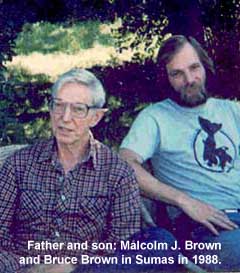
University of Washington Professor Malcolm J. Brown (1910 - 1992) walking in the garden with his grandaughter Laurel Brown, Seattle, WA, July 1986.
|
Additional reading -- Malcolm Brown's George Moore: A Reconsideration. Also see Bruce Brown's commentary on The History of the Corporation for Malcolm Brown's contribution to that work.
|
|
|

II
The first literary writer to sense the literary potential of the Parnell story was Standish O'Grady. To the discoverer of Cuchullain thus belongs the second and equal honor, the discovery of Parnell. Socially oriented like Moore and Lady Gregory, he too had been wrathful in the beginning, as we have seen. But afterward a chance meeting with the dying Chief moved him to pity. The violent clerical explosion that accompanied the Split had stirred him to feel almost fellowship with the hard-pressed fellow Anglican. He suspected, too, that Parnell was harmless, "no out-and-out revolutionist," and that he must all along have "planned out ways and means for preserving the Irish gentry, not at the cost of the Irish peasant but at the cost of the Imperial Treasury," envisioning Wyndham's Land Act two decades ahead of the event.
O'Grady had attended the Rotunda mass meeting after the close of the sessions in Committee Room Fifteen, and he noted that Parnell was "illdressed, his hair was long and untrimmed, he was nearly bald, the rigid back and upright carriage were gone, he was bowed in the shoulders, his face was emaciated, he looked like a man who would not last long." A few weeks later he met him driving along a country road in Wicklow. It was a cold day and Parnell, he said, was "muffled in the most copious manner [with] quite a hill of rags, cloaks, and shawls." The two men talked for ten minutes, or rather Parnell talked, "talked almost altogether about his mines and quarries, on that subject he was almost cracked." In tune with Thomas Davis, Parnell had ordered Avondale to be "pierced with shafts" and told O'Grady "he believed that at last he had struck iron, and was going to do great things in the bowels of the earth." Again O'Grady noted the "pallor of death" on his "worn and hollow face."
After Parnell had fulfilled these prognostications and died, O'Grady remembered him fondly. A little book of historical essays called The Story of Ireland, published just in time to catch the disaster of the second Home Rule bill, is packed with a miscellany of sharp new paradoxes. He admired the "cheerful, careless" rapacity with which the Viking raiders had gutted the Irish tombs of their treasure; he admired Cromwell; he admired the yeoman militia who crushed the rebellion of 1798. He also admired the dead Parnell. Concerning the scandal, he predicted that history would reverse the verdict of the hysterical passing moment:
- The offense which led to his overthrow and then to his death will not militate against his reputation in history. The Muse of history loves best her imperfect heroes. That is curious, but a fact, and the imperfection found in Parnell is just that which, instead of showing as a blot, becomes, when seen through softening mists of time and memory, something that radiates a pathetic beauty. This too is curious, but a fact. Posterity will easily forgive Parnell and like him probably all the better for his weakness.
This was a bold and original interpretation, the first sketch of literary Parnellism.
O'Grady concluded his Parnell vignette with a second originality, pitched in a more exalted tone. Always a student of heavenly melodrama, he described the graveside scene at Glasnevin in the falling October dusk:
- Again I state a fact; it was witnessed by thousands. While his followers were committing Charles Parnell's remains to the earth, the sky was bright with strange lights and flames. Only a coincidence, possibly; and yet persons not superstitious have maintained that there is some mysterious sympathy between the human soul and the elements, and that storms and other elemental disturbances have too often succeeded or accompanied great battles to be regarded as only fortuitous. Truly the souls of men were widely and deeply troubled that night, electrical and high-wrought in the extreme.
Modern Yeatsists will instantly recognize O'Grady's words; his eschatological meteorology was destined to see hard literary service. Not for a long time to come, though.
III
In the beginning Yeats watched Parnellism remotely, a casual and mildly interested spectator. His aloofness is not surprising, since O'Leary himself did not become a Parnellite until December 1890. The Sligo Pollexfen clan was naturally anti-Parnell; and John Butler Yeats was another Irishman to be called home by the outburst of the land war in 1880, threatened with poverty at the loss of his Kildare rents. Yeats fils at age fifteen was too young to comprehend the land war itself, but he had reached seventeen and eighteen at the time of the imprisonment of Parnell, the Kilmainham treaty, the Phoenix Park murders, and the hanging of the Invincibles. The Yeatses were living in Roundtown that year, and if young Willy had been on the roadway one May evening after teatime he could have seen the cabby Kavanagh drive by at high speed with Joe Brady clinging to his outside car. On all this passionate historical drama his published writings are totally silent.
In 1885, as we have noted, Yeats began his study of Young Ireland and stood "in the presence of his theme." Two years later, after seven years in Ireland, the Yeatses moved back to London again, at first briefly to South Kensington and afterward to Bedford Park, Chiswick, for a long residence. Yeats now meditated his theme in the British Museum. He composed Irish verse, anthologized Irish fiction, and assembled from published folklore a book about Irish fairies. Meanwhile Irish history continued as always to produce its regular quota of startling episodes. The Times facsimile and the Plan of Campaign came to pass, and the special commission set up shop. Though Yeats was pleased to write at this time, "with Irish literature and Irish thought alone have I to do," he allowed these events also to pass him by unperceived, or at least, unrecorded in the published letters.
Up to the moment of the Split, Yeats's letters show an attitude toward the living Parnell that can only be called indifferent. Through O'Leary's recommendation, he became literary correspondent for the Boston Pilot, published by John Boyle O'Reilly, a Fenian alumnus of English prisons. In the three years beginning with 1889, nineteen letters were sent forth and printed under the by-line, "The Celt in London." In all these pieces, which combined to make a book of modest length, the very term "Home Rule" was taboo, and Parnell's name appeared but twice, once in a list of the prepublication subscribers to O'Leary's book on Fenianism, once again in a simple notation of passing time, in the phrase, "down to the death of Parnell." Yeats's private letters are equally indifferent. As soon as the family moved back to London in 1887, he told of hurrying to the House of Commons in order to listen to the Irish oratory. He was particularly taken with Tim Healy's "rugged, passionate speech," denoting "a good earth power." The one trip was seemingly all he required. The first appearance of Parnell's name in the Wade collection of letters does not occur until four years later, after the Split and the North Kilkenny by-election, in a letter to John O'Leary dated January 22, 1891. It restates approximately O'Leary's own position of the time, and while acute, it also carries a toneless quality of ventriloquism. Yeats said:
- It seems as though Parnell's chances had greatly improved these latter weeks. His last two speeches were wonderfully good. I wish I was over in Ireland to see and hear how things are going. The Hartlepool victory should help him by showing that his action has not injured the cause over here as much as people say. [Hartlepool was the Liberal party's first English byelection victory after the Split.] My father is bitterly opposed to Parnell on the ground chiefly, now, of his attacks on his followers. To me, if all other reasons were absent, it would seem plain that a combination of priests with the "Sullivan gang" is not likely to have on its side in political matters divine justice. The whole business will do this good anyway. The Liberals will have now to pass a good measure if any measure at all-at least so I read the matter.
Richard Ellmann quotes a similar expression of this sentiment in another letter to O'Leary not in Wade, presumably written at about the same time.
While the Parnellite storm mounted to its final fury, Yeats relapsed once more into silence, which lasted nine months. Late in the summer of 1891 he went to Ireland on occult and literary errands. He had by then established a London publishing connection with W. E. Henley's journals, an unsatisfactory outlet because both English and "ninetyish," two poetic themes he already judged to be nullities. He looked to "Ireland alone," but he had no Irish publisher. He had been rebuffed by the Nation, apparently because he was identified with O'Leary. T. D. Sullivan had featured a clerical attack against the godlessness of his anthology of scenes from Carleton. Probing for new Irish outlets more distinguished than the Vegetarian or the organ of the Gaelic Athletic Association (defunct), he called at the United Ireland editorial office in Dublin. The welcome he received was effusive, for in August 1891 the future of Parnellism was not so sanguine that United Ireland could afford to slight any opportunity of extending its list of friends. Yeats wrote to O'Leary that the editors were "ready for articles" and to Katharine Tynan he upgraded the phrase to "anxious for literary articles." For Parnell's paper he wrote twenty articles with his normal taboo still virtually intact, except for one statement of the anti-Split line and one attack on Healy.
His silence on Parnell was broken by a sudden, brief, and resounding burst. The same angry black-bordered Saturday issue of United Ireland that demanded revenge upon Sexton, O'Brien, and Healy for the murder of the Chief contained dirges for the occasion written by poets of O'Leary's group, now banded into the Young Ireland League. Katharine Tynan and Lionel Johnson were represented. Among them too was W. B. Yeats, who offered a poem entitled "Mourn-and Then Onward," a doctrinaire statement of the Fenian line. He thereupon disowned it. He never reprinted it, justifying himself no doubt with the knowledge that it is not a good poem, though he did reprint other occasional pieces equally flat (for example, "Shepherd and Goatherd"). And he never attempted to strengthen it with the revisions that reclaimed other unripe efforts.
On Sunday, the very next day after "Mourn-and Then Onward," Parnell's corpse arrived in a sealed lead casket at Kingstown at six in the morning. His poet-encomiast happened to be on the Kingstown pier. "I was expecting a friend [Maud Gonne], but met what I thought much less of at the time, the body of Parnell." Yeats did not go to the funeral, for (at age twenty-six) "being in my sensitive and timid youth, I hated crowds," besides hating "what crowds implied,"14 and thus to his later chagrin he missed the cosmic skyrockets. He seems to have watched the procession, however, for on the same Sunday he wrote his sister Lily a colorful report:
- I send you a copy of United Ireland with a poem of mine on Parnell, written the day he died to be in time for the press that evening. It has been a success.
- The Funeral is just over. The people are breathing fire and slaughter. The wreaths have such inscriptions as "Murdered by the Priests" and a number of Wexford men were heard by [a] man I know promising to remove a Bishop and seven priests before next Sunday. Tomorrow will bring them cooler heads I doubt not.
- Meanwhile Healy is in Paris and the people hunt for his gore in vain. Dillon and he are at feud and the feud is being fought out by the Freeman and National Press in diverse indirect fashions.
- Tell Jack I have no more fairy articles at present but will get some done soon.
This occurrence of Parnell's name is the second to appear in Wade's edition of the Yeats letters, and the last occurrence of substance. His little youthful flurry of Parnellism he had now put behind him. Two months later; Parnell's name occurred a third time when he reported to O'Leary that he had written to a certain Lavelle about stirring up the Young Ireland League and that he had received the reply-"they were waiting until things had settled down after Parnell's death." To find the fourth occurrence in his letters, we must skip ten years forward.
It was no effort for Yeats to embrace the Fenians anti-Split line proclaiming that "Parnell is dead" and "you cannot bring him back to life," Fenian slogans that aimed to cool down the popular debate whether Parnell had or had not been "hacked to pieces" by his stalwart lieutenants. At the first appearance of O'Grady's new line on Parnellism, it was Yeats himself who took the trouble to scold him for trouble mongering:
- The Story of Ireland [is] an impressionist narrative of Irish affairs from the coming of the gods to the death of Parnell, which has aroused acrimonious controversy, and is still something of a byword, for Ireland is hardly ready for impressionism, above all for a whimsical impressionism which respects no traditional hatred or reverence, which exalts Cromwell and denounces the saints, and is almost persuaded that when Parnell was buried, as when Columba died, "the sky was alight with strange lights and flames."
O'Grady might be ready to be "almost persuaded" about the heavenly portents, but plainly Yeats was not. His Parnellism still lay in the remote future.
Years passed, and toward the turn of the century he is found condemning Parnell for his materialism. Parnell's great effort, he said, was really un-Irish and utilitarian: "the Celt, never having been meant for utilitarianism, has made a poor business of it.... " The literary movement's initial Dublin theater successes led him to speculate that Parnell's death might be the work of an all-wise but devious Providence bent on creating an Irish theater: "Our [dramatic] utterance was so necessary that it seems as if the hand that broke the ball of glass, [i.e., destroyed Home Rule] that now lies in fragments full of a new iridescent life, obeyed some impulse from beyond its wild and capricious will." If the reader will turn back now and reread Yeats's stirring public message on Irish history that I used for the epigraph of this volume, he will be in a position to learn what his private understanding of the "important destiny" of Ireland was: it was his completion of the manuscript of The Shadowy Waters.
In 1900 Redmond announced that he had the cash in hand to build the great Parnell monument in Rutland Square. The project carried no political interest for Yeats. But one day he read in the papers that the lord mayor had gone to America to shop for a Parnell statue, and he was seized by the reasonable fear that the new memorial would prove to be another in the sculptural taste of A. M. Sullivan and in the style of Father Mathew's marble effigy on O'Connell Street. He wrote a letter to the press demanding that a commission of artists be made responsible for the artistic design. Dubliners were read a lecture, strictly aesthetic: "The good sculptor, poet, painter or musician pleases other men in the long run because he has first pleased himself. Work done to please others is conventional or flashy and, as time passes, becomes a weariness or a disgust. Yours truly W. B. Yeats." Thereupon his silence on the subject of Parnell once again descended, lasting this time for more than a decade.
IV
Without prologue there suddenly appeared in Dublin the most daring addition to literary Parnellism since O'Grady's original discovery fifteen years before: Lady Gregory found Parnell's tomb empty, so to speak. In 1911 the Abbey Theatre produced her one-act play, The Deliverer, about the Egyptian captivity of the chosen people. When the first Israelite speaker opens with, "I'm near starved with the hunger," the Kiltartan dialect bespeaks an Irish allegory. With study, the modern reader will discern that one of the peasant characters represents Dillon, that another carries the loose-lipped name of "Dan," that another one is sufficiently revolting to stand for Healy (who had just donated five pounds to the Abbey endowment fund), and that a fourth, called "Malachi," is some sort of a poetical Parnellite.
After a leisurely dramaturgical preparation, enters on stage MosesParnell, called "The King's Nurseling" because of his favored position in Pharaoh's household. On overhearing a conversation that reveals his parentage to be Israelite instead of Egyptian, he "then and there" resolves to set his captive people free: "What way could I have an easy mind in it, and my own people being under cruelty and torment? It is along with you I will stop." As his scheme for flight matures, Healy and Dillon are at first effusively appreciative, relishing especially the coarse materialistic pleasures to come: "Quality fish it would be easy to be eating. The bones of them will melt away in the fire. The smiths do be forging gold the same as iron. . . . We will lift him up on our shoulders passing every bad spot on the road! We'll have a terrible illumination for him the day we will come to our own! We will, and put out shouts for him through the whole of the seven parishes! His name will be more lasting than the cry of the plover on the bog!"
But after a few more lines of dialogue they turn suspicious and resentful. He had neglected to give them a "red halfpenny" to drink his health with, and "according to what I'm told, he's a regular Pagan." So they stone him to death and throw his body to "the King's cats" -- "They'll have the face ate off him ere morning." These sacred carnivores, kept to honor some mysterious superstition, appear to have arisen out of Lady Gregory's bitter Protestant imagination; and Malachi moralizes in a speech marked for sardonic delivery: "They [the Egyptians] were said to give him learning and it is bad learning they gave him. That young man to have read history he would not have come to our help."
Then a prodigy happens. Bleeding and lame, Moses-Parnell rises up and crosses the stage while Malachi delivers the curtain speech: "Wandering, wandering I see, through a score and through two score years. Boggy places will be in it and stony places and splashes-and no man will see the body is put in the grave. A strange thing to get the goal, and the lad of the goal being dead. (Another screech of the cats. He laughs.) I wouldn't wonder at all he to bring back cross money to shoot the cats. He will get satisfaction on the cats (Curtain)." An appendix to the published play explains that ten years earlier Lady Gregory and Yeats had heard an old man chanting an incantation in Gaelic which was translated for them: "He is living, he is living," meaning Parnell. When they inquired of a policeman what he meant, they were told: "There are many say that. And after all no one ever saw the body that was buried."
By chance, The Deliverer was the first Abbey play to experiment with the revolutionary new scenery and lighting ideas of Gordon Craig, en route to fame in Moscow. Audience response dwelt mostly on the scenery, so that Lady Gregory's message about the risen Parnell did not get through. The contemporary press reports pasted in William Henderson's scrapbook at the National Library pronounced the allegory unfathomable. The Freeman's Journal concluded that it intended "an application wider than the actual historical one" but it did not speculate what it might be. The Daily Express said it was "somewhat peculiar"; the Irish Times, being unfamiliar with Cairbre Cat-Head, said it was "unclear." The sour and compulsive playgoer Joseph Holloway, after condemning Craig's "freak scenery and lighting," condemned the play as well: "The audience looked on in wonder during the progress of The Deliverer, all wondering what it was about and why all the Egyptians spoke Kiltartan, like the natives of the region of Lady Gregory's [home]." It was all in all "beneath contempt," he said, and he enthusiastically seconded the actress Sara Allgood's characterization of it as "tripe."
From this point of vantage it seems plain that Lady Gregory's object in The Deliverer was to borrow Parnell's luster to refurbish the image of her social class. Since history clearly identified him with agrarianism, the "contrary" of the Protestant landlord, her claim might be supposed a daring adventure into paradox. In military metaphor her stratagem would be called turning the enemy's flank; or in the language of the man in the street, confusing the issue. But the little play happened to be devoid of literary force and so it sank into oblivion, message and all; and more years passed.
Yeats had not forgotten it, though. Among the poems of Responsibilities (1914) appeared his first Parnellite poem since 1891, "To a Shade," an occasional piece. The occasion was not at all Parnellite, but an encore on the adventures of Sir Hugh Lane, Lady Gregory's nephew. I ask the reader's pardon for one last mention of his offer to donate paintings to the Dublin Corporation, and of its rejection when the would-be benefactor and his proffered gift were enthusiastically denounced by the philistine "pack" gathered around William Martin Murphy. The poem advises Parnell's "shade," if it should return to Dublin, to visit only the harbor:
- drink of that salt breath out of the sea
- When grey gulls flit about instead of men,
for in the town "they" -- the Sullivans (not yet Yeats's friends) -- "are at their old tricks yet."
Following up Yeats's discovery in "To a Shade," the device of the revenant ironique expanded into an Irish literary fad. In 1916 George Moore used it in The Brook Kerith, not upon Parnell but Christ. Lennox Robinson in The Lost Leader (1918) took Christ out and put Parnell back in again, working from Moore's model and with Moore's hearty applause. Like Moore's Christ, Robinson's Parnell is not dead, only hiding; and what a rare setting for soliloquy when he re-emerges to comment upon the contemporary scene: ". . . I feel there is in Ireland a vague passion, an objectless desire. It's the great moment that comes but once or twice in a nation's history, it's when the water stirs, it's when the mind of a nation is broken up, is ready to be moulded, is soft clay, warm wax. That moment has come now. . . ." The soft wax was evidently a canonical metaphor.
Responsibilities also put on display for the first time, beside "To a Shade," Yeats's personal trademark of "coldness," of morning light "the hour before dawn." The theme proliferated in Wild Swans at Coole (1917) in "The Fisherman," to whom he would like to write one poem "cold and passionate as the dawn." The fisherman is said to be "a man who does not exist." But as everybody knows, coldness was Parnell's trademark as well as Yeats's. The coincidence was not yet noted, though the two drew steadily toward a moment of dramatic impact and cross-fertilization.
During the Black and Tan War Yeats was busy composing his autobiography. In 1921 he published a section called Four Years: 1887-1892, years when Parnell was the solitary actor on the Irish stage. Not on Yeats's stage, though; during those years he had been preoccupied with Chiswick, Morris, Blake, Madame Blavatsky, and the British Museum. Parnell gets into his volume briefly and abstractly, but in the important new role of O'Connell's contrary, the "solitary and proud" against "bragging rhetoric and gregarious humor." In the next few months there was a violent shift in the balance of Irish politics. The Treaty was signed, the Civil War began, and Yeats was drawn into closest comradeship with the "Sullivan gang," culminating in his appointment as a Free State senator in September 1922. As soon as he put on the statesman's mantle, his Parnell "changed mask" and became so abstractly tragic that he could never pain the new comrades. Yeats borrowed from Mrs. O'Shea's book her scene from Axel, when Parnell had proposed a double suicide on Brighton pier, and an anecdote of Parnell's bloody hands, torn by his own nails, when he finished his reply to "Foster" in the House of Commons. He added a family remembrance: uncle Pollexfen, though anti-Parnellite, did Parnell some courtesy in the disastrous 1891 Sligo by-election. He then talked with Parnell for a few moments, proving that the family had seen him plain. (Yeats was not attentive when he gave out the content of the conversation-not the stag dragged down by dogs nor the iron-ore prospects at Avondale, but a detail jarring to the emerging literary Parnell-the unspeakable perfidy of Gladstone.) In A Vision (1925), the domestic tragedy is still dominant, and Parnell is consigned to the Tenth Phase, reserved for all those prone "to some woman's tragic love almost certainly."
V
In 1932 we reach a new twist in the long road. Yeats was now no longer a senator. The Free State saw no more use for his services and had taken back his seat. On his own part, he had been outraged by the Dail's enactment of sectarian censorship and divorce laws; he felt, too, that Mr. Cosgrave had not been sufficiently ruthless in the extermination of his ex-comrades of the left. His political gloom was deepened by the appearance of portents, not confined to those gifted with second sight, of the approaching election victory of the surviving remnants of those same ex-comrades, organized behind de Valera in the Fianna Fail party. Mere anarchy was about to be loosed upon Ireland, and Yeats believed that it would be necessary to forbid the election: "If any government or party undertake this work it will need force, marching men (the logic of fanaticism, whether in a woman [those amazons once more] or a mob is drawn from a premise protected by ignorance and therefore irrefutable); it will promise, not this or that measure but a discipline, a way of life; that sacred drama must to all native eyes and ears become the greatest of the parables." The "sacred drama" he explained, would project a Unity of Image which would beget Unity of Culture. "A nation should be like an audience in some great theatre," he said, and he quoted Victor Hugo : "In the theatre the mob becomes a people." Therewith, he threw the prestige of his genius, of the Nobel Prize, and of the senate of a sovereign republic behind the Blue Shirt champions of Unity of Culture, General O'Duffy and his adjutant Captain MacManus, who was even then gestating a book on Irish fairies.
Parnell's induction into the "sacred drama" occurred in the opening months of de Valera's year of victory, in an unnamed, unattached stanza beginning, "An age is the reversal of an age." It said that when "strangers" had murdered Emmet, Fitzgerald, and Tone, Irishmen were only spectators "It had not touched our lives." But the death of Parnell threw the cones into reverse gear:
- . . . But popular rage,
- Hysterica passio dragged this quarry down.
- None shared our guilt; nor did we play a part
- Upon a painted stage when we devoured his heart.
What happened to poor Pigott, the Nonconformist English voter, and "the hillside men"? As history this is plainly ludicrous, but as an expression of private hatred, it is powerful, if enigmatical. The fact that more than two more years passed before he released the poem in its augmented and definitive form suggests difficulty in composition. Two of the new verses expand on the phrase "devoured his heart." Yeats had written in 1927 the splendid lyrics, "Two Songs from a Play," a statement of the myth of Dionysushis murder, the ingestion of his heart by his murderer, and his perpetual rebirth. He now felt an understandable temptation to repeat his success, as Joyce had done in bringing back the "citizen" as Skin-the-Goat, "positively last performance." He resurrected Standish O'Grady's old meteor portent at Parnell's graveside ("What shudders run through all that animal blood?") and then reworked the Dionysus lyrics as an embellishment for Parnell. Next, the old 1931 stanza was set into final place, "An age is the reversal of an age," and so on. He now named the poem "Parnell's Funeral."
These stanzas would make a conventional base for a rebirth trope transfiguring Parnell's death. But the spooky ritual leads nowhere; there is no rebirth, and the poem trails off into a stridency equating Parnell with Swift, more an atavism than a rebirth. Was the reborn savior first assigned to General O'Duffy, his horoscope then in the ascendant? If so, Yeats's roster of "true Irish people" possessing "the best blood" would have read: "Berkeley, Swift, Burke, Grattan, Parnell, Augusta Gregory, Synge," and then-not "Kevin O'Higgins" the Irish Mussolini, the name actually listed in On the Boiler -- but an even more incongruous name, General O'Duffy. Perhaps it was unfortunate for the unity of "Parnell's Funeral" that the Blue Shirts had faded in the two years between. As Conor Cruise O'Brien said, "O'Duffy proved a flop," and in the end he had to be left out of any hero role and with only modest moral ascendancy set down at last between de Valera and Cosgrave as another of the unregenerate who had been a grave disappointment to Yeats.
If this were the whole poem, it would be notable mainly for its fanciful insolence. But there is a fourth stanza in Part I, the most arresting, added just after the old 1931 nucleus, as follows:
- Come, fix upon me that accusing eye.
- I thirst for accusation. All that was sung,
- All that was said in Ireland is a lie
- Bred out of the contagion of the throng,
- Saving the rhyme rats hear before they die.
- Leave nothing but the nothings that belong
- To this bare soul, let all men judge that can
- Whether it be an animal or a man.
Now, this stanza is not instantly clear, since the antecedents of "that," "this," and "it" in lines 1, 7, and 8, respectively, are open and conjectural. Where there are equivocations there will be variant readings, and for myself I take the "that" to refer to the "animal blood" of the first stanza and the "popular rage" in the third stanza, the "this" and the "it" both to refer to Yeats's "bare" or disemboweled soul ("Where there is nothing, there is God" was one of Yeats's early exercises in paradox). So read, the effect of the stanza would be to place Yeats beside Parnell as another sacrificial victim, another proud and lonely man dragged down by Irish dogs. An impulse of a similar sort had arisen at the beginning of his career in "The Crucifixion of the Outcast" and it was reiterated in the early plays, most clearly in The King's Threshold. Line for line, this last version of his theme is by far the most resonant, but as a whole it adds up to the same story as forty years before: Irishmen spurn Unity of Culture; I am crucified; mad Ireland hurts me into poetry. The outcry seems rather disproportionate to the grievance.
Over the years the literary image of Parnell had been enlarged through a series of identifications. First came Moses, then Christ. "Parnell's Funeral" added Swift and Dionysus. Yeats's last play added Cuchullain. And still he was not through. One of his last poems, called "Parnell," identifies him with Coriolanus. It says in toto:
- Parnell came down the road, he said to a cheering man:
- "Ireland shall get her freedom and you still break stone."
One senses here a dull malignancy, and rejoinder comes instantaneously: Who ever supposed otherwise? Yeats told Dorothy Wellesley that the poem is "an actual saying of Pamell's," though indefatigable scholars have not found when or where. Whether it belongs to the historical Parnell or not, it undoubtedly pleased Yeats's fancy. To the cluster of Parnell-MosesChrist-Swift-Dionysus-Cuchullain-Coriolanus we must therefore add W. B. Yeats himself. As if we did not already know of the identity from the limestone slab in the graveyard in county Sligo -- "Cast a cold eye""Parnell's Funeral" makes it explicit. The man he called by the name of the most spectacular Irish statesman of the nineteenth century refers to somebody else, to the poet as a demoralized but eloquent old man.
One need not look further for the source of the paradox that the national poet of Ireland is not without honor save in his own country. "Parnell" and "Parnell's Funeral" demand for their poetic effect not only a Yeatsian "ignorance," but ignorance of the ordinary sort. Remembering that a reading of Joyce is impoverished by ignorance, not enriched by it, one would judge Yeats's contrary arrangement not the best conceivable. Possibly it is to be grieved over. From Countess Cathleen to Purgatory, one is again and again struck by the incongruous match of dazzling verbal energy to fables that miscarry and to attitudes that, for excellent reason, he dared not state with total candor. There is little benefit, though, in brooding on the point: as Maud Gonne had said, Parnell is dead, Dr. Cronin is dead, and "the British Empire is not dead yet." Yeats is dead, and it is hard to imagine that he could have been other than he was.
Still, yesterday's determination is today's free, enlightened option. Yeats's practice demonstrated with resounding finality the untruth of his theory that whatever is well said must be so. Like his precursor John Mitchel, he almost lacked the capability to write an uninteresting sentence. But on the question whether what he wrote would wear-that we would have to see about, and have to judge according to Flaubert's principle that beauty is the splendor of truth. We would not want to go on forever praising him for his vices and his virtues indifferently.
VI
In the Joyce family, as I have explained, Parnellism was not an abstract exercise in ethics, but one of those realities that politicians call a "gut issue," old John Joyce's last hope for rescue from his dismal downward journey in life. In the Split he maintained a ferocious loyalty to the Chief, and we are told that he once accosted Tim Healy in a theater and made him feel the sting of his tongue. James Joyce's experience of Parnellism was thus more concrete than Yeats's and his literary exploitation of it far more substantial and wide-ranging. He began, like Yeats, with a funeral dirge. Aged nine at the Split, young Jimmy exercised his precocity in the composition of an occasional poem called "Et Tu, Healy," now lost. A quarter of a century later, he opened A Portrait of the Artist with a Parnellite fantasy, the delirium of the feverish child at Clongowes Wood who sees the Kafkaesque death ship entering Kingstown harbor in the dark of night and the people kneeling and wailing: "He is dead. We saw him lying upon the catafalque." This was the same scene that Yeats saw at six o'clock in the morning and remembered with very different affections.
Since time did not stop with the Chief's death, the faithful few of 1891 were forced to move along with history and to choose one of the two alternate paths that Parnell himself had opened. They might on the one hand follow the path of least resistance with the Irish parliamentary party. In Joyce's college days, the Split had healed. John Redmond, who had once rallied the Parnellite remnant at the brink, finally made a fusion with O'Brien and the Sullivans in a new party which he headed. Joyce rejected this choice with contempt. Dubliners demolishes Redmondism in "Ivy Day in the Committee Room," Joyce's first experiment in mock epic and by intention one of the most mercilessly dreary episodes ever put on record. A careful reading of the story reveals that the tragic flaw in Redmondism is its lack of patronage, though much emphasis is put also on Irish ignorance, ignobility, and catarrh. By coincidence the election of an alderman falls on the anniversary of Parnell's death, and the miserable ward headquarters of the party bears the name, if not the number, of the fateful caucus room at Westminster. One of the ward canvassers in the story generates enough phlegm in his throat to douse the fire with his spit, and the petulant whine of Parnell's heirs is punctuated by the one sort of cannonade appropriate to the craven and verminous, the pop of stout-bottle corks warmed on the hob.
On the other hand, Joyce had also open before him Parnell's own last Fenian turn, moving with John O'Leary down the path that led in good time to Easter Week. He felt a certain remote respect for this alternative. Among the Irish heroes whom he spared from his lampoons, O'Leary is one of the fortunate few. It is Fenianism that exalts the world-famous Christmas dinner in A Portrait. When the Ribbon Fenian Casey and the devout Catholic Dante re-enact the Split over the turkey and dressing, has any reader ever been known to feel that Dante got the better of the argument? But Joyce did not take the Fenian road either. Maud Gonne's epithet for Skin-the-Goat -- "brave Fitzharris" -- will not be found in his works. His sense receptors had reported that Fenianism was a lost cause; that the khaki power of Private Carr and Private Compton in the "Circe" chapter of Ulysses was fixed for all time and impregnable; and that with the terminal defeat of Gladstone, Ireland belonged absolutely to Balfour and Chamberlain: "Who fears to speak of nineteen four?" His estimate of the "power structure" was naturally not groundless, and among the life models for the college boys in A Portrait (whom Stephen Dedalus twitted for conspiring to make a "hurley-stick rebellion"), two of them did meet their death from British bullets. Reality has been harsh, however, in its silent critique of Joyce's elaborate, lovingly ornamented theme of Irish revolutionary perversion, betrayal, and futility.
To remain a pious Parnellite and yet to be neither Redmondite nor Fenian was not easy. Joyce's expatriation undoubtedly made it simpler. He accomplished the feat intellectually by freezing history at the instant of the Parnellite disaster, like the Lisbon clocks that stopped at the first shock wave of the earthquake. He cherished and savored the rancors of the Split forever. Twenty years after the funeral he was explaining to Italians that Irishmen had honored Parnell's appeal not to throw him to the wolvesinstead, "they tore him to pieces themselves":
- 'Twas Irish humor, wet or dry
- Flung quicklime into Parnell's eye.
Even in the last months of his life, fleeing before the advancing Nazi armies after the fall of France, he rejected the suggestion that he should seek safety in Ireland, and the quicklime rumor of half a century earlier was cited as a sufficient reason. Some might think he was living in the past.
The Christmas dinner of A Portrait generates the most empathic formulation in all literature of the sheer ecstasy of factional and sectarian rancor, a gob of spit in a harridan's eye. Its nationalism is therefore antinational, a paradox well known to the Fenians, who feared the allure of just this addiction above all other political pitfalls. Joyce's scene is so powerfully remembered and wrought that it has constituted for the ordinary readerand for the literary expert as well-a gloss to explain all Irish history. When the aging Yeats entered his last period of political fanaticism, he turned back to it for meditation and inspiration. Even so careful a scholar as Adaline Glasheen speaks impulsively of the "traditional faithlessness of the Irish people." Thus old John Joyce's chagrin at the collapse of his job prospects is monumentalized as though it were some universal truth rather than for what it is, a dramatized instant of impassioned self-contradiction. Mr. Casey's touching words hide an equivocation, and Dante (if she had stopped screaming) might have trapped him with the question, Do you go with John Redmond or with Tom Clarke?
Joyce's literary vehicles for Parnellism include elegy, fantasy, mock epic, verse pasquinade, public lecture, and Balzacian realism. The list is completed by a rich addition: farce. Among the high comic successes of Ulysses, one of the chief is a passage in the "Eumaeus" chapter, where Mr. Bloom cogitates with cliches and mixed metaphors upon Parnell and the meaning of his life. The old Joycean venom lingers. "Friend cabby" in Skin-the-Goat's shelter offers an incoherent catalogue of the popular theories about Parnell, then asserts: "Dead he wasn't. Simply absconded somewhere. The coffin they brought over was full of stones." These words provoke Bloom into a long chain of thought. He was surprised that any Irishman had remembered Parnell, for though in the beginning "in nine cases out of ten it was a case of tarbarrels, and not singly but in their thousands," still, in a short while it was "complete oblivion." Corroborating Joyce's lecture to the Italians, Bloom decided that "evidently something riled them in his death." It was the fact that "they were distressed to find the job was taken out of their hands" by natural death owing "to his having neglected to change his boots and clothes after a wetting when a cold resulted and failing to consult a specialist he being confined to his room till he eventually died of it amid widespread regret before a fortnight was at an end."
As for Parnell's return from the dead, the positivistic Bloom thought it "highly unlikely." All the same, his "whereabouts" were always "decidedly of the Alice, where art thou variety"; therefore it was "within the bounds of possibility" that he really might be somewhere in hiding. If so, he would not be happy at the state of Irish affairs. "Naturally, then, it would prey on his mind as a born leader of men, which undoubtedly he was, and a commanding figure, a six-footer or at any rate five feet ten or eleven in his stockinged feet, whereas Messrs So-and-So who, though they weren't even a patch on the former man, ruled the roost after their redeeming features were very few and far between." Natural or supernatural, any Joycean Irish revenant would necessarily have to be ironique, and now Bloom's thoughts recall Yeats's "To a Shade," though with a blessed loss of solemnity. "As regards return," it would be wise in his opinion to "sound the lie of the land" beforehand, and "you were a lucky dog if they didn't set the terrier at you directly you got back."
Bloom's silent thoughts are disturbed by a remark from Skin-the-Goat, questioning Captain O'Shea's masculine sufficiency. All laugh except Bloom, O'Shea's counterpart in a different triangle. "Without the faintest suspicion of a smile" he begins to pass through his mind the elements of Parnell's domestic catastrophe. The mode being farce, Bloom cannot assume the tragic manner of Yeats's suicide scene on Brighton pier, or of Henry Harrison's dictum that the Parnell-O'Shea case was one of the world's greatest love stories. He must deflate, and there follows a new addition to literary Parnellism:
- A magnificent specimen of manhood he was truly, augmented obviously by gifts of a high order as compared with the other military supernumerary, that is (who was just the usual everyday farewell, my gallant captain kind of an individual in the light dragoons, the 18th hussars to be accurate), and inflammable doubtless (the fallen leader, that is, not the other) in his own peculiar way which she of course, woman, quickly perceived as highly likely to carve his way to fame, which he almost bid fair to do till the priests and ministers of the gospels as a whole, his erstwhile staunch adherents and his beloved evicted tenants for whom he had done yeoman service in the rural parts of the country by taking up the cudgels on their behalf in a way that exceeded their most sanguine expectations, very effectually cooked his matrimonial goose, thereby heaping coals of fire on his head, much in the same way as the fabled ass's kick. . . . it was just the wellknown case of hot passion, pure and simple, upsetting the applecart with a vengeance and just bore out the very thing he was saying, as she also was Spanish or half so, types that wouldn't do things by halves, passionate abandon of the south, casting every shred of decency to the winds.
The effect of Bloom's spate of inexact yet lucid verbiage is to transform the Chief, the uncrowned king, the proud and solitary, the august MosesChrist-Swift-Dionysus-Cuchullain-Coriolanus-Yeats, into a humbled suffering specimen of Homo sapiens, much like Bloom himself. "She also was Spanish," said Bloom, sensing an identity of Molly with Mrs. O'Shea, and in turn of Parnell with himself. With this observation, Bloom had come back to Standish O'Grady's first formulation thirty years before, when he pitied the seedy and spectral invalid he met on the frozen road in Wicklow. O'Grady had said that the time would come when history would admire Parnell for his very weakness, and Joyce thought him correct. Thus the two branches of literary Parnellism both belonged to O'Grady: first Yeats's portentous Dionysus, whose signal is a shooting star; and now Joyce's poor forked radish, who has been "carried away by a wave of folly," and "for the millionth time" encounters "the usual sequel, to bask in the loved one's smiles." While the literary Parnellism of Mr. Casey's tearful "My dead king!" was a political self-contradiction, Bloom's newest variety was not, having bypassed the political issue altogether. To someone now proposing the question, What kind of a Parnellite are you? Bloom could cheerfully reply: humani nihil a me alienum puto. This is a resounding disposition of the Parnell case. But we must not get our categories mixed; and a last rebuttal must still be made to Joyce's solution: this homo humanus was not exactly an ordinary citizen.
VII
Bloom's great discovery has run like spring sap through all the branches of modern Irish literature. At Henry Harrison's urging, Yeats wrote a Pamellite poem without any shooting stars and with only a touch of Coriolanus' acerbity. One of the nighttown people in Skin-the-Goat's shebeen remarks to Bloom: "A fine lump of a woman, all the same," and Yeats's rendition of 1937 goes:
- But stories that live longest
- Are sung above the glass,
- And Parnell loved his country,
- And Parnell loved his lass.
Conor Cruise O'Brien has shown that a Pamellism like Bloom's forms the dominant theme in the work of Sean O'Faolain, and from that cue one is led to see it dominating also Frank O'Connor, F. R. Higgins, Austin Clarke, Liam O'Flaherty, Brendan Behan, and all the profusion of wonders contained in O'Faolain's old literary journal, the Bell. Where did Bloom get it? At a source that antedates literary Pamellism. His immediate model is Stephen Dedalus' "profane joy" in the choice "to five, to err, to fall, to triumph." But before that, it had permeated all the work of James Stephens, all of Synge except the two tragedies, and all of George Moore's Irish work. And before that?
The theme summed up in Stephen Dedalus' "Welcome, O life!" suggested a formidable contrary at hand. If we start far back up the chain of historical events, the reader will remember that we first encountered a singular Irish habit of mind in the factionalism of the O'Connells, when they attacked Young Ireland's "indecent" song about a young man infatuated with a "cloistered nun." Then it was Gavan Duffy, a younger man in those days, who anticipated Joyce's point. Later we met the stance again in Archbishop Cullen's stem synodical sermon at Thurles. There was no reply to the Thurles doctrine. The decades pass; the fifties, the sixties, the seventies, fall in silence. But in the eighties the silence is suddenly ruptured by a partnership between a young poet and a middle-aged Irish revolutionist:
- My singing sang me fever free,
- My singing fades, the strings are torn,
- I must away by wood and sea
- And lilt a ululu forlorn,
- Or fling my laughter to the sun
- For my remembering hour is done.
This is not a very good try. It survives only a couple of printings before it is replaced by another stanza. After all, the boy is hardly twenty-two. But the tone is bold, the aim is right. Next year, at twenty-three, he will fix the theme in its permanent form, out of which countless glories of Irish literature will arise. For if an issue turns on nothing more complicated than Irish puritanism, who could match W. B. Yeats's blasts, then or ever? Oisin and St. Patrick are in colloquy about the Fenians in hell:
- Oisin. Ah me! to be shaken with coughing and broken with old age and pain,
- Without laughter, a show unto children, alone with remembrance and fear;
- All emptied of purple hours as a beggar's cloak in the rain,
- As a hay-cock out on the flood, or a wolf sucked under a weir.
-
- It were sad to gaze on the blessed and no man I loved of old there;
- I throw down the chain of small stones! when life in my body has ceased,
- I will go to Caoilte, and Conon, and Bran, Sceolan, Lomair,
- And dwell in the house of the Fenians, be they in flames or at feast.
"The Politics of Irish Literature" © Copyright 1973 Malcolm Brown
| New CD-ROM LIBRARY EDITION |
|
|
 |
"Great book. Fascinating..."
-- Jack Weatherford,
author of
The History of Money
|
The History of the Corporation
by Bruce Brown
* READ free excerpts on astonisher.com
* BUY the complete book at the astonisher.com store
|
|
|
© Copyright 1973 - 2012 by Bruce Brown
and BF Communications Inc.
Astonisher and Astonisher.com
are trademarks of BF Communications Inc.
BF Communications Inc.
P.O. Box 393
Sumas, WA 98295 USA (360) 927-3234
Website by Running Dog  |