Chapter Five
The Retreat from Clontarf
AFTER CLONTARF the decay of O'Connell's Repeal movement spread uncontrolled. The state trials absorbed the full energies of all the leaders for nearly a year, leaving the agitation to peter out week by week. In leisurely time the defendants were tried and convicted by an all-Orange jury. Delay of sentencing killed several more months. Finally they were called up in June 1844 and sentenced to one year's imprisonment in Richmond jail, south Dublin. Three months later came a pleasant surprise: on appeal, the House of Lords reversed the jury's verdict and freed the prisoners. The news reaching Dublin in the evening, O'Connell and the rest went home that night and slept in their own beds. Next morning they returned to Richmond to lead one of those great Dublin street processionals that mark the stages of Irish history, moving back in triumph through the city, cheered by a multitude which filled the street from curb to curb and stretched six miles from front to rear. The prisoners' carriages were drawn by joyful Repealers who earnestly trusted that the Liberator, once more free, would now lead them out of the maze of their tribulations. It was not an exorbitant hope, yet it would be many a long day before Dublin would have another triumph to celebrate.
Politically, O'Connell had come to a dead end. He had pushed moral force to its limits and had failed. Beyond, he thought he saw the abyss of "Jacobinism"; therefore the need of the day was for ordered retreat. But retreat to what? He was suddenly timid and uncertain and could not say, but the revival of the old Whig alliance at some opportune time was plainly on his mind.
A view of the prison yard at Richmond revealed an incongruous scene of the great prisoner: "addressed by bishops; complimented by Americans; bored by deputations; serenaded by bands; comforted by ladies; half smothered with roses; half drowned in champagne" -- a much-pampered convict. "In an elegant tent, with a green flag flying over it, O'Connell, with his green Mullaghmast cap on, received his deputations and made them gracious answers, not without a seasoning of merry jest. Through the trees, and amongst parterres of flowers, one might see `the martyrs' and their friends sauntering about."' This sarcasm of John Mitchel's insinuated that O'Connell in Richmond jail had already betrayed Repeal. His speech on his release bore out the suspicion, for he spoke warmly of the Whigs and announced that the monster meetings would not be resumed. The meeting at Clontarf, he said, "was called legally, it was illegally prevented from meeting," hence "we are bound to vindicate a great principle." But vindication did not lie in actually holding that meeting; that was not at all necessary since "the principle has been sufficiently vindicated by the House of Lords." So far from Tara of the Kings had the eleven months in criminal court taken him.
He was now seventy years old and failing. The anxieties of the state trials had deeply afflicted him, and the disease that Young Ireland later liked to call by the lurid name "softening of the brain" was already perceptible in the confusion of his behavior. He spent more and more time with his beagles at Darrynane, leaving the business of the Repeal movement to the care of his petty and treacherous son John. A sympathetic weariness overtook his followers. The skyrocketing of income from the Repeal rent was long past; now its steady fall was a weekly reminder of failure at hand.
II
The Repeal Association maintained a busy surface optimism, but under it lay the shameful fact that none could deny but few were bold enough to mention: O'Connell's ludicrous self-exposure. The Young Irelanders had mostly agreed with O'Connell's guess that Repeal was going to be won cheaply. They were perhaps not so euphoric as the Liberator, who grandly guaranteed at Roscommon that "the hour is approaching, the day is near, the period is fast coming when-believe me who never deceived you-your country shall be a nation once more."3 The Nation was unclear how a monster meeting "could conquer a great army,"4 yet it was as severely jolted as O'Connell himself when Wellington's cavalry rode out through the streets to Clontarf. The Young Irelanders might be said to have shared somewhat in the moral onus of the fiasco. But not holding any position of authority in the association, they had no actual responsibility and were free to dissociate themselves from it.
From the moment of O'Connell's surrender to Peel's proclamation, the Young Irelanders regarded him as an obstacle blocking the path of Irish nationalism. In the first hours following Clontarf, Davis' anger had flashed out in a ballad entitled "We Must Not Fail," with the chilling word "coward" plain to see:
- We took the starving peasant's mite
- To aid in winning back his right,
- We took the priceless trust of youth;
- Their freedom must redeem our truth.
- ......................
- Earth is not deep enough to hide
- The coward slave who shrinks aside;
- Hell is not hot enough to scathe
- The ruffian wretch who breaks his faith.
These verses did not say that O'Connell should have brought a regiment of pikemen out to Clontarf, but they certainly did say that he should have held fast, faced up to Wellington's dragoons, and let the consequences be what they might.
|
|
Table of Contents
|
|
Astonisher.com is pleased to offer The Politics of Irish Literature by Malcolm Brown, complete and free for your personal use.
Praise for
The Politics of Irish Literature |
 |
|
"This brilliant study of the intersection of politics and literature in Ireland amounts to a dazzling portrait gallery. Reading it one feels about one the breath, warmth, and passions of the dead all come alive again."
-- Sean O'Faolain in the Manchester Guardian
"Mr. Brown's masterpiece has made me want to hire a nearby housetop and recite whol chunks to every passerby..."
-- Michael Foote in the London Evening Standard
"The author of the best book on George Moore now gives us what is in all likelihood the best book on the politics of modern Irish literature."
-- Virginia Quarterly Review
|
|
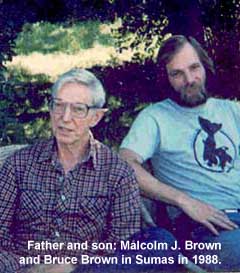
University of Washington Professor Malcolm J. Brown (1910 - 1992) walking in the garden with his grandaughter Laurel Brown, Seattle, WA, July 1986.
|
Additional reading -- Malcolm Brown's George Moore: A Reconsideration, also here on astonisher.com.
|
|
|
Davis and the Young Irelanders watched the symptoms of O'Connell's disintegration with the greatest alarm. Like Yeats's O'Rahilly, they had helped to wind O'Connell's clock and now they wished to hear it strike. They were forced, therefore, to try to seize the initiative of the movement for themselves. But if the old man was no longer leading, he still tolerated no insubordination. Hence they saw that they must act quickly to establish their own lines of public communication.
Desperation, almost panic, showed plainly in Young Ireland's scramble to find some popular foothold of their own, independent of O'Connell. Their first adventure led them headlong into a youthful absurdity. Next to O'Connell and Davis, the most memorable Irish historical figure of the times was Father Theobald Mathew, who made war on drunkenness with revivalist methods. He had produced one of those spectacular mass emotional explosions that fascinate sociologists, as his teetotal crusade spread through Ireland like a Missouri camp meeting afflatus. Though nonpartisan, he had been essential to O'Connell's Repeal agitation. Had there been a million drunks at Tara, O'Connell would undoubtedly have had difficulty in carrying out his promise of nonviolence, and Peel's anxiety over the monster meetings was based less on the numbers who came out than on their fearful sobriety. The Young Irelanders, too, greatly admired Father Mathew. He had gathered a hundred thousand people into a single meeting to take the pledge, had built a membership of two million, had cut the Irish consumption of spirits in half, had eliminated nonagrarian crime from county Cork. He had found what the Young Irelanders were seeking, a scheme to generate a mass spiritual fervor for useful ends. They joined up and took the pledge, and Duffy reported that the Nation's editorial rooms never saw anyone "gravely exceed in wine" or heard anyone "utter a coarsely licentious jest."s The Nation's impulse was to harness the methods of Father Mathew to its own program by stirring up an abstinence frenzy of its own.
It persuaded Carleton to write a temperance novel for the cause. Then one Saturday without warning it came forth with a great blast against another filthy and expensive Irish habit, the use of snuf. This campaign died the same week in which it was born, and one imagines that Dublin's laughter must have done its work.
Another tack was tried. If the shortest road out of Manchester was through the door of the nearest pub, after Father Mathew's crusade there was no road at all out of Ireland's misery. The Nation pondered this difficulty: "Teetotalism has taken from the people their only enjoyment. They are altogether without public amusement. They dare not meet for athletic sports, or they are denounced as illegal and riotous assemblies; they dare not go to `night dances,' as their Clergy, knowing that intoxication has sometimes made them scenes of immorality, have forbidden it. . . . They need some stimulant." Has it not been said that Ireland sober is Ireland stiff? Father Mathew's own solution for the problem was to organize parish brass bands for teetotalers. The remedy the Nation prescribed without false modesty was itself, its program-get manufactures, improve trade, keep absentee rents in Ireland, and the rest of it-but especially its celebrated nationalist spirituality, which was offered to serve among its other useful purposes as a substitute for the cruiskeen lawn.
The Nation came forward next with a blueprint for the establishment of reading rooms to be sponsored by the Repeal Association-three thousand of them, one for every parish in the country, all devoted to the nurture of patriotism. It promised that these would make the association more businesslike, resuscitate the dying pressure of the agitation, and combat peasant sin. A reading list of nationalist books was drawn up for guidance. "The Association," said the Nation's prospectus, "will supply the Repeal rooms with at least a few of the very best books. The People will be reading and learning them instead of drinking, smoking, or card-playing."8 Davis took his proposal to O'Connell, who offered no open objection; but noting that it aimed to tap the sources of his own strength, he sabotaged it with silence.
Could the Life of Henry Grattan in four handsome volumes really draw Irish youth from tobacco, whisky, and pitch and toss? The Nation thought so. One Young Irelander, Thomas MacNevin, brought in a report of having captivated a rural audience of two hundred with nightly readings from Benjamin Franklin's Autobiography. He envisioned a nationwide program of public readings stressing the "biography of self-sustained energetic men." The Nation turned to exhortation: "Every parish has a school, a news room, a Repeal Reading-Room, or some one of them, or it has not. Where they are not they must be established-where they are they must be watched, nurtured, made productive." But nothing much happened, and repeated frustration gave the young men an unfamiliar sensation of futility. "In nothing are we, Irish, more deficient than promptitude and exactness in business," they said, as their hopes for the three thousand reading rooms evaporated. In the end John O'Connell openly attacked the scheme and killed it, leading Davis to reply in a sentence pattern familiar to readers of Irish literature through its reiteration by John O'Leary and Yeats: "There are higher things than politics, and I will never sacrifice my self-respect to them." The word "politics" was beginning to take on a specialized function here; and as O'Connell noted, the speaker himself, strictly considered, was not as innocent of political motive as his words implied.
Finally Young Ireland organized the Eighty-two Club. The Nation had not forgotten that its first duty was to win the cultivated classes for Repeal, but, as we have seen, the task had not been carried out. After the release of the prisoners from Richmond, it occurred to Davis that there should be a new association formed to catch the cultivated sympathizers who perhaps wished to belong to something, but avoided the Repeal clubs as too vulgar. So the Nation announced the formation of the Eighty-two Club, whose name commemorated the year of Dungannon. Its formal purpose was "to encourage Irish art and literature and to diffuse a national feeling through society."" It was rigorously nonsectarian, serving to bring O'Connell, who was honored with the presidency, into an unaccustomed friendly social rapport with some of the more elegant Protestants. Other well-to-do Catholics were naturally expected to crowd forward to mingle with their Protestant fellow countrymen. Except for O'Connell and the Catholic Young Irelanders, however, the club remained mostly liberal Protestant, and the Nation was forced to publish a rather embittered leading article castigating loyalism among the Catholic gentry, in theory a contradiction in terms, in actuality a painful fact.
To render itself exclusive, the Club required a costly tailored uniform, described by the Nation in full: "a green body coat with velvet collar, white skirt linings, and gilt buttons inscribed `1782,' in a wreath of shamrocks, white tabinet vest, green pantaloons, uniform with coat in winter, and white duck in summer, patent leather boots, white kid gloves, and black satin cravat." As a further safeguard against popular contamination, it adopted what Duffy called "a strict ballot," that is, the blackball. As it turned out, the club solved none of Young Ireland's problems. Duffy thought it too exclusive. Denny Lane noted that it did not make Repeal any more palatable to Protestants, though it did inflame their nationalism in the literary and musical sectors. Dublin in its cynical way thought the club hilarious, and Lane especially warned against attempting to export it to Cork: "In Cork the people in general have a great hatred of uniforms. . . . This I think principally arises from the morbidly keen sense of the ludicrous which Cork men generally possess."
The comic stumbling of Young Ireland in the immediate post-Clontarf phase bore all the marks of perennial Dublin farce. But on s'engage et puis on volt; and who is immune to error? Against the background of the tragic history that was then unfolding, with its million human lives at stake, Young Ireland's activity during those desperate months appeared in retrospect rather more pathetic and wistful than comic. Davis' teetotalism, reading rooms, and green uniforms aimed to strike a secular taproot into the mass of popular Ireland in emulation and rivalry of the organization of the Repeal Association, that is, ultimately, of the clergy itself. Following this thread of Davis' thought, a later generation tried again with Yeats's national theater and Douglas Hyde's Gaelic League, succeeding where the pioneer had failed.
III
After these organizational catastrophes Davis sometimes felt the world falling in on him. Though normally active and optimistic, he began to ponder the true scope of Young Ireland's difficulties and the growing signs of Irish defeat. The more gloomy the prospect, the more transcendental his language. If Young Ireland had nothing else left, it had voice. It owned the Nation with its monopoly on literary taste and on "what is far above and beyond it all." A letter from Davis to a couple of hundred resigning London Repeal wardens showed him thinking that if worst came to worst and the Young Irelanders were cut adrift from O'Connell's association, they could still function from their private base, "the rising national literature of Ireland." Above "politics," above mere organization, there was poetry and the poetic nation. Its "angel voice" was the Nation.
The finished form of Davis' more somber ideology, heavy with thoughts of impending defeat, was elaborated in a defensive letter to Maddyn, Young Ireland's croaking raven:
- The machinery at present working for Repeal could never, under the circumstances like the present, achieve it; but circumstances must change. Within ten or fifteen years England must be in peril. Assuming this much, I argue thus. Modern Anglicanism, i.e., Utilitarianism, the creed of Russell and Peel as well as of the Radicals, this thing, call it Yankeeism and Englishism, which measures prosperity by exchangeable value, measures duty by gain, and limits desire to clothes, food, and respectability; this damned thing has come into Ireland under the Whigs, and is equally the favorite of the Peel Tories. It is believed in the political assemblies in our cities, preached from our pulpits (always Utilitarian or persecuting); it is the very apostle's creed of the profession, and threatens to corrupt the lower classes, who are still faithful and romantic. To use every literary and political engine against this seems to me the first duty of the Irish patriot who can foresee consequences.
Davis then weighed the chances for an Irish papal supremacy, a "Catholic Ascendancy" that would supplant the Protestant Ascendancy. He felt no alarm. Better Catholic Ascendancy than to be trapped in "the iron gates of that filthy dungeon" of Englishism or Yankeeism. Moreover, "even a few of us laymen" could, he thought, effect the certain ruin of papal supremacy in twenty years, "leaving the people mad it might be, but not sensual or mean." Finally, he weighed the virtues of insurrection, a subject which he had previously preferred to touch only poetically. His letter continued:
- Still more willingly would I (if Anglicanism, i.e., Sensualism, were the alternative) take the hazard of open war, sure that if we succeeded the military leaders would compel the bigots down, establish a thoroughly national Government, and one whose policy, somewhat arbitrary, would be anti-Anglican and anti-sensual; and if we failed it would be in our own power before dying to throw up huge barriers against English vices, and dying to leave example and a religion to the next age.
Within this single expression of Davis' momentary despondency, Irishmen of poetic bent might find all the ideas and affections that seemed needed in the well-stocked sensitive mind for a long time to come. Davis' black thoughts authorized the brigade of Irish "anti-Sensualists" to follow. A very large part of Yeats's nationalist thought is referable to it: his Red Hanrahan, "faithful and romantic" and lower-class; his "Man Who Dreamed of Fairyland," defying the "exchange values" of Englishism and Yankeeism; his "somewhat arbitrary" militarist hero, Eoin O'Duffy; his Senate speeches against "papal aggression"; and in Davis' italicized qualification of the phrase "Peel Tories," even a forethought of his "Prayer for My Daughter." "To use every literary engine" against Utilitarianism, Yankeeism, Englishism-Davis' words seem a clear command precisely echoed in Yeats's famous phrase, the "war of the soul against the intellect."
But when Davis' thought was taken up by his posthumous literary disciples, its substance was lost. His grand and gloomy aestheticizing drew its entire meaning from the immediate concrete occasion-the cowardice of the Irish gentry, the impassive and sinister threats of English political economists, and Davis' own intuition of ruinous social cataclysm at hand. His tone of paroxysm sounded to a later literary generation as though it were directed exclusively against "Sensualist" philistinism and bad taste. That was only his way of speaking. He was lamenting instead his glimpse of the oncoming of naked barbarism.
IV
The Nation's first year had built a nationalist symbology from two interlocking elements-a practical base and an "anti-Sensualist" overlay. At peak strength, the two halves operated as a single organism, complementing and enriching each other. The practical half gave point, force, and body to the ideal. The idealistic half gave perspective and reinforcement to the practical, lighting its own splendor with the dignity and exaltation it had abstracted from the success of the system as a whole. But in retreat the symbology would be subjected to fragmentation, the two halves tending to pull apart, with consequent damage to each. The practical half then drifted back toward a grubby, inglorious opportunism. The idealistic half, freed from the pull of gravity, took off toward a "pure" obscurantism, toward a mysticism that struck Yeats as having "never been entangled by reality"1s and that persuaded George Russell it was the true substance of Ireland, requiring a body made up of lakes, hills, people, and so forth only because (like John MacCormack's "Little Bit of Heaven") it had to have some place to alight.
In bringing anti-Sensualism to Ireland, where it was already in redundant supply, was Davis not carrying coals to Newcastle, as the saying is? To hold its position Young Ireland was forced to declare itself more spiritual than not only the Yankee and Saxon, but even O'Connell himself. "The restoration of Irish independence has been advocated too exclusively by narrow appeals to economy," the Nation wrote in obvious reference to the Liberator. Its own first object, by contrast, was not to combat Irish poverty, nor even to secure for the people a domestic legislature, but most of all, it said, rising to crescendo, to "inflame and purify them with a lofty and heroic love of country-a Nationality of the spirit as well as of the letter." To accuse O'Connell of being defective in this of all traits touched on the outrageous. True, he had no niche in his program for les chants qui retentissent sur les bords des lacs, and his view of Irish history was unromantic and crude. He merely said, "The English arrived in Ireland one fine morning about six hundred years since, and have done nothing but disturb and devastate it." But after all, he was the crony of archbishops and marched beside a thousand priests and fifteen hundred curates, the official custodians of Ireland's world-famed spiritual assets. Well: if O'Connell's shoe fit the clergy, let them wear it, too-that was the Nation's implied attitude. This was not the last time that Irish poets would betray annoyance in the discovery that when they brought spirituality to the Irish marketplace, they found a strong competitor already operating there. The rarefied mists that became the trademark of the Irish literary movement in later times traced from Davis' practical quandary, how to achieve a spirituality beyond pure ether.
V
We have no record of O'Connell's thoughts on the spirituality contest, but there were many signs of his growing impatience with Young Ireland on other matters. He proclaimed that his release from Richmond jail was a "miracle," the result not of English party politics but of divine intervention; and when the Young Irelanders laughed at his fancy, his feelings were hurt. His captive newspaper began to hint that the Young Irelanders were a war party, and innuendoes spread that they were also "godless." Even sex got into the quarrel eventually, in spite of the young men's aversion to licentious jest. John O'Connell "uttered a shout of triumph" upon discovering in the pages of a Young Ireland anthology these lines of verse:
- There was an Irish lad
- And he loved a cloistered nun.
"Could anything be plainer," said Duffy, paraphrasing the attack, "than that Young Ireland wanted the cloisters to be violated?"
There were disputes over literary taste. O'Connell was fond of Sam Lover, but the Nation despised him as "one who pandered to English prejudice by taking the stage Irishman as his hero," and it saw nothing humorous in Handy Andy's scheme for icing the champagne. Davis, on the other hand, liked Carleton, William Maginn, and "Father Prout," but O'Connell thought of these either as vile Peelites or, worse still, Catholic renegades. Davis' self-assured reply to O'Connell's critical blustering was a model formulation of civilized literary self-defense, not bettered by Yeats's response in a parallel case years later. "Uniformity of taste in literary matters is not to be expected, and, perhaps not to be desired," he said, adding that literature "is a subject in which a mistake will do nobody any harm." In defending the novelist John Banim he seems to have been thinking also of the Nation's staff poet-poor, miserable, opium-eating James Clarence Mangan -- and further, of all the polies maudits of the world, "who have so strong a claim, not only on the forbearance, but the gratitude of the world." Who would be so cowardly, he asked, as to heap wanton injury "upon those whose gift, while it confers only delight and benefit to others, is a fatal one to themselves?"
VI
Soon bigotry intruded into the dispute, for demoralization was now out of control. Peel in early 1845 concluded that coercion had had its full inning in Ireland and that the time was ready for the shift to amelioration. "I Sent a message of peace to Ireland," he told the House as he presented two Irish education bills. The first bill provided a threefold increase in the funds for Maynooth College, where Irish youth train for the priesthood. This offer had the double advantage to Peel of cooling the disloyal ardor of the Catholic clergy while at the same time inflaming the divisive passions of Orangemen, who went about for years afterward muttering against "the perfidy of the Maynooth grants."
Peel's second bill proposed to set up three nonsectarian Irish colleges for the benefit of the country in general. Davis found the proposal irresistible. As we have seen, his trust in the virtue of education was the foundation of all his thought, and long before Peel's bill he had happily envisioned a cluster of peaceful academic towers arising above the trees against the backdrop of the Dublin Mountains, where great minds might labor for Ireland's comfort and splendor. The Catholic hierarchy divided on the nonsectarian feature, some bishops stressing the urgency of improved Irish education regardless of the sponsorship, others believing that the Irishman's faith would be jeopardized if Catholics sat in the same classrooms with Protestants in what was called a "mixed" college. Archbishop MacHale joined with the latter group and denounced Peel's bill, so that the proposed colleges quickly got themselves stigmatized as "godless." O'Connell resoundingly attacked the bill in the hope of embarrassing Peel. Davis refused to agree with him, and put up a fight both in the Nation and in the association.
One afternoon at the end of May 1845 the mixed colleges issue was being warmly debated in Conciliation Hall, the Repeal Association's fine new headquarters. O'Connell gave a long speech against the bill. When he had finished, a Young Irelander named Michael Barry defended the mixed colleges, speaking ostentatiously as a Catholic. The next speaker was a man named Conway, who had applied for membership in the Eighty-two Club and been blackballed. He attacked Barry as an irreligious Catholic, invoking the authority of St. Patrick, who "was no friend or patron of masked infidelity -- or mixed education (hear, hear)." He then extended his attack to Young Ireland collectively. Davis came heatedly to Barry's defense. He took the floor and was addressing Conway scornfully as "my old college friend-my Catholic friend-my very Catholic friend" when he was interrupted by O'Connell : "It is no crime to be a Catholic I hope? . . . The sneer with which you used the word would lead to the inference." Davis sensed a fight impending and pleaded for calm and unity. "Disunion, alas, has destroyed our country for centuries," he said; but he would not recant, and he finished his argument in favor of the bill. O'Connell then rose again to speak angry words which echoed harshly in the minds of Irishmen for a century afterward:
- The section of politicians styling themselves the Young Ireland party, anxious to rule the destinies of this country, start up and support the measure.
- There is no such party as that styled "Young Ireland" (hear, hear). There may be a few individuals who take that designation on themselves (hear and cheers). I am for Old Ireland (loud applause). 'Tis time that this delusion should be put an end to (hear, hear, and cheers). Young Ireland may play what pranks they please. I do not envy them the name they rejoice in, I shall stand by Old Ireland (cheers). And I have some slight notion that Old Ireland will stand by me (loud cheers).
When he finished, Davis was weeping and Dillon, sitting behind him, began to spit up blood. In the meeting all was excitement, shock, and anger. At last Smith O'Brien, the chairman, broke the spell with his sole recorded witticism: "I belong to Middle-aged Ireland." Then there were apologies and handshaking all around. But the damage was done. O'Connell's great organization, whose efficiency had so pleased Davis, had turned itself into an efficient nuisance, ready to spread slanders against Young Ireland with preternatural speed. O'Connell's taunt, "There is no such party as that styled `Young Ireland,"' had touched the tender spot, precisely like Davis' epithet "coward" after Clontarf. Thanks to the cruel accuracy with which the two leaders had exposed one another's contradictions, Peel might now relax, for "the integrity of the empire" was to be safe for a long time to come.
O'Connell's angry questioning of who would "rule the destinies of this country" was strictly political in its immediate application, intended merely to force a clean split between the left and right wings in the Repeal Association. But in seeking to arm Young Ireland for combat, Davis had entangled the peripheral aesthetic issue in the main dispute. Poetic nationalism he claimed to be not merely an equal partner, but even the receiver in bankruptcy of the religious nationalism at the source of O'Connell's power. By accident O'Connell had broached this secondary issue, and his either-or dilemma forced a senseless choice between "godless" poetry (Young Ireland) and holy antipoetry (Old Ireland). The question thus became, Shall poets "rule the destinies of this country"? The popular answer was a vociferous no heard from the aroused sanctimonious Irish philistinism for which the two O'Connells set a miserable example, henceforth one of the fixed poles of Irish culture. But another possible answer suggested by the form of the question was yes. More than once in his career, Yeats was to have that answer in mind. In that case, any poet's detractors were not only vulgarians but traitors. The poet's activity carried its own guarantee of virtue, together with the temptation to grandiloquence seen occasionally even in the shy and gentle Davis. To such implied claims the philistines naturally responded with O'Connell's withering sarcasm to Davis: for whom do you speak and how many votes do you command?
VII
Then suddenly Davis was dead of scarlet fever, only three months after the fight over the mixed colleges bill. Duffy was awakened in the early morning and summoned to the house of Davis' mother in Baggot Street to behold "the most tragic sight my eyes had ever looked upon -- the dead body of Thomas Davis." A servant told Duffy that through all his last hours Davis had complained of "interrupted work." The stricken Nation came out on Saturday with heavy black borders in mourning for its guiding spirit. It printed an account of the funeral. The Eighty-two Club had come, also the officials of the Repeal Association, the Dublin Corporation, and all the Irish learned societies and academies. O'Connell wrote in from Darrynane, "As I stand alone in the solitude of my mountains, many a tear shall I shed in memory of the noble youth." A horde of nameless mourners appeared at the funeral, as told in Yeats's anecdote borrowed from Oscar Wilde's mother. She had seen the hearse and the great crowd pass and had asked, "Who is dead?" Someone said, "Thomas Davis." Though one of the "cultivated classes," she had to ask again: "And who was he?" And the reply was, "He was a poet."
There is a curious fact about Davis' premature death that provides us -- by subtraction, as it were -- with a powerful insight into the moral energy of Irish nationalism. If we kept a tally of the prominent Irishmen in our narrative who were jailed or forced to flee the country, we would already have recorded in 1843 the names of the two O'Connells and Duffy (besides Isaac Butt, though he was jailed for debt rather than for his political beliefs). Eventually the list will grow to great length and include almost every Irish name mentioned in this volume. Missing from the jailer's roll call is only one leading historical personage: Thomas Davis, dead at thirty-one. John O'Connell once astonished Davis' friends with the accusation that a moral blight attached to the dead youth: what kind of a patriot was it who would dare to expire before he had ever matriculated in Green Street Courthouse?
"The Politics of Irish Literature" © Copyright 1973 Malcolm Brown
| New CD-ROM LIBRARY EDITION |
|
|
 |
"Great book. Fascinating..."
-- Jack Weatherford,
author of
The History of Money
|
The History of the Corporation
by Bruce Brown
* READ free excerpts on astonisher.com
* BUY the complete book at the astonisher.com store
|
|
|
© Copyright 1973 - 2010 by Bruce Brown
and BF Communications Inc.
Astonisher and Astonisher.com
are trademarks of BF Communications Inc.
BF Communications Inc.
P.O. Box 393
Sumas, WA 98295 USA (360) 927-3234
Website by Running Dog  |