Chapter Twenty-three
Poetry Defends the Gap: Yeats and Hyde
PARNELL'S RELICTS on the parliamentary side of his political family, his faithful few, took for their new leader young John Redmond. The inheritance from the fallen Chief was not a great ballot box asset just then, and for a time it seemed that the heirs would be totally eliminated from Irish politics. The Sullivans naturally expected to inherit the mantle of party leadership as their reward for Healy's extermination of Parnell. They were challenged, though, by rivals equally willing to lead and substantially stronger, the antiParnellite agrarians Dillon, O'Brien, and Davitt. The old discipline and unity-once the envy of Westminster-broke into a loose and snarling anarchy divided behind the three feudists Redmond, Healy, and Dillon. Later on Dillon and O'Brien also fell out, and then the factions were four. Everybody has always deplored this dissension among Parnell's lieutenants, the lieutenants themselves most of all. The censure is understandable, but it is hard to discover how it made any particular difference in the parliamentary struggle, strictly regarded.
We have said a good deal about the "first," or 1886, Home Rule bill. There was a "second," or 1893, Home Rule bill too, not as well known, but in some ways more interesting. Unlike the first, it actually passed the Commons. Parnell's grave in Glasnevin was still fresh when Salisbury's second ministry ran to the end of its six-year term. In the general elections of 1892, Redmond's Parnellite party just barely survived with nine seats. By contrast, the anti-Parnellites of varied descriptions won seventy-two. The total Irish parliamentary strength was therefore eighty-one.* The real significance of these figures lay not in Redmond's poor showing, but in the size of the Irish total, approximately the same as in glorious 1886. The broken heads and the dead Chief had hardly touched the overall strength of the Irish parliamentary party.
All Irish eyes turned, then, upon England, Scotland, and Wales. In the new elections of 1892, Home Rule was again the big issue. Lord Salisbury's campaign adverted to the Irish cockpit with upturned eyeballs and despaired at the prospect that the ruffian quarrel inside the Irish party might be transferred to the floor of an infant Irish parliament. Gladstone, in turn, campaigned once again on "Justice to Ireland." In the voting Home Rule won him back 8o of the 114 seats it had cost him in 1886. With the backing of the 81 Irish members, he had a majority of 40 seats, enough to form a government. Gladstone introduced his second Home Rule bill, and the theory of Parnell's expendability was holding up well.
Gladstone had just passed his eighty-fourth birthday when the new Home Rule battle opened. His general staff was perhaps less treacherous than in 1886, but his new ministers were publicly unenthusiastic for Home Rule, and privately they would have been glad to hear the last of it. The seven years since 1886 had also multiplied Gladstone's difficulties in Ulster. At the critical instant in the Home Rule debate, Belfast Unionists staged the largest protest rally the north had ever seen. A Presbyterian preacher named Robert Lynd gave them fresh spiritual guidance to go with Lord Randolph Churchill's "Ulster will fight," the old watchword of 1886. "We say of Home Rule as Lord Macaulay said of O'Connell's demand for Repeal," Lynd said, "-- never! never! never!"
These were trying problems. Still, Gladstone had the votes. When he called the third reading, his bill passed, 301 to 267. And so the sevenhundred-year-old story of Irish troubles ended happily after all. Great Irish rejoicing. But there was one last barrier to clear: the House of Lords. The Commons had spent eighty-four days in careful debate before passage. The Lords debated the bill for less than a week, then divided -- 41 for to 419 against. Fatigued and despairing, Gladstone resigned. The queen, without consulting him about his successor, appointed Lord Rosebery prime minister. Rosebery struggled along for another year before he, too, collapsed. Parliament was mercifully dissolved and a new general election called. The Tory-Unionists came in with a majority of 152 seats, making the most one-sided House of Commons in sixty years. For the Irish moral force nationalists, it was the darkest day since 1801. Some flaw seemed to have developed in the logic by which Parnell was expended in order to clear the road for Home Rule.
II
The mandate that Salisbury had once asked for was now given him. He became a fixture in office, standing upon the Union at home; and, with Chamberlain now in the colonial office, upon the promise of imperial glory overseas. During the two decades following the 1886 Home Rule election, Salisbury or his nephew Arthur Balfour was to be prime minister for seventeen years. A whole historical epoch was dominated by the Tory-Unionist ascendancy, with the bedraggled Irish parliamentary party absorbed into the impotent Liberal opposition. A youth like Joyce, aged eleven at the second defeat of Home Rule, could grow up and leave the country without ever knowing any other Ireland than Salisbury's and Balfour's.
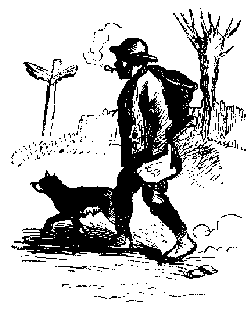
Those who read in the opening words of Joyce's Dubliners an Irish historical allegory may be somewhat simplistic, but they are probably not far off the mark. Father Flynn is dying: "There was no hope for him this time: it was the third stroke." This is Balfour's Ireland right enough, a perfect likeness. But it was unwise to generalize any more broadly than that. Joyce's paralyzed priest was not the ultimate Irish emblem. We know him well, for we have met him constantly in our excursion through nineteenthcentury Irish history: he was Gavan Duffy's corpse on the dissecting table. Balfour's Irish government was not for perpetuity -- it only seemed so; and Duffy's corpse was never a very trustworthy corpse. It was always rising up again, like the one at the end of Synge's play who pops out of his coffin ready to fight: "You'll see the thing I'll give you will follow you on the back mountains when the wind is high."
|
|
Table of Contents
|
|
Astonisher.com is pleased to offer The Politics of Irish Literature by Malcolm Brown, complete and free for your personal use.
Praise for
The Politics of Irish Literature |
 |
|
"This brilliant study of the intersection of politics and literature in Ireland amounts to a dazzling portrait gallery. Reading it one feels about one the breath, warmth, and passions of the dead all come alive again."
-- Sean O'Faolain in the Manchester Guardian
"Mr. Brown's masterpiece has made me want to hire a nearby housetop and recite whol chunks to every passerby..."
-- Michael Foote in the London Evening Standard
"The author of the best book on George Moore now gives us what is in all likelihood the best book on the politics of modern Irish literature."
-- Virginia Quarterly Review
|
|
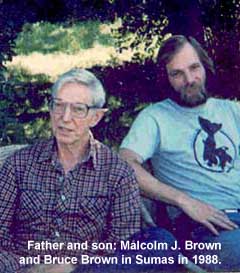
University of Washington Professor Malcolm J. Brown (1910 - 1992) walking in the garden with his grandaughter Laurel Brown, Seattle, WA, July 1986.
|
Additional reading -- Malcolm Brown's George Moore: A Reconsideration, also here on astonisher.com.
|
|
|
III
The Tory-Unionist victory of 1895 closed the last act of the Parnell affair, four years after his death. All the boxers' postures taken by his political heirs were frozen by the posthumous catastrophe. The anti-Parnellites interpreted their defeat as the necessary result of Parnell's perverse passion to rule or ruin. They saw the nation wrecked by a monomaniac obsessed with private objectives utterly inimical to statecraft. He had destroyed the Irish party, they said, destroyed the English Liberal party, and for good measure destroyed himself, too.
As for remorse, they had none, for they agreed with Healy when he said with less originality than usual: "The wine was drawn and it must be drunk." Unlike Matty Bodkin, Parnell would not go quietly. Some who would object to Healy's sponsorship might prefer Davitt's formulation: these "uncrowned kings" make splendid leaders, and for all that, they can wreck everything too.
Over in the Redmondite corner, the defeat of the second Home Rule bill was seen as a just vengeance upon the party Judases, a cosmic sarcasm to match Parnell's quip in Committee Room Fifteen: if you sell me, get my price. He had been sold for Home Rule, but there was no Home Rule. Gladstone the swindler** had finished off the betrayal begun when Healy, O'Brien, and Sexton "surrounded Parnell and hacked him to pieces." Redmond taunted his enemies with the contention that the party would have won through somehow if the Chief were still alive and at the helm. Many believed him, and many believe him to this day.
IV
The Old Fenians stood amid the wreckage of Home Rule the most successful Irish ideological speculators on the catastrophe. The outcome held no surprises for John O'Leary, hardened by forty years of Irish political experience. Had he not predicted that Parnellism must at last "work itself out"?
Proven prophetic power and the ownership of Parnell's corpse put Fenianism back in business once more, with insurrection again the order of the day. But its new efforts were frosted by bad news on the American wing. Unexpectedly the Clan-na-Gael fell apart. A Chicago Fenian named Alexander Sullivan (not to be confused with the Bantry Sullivans) formed an Irish-American junta called "The Triangle," seized control of the organization, and pushed John Devoy to the sidelines. The dispute was at first political, arising when Devoy criticized Sullivan's diversion of Clanna-Gael money into dynamiting. Then the differences got out of control. Devoy and Sullivan took to carrying pistols for protection against one another, and at one Irish-American gathering the two stood face to face in such anger that the bystanders expected each man to draw and fire.
Devoy's Chicago ally in the feud was a fellow Fenian, a physician named P. H. Cronin. One afternoon in 1889 just before the Parnell divorce case broke, he went out on a house call and never came back. Some weeks later his beaten and butchered body was fished out of a Chicago sewer. The murder suspects were Alexander Sullivan himself and another Triangle Fenian known as "Sullivan the Iceman." Sullivan's defence was the claim that Dr. Cronin was not dead at all, that the body found in the sewer belonged to somebody else, and that the supposed victim would turn up in London in due time and reveal himself as a British spy. The awaited reappearance never took place, and the taint of murder for private revenge settled on the Clan-na-Gael. The lurid scandal disintegrated American Fenianism, and by Devoy's estimate, set Irish nationalism back fifteen years in its work.
Archbishop Croke read the burial service over Irish nationalism: "The hope of attaining a legislature for our country within measurable time is no longer entertained by reasoning men," because "what one set of Irish politicians proposed for the common weal would, almost of a surety, be derided, denounced, and scornfully rejected by another." But according to the standard Irish rule, the nadir of one political cycle marked the start of the next cycle. The moment to start rebuilding was at hand. O'Leary's most successful nationalist enterprise was, as we have seen, his literary movement. At the final defeat of Home Rule it was a fine healthy seven-year-old with real achievements behind it and many hyperactive minds already involved. It now subdivided and began to proliferate like yeast.
V
With the Tory election landslide of 1895, my formal history ends. In the past all literary commentators used to pause just here-where Ireland lay once more a corpse on the dissecting table-to admire Yeats's poetic "revulsion against Irish politics." But recently this aesthetic piety has been jolted by Conor Cruise O'Brien's study of Yeats's politics in the 1930s, which demonstrates that his embarrassing ideological "flirtations" were not flirtations at all but the real thing, and that his tendency "to write off all politics with a kind of contempt, a plague-on-both-your-houses air,"s can be taken at face value only at great peril to the truth. It we surrender up the theory of the nonpolitical Yeats, we must say good-by as well to the touching old image of the Irish muse of the early 1890s lifting her skirts to avoid being soiled by ruffian mudslinging.
While the Fenians set great value by the Glasnevin Parnell as a symbol of defiance against prime ministers and priests, they had no further use for the concrete issues on which he fought his last campaign. They repelled Redmond automatically. Those like Devoy who lived to witness the logical end of Redmond's leadership in 1914 -- when he renounced the Irish demand far immediate Home Rule because England was in extremity-were entitled to claim that they had predicted it all a quarter of a century before, if that were any solace. The Fenians' post-Parnell line, memorably stated by Maud Gonne, noted that Dr. Cronin was dead and that "you cannot bring him back to life," and that Parnell and Home Rule were dead, too. But she added, "the British Empire is not dead yet." As for the parliamentarians' great purpose in life: "Home Rule was the carrot dangled before the donkey's nose to keep the donkey quietly trotting along in the harness of the British Empire." And the meaning of the Split was simply that "Redmond and Dillon were quarrelling over who should hold the carrot." The order of the day was to go over the heads of all the factionalists, Parnellite and antiParnellite equally, in order to get on with the work of the Irish revolution.
The first of the Fenians' tasks was to try to tranquilize the Split. They now brought forward those nationalist projects that were by nature most immune from factionalism and most likely to penetrate to the Irish people directly. Immediately after Parnell's funeral, Yeats pressed O'Leary to suggest something for Maud Gonne to do: "What she needs is some work," he said.' O'Leary set her to resuscitating the old Amnesty Association, the ideal nationalist activity for the nadir phase. As with the Ladies' Land League, there was no defense against a maenad in fury, and in record time she won the release of the generation of Dynamitard prisoners.
VI
The literary movement too was estimated to hold promise for undercutting the Split. Parnell was no more than buried before the established Irish literary societies, the Southwark Literary Club in London and the PanCeltic movement in Dublin, began to simmer. Yeats took command, calling a hosting of all the literary Celts of London on December 28, 1891, a couple of months after Parnell's funeral, at his father's house in Chiswick. The official historian of the movement has left us a memorial of the celebrated moment. He reported: "The house seemed 'beyant the beyants,' as we say in Ireland, but when reached at last we had our reward, for it was in every sense a meet haunt for a poet or an artist. We soon forgot the taunts and rebuffs of old Boreas, wafted as we were by the associations and the conversation to the dreamland of an Irish Olympus. Yeats was full of schemes and projects: and I cannot say that the Southwark element was wanting in enthusiasm." The schemes Yeats had in mind were: (I) to open an intense cultural agitation centered around weekly concerts, lectures, discussion, and poetry readings; (2) to set up a network of nationalist reading rooms throughout the country; and (3) to organize the mass distribution of a series of new nationalist books. These proposals were adopted as the official program of the accelerated poetical movement. In addition, Yeats planned to organize a national theater that would stroll through the countryside performing at the cart's tail before peasant audiences. Douglas Hyde sat in at the Chiswick launching of Yeats's movement, but shortly afterward wandered away to pursue his own ambition in defiance of Yeats's advice, to revive the Irish language through the organization of the Gaelic League.
The reader will recognize that Yeats and Hyde had lifted the machinery for the new Irish cultural movement bodily from Young Ireland's literary organization of 1843, which Thomas Davis had contrived originally as an instrument to challenge O'Connell's monopoly upon the peasants' sources of political guidance. While it would be incorrect to say that the 1843 and the 1891 cultural movements were not aesthetic, they were certainly political as well. The new unity slogan, "Parnell is dead," did bear an ambiguity, though. In the process of transmission, Hyde and Yeats altered the original Fenian stratagem, and the cultural movement was carried through mutations even more bizarre than the student of Irish history is accustomed to expect.
On the language-revival side the confusion was impossible to conceal. Hyde's speech stated his object in this way:
- It is a fact, and we must face it as a fact, that although they adopt English habits and copy England in every way, the great bulk of Irishmen and Irishwomen over the whole world are known to be filled with a dull, ever-abiding animosity against her, and-right or wrong-to grieve when she prospers, and joy when she is hurt. Such movements as Young Irelandism, Fenianism, Land Leagueism, and Parliamentary obstruction seem always to gain their sympathy and support. It is just because there appears no earthly chance of their becoming good members of the Empire that I urge that they should not remain in the anomalous position they are in, but since they absolutely refuse to become the one thing, that they become the other; cultivate what they have rejected, and build up an Irish nation on Irish lines.
No ambiguity here; this is good strong political language. And even further, he chose an exciting political simile to describe how his object was to be carried out: ". . . nothing less than a house-to-house visitation and exhortation of the people themselves will do, something . . . analogous to the procedure that James Stephens adopted throughout Ireland when he found her like a corpse on the dissecting table." This is also plain speaking. But he quickly added the qualification that the house-to-house canvass would be "with a very different purpose" than Stephens'. Now his listeners were forced to wonder what he was driving at, for it was very late in the evening to claim nonpolitical purity, though afterward he did so, vociferously. The question unanswered was what kind of politics did Hyde have.
The reader will remember that Thomas Davis' nationalist activity followed twin guidelines: one, that "Arigna must be pierced with shafts and Bonmahon flaming with smelting houses," the other, that Irishmen must "reach at what is above and beyond it all . . . [in order to] extricate the lightning flash from the black cloud that bound it." Hyde bit upon the thought that if Davis' purpose was to create a spiritual nation, why need Irish political aspiration pursue the old methods that were so roundabout, agonized, and foredoomed? If one simply walked off and forgot Arigna and Bonmahon, and Home Rule, and poverty, the spiritual nation was already at hand. There it was, waiting to be seized-provided Irishmen could be induced to revive the dying language.
Hyde's recruiting campaign led off with the familiar Irish dilemma of Esau and the mess of pottage: Let us suppose, he said, that there should arise in England a corps of "able administrators" and "careful rulers" who succeeded in "making Ireland a land of wealth and factories," until all were "fat, wealthy, and prosperous," but at the cost of the extinction of the "O's" and the "Mac's" of Irish names and the obliteration of Irish historywould Irishmen accept this bargain? "Nine Englishmen out of ten would jump to make the exchange, and I as firmly believe that nine Irishmen out of ten would indignantly refuse it." Put bluntly, Irish spirituality and Irish poverty were pronounced a natural harmony. Along with his genuine nationalism, Hyde felt a temptation toward collaboration derived from the presumption that Salisbury and Balfour were permanent fixtures in Downing Street. But the Gaelic League, like the old Land League, spread like fire and among the tens of thousands of new members there were many who had no desire for collaboration. The league thereupon took on a peculiar double life. Joyce seems to have thought of it as a repressive clerical institution and he nominated satirically "Soggarth Eoghan O'Growney," the San Francisco priest who wrote little Gaelic League primers, among the nation's mock heroes. But his contemporary, W. P. Ryan, charged that the clergy had sabotaged the league's work from fear of revolution. And Patrick Pearse was able to harbor two contradictory opinions: first, that "the Gaelic League was no Messiah . . . the Gaelic League, as the Gaelic League, is a spent force"; and three months later that "the Gaelic League will be recognized in history as the most revolutionary influence that has ever come into Ireland."" After the Treaty, the language movement was still torn by the same confusion, and while the government enshrined it officially among the nation's schoolroom pieties, in daily practice it was thrown into the hopeless struggle against English and told in effect to survive if it could.
VII
On Yeats's side of the movement, a parallel equivocation developed, fogged over by the normal mysticism of his critical utterance. His first mid-crisis experiment in formulating a rationale plucked at Davis' spiritual string:
- Amid the clash of party against party we have tried to put forward a nationality that is above party, and amid the oncoming roar of a general election we have tried to assert those everlasting principles of love of truth and love of country that speak to men in solitide and in the silence of the night. So far all has gone well with us, for men who are saddened and disgusted with the turn public affairs have taken have sought in our society occasion to do work for Ireland that will bring about assured good, whether that good be great or small.
Standing not merely "above party" but "in the silence of the night," Yeats's purity was altogether ethereal. On a second look, however, his claim seemed somewhat presumptuous, and it was so interpreted by his contemporaries. For, while one might with great mental effort imagine a league of nonpolitical Gaelic-speakers, a society of nonpolitical Irish poets is simply unthinkable. Nonpolitical poets do not form societies; they abhor societies. Hence with Yeats as with Hyde the question that lingered was: What kind of politics is it?
The charter objective of the new literary movement was revealed in its decision to co-opt all the warring parliamentary leaders of the Split as vicepresidents. Except for a strong dislike of Healy, the society did not have much serious preference for any one of the parliamentarians over another. It was therefore an occasion for rejoicing when it succeeded in recruiting as literary comrades to Old Fenians, to poets, and to one another, the august political personages who were said to have just hacked Parnell to pieces: T. D. Sullivan, Justin M'Carthy, and the agrarian William O'Brien, a true friend who was still sponsoring Yeats's literary movement down into the old age of the Abbey Theatre.
Anti-Split sentiment poured out profusely. "During this evening at least, we are disarmed"-this was the peace message of the opening address delivered by the Anglo-Irish litterateur, the Reverend Stopford A. Brooke. "We speak together pleasantly, as French and English did in the Peninsula, when beside the brook in the evening they drew water for the armies that in the morning were to renew the battle." And feeling called on for the highest spiritual effort, he added lugubriously: "As the dead who were enemies are reconciled at last when they lie together in some great church like Westminster, so living foes are reconciled at last when they lie together in the great Temple of their country's literature."
VIII
The special sorrows of the Irish poets as compared to the Gaelic linguists are nicely formulated in Yeats's poem to Hyde beginning, "Dear Craoibhin Aoibhin, look into our case," a humorous plaint against the impossibility of making poetic peace with Dublin's taste. The Irish Literary Society opened up its work of unifying the nation with a grand cat-and-dog fight. In the name of amity, the presidency was offered to the most illustrious living patriot, the aged veteran of 1843, Gavan Duffy, now Sir Charles Gavan Duffy. After his departure from Australia he had retired to Nice, at the right distance to cheer on the Parnellite offensive without incurring any partisan stigmata. Sir Charles accepted the new honor gladly. Yeats had already made publication arrangements for the new Irish library with T. Fisher Unwin in London, and with courteous firmness he sent Duffy his instructions, giving the scheduled date of the first Dublin meeting and adding:
- Perhaps you will be in Dublin then and will be so kind as to take the chair. The young men wish greatly that you would.... P.S. It seems to Mr. O'Leary and myself that it would be a good step towards ensuring circulation to fix as soon as possible upon the first 3 volumes of the proposed library. Mr. O'Leary and myself think that a good first volume would be a life of Wolfe Tone. . . . Mr. O'Leary thinks that my "Ballad Chronicle" would make a good second volume. For the third volume he suggests that Lady Wilde be asked to take up again the book on Sarsfield that had been projected for her. We of course wish to know if you think this a good selection or if you have anything to say in opposition or in modification.
It turned out that Sir Charles had something, had much, to say in opposition. He held very strong opinions of his own, not one of them in accord with "Mr. O'Leary and myself."
Half a lifetime in Australia had obliterated from Duffy's brain most of the vestiges of the old Nation's mystique. As soon as he had "kindly" taken the chair and commenced his oration to the assembled poets, he made it clear that his mind was now wholly captive to Arigna and Bonmahon. His keynote was challenging: "When I met in France, Italy, and Eygpt the marmalade manufactured at Dundee, I felt it like a silent reproach"; and to let his listeners share his reproach he added the further superfluous information, "Oranges do not grow in Dundee." One could hardly misconstrue his meaning, and he drove home his thought with insistent blows on the one theme: "Good books make us wiser, manlier, more honest, and what is less than any of these, more prosperous."15 (He did say "less," an atavism.) He then announced that the first title for the new library venture would be an unpublished manuscript by Thomas Davis called "The Patriot Parliament" describing the constitution of James II's Dublin government-in-exile of 1689. It would be followed by anthologies of important but forgotten patriotic effusions taken from the Irish magazines of the decades just before and after the Act of Union. As for publishing the literature currently being written in Ireland, that was totally out of the question. "Who is W. B. Yeats?" he asked. He canceled Yeats's publishing arrangement with T. Fisher Unwin and replaced it with a contract of his own.
To a bystander, Duffy would seem to have invented problems where no problems were, setting up a senseless publication dilemma between Yeats's poetry and Davis' history. Anybody ought to have seen that what the situation called for was not either-or, but both. The celebrated Girondist habit of seeking the middle way had somehow failed Duffy, through vanity or ignorance resulting from residing too long abroad, a disability later to be experienced also by his fellow countryman, Joyce. To Yeats the fact that Duffy was a great untouchable fifty years his senior meant nothing. What only concerned him was that his projected "Ballad Chronicle" was dead and the Countess Cathleen had lost the society's sponsorship, forfeiting an estimated sale of ten thousand copies. He counterattacked furiously, supported by John O'Leary and the anti-old-fogey youth.
It was "on both sides" that "hard words were spoken." The fighting turned dirty all around and in the thick of it was Yeats, discovering for the first time his redoubtable gift for public controversy. The citizens of Dublin learned from his polemics contra Duffy that it would be unpatriotic to direct the Irish National Library project from distant Nice; also, that forty years earlier Duffy had destroyed William Carleton's talent by enticing him to didacticism in the anti-Ribbon novel, Rody the Rover. Aged Mitchelites turned out and disrupted one of Duffy's meetings with catcalls, "Remember Newry" and "There's a grave there." Though indebted to these graybeard ruffians, his unsummoned champions, Yeats offered Duffy formal apologies. In his memoirs he added further angry embellishments drawn from afterthoughts: that Duffy "so lacked rancor" that he was barren of personality; that he had hired a boy to read to him in the evenings from Carlyle's Heroes and Hero Worship; that he had brought to town a Carleton manuscript "into the center of which he had dropped a hot coal, so that nothing remained but the borders of every page" (an anecdote suggested by the actual fate at the Yeats fireside of an unsolicited manuscript from a young poetess). When he used "a bad argument," O'Leary withdrew his support -- a caprice, Yeats said, because "one cannot fight a battle in whispers." Suddenly he was drawn to the joyful wisdom that "strife is better than loneliness," an opinion that was to furnish Dublin with a succession of poetic crises through the rest of his life.
IX
The casus belli -- should Davis or Yeats take precedence in the new Irish library scheme? -- was immediately obscured by other contentions. When attacked, Duffy invoked his authority as the possessor of the Young Irelanders' patriotic mantle. Yeats thereupon attacked Young Ireland, declaring its poetry worthless as poetry, mere doggerel and flatulence. Outraged, Duffy stood on his dignity and white hairs and attempted to defend the dubious position that the Young Irelanders were the supreme masters of the poetic art. Yeats thus succeeded in getting the issue into the most convenient form for his purpose. He brought over from Fleet Street the poet Lionel Johnson, an English aesthete-convert to Catholicism, to lend a touch of holiness to the poetic attack. Against the venerable Duffy he pitted the venerable John O'Leary, whose ancient difficulties with the poetry page of the Irish People had slowly and painfully forced him out of Duffy's position and into Yeats's. Yeats lost the battle but won the war. Duffy lacked the wit to retreat to a stronger position, so he held his ground and let himself be slaughtered. "Old fogeyism" in literature went down to defeat and Yeats established himself as a fearful champion of Irish poetry, a position he occupied permanently. "Oh yes, Shakespeare?" said Stephen Dedalus. "You mean that chap that writes like Synge."
It would have been fortunate for Ireland if all her quandaries were so easily dissolved. But under the aesthetic battle smoke there had opened a cluster of other pressing issues where Yeats's natural advantage was considerably weaker. Like an embattled Shakespearean king, he was in every corner of the field searching for Duffy. Duffy lifted an idea from his old enemy Cardinal Cullen and hinted at mortal sin lurking in any literary effort sympathetic to the French, those "godless scoffers." He quoted with approval the position taken by Father Hogan of Maynooth urging the Church to take a leading part in the Literary Society in order to give weight to "our denunciations of dangerous books, and especially of light and licentious reading" or of "what is either silly or debased." At the crucial vote in the society, he defeated Yeats by letting it be known that be carried in his pocket a letter offering the support of Archbishop Walsh, but only on the condition of the poet's good behavior. Yeats's memoirs say that it "warned that after his [Duffy's] death the [publishing] company would fall under a dangerous influence."
Duffy having enlisted the clergy on his side, Yeats set himself against the clergy. But his inherited Anglicanism was not so reckless as to suggest a frontal attack, for somebody had taught him his basic nonsectarian lesson well. Before the Split he had made the clergy a peace offering in those marvelous ballads on the two priests O'Hart and Gilligan. After Archbishop Walsh and Duffy joined forces, there were no more of these clerical offerings, but only stern and stubborn opposition. Nerve and good spirits served him well, and he was ready to defend himself as required. Eventually Frank Hugh O'Donnell, a familiar acquaintance of ours out of Irish history, turned up in town and set about to destroy Yeats by the same time-tried treatment he had once given "the atheist Bradlaugh" in the House of Commons. He wrote a pamphlet attacking Countess Cathleen on various grounds, but especially for an incredibility-an Irish woman "unfaithful to her marriage vows" -- and for a blasphemy -- a scene where "good old Father John, in spite of his prayers and his breviary, [is] killed by the devil in the shape of a brown pig! How Irish! How exquisitely Celtic!" Yeats was fully competent to handle O'Donnell at any time without resort to "removal" of O'Donnell in the "manly way," as one of his somewhat credulous biographers tells us was seriously urged by his patriot comrades.
Yeats challenged the clergy to a gentlemanly duel on fair terms, the spirituality of the sidhe to be pitted against the holiness of the saints, and let the best man win. His first literary response to the Split was to hasten to Sligo for spiritual reinforcements: "I went down into Connaught to sit at turf fires," he said -- or more precisely, to write down from the dictation of Mary Battle, the Pollexfens' cook, her rendition of the "ancient tradition" of pre-Christian Irish supernatural belief. His first post-Split publication, The Celtic Twilight, was built from Mary Battle's responses; his second was the sensational spirituality of The Land of Heart's Desire; his third, the 1895 Poems containing the collected sidhe poems that had been fed into W. E. Henley's London journals at a steady pace since the fight with Duffy. He intensified his London occult involvement. Out of these sources he constructed a complete new Irish national mystique, and not very long after, he was able to claim: "The arts are, I believe, about to take upon their shoulders the burdens that have fallen from the shoulders of priests, and to lead us back upon our journey by filling our thoughts with the essences of things, and not with things."
Yeats's critique charged that the Catholic clergy was positivistic, concerned merely "with things"; and in a later time his metaphorical "greasy till" for Irish prayers reached print one year ahead of Joyce's cash register accounting system in heaven. But naturally nobody could be quite as positivistic as positivists themselves. Duffy advocated economic progress and Yeats set himself against economic progress with an astonishing dogmatism. In the midst of the Duffy fracas he sent the Boston Pilot a sketch of the scene inside the Dublin library. "At my left hand is a man reading some registers of civil service or other examinations; opposite me an ungainly young man with a puzzled face is turning over the pages of a trigonometry work," he wrote in disgust. No man doth live by bread alone, and what Ireland wanted was not progress but poetry. Before O'Connell disturbed the Irish peasants, their normal outlook was poetic, and they could "still remember the dawn of the world," following a dream that "has never been tangled by reality." From "their unbroken religious faith, and from their traditional beliefs, and from the hardness of their lives" they had learned "that this world is nothing, and that a spiritual world, where all dreams come true, is everything," a thought that harmonized precisely with Dr. Cullen's own homily on poverty at Thurles. Naturally the life of the Irish poor was "somewhat inhospitable," but it was beautiful, because "little had changed since Adam delved and Eve span." In the peasants' world "everything was so old that it was steeped in the heart, and every powerful emotion found at once noble types and symbols for its expression." Catholic Emancipation was the peasants' first big mistake, he said, and the tithe war was the second. Afterward they had been led astray by the bog lights of mechanistic and abstract economic and political grievances.
X
One of Duffy's contentions was that Irishmen could better employ their time in the study of the Irish past than in the reading of contemporary poetry. Yeats enthusiastically accepted this either-or challenge, either Davis or Yeats, either history or poetry. Against the advice of Edward Garnett, Unwin's reader, he turned it around and opened fire against Davis' "tractate" (the manuscript competing for publication against The Countess Cathleen). To show that he meant business, he offered a list of the "Thirty Best Books" for the proposed new lending libraries, and filled the section called "History" mostly with historical effusions by Standish O'Grady. (His list of poets, masters at "the banquet of the moods," consisted of Allingham, Ferguson, Hyde, and also Katharine Tynan, of whom he had recently written truthfully in a London review that her lyrics were superior to those of "Eva of the Nation.") His stunt aroused widespread indignation, and in a revision he did add as a conciliatory gesture the, Jail Journal and Wolfe Tone's Autobiography to stand beside O'Grady. But when he was attacked for his "ignorance" of Irish history, he made the startling reply that ignorance is a superior state of being; far better to be, as he later said, "ignorant and wanton as the dawn." He put his curse on all "argument, theory, erudition, observation," quoting Blake for his authority. What was wanted in history was not records, but revelations, not "illusions of our visible passing life," but service to "the moods," lacking which "we have no part in eternity."
Extreme historical subjectivism was not new with Yeats, for his wellknown banner inscription, "Words alone are certain good," dated back to 1885. His predilection had no doubt been reinforced by his reading of O'Grady's subjective historiography in the mid-1880s. The fight with Duffy did not weaken it. After 1892 he was permanently committed to the proposition that truth is the passionate conviction of just such a person as himself. But other people's passionate convictions-Constance Markiewicz's, for example-were "abstractions." As a theatricality, his opinion flaunted an arresting impudence like Wilde's epigram, "Nature imitates Art." But Yeats's version asks to be much more solemnly intoned than Wilde's. Everybody quotes the sonorous lines in "An Acre of Grass"
Grant me an old man's frenzy, Myself must I remake
- Till I am Timon and Lear
- Or that William Blake
- Who beat upon the wall
- Till Truth obeyed his call.
So what does it mean? If the reader will stare at it long enough, he will discover that the word "obeyed" will finally stare back at him. It is a simple solipsism, the view that the world is generated in the angry vision of W. B. Yeats. Solipsism is the content, too, of his oracle that "man can embody truth but he cannot know it," which interpreted means, among other things, that history is not records but revelations.
Irish records in particular. As Thomas R. Whitaker's very thorough investigation of Yeats has put it: "If, as Yeats' occult tradition had also maintained, the will is transcendental and the world is its, mirror or shadow, the poet who interprets such unconscious manifestations may be an ideal historian." The view carries some authority, for did not Keats say (in part) that Beauty is Truth? Yeats's fellow countrymen necessarily held the opposite view: "We Irishmen think otherwise." They sometimes felt Yeats's flamboyant ignorance a nuisance, believing that if they might be permitted to think so, Irish history was not merely a neo-Kantian construct in the minds of poets, but was a public reality to which any symbolic invention could properly be asked to make some sort of reference.
Yeats's further elaborations of his theory explained that valid Irish history must seek only to create "strangeness" and "personality": contradictions of character must be highlighted, and the depiction of Irish history as "a mystery-play of devils and angels" must be abandoned forthwith, even though "there really had been," as he explained later, "villain and victim" in some mysterious form not specified. His general historical directive was find an irony! By this stipulation he seemed to mean that all important historical personages ought as a usual thing to be projected as Hamlets. We have already remarked on his portrait of O'Leary in the role. Somewhat more outrageously, he subjected Davitt to the same transformation, meaning it for high commendation. But Davitt's companion J. F. X. O'Brien (our old acquaintance from the Cork courtroom), whom he disdained as a Sullivanite, he refused to transform into Hamlet because he "did not care whether he used a good or a bad argument, whether he seemed a fool or a clever man, so that he carried his point." Patrick Sarsfield's biographer must emphasize, he said, that his hero had married for money and was lax in his discipline of pillagers. Major Sirr, the murderer of Lord Edward Fitzgerald, must be admired by Irish historians for his love of children and painters. In projecting Daniel O'Connell's personality, the big point was that he was unchaste and had once said, "the verdict's the thing." The rule seems a powerful truth instrument, very modern-American-academic. One discovered, though, that it was difficult to apply, for when George Moore in Hail and Farewell told how Sir Hugh Lane had exhibited himself to the guests at Coole Park in one of his Aunt Augusta's frocks, Yeats found in the anecdote no ironic discovery of personality or strangeness at all, but only a dastardly slander by "an old foul mouth."
Anyone familiar with Irish history will understand that Yeats's freeranging counterattacks invited trouble. William Martin Murphy's newspaper, the Independent, supported later by D. P. Moran's weekly Leader, replied with untiring rebuttal against the Celtic twilight, somewhat in the style of Joyce's celebrated pun. Yeats's normal self-defense should have turned for support to the Fenians. But they too were offended by the oddities in his onslaught, so that when the sides were chosen, they went mostly over with Duffy, creating a spasmodic unity of all shades of nationalists against him. Hence his political commentary afterward tended to obliterate the differentiation between Fenian and Sullivan, between John MacBride and W.M.Murphy, blurring a distinction necessary to comprehend modern Irish history and literature.
XI
The advanced nationalists could see Yeats's genius right enough, but they were somewhat repelled by the manner at once chilling and frenetic, or in his phrase, "cold and passionate." In the Wade letters one picks up a thread of his waywardness on July as, 1889, where he is found plunging head first into the murk of the Cronin murder case. There appeared in London Mrs. Alexander Sullivan, the wife of the head of the Chicago Triangle. A couple of months after the "poor Pigott" letter, Yeats wrote to Katharine Tynan:
- I have seen such a good deal of Mrs. Alexander Sullivan. She is looking much better than when I wrote last and seems to have quite recovered her spirits. She is coming this evening to meet York Powell, Sydney Hall and Miss Purser. I wrote an article for her a day or two ago-something about Dr. Cronin. She is not yet sure that he is dead at all. He seems to have been a great rascal. It was really a very becoming thing to remove him -- if he be dead and the man found in Chicago be not someone else. A Spy has no rights.
Yeats's biographers have told us wrongly that he "had a sensible impatience of internecine quarrels." His haste to follow Mrs. Sullivan's invitation to entangle himself in a blood feud in far-off Chicago looks instead like adolescent adventurism for no conceivable object. The escapade naturally made him new enemies. He alienated the Dublin Fenians, all anti-Triangle and pro-Devoy. He also alienated John Devoy himself, the last man that any Irishman would want to choose at random for his enemy. Another believer in the theory that "one cannot fight a battle in whispers," Devoy counterattacked Yeats through his poetry, and all of O'Leary's efforts failed to make peace between them. Devoy's files contained a courteous solicitation from Yeats for an interview in New York dated 1903. His answer has not survived, but as late as 1911 his enmity was still lively, for in that year John Butler Yeats watched him writhing at an Abbey performance of the Playboy in New York and muttering, "Son of a bitch, that's not Ireland." For further expressions of his tenacious vengeance, the reader may consult the Gaelic American's vituperative stories about the Abbey's American tour which were gathered by Lady Gregory.
XII
One's eye is drawn next to a couple of startling letters from Yeats to O'Leary dated July 1892. The first recounts Yeats's private negotiations with S. L. MacGregor Mathers, an adept, magician, and translator of Kabbala Unveiled, a hysteric whose mind ran on "streets running with blood" as a necessary prelude to the conversion of the world to occultism. He is the magician in Yeats's essay called "Magic" and the subject of the line, "I thought him half a lunatic, half knave." The letter says:
- Dear Mr. O'Leary, I wrote to Mathers but found that he is as I feared in Paris. He has written me a long letter going into the question of organization. I would send it on to you but he had mixed up with it some occult matters which are of course private. He would be glad to meet any one who came from us, and would go carefully into the whole question. . . . He is strong for an immediate commencement on the ground of the length of time such things take. I am writing to him an explanation of my own position in the matter and the reasons I see for some delay. My own occult art (though I Cannot expect you to accept the evidences) has again and again for a longish time now been telling me of many curious coming events and as some have come true (all that have had time) I rather expect the others to follow suit and the time for his plan among the rest.
One would have to infer from this mysterious message that Yeats had on his own responsibility committed "us" -- O'Leary and himself -- to undertaking joint political adventures of a sensational but unspecified nature with the "half a lunatic" occultist. O'Leary's reply we lack, but its content can be reconstructed. He apparently reprimanded Yeats for proposing any political adventure whatever with Mathers and for seeking his political guidance in Mathers' magic incantations. Yeats's second letter, replying to O'Leary's missing reprimand, first gave excuses for his negotiations with Mathers, then said: "Now as to Magic. It is surely absurd to hold me `weak' or otherwise because I chose to persist in a study which I decided deliberately four or five years ago to make, next to my poetry, the most important pursuit of my life. Whether it be, or be not, bad for my health can only be decided by one who knows what magic is and not at all by any amateur." He then accused O'Leary of conspiring with John Butler Yeats against him, and concluded with a defiance of O'Leary's "reproving postcard": "If I had not made magic my constant study I could not have written a single word of my Blake book, nor would The Countess Cathleen have ever come to exist. . . . I have always considered myself a voice of what I believe to be a greater renaissance-the revolt of the soul against the intellect-now beginning in the world."
If this second letter on the Mathers affair could be isolated from the first, it would look like a plucky Defense of Poesie against a brutal political encroachment, and it is universally so interpreted. But when poetry is not under attack, can it be said to be defended? The issue raised is not the integrity of poetry, but political adventurism, those "curious coming events" of which Yeats and Mathers had second-sight prior notice.
Yeats's tantalizing, mysterious language in the two letters to O'Leary was clarified thirty years later in his autobiography (see "The Tragic Generation," part 18). MacGregor Mathers, it turns out, was a literalist. He believed in the "power" of magic, and by power he meant just that. As Yeats's recollections tell us, his dream was "doubtless vague," but however that might be, he got himself a sword and "imagined a Napoleonic role for himself, a Europe transformed according to his fancy." Like Joseph Chamberlain in 1886, he further occupied himself in passing out prospective ministerial appointments "to unlikely people." Unfortunately, a scholar has no choice but to read the same literalism back into Yeats's two letters. The coming "revolt" of soul against intellect was apparently envisioned as military. Inflamed by Mathers' "lunacy," Yeats's dreams had apparently forecast the imminence of Armageddon, after which the blessed state that he later called Unity of Being would be imposed on Ireland. But what about the "sinews of war"? They would consist in the invocation of vast and terrible magical images, ready to "move of themselves with some powerful, even turbulent life, like those painted horses that trampled the rice-fields of Japan." Naturally, the imminent Irish revolution would be directed by adepts and occult poets; for it is Mathers' dubious distinction in political science to have invented a polity more repulsive even than theocracy. Offhand, Yeats's overexcited state of mind might seem charmingly youthful and Shelleyan. But it needed only another crisis and the comrades in Sam Browne belts to produce the unamusing adventurism of 1932, when he set out with General O'Duffy to make certain that "Europe belongs to Dante and the Witches's Sabbath, not to Newton." In any case, O'Leary and John Butler Yeats read his letter and stood appalled. They thought he must be losing his "health," that is to say, his mind. He thought them fools, mere positivists, an opinion easily extended to their less brilliant compatriots in the mass.
This extraordinary exchange of letters on Mathers closed the creative phase of the Yeats-O'Leary relationship. They continued to correspond, mostly about the repayment of a trifling debt Yeats owed O'Leary. Yeats now took all pains to stress his independence. Mathers came once again into the correspondence. Yeats wrote, enclosing a bit of cash, that he was off to Paris and could be reached at a certain address-care of S. L. Mathers. Responding to O'Leary's offer of Parisian introductions, he added that besides Mathers he wanted to see nobody else in Paris except Verlaine and Mallarme, "for just now I want a quiet dream with the holy Kabbala and naught else, for I am tired-tired." Let O'Leary put that in his dudeen and smoke it. Eventually Yeats made a public declaration of his independence in a Bookman review of O'Leary's long-awaited book, Recollections of Fenians and Fenianism. The review praised O'Leary for "abstract" moral courage, which he contrasted to the "loose-lipped, emotional, sympathetic, impressionable Irishman." O'Leary believed, he added, that there are things a man should not do even to save a nation. But his book he found to be "ill arranged" (it is chronological), "rambling," and, an afterthought added, "unreadable." As for himself he preferred "the history of the soul" to any "history of things." With these remarks, the Yeats-O'Leary correspondence terminated except for a few strays, requests by Yeats for some favor, always amiably granted. The severance was perhaps overdue. O'Leary was drawing toward his seventieth year, and the designation "Old Fenian" was finally becoming literally accurate. And after reading the letters about Mathers, one is surprised to make the calculation of Yeats's age and find that it comes out at thirty years.
The friendly separation from O'Leary left Yeats in much more complete command of the new national literary activity than Hyde could ever build on his side of the fence. In marvelous self-contradictory style, the poetic movement flew Fenian colors but (by Yeats's revision of the anti-Split slogan) officially disdained politics. Yeats operated henceforth upon the hidden premise that no urgent Irish problem remained on the list of unfinished national business except the correction of Irish taste. His subsequent behavior in nearly all its details can be referred back to this base, both in its hits and in its misses. I have spoken a good deal about the misses; among the hits, the most wonderful was naturally the Irish literary movement itself, which proliferated with such energy, and composed so many poems, plays, essays, short stories, and novels that some misanthropic onlookers began to complain of overproduction. In wrestling with: the enigma of Parnell's rise and fall, I quoted earlier Brecht's great epigram about the ideal leader, political or cultural: the teacher of the people, by the people taught. Yeats's last serious attempt to honor the principle was his projected multivolumed treatise on the Irish fairies, which he finally aborted as a monster of pedantry and tedium. Afterward, he fell into a habit that can only be described by the phrase of a well-known sociologist of Victorian times, "the fetishism of commodities," the commodities being works like The Shadowy Waters and At the Hawk's Well. The inevitable concomitant was resistance and in turn the burgeoning of his two dominant last themes: alienation from those who refused to be taught, and the method that Herbert Howarth has called "the story of the making of the work made."
To replace O'Leary Yeats chose for his new political guides his fellow occultists, among whom Armageddon was a subject for daily breakfasttable conversation. His memoirs, in mysterious language, recall these years as a time when he was driven by fear of democratic excess into personal fanaticism, attributed unchivalrously to Maud Gonne's example. We are indebted to Richard Ellmann for finding a letter by Stuart Merrill describing a talk with Yeats in 1896: "Yeats, who has a very clear idea of social questions, and who sees them from a lofty level, favors a union of superior forces for revolutionary action. He envisages revolution after an impending European war, like us all. He has even collected the prophecies of various countries on this subject, and all are agreed that the war will be unleashed in these next few years." Merrill's words "prophecies," "superior," and "lofty" were not carelessly chosen, and this conversation can hardly be what Ellmann had in mind when he described Yeats's behavior of the time to be essentially struggles against extremists.
XIII
Fenians were thoroughly familiar with the phenomenon of the verbal revolutionary, called a "spouter" and believed dangerous. Yeats thought it singular that his young nationalist acquaintances were constantly scrutinizing one another to estimate how much each "would be willing to sacrifice for Ireland." He failed to grasp what their question meant because his own case was naturally special: an acknowledged genius is not to be confused with the public-house warriors of "Slattery's Mounted Fut." Yet Irishmen sensed in Yeats, beginning at the Duffy fight, a reserve, even a contempt, lurking in the great sensibility, and a feeling that he had strayed among them (as he later confessed) much as "one might choose a side upon the football field."
The formal public face of his patriotism was dull enough, consisting mostly of exhumed slogans out of the Irish past. He deplored the rancors of class, thinking of the Coopers and the Gore-Booths of Sligo. Acting from a sense of aristocratic obligation to art, those great Ascendancy families had condescended to recognize socially the poet nephew of their bourgeois neighbor Pollexfen; and Yeats in gratitude took up his enemy Duffy's old ideal of "a combination of all classes." Not understanding the unpopular reception accorded Lord Carlisle's consignment of Ireland to be forever the "mother of flocks and herds," he offered his audience the same bucolic future, predicting that "Ireland will always be a country where men plow and sow and reap." He occasionally said something, though very little, about certain political differences existing between Ireland and England. Prosperity he rejected on behalf of his countrymen, as he spoke a very great deal about Ireland's preference for "visions of unfulfilled desire" over English materialism and the "sordid compromise of success." All this added up to an elaborate endorsement of Douglas Hyde's retreat to the proposition that Irish spirituality and Irish poverty were two sides of the one priceless coin. Yeats and Hyde-like Arnold-were both ready to settle for a strictly poetic solution of Irish national ambitions. There was an important difference, though, between them. The gentle Hyde, angry at no living soul, thought his object could be achieved peacefully. But Yeats anticipated a need for physical force. He could not draw his mind from Mathers' bloody apocalypse, from overheated meditations on "The Valley of the Black Pig." There, as prologue to the soul's reconquest of the world,
- the clash of fallen horsemen and the cries
- Of unknown perishing armies beat about my ears?
Looking at the anemia of his social ideals, his fellow countrymen were entitled to wonder why, if his Ireland was never actually going anywhere, his melodrama was so very pressing.
Many times in later life Yeats suggested that the smashup of Parnellism signaled the great moment for Irish poetic release: "A couple of years*** before the death of Parnell, I had wound up my introduction to those selections from the Irish novelists with the prophecy of an intellectual movement at the first lull in politics, and now I wished to fulfil my prophecy. I did not put it in that way, for I preferred to think that the sudden emotion that now came to me, the sudden certainty that Ireland was to be like soft wax for years to come, was a moment of supernatural insight." The statement is puzzling, for Ireland already had "an intellectual movement." The six years before Parnell's death were as happy and creative as any in Yeats's whole life. That "Ireland was to be like soft wax for years to come" is curious too; it refers not only to Mathers' schemes for a takeover, but to more humble ambitions as well, to the need of normal literary acclaim. He had passionate hopes for his projected Unity of Image. His hopes were at least in part a futility. For that he could rightly blame the senility of Sir Charles Gavan Duffy. He could rightly blame himself, too, though he did not do so.
Irishmen might be hostile, but Oscar Wilde turned up one night in London after the theater and praised all of Yeats's work extravagantly. By definition that was the epitome of success, and it added to his bitterness over Irish troubles. In March 1894 he published a strange, rancorous story, "The Crucifixion of the Outcast," in which monks torture and then crucify an Irish "gleeman," a poet like himself. They hate him for his imagination. The story has a marked paranoid tone, like Stephen Dedalus' uneasiness over "the archons of Sinn Fein and their noggin of hemlock"; and thus was born a new literary recipe, the theme of the crucifixion of the Irish outcastpoet.
On bidding farewell to O'Leary, Yeats chose for his new literary mentor a poet of "the tragic generation," Arthur Symons. Through Symons he met George Moore and in turn, Moore's cousin, the Galway landlord and litterateur Edward Martyn, the hero of Hail and Farewell. Martyn invited Yeats and Symons to visit him at his Victorian-Gothic castle in Galway. They went and there met Martyn's regal neighbor from Coole Park, the widowed Lady Gregory, who had a marble bust of Maecenas in her garden and an incipient literary organizing ability second only to that of Yeats himself. She saw in Yeats a rare and delicate talent in process of destroying himself with madness and bad company, and a genius competent to restore the tarnished luster of her social class. A "witch," said Symons; "he could tell from her `terrible' eye that she would `get Willy." Get him she did, if that is the right phrase, for in her he saw "the best blood," ceremonial stability, understanding, convalescence, and the promise of being pampered with custard and hot-water bottles. Ring out the old, ring in the new.
Lady Gregory's new phase of Irish literature prepared to recapitulate the old struggle against Duffy. To narrate these wars in full would range far beyond the limits of my study, for an intense conflict occupied the next thirty years, the Playboy fracas itself forming merely one skirmish. The dispute never was finally adjudicated. It can be said in brief that over the years many telling points were scored on both sides. Yeats established three facts incontrovertibly. (1) The author of "God Save Ireland" was not "one of the greatest poets who ever moved the heart of man." (2) ". . . It is extremely easy to be less great than Mangan or Carleton; it is not impossible to be greater; but to be Mangan, to be Carleton, is a clear impossibility" -- in short, if you have no individuality of style and theme you have no literature (3) No one would dare say "that Irish literature had not a greater name in the world" than it had had when he first came forth fighting Yeats's opposition established their three points with equal clarity. (1) It was incongruous for Ireland's national poet to assert, or even to think privately, that The Shadowy Waters "is a wild mystical thing carefully arranged to be an insult to the regular theatre-goer who is hated by [myself and Florence Farr]." (2) Abstractly considered as poetry, Yeats's work was undeniably beautiful, but as nationalism it was noteworthy for his laughable alienation from the Irish nation, past or present. (3) While any audience must grant "the postulate of freedom for the dramatist," still, in a theater called national it must "reserve the right to judge" for itself "whether these dramas are national," since all "art must be judged by the actual results the artist submits to our criticism" and not by the author's "intention." This last argument undoubtedly sensed that the reciprocating creative cycle of poet and people was seriously disturbed, if not ruptured. Yeats's respectful rebuttal stated that while all valid art is certainly national, criticism must always "be international." His adversaries translated "international" to read "English," and there the issue joined and the battle lines formed for the contention that continues to this day.
Next chapter...
"The Politics of Irish Literature" © Copyright 1973 Malcolm Brown
* These were the electoral statistics that fixed themselves in Joyce's mind as the telltale of Irish ignobility, and he allowed Mr. Bloom to quote them for his thoughts "of seventy-two of eighty-odd constituencies that ratted at the time of the split and chiefly the belauded peasant class, probably the selfsame evicted tenants he had put in their holdings."
** Joyce seems to have believed that Gladstone had actually connived wickedly with the Lords to kill the second Home Rule bill. This would naturally be an interesting fact, if true. It is almost certainly untrue. Still, his biographer J. L. Hammond speaks of his last effort as "hopeless," since the slaughter by the Lords was "certain," and his own Liberal cabinet was in rebellion against him. The suggestion of window dressing in the whole 1893 parliamentary transaction is rather strong.
*** The phrase "a couple of years" is inaccurate; "a couple of months" would be closer. The introduction mentioned was written during the frenzy of the North Kilkenny byelection. The effect of the slip of the memory is to smear the glories of Parnellism at the height of its power with the shame of the Split.
| New CD-ROM LIBRARY EDITION |
|
|
 |
"Great book. Fascinating..."
-- Jack Weatherford,
author of
The History of Money
|
The History of the Corporation
by Bruce Brown
* READ free excerpts on astonisher.com
* BUY the complete book at the astonisher.com store
|
|
|
© Copyright 1973 - 2008 by Bruce Brown
and BF Communications Inc.
Astonisher and Astonisher.com
are trademarks of BF Communications Inc.
BF Communications Inc.
P.O. Box 393
Sumas, WA 98295 USA
(360) 927-3234
Website by Running Dog 
|