100 Voices from the Little Bighorn: eye-witness accounts of the Battle of the Little Bighorn Windows 7 / Windows XP Wireless Home Network Bible by Bruce Brown
Biesbol en Cuba! Astonisher.com Free (Thought) Banners


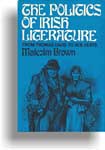
cover thumbnail of Malcolm J. Broiwn's "The Politics of Irish Literature"

"Mr. Brown's masterpiece..."
-- Michael Foote in the London Evening Standard

The Poltics of Irish Literature
by Malcolm Brown

* READ the complete book free on astonisher.com


The Politics of Irish Literature
From Thomas Davis to W.B. Yeats

by Malcolm Brown

Chapter Eleven
Fenianism Mobilizes

THE NATION estimated that the physical force impulse was totally extinguished in Ireland by the time O'Donovan Rossa came out of Tralee jail in 1859. A. M. Sullivan felicitated himself on his editorial accomplishment. The Fenians naturally put forward the opposite prediction, and before the year was out James Stephens was back at work in Skibbereen. The story of his reunion with the released prisoners has been preserved in Rossa's childlike prose, telling how half a dozen Phoenix men met him in Bantry: "We went in Denis O'Sullivan's yacht to Glengarriff, where we had dinner. Stephens paid for the dinner. Sailing through Bantry bay, Stephens was smoking a pipe. I remember his taking the pipe in his hand, and saying he would not give the value of that dudeen for the worth of Ireland to England after the death of Queen Victoria; that she, in fact, would be the last English reigning monarch of Ireland."'

In prognostication Stephens was not omniscient. Rossa wondered whether he himself believed what he told others: "I do not know did he speak that way that day in Bantry bay, from the strong faith he had in the success of his own movement. Anyway, the way he always spoke to his men seemed to give them confidence that he was able to go successfully through the work that was before him, and before them. That was one of his strong points, as an organizer." Stephens' vision of Ireland's future was too enthusiastic in its timing, yet it was not inaccurate in substance. Victoria herself would never see the end of the Union, but in the midst of the Fenian excitement the future English monarch was born who would. Sullivan's prediction, on the other hand, was absolutely wrong, and he was shortly forced to retract his self-congratulation: "Foolish was the best of our wisdom in thinking this was the end." The Phoenix affair was not the finale of Fenianism, but the overture.

Leaving the Skibbereen veterans to run on their own steam, Stephens now concentrated his energy upon building up the pressure in Dublin. He found the city full of hidden nationalists waiting to be asked, and the serious swearing in of new members quickened. In about a year the organization was ready to demonstrate its strength in public. The issue chosen, the most perfect Ireland could offer, had to do with a wake.

II

Among the seven Young Ireland felons in Van Diemen's Land, the least conspicuous was Terence Bellew MacManus. His history was about the same as Meagher's. After Ballingarry he was captured, tried, convicted, sentenced to death, reprieved, transported, and at last rescued and set ashore a free man in San Francisco, where he settled down in the grocery business. Early in 1861 he died there, still a young man, still unrepentant. Some months afterward a group of San Francisco Fenians hit upon the idea of agitating for the cause by digging up the corpse and shipping it back to Ireland for reburial. Since there was not yet a transcontinental railroad, the project was a considerable undertaking. But a committee formed, money accumulated, and in due course the coffin set forth on its journey. As the Irish nationalist press proudly noted, it was the longest funeral procession attempted in all history, outdistancing by far the return of Napoleon's bones from St. Helena.

The body arrived in Dublin at dawn one Monday and the grand finale was scheduled for the Sunday following. A delegation waited upon Archbishop Cullen requesting him to permit the corpse to lie in state in the Marlborough Street cathedral for the six days before the burial, and also to furnish the same lavish obsequies that had been provided by Archbishop Hughes when the corpse passed through New York. Cullen was trapped in a dilemma. To accede to the Fenian request would sanctify wickedness. But to refuse would desecrate the rigid formalism of the death protocol, offend the flock, and isolate the hierarchy. The troubled archbishop elected the latter choice. The cathedral was closed to the mourners, and the corpse had to be carried down the street to the Mechanics Institute to repose there in state until next Sunday.

Cullen's boycott of the MacManus funeral forced Dublin to declare its allegiance in public. Down to the last hour it was not certain which side it would choose. Luby went to the Mechanics Institute Sunday morning in the rain and was disturbed to find nobody about. After a while a few people wandered in, then some more. In midafternoon, when the procession was ready to start, the brass bands appeared and led out with a funeral march. Luby fell into rank behind the coffin, not certain whether anybody was behind him. The procession moved north up Gardiner Street, and as it turned west into Great Britain Street, he glanced back at the squares along the river where the procession was forming. "Then, indeed, I was overawed," he said. "I saw the whole length of Gardiner Street filled with dense masses of men, and fresh masses, endlessly, as it seemed." Dublin had voted with its feet, and no mistaking its choice. The multitudes that Stephens had promised were really there. The burial of a man almost unknown except as a token of nationality had brought out fifty thousand marchers, more than had followed the coffin of world-famed O'Connell. Onlookers numbered one hundred thousand more. "I could have sobbed and cried," said Luby. "I felt, as I never felt before or since, the grandeur, the magnetism of an immense crowd of human beings, when all are, for the time being, gloriously animated with one and the same noble aspiration and conviction."

Table of Contents
The Politics of Irish Literature by Malcolm Brown

Astonisher.com is pleased to offer The Politics of Irish Literature by Malcolm Brown, complete and free for your personal use.

The Politics of
Irish Literature

From Thomas Davis to W.B. Yeats
by Malcolm Brown
Part I: The Peculiar Irish Setting
1. History and Poetry: Some Irish Paradoxes
2. Thomas Davis' Ireland
Part II: Young Ireland
3. O'Connell and Davis in Partnership
4. The Nation's First Year
5. The Retreat from Clontarf
6. Black '47
7. '48 and Insurrection
8. Beside the Sickbed: Carlyle, Duffy, Dr. Cullen
9. John Mitchel after '48
Part III: Fenianism
10. Mr. Shook
11. Fenianism Mobilizes
12. O'Leary and the Irish People
13. "The Year for Action"
14. The Agony of Fenianism
Part IV: Home Rule
15. The Ballot Box Once More: Isaac Butt
16. Parnell and Davitt
17. The Land War in Mayo
18. After Kilmainham: Bakhuninism in Phoenix Park
19. After Kilmainham: Davitt and Standish O'Grady Take Stock
20. The Irish Party in Maneuver
21. Enter: W. B. Yeats
22. Catastrophe
23. Poetry Defends the Gap: Yeats and Hyde
24. Literary Parnellism

Praise for
The Politics of Irish Literature
cover thumbnail for "The Politics of Irish Literature" by Malcolm Brown

"This brilliant study of the intersection of politics and literature in Ireland amounts to a dazzling portrait gallery. Reading it one feels about one the breath, warmth, and passions of the dead all come alive again."
-- Sean O'Faolain in the Manchester Guardian

"Mr. Brown's masterpiece has made me want to hire a nearby housetop and recite whol chunks to every passerby..."
-- Michael Foote in the London Evening Standard

"The author of the best book on George Moore now gives us what is in all likelihood the best book on the politics of modern Irish literature."
-- Virginia Quarterly Review

Professor Malcolm J. Brown walking in the garden with his grandaughter Laurel Brown, Seattle, WA, July 1986

University of Washington Professor Malcolm J. Brown (1910 - 1992) walking in the garden with his grandaughter Laurel Brown, Seattle, WA, July 1986.

Additional reading -- Malcolm Brown's George Moore: A Reconsideration, also here on astonisher.com.

From Great Britain Street, where Luby looked back upon the multitudes, the direct route to Glasnevin Cemetery turned right, northward, at Rutland Square. But the funeral procession did not turn. It marched on to the west, veered south, crossed the river upstream, and turned east again. The objective of this detour a couple of miles out of the way was St. Catherine's Church in Thomas Street, before which Robert Emmet had been executed in 1803. At that spot each contingent of the procession stopped for a moment and each marcher bared his head. Then they moved quickly through the College Green and back across the river to Rutland Square again, closing the loop, and at last took the direct road to Glasnevin. It would have been hard to misconstrue the question they had posed: Emmet is to MacManus as MacManus is to-whom?

The "drawing-room rebels" had fixed strong claims on Emmet's memory. They cherished the pathos of Tom Moore's song about his fatal love for Sarah Curran: "She is far from the land where her young hero sleeps"; and they memorized the brave oratory of the doomed patriots' debate against Lord Norbury. But according to Fenian theory, Emmet's courtroom words did not hold all of his meaning. His mode of death, for example, was not congenial to arrangement for voice and pianoforte; yet it contained weighty meanings all the same. The Fenians' line of march to the once-bloody spot in Thomas Street proclaimed that if one cared to stir the embers of Emmet's memory, he should not shrink from its integral horror as a timely political lesson. The languid gentility of Tom Moore's song concealed the ghastly severed head; let it be seen. The street before St. Catherine's Church had run with Emmet's blood, dogs had licked it from the cobbles, and Dublin ladies had shyly dipped their handkerchiefs in it. If O'Connell had not cared for blood, the fact still remained that blood was the pigment with which Irish history had been written-such was the physical force view of the matter.*

The MacManus procession did not reach Glasnevin until nightfall. A torch was brought so that the American Fenian who had escorted the body from San Francisco could see to read the manuscript Stephens had prepared. "In order to arrange my ideas the better," the American said, "I have reduced my thoughts to writing." He set to his task "like a Trojan," said Luby, and stumbled only on one word.

Stephens was not Pericles nor Meagher of the Sword, but as O'Leary remarked, the speech "served its purpose fairly well at the time, and that is sufficient to say of most speeches as indeed of most things." That purpose was, first of all, to acknowledge the position just won. Any Irishman not blind could see that the physical force leaders had succeeded in opening an effective revolutionary contact with the Irish people, completing the necessary first step and clearing the barrier where Davis, Mitchel, Smith O'Brien, and Duffy, for two decades past, had all fallen. Stephens was understandably proud of his momentous achievement: "Fellow countrymen, you have accomplished a great as well as a holy work this day, and I congratulate you with all my heart and soul. Why did you ever doubt your capabilities?" As for the transition to the next step, let Irishmen now employ "heart and arm and intellect . . . without noise or bustle," and "the day" for which all Irishmen longed "cannot now be very far off "

III

The MacManus funeral raised the Sullivan-Stephens vendetta to a new stage. Sullivan had "suffered and sacrificed" from the violent recoil of his "friendly remonstrance" and he confessed that a secret revolutionary society is "certainly a terrible power." Looking about for comfort, he first tested the political assets of clericalism. The old Nation's "haughty impartiality" toward sect went under, as Davis' paper turned national-Catholic (and "to my mind," said O'Leary, "much more the last than the first"). Increasingly the new Nation lifted its eyes to Rome. The story of Pius IX's growing burden of temporal cares filled many columns. "It was not the Pope who desired to have a people to rule but the people who desired to have a Pope rule them," Sullivan said. The Syllabus Errorum, that most unecumenical document, received his hearty applause. Modern progress, civilization, free thought what were they after all? Little more, really, he said, than Bell's Life in London, Renan, Colenso, "lunatic" Garibaldi, and "Joe" Smith (the Mormon). A rival editor complained that Sullivan had taken on board the nationalist movement too many saints, that for himself he was "sick of saints" and "cant about saints."

Sullivan's next step for covering his losses was more original. His Fenian enemies were startled to find that even while the feud raged, their casualties were the object of his studied solicitude. The Skibbereen teacher was hardly behind bars before Sullivan had launched a subscription for the relief of his aged mother, and he wept journalistically for his mortal enemy, O'Donovan Rossa, on his release from Tralee jail: "What a terrible punishment. . . . Jeremiah O'Donovan, once a prosperous trader, a husband, and a father returns to a desolate home, his children beggared!" Sometimes the Fenians spurned his condolences. And yet it was hard to repel his exaltation of their fallen.

At the same time, to fight fire with fire, Sullivan began to accumulate his own private arsenal of bloody symbology. He outdid everybody in the royal welcome he gave the tamed '48 revolutionaries straggling home from Van Diemen's Land. He then exhibited them with their acquiescence as his personal property. When Marshal MacMahon, one of Napoleon III's numerous unattractive generals, won a famous victory in Italy, the Nation proved in two columns of small type that his ancestors had indubitably been wild geese. The marshal was presented with a jeweled Irish sword and his glory was also made the Sullivans' private property. Sullivan's most popular book, the Story of Ireland, a history for juveniles, offered floods of gore no less than of sentiment, and Emmet's severed head appears in this children's moral force narrative complete with all the details except the ladies' handkerchiefs.

When MacManus' corpse arrived in Dublin, Sullivan took up the challenge contained in the Fenians' implied rhetorical question, Who is the living heir of Emmet and MacManus? and gave the bold answer that he was the heir himself. Archbishop Cullen might disdain the corpse, but he proposed to seize it for his own. He mobilized a moral force flying squadron backed by Father Kenyon and a large, fierce-looking relative of O'Connell's called The O'Donoghue of the Glens (to whom we have already been introduced through Joyce's Donnybrook in Ulysses). In six days and nights of intrigue, he fought the Fenians for the select front positions on the obsequies committee, in the procession to Glasnevin, and at the graveside. Holding the advantage of possession, the Fenians beat off his attacks. At the week's close the vanquished retired from the field, leaving behind a rumor that the coffin did not contain MacManus' corpse but only a lot of California rocks.

In strict consistency Sullivan should have had no more use for MacManus' corpse than Archbishop Cullen had, or than O'Connell had for Wolfe Tone and "the miscreants of 'Ninety-eight." The difficulty was that the consistent moral force position no longer held any allure. Whether Sullivan liked it or not, he was forced to come to terms with the physical force tradition, to attempt a hybrid fusion of bloody sedition and peaceful constitutionalism. So, the fusion was made (a "blend" he called it). He simply referred the bloody face of Irish life to past time and the moral force face to the present and future. With this fine discrimination, his hybrid took root. There was a recklessness about his solution, though, for suppose one's political followers should get their verb tenses confused?

IV

O'Leary summed up the battle for possession of MacManus' corpse in this way:

. . . The O'Donoghue and Mr. A. M. Sullivan . . . wished to make the funeral a mere commemoration of the past, having no significance in the present, and affording no lesson for the future. M'Manus had lived and died a rebel. With them all that was a thing of the past. 1848 was dead and gone, a mere thing of memory, and to many of them scarcely among the pleasures of memory. To Stephens, Luby, and their friends and followers, things, however, wore quite another aspect. They felt that they were carrying out the principles of '48 to their legitimate consequences by reverting to that solider and sterner policy of '98. . . .

This old quarrel over the proper ownership of Irish political corpses leaves us with a sensation of deja vu. When the eye picks up O'Leary's catchphrase "dead and gone," we suddenly place the MacManus affair as the original pattern from which Yeats later constructed his second most popular poem, "September 1913," and his refrain, "Romantic Ireland's dead and gone." The parallels are numerous: in both a dead physical force hero, in both a bogus Sullivanite claimant (Yeats's enemy in "September 1913" was a surviving stalwart of the Bantry band, William Martin Murphy), in both an argument for the right of possession based upon the superior nobility of the speaker. Yeats apparently represents himself as the bold Fenian man of 1913, decrying the new age for its cupidity and cowardice. The perfunctory remark is then in order: how little did Yeats guess that in three years Pearse and Connolly would occupy the General Post Office, and so on.

The connections between "September 1913" and the MacManus affair are, I think, overwhelming. It is by no means clear, though, that the conventional conclusion was what Yeats really meant. To begin with, his actual political position in 1913 according to the MacManus parallel was not with, but against, O'Leary's ghost. He was at that time at odds with the IRB, O'Leary's offspring, and was therefore exploiting that special blend of moral force with bloody ornamentation that O'Leary abominated as belonging by right of discovery to A. M. Sullivan's ghost. The first printing of the poem bore the interesting subtitle, "On reading much of the correspondence against the Art Gallery." The romantic entity buried with O'Leary was thus not primarily his militance, but his taste; and O'Leary's revolutionary name was invoked not to impel Irishmen to shoulder arms rather than live as "slaves that were spat on," but to enforce another demand altogether, very remotely connected-that is, to compel the Dublin Corporation to build Sir Hugh Lane his art gallery astride the Liffey.

In the minds of most Irishmen, though, it was inevitably that other war that O'Leary symbolized, especially when the cues were so unequivocally bloody. When Yeats later deleted the subtitle, the poem seemed to be complaining that O'Leary's heirs were not revolutionary any more, but actually was complaining that they were. We are witness here at the birth of a unique mode of poetic expression, a political double entendre carrying public and private meanings that contradict one another. The device belongs properly to forensic and is rhetorical in the strict and literal sense, perfectly in accord with his advice to Lady Gregory on the morality of equivocal battle: "be secret and exult." We have earlier picked up other traces of the impulse. As we have seen, Yeats's portrait of O'Connell was undoubtedly a debater's sally, using the word "demagogue" with a hidden semantic shift that inverted its normal meaning. His observations on Mitchel and Swift were in the same pattern, and there exist Irishmen so cynical that they can catch a hint of double entendre even in the magnificent "Easter 1916" - the executions brought metaphors for poetry. We will meet it again in his delineation of Parnell.**

V

With MacManus properly buried, the military question was plainly the next order of Fenian business. During the great wake, Dublin had filled with countrymen ready to be sworn in on the spot. Afterward they scattered to their homes and spread the movement broadcast through Ireland. The Dublin membership tripled in three months. As recruits accumulated, Stephens learned to know the sensation of great power, and he sent O'Mahony in New York instructions to bid farewell to the tedium of postponing Irish action until some English crisis might by chance occur, phrasing his message in his highly individualistic style:

If there be one thing, in connection with the cause of Ireland, I more cordially detest than any other, it is what scribblers or spouters call "a Crisis." It has been the chronic bane of Ireland-a more fatal bane that famine or any other the enemy have had, to perpetuate their rule. A bane - a scourge - a disease - a devil's scourge it has been to us. Its best known formula has resolved itself into this: "England's difficulty is Ireland's opportunity." Blind, base and deplorable motto-rallying-cry-motive of action-what you will. May it be accursed, it, its aiders and abettors. Owing to it, and them, the work that should never have stood still, has been taken up in feverish fits and starts, and always out of time, to fall into collapse when the "opportunity," predestined to escape them, had slipped through their hands. Ireland's trained and marshalled manhood alone can ever make--could have ever made - Ire-land's opportunity. And this opportunity, the manhood of Ireland alone, without the aid of any foreign power-without the aid of even our exiled brothers, could have been made any time these thirty years; and, whether England was at peace or war, with this manhood alone we could have won our own. . . . Accursed, I say, be the barren, lunatic or knavish clods who raised this dog-souled cry. . . .

Without "even our exiled brothers"? That is, without Irish-American men and money? This was a verbal excess that Stephens could not have meant seriously. Searching for a practical scheme to arm and drill his secret army, he found his answer in the terrible news from America. The Battle of Bull Run had taken place in midsummer 1861 (while MacManus' corpse was at sea), extinguishing the hope for a quick summertime collapse of the rebellion. In the autumn General McClellan began organizing the Army of the Potomac for a prolonged struggle, gathering two hundred thousand recruits for a small first installment. It was noted that thousands of Irish lads were to be found among them. Fenian organizers turned up in Washington to establish centers in the Union army, explaining that this new activity was a roundabout approach to "the day."

Stephens believed that he could rekindle in Virginia and Tennessee the Irish military frame of mind. Long, hard schooling had made Irishmen gun-shy, and a baptism of fire seemed needed to undo the memory of the Penal Laws, the yeoman terror of 1798, and decades of O'Connell's nonviolence preachment. A more sophisticated attraction of the war was the opportunity for advanced military training on the American battlefields. While the shooting lasted, it could serve as a school of modern war; when it ended, the Irish pupils would all be graduates, battle-hardened and warwise. They would (and did) find their way back home and form themselves into a cadre for upgrading the untrained Fenian army already on the scene. The two merged forces were then expected to move in unison to make their own opportunity and settle matters with England.

The cost of Stephens' scheme was to be read in the American casualty lists. Looking on from Richmond, John Mitchel watched the increasing Irish involvement on the Union side and noted sourly that Stephens' program was making a few proficient soldiers and innumerable corpses. One all-Irish brigade, for example, went into action against Lee at Fredericksburg with 1,300 men and straggled out in the evening with only 250 left alive.

In spite of Mitchel's chagrin, the Fenian venture into the American war enhanced the enthusiasm at home. Dr. George Sigerson described the two transatlantic wings of Fenianism as viewing one another "magnified by the sea-mists." Irishmen's servility - "Soft day, sir John, soft day, your honor" - had already been shaken by O'Connell and Young Ireland. The news from American battlefields brought fresh self-esteem. Irish soldiers proved themselves as good as any other, but that was an old story. What was incredible was that large numbers of ordinary Irishmen were actually being commissioned as officers, and not just as second lieutenants. The felon Meagher now wore the stars of a Union general. And Dubliners pondered the case of Mick Corcoran, merely a local peeler until he sailed for New York, who had become General Michael Corcoran and now moved with ease in the circles of the mighty.

Reminding themselves that overseas their comrades were already in arms and would soon take up a place by their side, the Dublin Fenians allowed their optimism to run away with itself, inflating into a fantasy of a formal American invasion with ironclads and the rest of the paraphernalia of easy victory. Overexcitable patriots set a lookout for miraculous American succor, coming like Smith O'Brien's message of hope to the Poles-America to the rescue! A priest of county Queens, one Father Maher, made the salty observation: "The project of the iron-clad ships or by any other scheme of Fenianism is not a whit more ridiculous than if . . . [someone] announced the approach from New York of a fleet of monster sea-gulls, carrying on their backs 100,000 warriors, each with a revolver in his hand and powder and ball and provision for a month in his pocket, to take possession of this isle of ours. . . ."

Those who watched in vain for American salvation were candidates for disenchantment. Echoes of their ancient frustrations persisted down into Joyce's day to sound off in "the citizen's" pronouncement on the American comrades: "We'll put force against force, says the citizen. We have our greater Ireland beyond the sea. . . . But those that came to the land of the free remember the land of bondage. And they will come again and with a vengeance, no cravens, the sons of Granuaile, the champions of Kathleen ni Houlihan." These are history-oriented but highly personal Joycean aversions: a hatred of the 1904 heir of Fenianism, "the citizen," for his Machiavellian ease in inventing lies and his stupidity in believing his own inventions; a hatred also of Irish-Americans as true "cravens," blood brothers of "the citizen" himself. Among Joyce's Americans we recognize our old Phoenix acquaintance from Skibbereen singled out for deflation; for since Joyce knew innumerable Dublin street ballads, he must have known:

I robbed no man, I spilt no blood, though they sent me to jail;
Because I was O'Donovan Rossa, and a son of Granuaile.

If the ironclads were not forthcoming, Stephens could still hope for dollars. His home army had the men, but it had no powder and ball. Up to the time of the MacManus funeral, the American Fenians had paid in hardly one-fifth of their 1858 pledge. The first two years of the Civil War saw no improvement. Late in 1863, however, Union victories at Gettysburg and Vicksburg foretold the approaching end of the war and gave hope that Ireland's great day was drawing near. A Fenian convention in Chicago in the autumn of 1863 keynoted a spirit of belligerence and immediacy. After it adjourned, a great burst of generosity swept over the Irish-American community, and in the next twelve months the drought of dollars was broken by a sudden flash flood. Collections increased a hundredfold overnight. By the end of 1864 Stephens was able at last to take action on the one remaining preparatory step for insurrection, the arming of his men.

Dependence on American greenbacks forced Stephens and O'Mahony to throw open the firm to unwelcome partners, the sachems of American Fenianism. Their "shamrock moistened with whisky," the American leaders were inclined toward a hysterical and ignorant style totally foreign to the methods of O'Mahony, Luby, O'Leary, Kickham, or even Mr. Shook himself. There is a quip attributed to O'Faolain:

Romantic Ireland's dead and gone,
It's with O'Leary in Chicago.

It was not long before the American subordinates declared themselves to be the principals. The Chicago convention of 1863 stripped O'Mahony of his financial control, transferring it to a "Fenian Senate" composed of Americans. Evidently Stephens was the next on the list. A bystander observed that the Americans told Stephens in effect, "Give us a battle or return our money!"14 In response to their pressure, he finally fixed "the day," to occur immediately after the cessation of hostilities in America. The year 1865 he named "the year of action."

VI

"The day" was not a close-held secret. Well-armed, the anti-Fenians bestirred themselves to head it off, undertaking a variety of ad hoc countermoves. Their scurrying resembled the activity of the Young Irelanders in 1845 when O'Connell was preparing to cast them out, except that it was now the heirs of Davis who were in the saddle.

Defamation of the Fenian character passed from the Nation to other expert hands. The clergy took up A. M. Sullivan's task and augmented his portrait of the coward patriot with the discovery of new vices, first embezzlement, then "profligacy." The Fenian leaders were charged with squandering in debauchery the pennies wheedled out of poor New York colleens. Archbishop Cullen issued a pastoral letter pointedly entitled, "Two Letters to the Catholic Clergy of Dublin, on the Cholera and Other Natural Scourges, and on Orangeism and Fenianism." He represented Stephens and his lieutenants as "seducers" who skulked "far away from danger, laughing at the simplicity of their dupes and enjoying the wages of iniquity." And who might these evil men be? he asked. "Have they been successful in business? Are they men to whom we would lend money or trust the management of our property?"

The aging Young Irelanders were asked to save the country from Fenianism. None came to Sullivan's assistance quite as sensationally as Darcy M'Gee, now transformed into a Canadian spokesman for the empire. On a return visit to Ireland, he went into Wexford and delivered a speech whose language was never to be forgiven by Irishmen, and particularly not by one unbalanced patriot who acted on his own initiative and shot him dead on the street in Ottawa three years later. M'Gee's speech began with a description of the American breed of Fenian, then moved by easy transition to the genus in its totality:

Their morbid hatred to England has been played upon during the Civil War by bounty brokers and recruiting sergeants. . . . They have deluded each other, and many of them are ready to betray each other. I have myself seen letters from some of the brethren from Chicago, Cincinnati, and other places offering their secret minutes and member's rolls for sale; the infamous old "stag" business over again; for as sure as filth produces vermin, it is of the very nature of such conspiracies as this to breed informers and approvers. . . . Men like Thomas Davis and Duffy, and others still living, would have scorned to range themselves with these Punch-and-Judy Jacobins, whose sole scheme of action seems to be to get their heads broken, and then to squeak out in a pitiable treble-"A doctor! ten pounds for a doctor! Send for a doctor!"

The campaign of vituperation necessarily made a cumulative impression on Irish minds. The Fenian leaders were driven into a characteristic sort of defensiveness by which they dramatized themselves amid slander as living proof of the false witness of their traducers. Any Irish public figure was normally expected to pass through the harrowing of hell, and it was inevitable for Stephens and O'Mahony to be described as monsters of peculation. For rebuttal, they lived and died in virtual poverty, though both handled great sums of money. O'Leary's public dramatization of his "old Roman" probity and stoicism was certainly natural to him, but it was also a specific answer to M'Gee's Wexford taunt, "Send for a doctor!" flung at him in a manner that O'Leary took the trouble to describe as "blatant blackguardism" and "corrupt villainy."

The rowdy and scurrilous side of Irish history is familiar to all readers of Irish literature. Irish public controversy often seemed pure madness, yet it did have its decorums. For example, the clergy were permitted vituperation, but rejoinder in kind was disallowed. When O'Leary referred in public to Archbishop Cullen by his naked surname, omitting the deferential "Dr.," he was thought to have outraged civility. Gavan Duffy was simply not himself when he described his clerical opposition in the Tenant League as "the gibbering" of a "horde of busy idiot faces." Even in Joyce's generation, Simon Dedalus' allusion to the "tub of guts up at Armagh" was, in print at least, an astonishing novelty. But as if in recompense for the first rule, the Fenians enjoyed a similar sanctuary in political debate, so that while no limit was set upon the use of personal slander against them, attacks upon their political principles were required to be stated in the name of some patriotism even more noble. T. D. Sullivan complained that "the Fenian leaders were to be free to denounce `agitation' and `agitators' to their heart's content"; while "the agitators [i.e., the Sullivans] should not dare to reply, on peril of being held up to opprobrium as aiders, abettors, and informants of the British government." Apart from these two decorums, everybody let his personal spleen be his guide, and naturally all were quick to cry "Foul!" against an opponent. After all, Grattan himself was a virtuoso of vituperation. Those who believe that John O'Leary was incapable of venom would find their opinion shaken by a reading of his attacks upon "A. M. Sullivan-Goulah" in 1863 and 1864. In the same pattern, Yeats's attacks on George Moore, Arthur Griffith, and W. M. Murphy show that he was like everybody else cheerfully at home in the gutter, if there the battle raged.

Not that the Fenians lacked their unique modes of self-expression. After the death of Prince Albert in 1861, the Dublin Corporation announced a plan to erect a memorial statue in College Green. The Nation burst into loud protest. The spot where the Volunteers had drilled in '82 could receive only the one fitting memorial, to Henry Grattan. Sullivan called a mass meeting to deplore the insult to Irish honor. Stephens sensed that an agitation of "scribblers and spouters" was afoot, more O'Connellite monster indignation. The Dublin Fenians were called out and given orders to "take over." They jammed the Rotunda, pushed Sullivan and The O'Donoghue of the Glens off the rostrum and out the door of the hall. Sullivan called a second meeting, admission by pass only. The Fenians asked, What kind of a mass meeting is it that requires a pass to get in? Some of them forged passes, but they were exposed by a vigilant doorkeeper in time to prevent a second riot. Disrupted by "England's Allies," as the Nation called the Fenians, the agitation over the Albert memorial died.

VII

By 1864 Stephens had thousands of men under his orders in Dublin and Cork, and Kickham had called another fearful hosting on Slievenamon, attended this time by a horde that was disciplined, if still unarmed. In the extreme urgency of the hour, Archbishop Cullen became impatient with the failures of the laity and descended into the arena in person. He announced a new political organization called the National Association of Ireland and summoned the bishops to town to sit with him on the platform of the aggregate meeting. All responded except Archbishop MacHale, whose letter of regret reminded Cullen once more of the firm of Sadleir, Keogh, and Cullen.

The day for launching the association fell not by accident in the same week the news reached Dublin that Sherman had marched into Savannah. On the Rotunda rostrum, raised to extra height to prevent surprise attack by any prowling Fenian scaling party, sat five bishops, six canons, and two priests to represent the rank and file, together with Archbishop Cullen, ready to give the blessing, to deliver the address, to move the first resolution. His speech reviewed the ills of Ireland: depopulation, nearly 40 percent population loss in twenty years; the loss of merchant trade in the county towns; poor farm prices, a compulsive conversation-starter of the strongfarmer class the world around; and general poverty, deepening each year regardless of the emigration. He sketched what seemed to him the causes of these ills: the flooding of Irish rivers, the backwardness of husbandry, the "banishment of manufactures," absenteeism, and the sinful wealth of the Anglican Church of Ireland. When the parliamentary program was presented, it was found to call for only the Ulster tenant right, free sale of improvements, the smallest of the Three Fs. The other two demands were for disestablishment of the Church of Ireland and for a government-funded Catholic college. On the national issue, silence; there was no national program at all.

This was rather a parsimonious counteroffer for an organization hoping to block the Fenian drive toward armed rebellion. Even A. M. Sullivan was dismayed. He would have preferred His Grace to remain behind the scenes where his political obtuseness would be invisible. Stephens and O'Leary barely condescended to assault their new ecclesiastical rival in the field. In Cullen's program they saw O'Connell's old addictions: to beg "a little something for Ireland," to find places for the unemployed Catholic gentility, and to disrupt the projects of the advanced men. The hierarchy, they said, "will be ready to join sham-patriotic movements leading nowhere, such as the Tenant League, the new National League, and others of that stamp; or they will join narrow struggles, tending to promote their own immediate interests; but to a real National movement they will never give their adhesion in good faith." But whatever the triviality of Cullen's response to the Fenian threat, he had established one momentous precedent. The "boors in broadcloth" had found a friend in high place; and the Church, if but ever so timidly, had embarked upon its first agrarian adventure. This is the inconspicuous seed from which Parnellism later grew.

Next chapter...

"The Politics of Irish Literature" © Copyright 1973 Malcolm Brown

* Their point about the inseparability of martyrdom and terror was perhaps well taken, or at least Joyce thought so. He made the -same point himself in his collage of the Emmet execution in the "Cyclops" and "Circe" chapters of Ulysses with a minute account of the hangman's duties, conveyed in the incongruous language of the society page: "On a handsome mahogany table near him were neatly arranged the quartering knife, the various finely tempered disembowelling appliances (specially supplied by the worldfamous firm of cutlers, Messrs John Round and Sons, Sheffield), a terracotta saucepan for the reception of the duodenum, colon, blind intestine and appendix etc when successfully extracted and two commodious milkjugs destined to receive the most precious blood of the most precious victim. The housesteward of the amalgamated cats' and dogs' home was in attendance to convey these vessels when replenished to that beneficent institution." Ulysses, pp. 303-4.

** The great enigma of "The Second Coming" may also be traced to this habit, although the forensic masking is more urgent and skillful. It was first published in late 1920 at the peak of the Black and Tan terror, which it was naturally assumed to describe in the most obvious way, with a sphinx added to lend a touch of enigma to the bestial theme. Then an examination of the manuscripts led Richard Ellmann to date its composition in January 1919, many months before the Tans had ever been heard of, and the enigma deepened. Next Jon Stallworthy discovered even earlier manuscripts, written perhaps as early as the summer of 1913 (see Between the Lines [Oxford: Clarendon Press, 1963, pp. 16-25). In them he found an allusion to the Treaty of Brest Litovsk; and if the reader will look into the Yeats letters of that time, he will find him deeply absorbed in the hysteria of the Bolshevik scare. With this clue, our enigmatical sphinx gives place to the all-toorecognizable names on the front page of the newspapers. Lenin and Alexander Kerensky are respectively the "mere anarchy" and "the best" who "lack all conviction." But who is the "rough beast"? One would imagine that it would have to be the Bolsheviks, but this will not do, since Lenin is already taken care of. The only possible identification would be the interventionists, Admiral Alexander Kolchak and the English Brigadier General William Edmund Ironside, heralds of the new millenium with Yeats's hearty applause.

But Stallworthy found an even more interesting clue in the canceled line of the manuscripts reading, "And there's no Burke to cry aloud no Pitt." For any Irish nationalist, the name "Pitt" screams out from the page, for it answers "mere anarchy" with the unmistakable threat of '98, with its rich accretion of terroristic paraphernalia. Decoded, Yeats's Irish grievance was thus not against the Tans, but against "incendiary or bigot," against the IRA, whom the Tans were sent into Ireland to destroy; and his message to the IRA said: gentlemen, you have just exhausted my Christian charity. That Yeatsian virtue should wear the mask of the rough beast need not startle. The symbolic structure of "The Second Coming" is a close paraphrase of Standish O'Grady's emotional reaction to the successive phases of the land war, with which we are familiar. Yeats's preface to Resurrection remembered the rough beast as rather jolly, "associated with laughing, ecstatic destruction"; and A. Norman Jeffares' annotations of the poem add new testimonials to its virtue and attractiveness. The tone of the symbol also echoes the open threats of the reactionary terrorists of the time and of Yeats himself in 1932.

Stallworthy is inclined to interpret Yeats's tendency to drop off all specific cues as the poem approached final form as being aesthetically motivated, since a symbol too clearly defined "is drained of much of its imaginative potency." But there has probably never been a reader of "The Second Coming" who has not been dissatisfied with its generalities and has not attempted to imagine its natural referents. If my interpretation of the poem is correct, Yeats was very wise to make his readers guess at this or that ambiguity. "The Second Coming" would doubtless have lost some of its enormous authority if the word "Pitt" had by mischance been left in, or if (like "September 1913") it had borne a subtitle that accidentally exposed its secret: an excited longing, far ahead of the crowd, not only for the march on Rome and the beer-hall Putsch, but also for the Tans themselves, whose subsequent arrival he (1) deplored in a perfunctory poem later dropped from the canon, and (2) ambiguously linked to the IRA in "Nineteen Hundred and Nineteen" under the sentiment, a plague on both of you weasels.

Yeats's forensic masking casts a sardonic light upon his famous epigram that we make rhetoric out of our quarrel with others but poetry out of our quarrel with ourselves. It also adds a curious footnote to the fierce old battle cry of the 1950s, that every query into intention, single and double entendre alike, is a vulgarism inconsequential to the poem qua poem. "September 1913" and "The Second Coming" appear to make an interesting test of that proposition. And finally, it threatens embarrassment to those who put all their bets on Yeats's myth qua myth, disembodied and historically nonreferential. It would seem difficult to silence the question, What does the mechanism of his mythic "system" mean in this concrete setting-for example, in the arrival of the Tans?


New CD-ROM LIBRARY EDITION
cover thumbnail of The History of the Corporation by Bruce Brown

"Great book. Fascinating..."
-- Jack Weatherford,
author of
The History of Money

The History of the Corporation
by Bruce Brown

* READ free excerpts on astonisher.com
* BUY the complete book at the astonisher.com store

"An environtmental classic..."
Moutnain in the Clouds by Bruce Brown: 25th Anniversary

Mountain in the Clouds
by Bruce Brown

* READ free excerpts on astonisher.com
* BUY the complete book at the astonisher.com store


© Copyright 1973 - 2010 by Bruce Brown
and BF Communications Inc.

Astonisher and Astonisher.com
are trademarks of BF Communications Inc.

BF Communications Inc.
P.O. Box 393
Sumas, WA 98295 USA
(360) 927-3234

Website by Running Dog

Astonisher.com Most Read

1. The History of the Corporation
2. White Cow Bull at the Little Bighorn, #1
3. Conversations With Crazy Horse
4. Who Killed Custer?
5. Twisted Saga of Unsung 7th Cavalry Scouts
6. Windows 7 / XP Wireless Network Bible
7. Crazy Horse In Action
8.
Heart-Stopping Sturgeon
9. 100 Voices from the Little Bighorn
10.
The Digital Rip Van Winkle Returns

Obama has jobs for young Americans!

Windows 7 / Windows XP Wireless Home Network Bible by Bruce Brown

100 Voices from the Little Bighorn: eye-witness accounts of the Battle of the Little Bighorn

"What happens when an Apple goes to bed with a Dell?" by Bruce Brown

Sarah Palin: The kind of change America wants!

"Who Killed Custer -- The Eye-Witness Answer" by Bruce Brown

"Vernon Louis Parrington" by Bruce Brown

Content on this page requires a newer version of Adobe Flash Player.

Get Adobe Flash player

Dr. Whacko's Guide to Slow-Pitch Softball by Bruce Brown

"Opal Whiteley" by Bruce Brown

"The Digital Rip Van Winkle Returns" by Bruce Brown