100 Voices from the Little Bighorn: eye-witness accounts of the Battle of the Little Bighorn Windows 7 / Windows XP Wireless Home Network Bible by Bruce Brown
Biesbol en Cuba! Astonisher.com Free (Thought) Banners


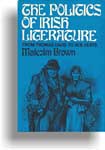
cover thumbnail of Malcolm J. Broiwn's "The Politics of Irish Literature"

"Mr. Brown's masterpiece..."
-- Michael Foote in the London Evening Standard

The Poltics of Irish Literature
by Malcolm Brown

* READ the complete book free on astonisher.com


The Politics of Irish Literature
From Thomas Davis to W.B. Yeats

by Malcolm Brown

Chapter Nineteen
After Kilmainham: Davitt and Standish O'Grady Take Stock

THE ESSENCE of Parnell's reply to Forster was that the Phoenix Park affair was not an issue of substance for Irishmen-a correct tactical position. And yet he was himself suddenly apprehensive of terror, and even militance. When he turned to carry out his own Kilmainham promise to calm down the land agitation, his fear of the irrepressibles reinforced his habitual scrupulousness in honoring a commitment. Davitt's first question on being told of the new Kilmainham line was, what did Parnell propose to do with the other family enterprise, the Ladies' Land League? He touched a tender spot. Toward his agrarian sisters Parnell felt no chivalry and no gratitude, negative attitudes he shared with others, Cardinal MacCabe for one, and also Mrs. O'Shea, who considered their actions "crass folly" and "criminality" and applauded her influential good friend's displeasure with "this wild army of mercenaries" and "fanatics."' Parnell's answer to Davitt's question was: "I fear they have done much harm" and "they have expended an enormous sum of money." He added that "they" -- presumably his sistershad told him that Ireland would have been better off if he had stayed in Kilmainham.

In Parnell's irritation can be seen the birth of the theme of the frenzied Irish amazon, of whom the Maud Gonne of Yeats's verse is the most resplendent and indefatigable example. The parentage was explicitly acknowledged by some of the more insistent voices of the myth. St. John Ervine, Belfast's unique contribution to Yeats's Irish literary movement, enthusiastically seconded Mrs. O'Shea's critique: the fanaticism of Irish women was "almost inhuman."' Liam O'Flaherty, too, felt drawn to sympathy with Parnell's aversion against his female auxiliary: "There was a women's organization called the Ladies's Land League, which did as much harm by thoughtless statements and actions as the organizations of political women among us in Ireland nowadays" -- a reference to Mesdames MacBride, Markiewicz, and MacSwiney. On this particular theme he wrote a novel, The Martyr. It was not one of his best; like some other Irish literary historicisms, this one is not weather-tight. Listening to Parnell's attack, Davitt remembered that it was the ladies after all who had finally toppled Forster, and he replied, "It appears to me that they have given good value for the money which was contributed to give the landlords and the Castle all possible trouble." However that might be, Parnell silenced the ladies' agrarianism without ado simply by cutting off their money. His habit of diplomacy was missing from the transaction, and his sisters never spoke to him again.

The Land League itself was the next to go. Davitt, Brennan, and Dillon were summoned to Avondale for discussions in September 1882, immediately after House passage of the twin bill for Ireland, the coercive Crimes Act and the conciliatory Arrears Act. The meeting was tense, for the Kilmainham treaty was not working well. Great numbers of peasants were barred from benefits under the new reform and were threatened with eviction. And as soon as the new Crimes Act became law, evictions began once again to soar. The league militants went out to Avondale to argue that Parnell had betrayed the neediest strata of the peasantry and written them off for extermination. They urged that the old Land League be reactivated and the land war reopened with the full vigor of November-December 1880.

By standing pat on the Kilmainham treaty, Parnell opened up the familiar vista of the Irish schism. Schism did not occur, though. The one was victorious over the three, but not, as John Butler Yeats thought, by the exercise of hauteur and insolence. Parnell never "governed with the iron hand," said Davitt. "No leader was ever more indulgent in the exercise of power or interfered less with his followers or gave a wider field for discussion or criticism. . . ." Still, he did prevail; which is to say that the other three, who had it in their power to tear the movement apart if they chose, chose not to. They submitted, and so it was that an agreement to bury the land agitation, "the Avondale treaty," was reached. A new political mass organization was announced, to be called the "National League," cleansed of the offensive word "Land." Its platform was, first of all, Home Rule; incidentally it also advocated "land reform" and the stimulation of Irish industry. By a revision of the old Land League constitution, the moderate Irish M.P.'s assumed the dominant voice in its affairs; and in 1884 local priests were co-opted into every branch as ex officio members. Soon the organization that two years earlier was the de facto government of rural Ireland had mutated into an O'Connellite vote-getting machine for the Irish parliamentary party. It welcomed the old land-war generals to membership, if they cared to come along, but most of them quietly drifted away. Dillon went to Colorado for his lungs; Egan settled down in Lincoln, Nebraska; Davitt accepted a place on the new board, and even journeyed to the United States to pacify the discontented Irish-American sponsors. But he remained critical, with Lancashire gradually replacing Ireland at the center of his thought and effort.

To defend himself against the charge of premature demobilization, Parnell argued that the land-war resurgence was now an exhausted force. He believed that it would be a foolish general who would overextend his pursuit without pause to catch breath. He believed that he had already achieved, in Yeatsian language, "of all things not impossible, the most difficult." Reversing Lalor's 1848 program, he proposed to kennel the wolf dog, or to alter the metaphor, to unhitch the economic issue from the political, to sidetrack agrarianism and to highball down the line with Home Rule. He believed that the great mass of his Irish followers approved his decision "I believe that the Irish People have very moderate ideas as to the improvement of their condition. . . ." He thought that men like Davitt, Dillon, and Egan who would push on with the land war regardless would soon find that they had no followers at their backs, and his order of the day was above all else to strengthen the Irish parliamentary party.

Table of Contents
The Politics of Irish Literature by Malcolm Brown

Astonisher.com is pleased to offer The Politics of Irish Literature by Malcolm Brown, complete and free for your personal use.

The Politics of
Irish Literature

From Thomas Davis to W.B. Yeats
by Malcolm Brown
Part I: The Peculiar Irish Setting
1. History and Poetry: Some Irish Paradoxes
2. Thomas Davis' Ireland
Part II: Young Ireland
3. O'Connell and Davis in Partnership
4. The Nation's First Year
5. The Retreat from Clontarf
6. Black '47
7. '48 and Insurrection
8. Beside the Sickbed: Carlyle, Duffy, Dr. Cullen
9. John Mitchel after '48
Part III: Fenianism
10. Mr. Shook
11. Fenianism Mobilizes
12. O'Leary and the Irish People
13. "The Year for Action"
14. The Agony of Fenianism
Part IV: Home Rule
15. The Ballot Box Once More: Isaac Butt
16. Parnell and Davitt
17. The Land War in Mayo
18. After Kilmainham: Bakhuninism in Phoenix Park
19. After Kilmainham: Davitt and Standish O'Grady Take Stock
20. The Irish Party in Maneuver
21. Enter: W. B. Yeats
22. Catastrophe
23. Poetry Defends the Gap: Yeats and Hyde
24. Literary Parnellism

Praise for
The Politics of Irish Literature
cover thumbnail for "The Politics of Irish Literature" by Malcolm Brown

"This brilliant study of the intersection of politics and literature in Ireland amounts to a dazzling portrait gallery. Reading it one feels about one the breath, warmth, and passions of the dead all come alive again."
-- Sean O'Faolain in the Manchester Guardian

"Mr. Brown's masterpiece has made me want to hire a nearby housetop and recite whol chunks to every passerby..."
-- Michael Foote in the London Evening Standard

"The author of the best book on George Moore now gives us what is in all likelihood the best book on the politics of modern Irish literature."
-- Virginia Quarterly Review

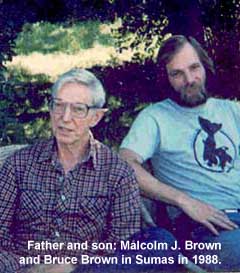
Professor Malcolm J. Brown walking in the garden with his grandaughter Laurel Brown, Seattle, WA, July 1986

University of Washington Professor Malcolm J. Brown (1910 - 1992) walking in the garden with his grandaughter Laurel Brown, Seattle, WA, July 1986.

Additional reading -- Malcolm Brown's George Moore: A Reconsideration, also here on astonisher.com.

In Davitt's opinion, on the other hand, Parnell's peace treaty broke a rising revolutionary wave and instituted a "counterrevolution." He believed that the agrarian upsurge of 188o had bought precious little with its prodigal expenditure of heroic energy. As we have seen, he thought the No-Rent Manifesto had come too late; but he also believed it premature. Since Parnell had refused his chance to call the rent strike on that angry day when his ticket of leave was canceled and all the Irish members were suspended from the House, he thought he ought to have waited until some future time when he could mobilize the entire peasantry. Then the chief secretary might well study whether he could evict half a million farmers and dig potatoes with bayonets. Until the Kilmainham treaty had undermined its fighting strength, the old league was, he thought, competent to deliver a knockout blow to landlordism .

In this old argument, Davitt's contention had its point. He saw that if the force of the agrarian offensive was waning, none was so weary of it as "the Chief" himself. Parnell had once remarked that imprisonment would drive him mad if he ever had to endure it for long, and Davitt surmised that claustrophobia was his prime motive for the Kilmainham treaty. Long afterward, Mrs. O'Shea's publication of Parnell's prison letters threw a different light on Davitt's suspicions. One letter written on the day after his arrest was anything but claustrophobic. It said: "Politically it is a fortunate thing for me that I have been arrested, as the movement is breaking fast, and all will be quiet in a few months, when I shall be released." But the expected rural quiet did not descend, and on February 14, 1882, with five months of jail behind him, he wrote Mrs. O'Shea: "I am very glad that the days of platform speeches have gone by and are not likely to return. I cannot describe to you the disgust I always felt with those meetings, knowing as I did how hollow and wanting in solidity everything connected with the movement was. When I was arrested I did not think the movement would have survived a month, but this wretched Government have such a fashion of doing things by halves that it has managed to keep things going in several of the counties up till now."' It is hard to read these letters as anything other than a wish for Forster to move in on the league and its ladies' auxiliary speedily and with his most efficient constraints.

Davitt's critique of the Kilmainham treaty raised a general alarm that the national revolution stood in danger of being stunted before its full growth. He thus anticipated a major anxiety for thoughtful Irishmen of a later time and broached the most repetitive if not the most perspicuous of all political fixations in later Irish literature-the disenchantment-withIreland theme. When the Treaty of 1921 finally arrived, it bore an incongruity between effort and achievement that would fascinate astringent bystanders, and imperialistic Englishmen particularly would be anxious to vociferate over the nonappearance of the Gaelic utopia (though they were more prone to a hurt silence, like Lady Peel on her visit to O'L eary). But Irishmen too, and even the Free State leaders themselves, felt twinges of embarrassment. When forced to make some kind of a statement on his program in 1922, Michael Collins announced unheroically: "The keynote to the economic revival must be development of Irish resources by Irish capital for the benefit of the Irish consumer in such a way that the people have steady work at just remuneration and their own share of control. How are we to develop Irish resources? The earth is our bountiful mother. Upon free access to it depends not only agriculture, but all other trades and industries." Davitt early caught hints that banality was an Irish historical potential; and he feared that Parnell had made it possible that an Irish revolution might sometime be fought, as Dubliners later heard it said perhaps excessively, to paint the royal-red pillar boxes a patriotic green. But it was Davitt himself who beckoned Parnell into the revolutionary leadership at Westport; and very happy he was that day when Parnell's courtesy relieved him of his revolutionary responsibility.

Davitt thought it possible to outwit the forces that would stunt the Irish revolution, if agrarianism could be kept in team with the other prepotent Irish objectives. Henry George gave him one kind of program: to "nationalize the land" by government purchase, the "economic rent" to be then collected by the government and used for amortization of the purchase debt, with the leftover cash used to defray the expenses of government. This slogan made no appeal to Irishmen. Davitt dreamed, too, of a union of Irish agrarianism with English socialism, and at one stage he started a newspaper in London, the Labor World, with a mixed trade-union, socialist, and agrarian orientation. Studying these shifts of his thought, his old Fenian comrades suspected that his brain was becoming addled. O'Leary concluded that he was not a nationalist any more, but "some sort of an internationalist and socialist." But to the modern observer, it is plain that he was groping toward the same fusion of land and urban grievance that was destined to ignite all of the major social revolutions of the twentieth century. He was notably lacking, though, in any theoretical grasp of either goals or methods. While Ireland in 1880 possessed all the ingredients for an explosion of the twentieth-century type, it is impossible to imagine that Michael Davitt was a man to weld them into a striking force, or supposing some initial success, that he could have organized a holding action to survive the fury of the inevitable counterattack. His program receded into the mists, to be superseded after a couple of decades by the forthright Marxism of James Connolly, Jim Larkin, and Sean O'Casey.

More self-commanding and more sensitive to the immediate actualities of the Irish and English balance of forces, Parnell curtly overrode Davitt's position, knocking down his ideas seriatim. The alliance with Henry George he disposed of by reminding the Irish peasant of his peasant human nature: "The desire to acquire land is everywhere one of the strongest instincts of human nature." He dispelled Davitt's scheme for an alliance with English socialism by pointing out that such an ally did not actually exist. Scorning the vague, half-militant, half-utopian tone of Davitt's language, he observed that there were but two ways by which the Irish peasant could possess the land-he could fight for it or he could buy it. The first of the alternatives, he said, "I say nothing about"; the total absence of any Irish army, arms, allies, or opportunity spoke for itself. The other alternative was at best not painless, but he warned the land-hungry that they would perhaps finally have to go on being land-hungry. Constitutional agitation had no magic solution for peasant frustration; it could at most "whittle down the price that the landlord asks for his land, but it must be paid" in the end.

II

Parnell's decision to cut free of Irish agrarianism for unfettered adventures in parliamentarianism entailed the dangers of stagnation in the same doldrums that becalmed O'Connell in 1842 and Butt in 1875. But without waiting for any prompting by Parnell, the Irish land issue was propelled by its own self-motion to trace out a new mutation not clearly foreseen by Gladstone, Davitt, or Parnell either.

The novelist George Moore wrote a series of naturalistic sketches of the land war for Le Figaro, later reprinted as Parnell and His Island. He had been living as an absentee landlord in high decadent style in Montmartre when the reverberations of Parnell's Ennis speech penetrated even so far and called him back home. In 1880 he was forced to meet with delegations of Moore Hall tenants, a task for which he was almost too enlightened. In Mayo, he wrote, no landlord could hide the naked essence of his privilege to collect rent-it was simple extortion: ". . . in Ireland there is nothing but the land; with the exception of a few distillers or brewers in Dublin, who live upon the drunkenness of the people, there is no way in Ireland of getting money except through the peasant. . . . in Ireland rent is a tribute and nothing else." His own "tribute," mailed to him regularly in Paris until it suddenly stopped altogether, had been exacted by virtue of the right of arbitrary eviction. But with the new peasant discipline and organization superior to the landlords' own, the arbitrary evictions and the tribute had vanished together.

Boycott's flight from Lough Mask House had demonstrated the impotence of both courts and military. Negotiating with his Land League tenants, Moore probed their minds to find what lingering power to threaten might still be left to him. Affecting indifference, he suggested that he had half a mind to sell out to some Englishman

"An Englishman here," cries a peasant. "He would go back quicker than he came."
"Maybe he wouldn't go back at all," cries another, chuckling. "We would make an Irishman of him forever."
"Begad! we would make him wear the green in great earnest, and a fine sod it would be," shouted a third.

Reaching for weapons Moore suddenly found he had none. He was ready to understand why Forster concluded that there was no effective countermeasure against the boycott, and why Parnell had said to the peasants at Ennis, "You have the game in your hands."

The surprise result of this disturbance of old relationships was that the outcry for a peasant proprietary, formerly linked with Jacobinism and jacquerie, once shelved by Thomas Davis as too dangerous, and lately fixed by Parnell as the daring limit beyond which he would never venture, was suddenly taken up seriously by Irish landlords themselves. They foresaw a long sloping fall of agricultural prices resulting in an interminable agrarian warfare that they could never hope finally to win. They concluded that it

would be wise to turn their dubious land values into sterling, to sell out to the tenants, and to betake themselves to England or the colonies. Not too hurriedly, though. They were disheartened, but not so much that they could be panicked when Davitt threatened that they "did not deserve in the way of compensation the price of their tickets to Holyhead." Parnell had spoken of whittling down the price. They settled back to wait him out. The conclusion came leisurely. It reaches beyond the limits of this study, but it should be sketched briefly in order to give a bearing on the sweeping cultural changes implicit in Gladstone's Land Act of 1881.

III

For many years landlord and peasant haggled, unable to agree on price or terms. Tory ministries sponsored new Irish land acts in 1885, 1887, 1891, and 1896, each containing schemes for peasant land-purchase, but none ever passed beyond pilot experiment. Then the Boer War rudely disturbed the English sense of imperial security. More portentous still, the German naval threat broke through the traditional encrustations of British ministerial thinking. To check the German advance, the Entente Cordiale with France was hastily concluded. At the same time and apparently in the same mood of military forethought, Arthur Balfour, the Tory prime minister (whom the Irish with their affection for nicknames called "Bloody" Balfour), and George Wyndham, his Irish chief secretary, determined to foreclose the danger of an Irish peasant explosion in the British rear and to bring to completion the agrarian solution left half-finished by Gladstone.

In 1903 a Connaught landlord named Captain John Shawe-Taylor, one of Lady Gregory's nephews, took it upon himself to call a meeting between the Irish agrarian leaders and the landlords to discover whether they might finally strike a bargain. The discussions resulted in a proposal: let the British government pay from the exchequer the difference between the asking and the offering price and advance one hundred million pounds to buy up the peasants' land-purchase debt, enabling the landlords to cash in at once and depart. Balfour and Wyndham were informed that on these terms the bargain could be sealed. In a memorial to Shawe-Taylor, Yeats later spoke of this episode as "so entirely unmixed with any personal calculation" that it seemed a "miracle," probably originating in "the communion of the soul with God"; and he garlanded Shawe-Taylor with the lines of Tennyson:

My strength is as the strength of ten,
Because my heart is pure.

When asked to pay the unprecedented sum necessary to close the land transaction, Balfour and Wyndham doubtless saw Shawe-Taylor's motives in a less mystical light. They decided, though, that the result would be worth even so high a price. Parliament that year passed the Wyndham Land Act, which promised the Irish peasant that when he had completed sixty-two and one-half years of installment payments, the farm would really be his.

Joint beneficiaries with their former landlords of the "fall of feudalism in Ireland," the Irish peasants were indubitably better off after the Wyndham Land Act guaranteed them against eviction, rack-rents, and famine. It has been said that the Irish countryman now consumes more home-grown calories than his counterpart anywhere else in Europe. Stability he has won, too. Yet in the midst of one of the most favored farming areas of the world, his per capita income is still among Europe's lowest. The massive enclosure of the land that followed the famine was permanent: by and large, the graziers held the choicest land and the small holders kept the fringes and the leftovers. Ireland was thus no more able to support its population after the agrarian reforms than before. One result, already noted, was that the unique Irish custom of postponed marriage was practiced to grotesque excess. And even so, the huge net emigration that had begun in 1847 persisted without a single year's pause for half a century beyond Wyndham's time. The land reforms were naturally better late than never. But if Thomas Davis' demands for a peasant proprietary could have been enforced in 1842 instead of sixty years later, Ireland today might resemble Greece and Spain less and Norway and Denmark more.

IV

The era of the agrarian reforms altered in a substantial way the "human nature" of the Irish peasant. With security, his old servile deference faded out altogether, carrying to completion O'Connell's campaign to resuscitate Irish self-respect. The shift of peasant manners was noted by George Moore when he unveiled the new liberated Moore Hall tenant with his genial threat of homicide. Moore was one of those to whom the traditional deference was owing, yet he recorded its disappearance without the slightest sense of injury. With Yeats it was otherwise. His relationship to Irish peasants was abstract and literary rather than immediate and personal, and his knowledge of Irish historical motion, the source of both the servility and the loss of servility, was not merely inferior to Moore's, but minimal by any standard. Yet he decried the passing of the old paternalism with a violence that recalls Carlyle's extermination of the "Repale" advocate he met on the Kildare railroad in 1848. In the revised Countess Cathleen he inserted a speech by the old household servant, declaring the proper norm:

. . . my old fathers served your fathers, lady,
Longer than books can tell. . . .

This attractive pristine servile state, Yeats insisted, was the condition genetically appropriate to the Irish lower classes and the condition really preferred by them, though momentarily perverted by John Locke's materialism and native loose-lipped demagogues.

In his rise out of starvation, the Irish peasant acquired a new sense of prudence and parsimony. Demonic recklessness faded into respectability. In literature, mad peasants like Yeats's Red Hanrahan and Synge's Playboy were transformed into cunning money-makers like the protagonist of Padraic Colum's play, The Land, or Somerville and Ross's incomparable Mr. Canty in "The Holy Island," with his copious potato pancakes, his snug farm, his substantial publican brother, his easy familiarity with the bishop himself. Stability encouraged literacy. The new Irish peasant drifted slowly free from the spirituality associated with his bronze-age belief in sowlths and changelings. Almost a propertied man, he threatened after the Land Act of 1881 to turn as materialistic as Maupassant's Normandy peasants or Dostoevsky's kulaks. To try to counter that threat, the Irish literary movement in its opening phase unmuzzled its spiritual wolf dogs. George Russell, the editor of the farm journal that Stephen Dedalus called "the pig's paper," fought peasant materialism on its own ground, insinuating spiritualized poetry in among the columns of livestock market quotations and advice to Irish beekeepers. Yeats converted himself into a Savonarola (a "Torquemada," Moore said) with the one text: materialism does not pay.

Politically, the post-Kilmainham land reforms drew the Irish countryside slowly out of its land-war belligerence into relative docility. Wyndham's fiscal gamble had turned a brilliant stroke in neutralizing the political pressure of Irish agrarianism. One Irish historian, Michael Tierney, even advanced the paradox that the Irish peasants had never been nationalist at all, leaving unexplained the question of where O'Connell's million listeners at Tara had come from. In 1916 the peasant did not rise, or even think about rising, to support his urban relatives in the Dublin insurrection; and de Valera is said to have complained in an unintentional but fascinating double entendre: "If only you'd come out with knives and forks!" Patrick Hogan, the first Free State minister for agriculture, found that English land legislation had worked over the ground so thoroughly that his ministry was left without any particular functions to perform, and he was forced either to contrive some duties or do without. Arming himself with the powers granted him under the Free State Egg Act, he struck with "ruthless" force against some twenty-three Irish farmers who had shipped eggs to London "externally dirty." Such was the initiative left for Irish agrarian reform after Wyndham completed the steps begun by Gladstone's Land Act of 1881.

The English stratagem, to disconnect colonial agrarian grievance from colonial political radicalism-it was Parnell's late strategy, too-became a standard counterrevolutionary technique in the course of the twentieth century. For all that, it did not forestall the Irish revolution for national independence. It bought only the neutrality of the Irish peasants, not their affection; and it ignored the historical fact that the spark of Irish revolutionary sentiment since 1847 had been first struck in the cities.

V

George Moore cast his literary observations on the land war into the Balzacian mode;* appropriately so, since the urge to get money or to keep money was the undisguised passion of the historical episode. Later, other Irish writers would also use Balzac's mode with striking success, as in Patrick Kavanagh's Tarry Flynn (1948) or in Somerville and Ross's great novel, The Real Charlotte (1894). But alternative literary modes were available. Standish O'Grady chose to do his literary stocktaking of the land war in the mode of Thomas Carlyle. This, too, was appropriate, since Carlyle's voice had already been officially adapted to Irish usage through the prose of John Mitchel.

O'Grady was Anglican, Trinity educated, the nephew of a peer, and as I have noted, the secretary of the landlord's convention called to act upon the crisis of 1881. Like Mitchel in the same post a generation earlier, he too came away crushed from listening to landlords exposing their incompetence and triviality. He wrote a gloomy pamphlet called The Crisis in Ireland (1882), reflecting the same mood of surrender that had overcome Moore in Mayo: "The 'No-Rent' movement, if the people voluntarily or through terrorism go out rather than pay, constitutes a difficulty which is, so far as I can see, insurmountable." The certain result would be "the complete destruction of the Irish landlords as a class." The Ascendancy was destined to be "turned adrift upon the world, ruined, hopeless, and homeless, many of them middle-aged and old," and bedeviled with a "more immediate and perhaps more terrible danger," that of Davitt's and Patrick Ford's socialism.

After the threat of outright land confiscation vanished, O'Grady overcame his first fright and issued a second pamphlet, Toryism and the Tory Democracy (1886), dropped his pathos for a session of recrimination against his class, guilty he thought of behavior "recreant" and "resourceless" in its "day of trial." Mitchel had harbored the same thoughts at the landlords' convention in 1847. But at the point where Mitchel had appealed to the Irish people to rise up and let him see "a hundred thousand pikes flashing gloriously in the sun," here O'Grady turned aside to follow an ideological path of his own. For he believed that the most noxious flaw in the Irish landlords' behavior, more deadly than their totem worship of the horse or their recourse to England's "rotten staff," was their willingness to parley with the "anarchic canaille," the "scum." Woe to those landlords who bowed to "the people at large"; they were "traitors to their class," these "foolish and cowardly," "silly and ignoble" men, so craven as to "pay Danegeld to their enemies." They would brainlessly loose "the unchained, masterless democracy," surrendering Ireland to "this waste, dark, howling mass of colliding interests, mad about the main chance-the pencecounting shopkeeper; the publican; the isolated, crafty farmer; the laborer tied to his toil, or tramping perhaps to the polling booth, as an enfranchised citizen, a member of the sovereign people, a ruler in the land, with the wolf on his right hand, and the poor house on the left, and in front, at his disposal, the whole property of the island."

Not that the Irish demos lacked great reserves of "noble qualities." Its "spiritual" assets were substantial: foremost among them was "poverty," augmented by "simplicity, religion, including respect for priests and bishops, and perhaps, above all, the pursuit of one ideal, which is not material interest-national independence." But their good impulses were never obedient to "moral suasion." They answered only to the summons of pitiless discipline: "For as sure as the earth under law rolls, so surely do all men need control, and most of all the poor laborer. . . . It is a tameless people, this, none on the earth's surface in such need of the whip and rein, having, indeed, much of the wild ass in its composition." Luckily, though, Irish laborers respected the whip and the rein and the superior man's "will to chastise." Luckily, as Yeats said later, their "backs ached for the lash."

And where was this master to be found? Not among the "Cat-Heads," for O'Grady at that time read no emblem of charisma in either Parnell's or Davitt's countenance. He wrote: "This land-leaguing democracy has no representative, not even a Tyler or Cade, anywhen back to the dim days of the Cat-Head [Cairbre Cat-Head, the Irish Spartacus], let them rave as they please of Silken Thomas or Red Hugh, or any worthy they please to choose and dub him theirs. Red Hugh, I think, would have offered but a short shrift to a committee of modern patriots going down to organize his tenantry on National-League principles." But among the scattered heroic fragments of the landlord class itself the savior would be found waiting. "Of you as a class, as a body of men, I can entertain not the least hope; who, indeed, can?" Yet, "you are still the best class we have, and so far better than the rest that there is none fit to mention as the next best." Who else could sense the measureless superiority of nobility over equality? Some lonely aristocrat hero of "the right mettle and the right calibre" stood ready, listening for the call. "To you, here and there over Ireland, or outside Ireland, and though but one, or two, or three I would now address myself, and especially to the young. . . . Ireland and her destinies hang upon you, literally so. Either you will re-fashion her, moulding us anew after some human and heroic pattern, or we plunge downwards into roaring revolutionary anarchies, where no road or path is any longer visible at all. And, dear friend, a word at parting: Make haste." This sounded like a requisition for Coriolanus, and it is a disappointment to learn that the redeemer on whom O'Grady finally settled his affection was Coriolanus' "Antiself," not even an Irish horseman, but that merry cynic and demagogue, Lord Randolph Churchill.

VI

All this overheated opinionation will, I think, sound familiar to many readers. For O'Grady was mentor and elder friend to W. B. Yeats, who reverberated sympathetically to the main features of his thought-attachment to oligarchy, belief that the end of the Irish gentry foretold the end of the world, yearning for the solitary redeemer, condescension to the Irish populace when its mood was obsequious, and hysteria against its more upto-date moods.

A memorial for O'Grady written by his son informs us, inevitably, that these attitudes suggest Swift. "The scathing invective which he here hurls forth reminds one forcibly of Swift. Those who wish to realize what depths of scorn and heights of enthusiasm can be expressed by language should study its pages." It will be remembered that the prestigious Swift was once invoked also to praise John Mitchel's defense of slavery against the "cant" of Henry Ward Beecher. Yeats, too, freely borrowed Swift's name to ornament his borrowings from O'Grady's Irish visions. He once advanced the theory that Swift chose celibacy out of a dreadful half-mad foreknowledge that the seizure of the eighteenth-century historic process by "intellect" and "mechanism" would shortly "beget the sans-culottes of Marat." The idea is arresting, but displeasure against Marat need not be fetched from so far back. In embracing O'Grady's social polity, Yeats's thinking traces more clearly from Cheyne Row in Chelsea than from the deanery of St. Patrick's. For Carlyle was O'Grady's prophet and writing master. Yeats admired O'Grady's pamphleteering prose and even praised it surprisingly for freedom from "rancor." The source itself, Carlyle's own prose, was not admired-that "vast popular rhetoric" derived from "preachers and angry ignorant congregations," with "no sentence not of coarse humor that clings to the memory"-another case of the Liberator grinning through the horse-collar. Perhaps. But all the same, the frenetic attitudes Yeats dignified with the stately phrase saeva indignatio from Swift's epitaph had themselves been derived through the middleman Standish O'Grady from "Shooting Niagara" and "On the Nigger Question."

One of the strands running through O'Grady's thought is easily identified as the Carlyle-Froude critique of the Irish gentry for its incompetence in scourging the restive canaille. The full force of O'Grady's anger against his class was a prodigy of nature. Set beside it, Grattan's rascals standing "in the sphere of their own infamy," Davis' "criminal dandies," and Mitchel's "genteel dastards" seem restrained. The landlords of Ireland, O'Grady said, were boys with a "boyish devotion to boyish amusement," attached only to their quadrupeds. They deserted their own wounded. They hid their ineffectuality in "anile and fatuous vituperation." They were "the sorriest and most ovine set of men that the encircling sun looks down upon today." History had no example to show of "an aristocracy so rotten in its seeming strength," so stupid, degenerate, outworn, effete, and so on. Naturally this profusion of enthusiastic self-critical maledictions did not pass into Yeats's thought, for they are directed against the "lovers of horses and of women," the Irish Protestant gentry, his favorite social class.

The reader may judge for himself whether the actual record of Irish history brings support to Yeats's position. The class that had no defenders found a friend in W. B. Yeats, through chivalry, and through eccentricity too, almost as though he had contrived an Oscarian paradox for the sport of it:

O what am I that I should not seem
For the song's sake a fool?

But it was not quite that either; he was in earnest right enough. Lady Gregory stands in our line of vision here. The effeminate tone of Yeats's class pride-for example, in his attack on George Henry Moore -- suggests a source in the Persse girls' "bitter Protestant" disdain for the Catholic gentility of the neighborhood; and "A Prayer for My Daughter" is well recognized to be more at home in its matter than "A Prayer for My Son." But the same lifelong need to "bend mediaeval knees" dominates Countess Cathleen, drafted eight years before Lady Gregory took him under her wing. For further explanation we are thrown back on John Butler Yeats's warm personal satisfaction-"vicarious" in the literal sense-in observing the theatrical leisure of the Irish aristocracy. "After this war a struggle will come between the haves and have-rots," he said during the First World War, "and though I know that the people are always right because always for justice, yet I will be against them because they would persecute and hunt like wolves and mad dogs the people who like to idle." Which came first, the father or the son?

Whatever the source, W. B. Yeats's infatuation was total. It obscured not only the vices of his model, but the virtues no less. Outside the literary orbit, the Irish Protestant gentry will never be widely acclaimed for its generosity "though free to refuse"; nor for its "planted lawns" (the grounds at Lissadell, Avondale, and Moore Hall resembled barracks parade yards); nor for its Italianate patronage of the arts ("Christ save us!" O'Grady said. "You read nothing, know nothing."); nor for its "tragic gaiety," for there was no tragedy. The Irish gentry will be remembered instead for its cheerful non-Yeatsian Benthamite good sense, since it provides history with its solitary example of a social class that took solid money in exchange for its privileges and went away quietly.

Next chapter...

"The Politics of Irish Literature" © Copyright 1973 Malcolm Brown

* Moore's Dublin-society novel called A Drama in Muslin (1886) depicts the languid fatalism of the Ascendancy after 188o, seen through the eyes of debutantes watching passionlessly the withering of their marriage prospects. For chorus to their pathos, a procession of duns from the unpaid moneylenders and dressmakers passes through the scene.


New CD-ROM LIBRARY EDITION
cover thumbnail of The History of the Corporation by Bruce Brown

"Great book. Fascinating..."
-- Jack Weatherford,
author of
The History of Money

The History of the Corporation
by Bruce Brown

* READ free excerpts on astonisher.com
* BUY the complete book at the astonisher.com store

"An environtmental classic..."
Moutnain in the Clouds by Bruce Brown: 25th Anniversary

Mountain in the Clouds
by Bruce Brown

* READ free excerpts on astonisher.com
* BUY the complete book at the astonisher.com store


© Copyright 1973 - 2010 by Bruce Brown
and BF Communications Inc.

Astonisher and Astonisher.com
are trademarks of BF Communications Inc.

BF Communications Inc.
P.O. Box 393
Sumas, WA 98295 USA
(360) 927-3234

Website by Running Dog

Astonisher.com Most Read

1. The History of the Corporation
2. White Cow Bull at the Little Bighorn, #1
3. Conversations With Crazy Horse
4. Who Killed Custer?
5. Twisted Saga of Unsung 7th Cavalry Scouts
6. Windows 7 / XP Wireless Network Bible
7. Crazy Horse In Action
8.
Heart-Stopping Sturgeon
9. 100 Voices from the Little Bighorn
10.
The Digital Rip Van Winkle Returns

Obama has jobs for young Americans!

Windows 7 / Windows XP Wireless Home Network Bible by Bruce Brown

100 Voices from the Little Bighorn: eye-witness accounts of the Battle of the Little Bighorn

"What happens when an Apple goes to bed with a Dell?" by Bruce Brown

Sarah Palin: The kind of change America wants!

"Who Killed Custer -- The Eye-Witness Answer" by Bruce Brown

"Vernon Louis Parrington" by Bruce Brown

Content on this page requires a newer version of Adobe Flash Player.

Get Adobe Flash player

Dr. Whacko's Guide to Slow-Pitch Softball by Bruce Brown

"Opal Whiteley" by Bruce Brown

"The Digital Rip Van Winkle Returns" by Bruce Brown