Chapter Two
Thomas Davis' Ireland
NINETEETH century Irish colonial discontent focused its animus against the Act of Union of 1800. In form the Union was a novel Irish institution, but in substance it was a wearing and tiresome old story -- more English misrule.
One of the areas of Irish grievance was commercial. English ambition proposed to hold Irish trade under those same famous disabilities that made history in colonial Boston and Philadelphia. Irish merchants resented the degraded economic status allotted to them, and awaited their chance for revenge. There is nobody who does not know the old adage, "England's extremity is Ireland's opportunity," and that opportunity came when the English army bogged down in Virginia and New Jersey after 1776. With Henry Grattan at their head, the Irish Protestants quickly organized their own army, called the Volunteers, a militia nominally for defense against the French flank, but actually for asserting a military argument to free Irish commerce from English interference. Emulating the American example, the Volunteers met in convention at Dungannon in 1782 and pronounced the Dublin Parliament, "Grattan's Parliament," to be independent of Westminster. The bold act of 1782 ushered in a brief season of Irish mercantile prosperity, leaving a symbolic mark upon the landscape in James Gandon's stately Palladian Dublin buildings, the Four Courts, the Custom House, and the remodeled Parliament House.
But a second economic misfortune even more grave was the condition of Irish agriculture. About a hundred years before the Union, William III's armies had won crushing victories over the Irish Catholics at the Boyne and Aughrim. The Williamite wars then closed in 1691 with the Treaty of Limerick, a Carthaginian peace by which a small minority, the Protestant Ascendancy, seized exclusive possession of all the Irish civic and economic rights. With an acquisitive eye fixed upon the remaining Catholic assets, Dublin's Protestant Parliament enacted anti-Catholic laws of the most imaginative brutality, resuscitating all the religious hatreds of the English Reformation as though the Spanish Armada, Guy Fawkes, and the burning of Latimer and Ridley were contemporary episodes. Thus began the infamous century of the Penal Laws, demeaning Irishmen into "slaves that were spat on," in Yeats's cruel taunt.
A long history of conquests, plantations, and confiscations, topped off by the Penal Laws, built an intolerable rack-rent land system, combining the most morbid features of feudal and laissez faire exploitation. In this sector of the Irish economy, the Protestants were no longer the oppressed, but the oppressors. Bishop Berkeley looked at the gentry of Penal Law times and said: "vultures with iron bowels." A contemporary fellow dignitary of the Irish Anglican church, outraged by the same ruthlessness in the countryside, composed a little pamphlet we usually think of as the most scathing satire of all the literature of the world. It was entitled "A Modest Proposal for Preventing the Children of poor People in Ireland, from being a Burden to their Parents or Country."
Agrarian abuses built up a potentially explosive anger among the peasants. And since the Protestant Ascendancy felt keenly the personal dangers of vengeance to which the top-heavy structure exposed them, they welcomed the security provided by a sturdy English connection. On this front they were impelled toward imperial loyalty.
The violent and seemingly insoluble contradiction in the ambitions of the Irish Protestants-alienated from England, yet suffering the indignity of the English connection in order to allay the nightmares of an Irish jacquerie-supplies us with one of the essential keys to modem Irish history and literature. The shouting of the Volunteers had hardly died away at Dungannon before the dilemma began to blight the great victory just achieved. For, while the 1782 declaration asserted Irish independence, it also reaffirmed Irish loyalty to England through the crown. England departed from Parliament House, good-bye; but England was still in possession of Dublin Castle and maintained there a disruptive dual govermnent, ultimately fatal.
When Grattan's Parliament turned to confront the agrarian crisis (or its equivalent form, the religious crisis), it found itself virtually paralyzed. It was a fabulously unrepresentative legislature, three-fourths of the members representing pocket or rotten boroughs. The Irish pension list for bribing the members was even larger than the English; and Grattan's historical luster is based in good part on his strange honesty, his refusal to sell the nation for personal advantage. Even so, his conscience was not quite clean, and much of the Dublin parliament's forensic talent was spent in debates between the Grattan and Ponsonby Whigs and the Fitzgibbon and Beresford Tories on the question whether the Protestant Ascendancy could best perpetuate itself by moderating or by solidifying the civil disabilities of the Catholics. The permanent unfinished business of the House was self-reform, and it remained unfinished business at the end.
|
|
Table of Contents
|
|
Astonisher.com is pleased to offer The Politics of Irish Literature by Malcolm Brown, complete and free for your personal use.
Praise for
The Politics of Irish Literature |
 |
|
"This brilliant study of the intersection of politics and literature in Ireland amounts to a dazzling portrait gallery. Reading it one feels about one the breath, warmth, and passions of the dead all come alive again."
-- Sean O'Faolain in the Manchester Guardian
"Mr. Brown's masterpiece has made me want to hire a nearby housetop and recite whol chunks to every passerby..."
-- Michael Foote in the London Evening Standard
"The author of the best book on George Moore now gives us what is in all likelihood the best book on the politics of modern Irish literature."
-- Virginia Quarterly Review
|
|
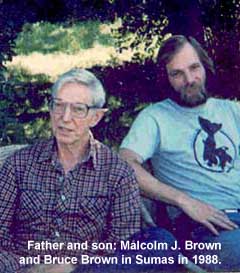
University of Washington Professor Malcolm J. Brown (1910 - 1992) walking in the garden with his grandaughter Laurel Brown, Seattle, WA, July 1986.
|
Additional reading -- Malcolm Brown's George Moore: A Reconsideration, also here on astonisher.com.
|
|
|
Militant republicans from the old disbanded Volunteers looked upon the arrogance of Irish political corruption with growing anger, and some of them concluded that revolution itself would not be so difficult as parliamentary reform. Among these was Wolfe Tone, a Protestant who had been awakened by the American Revolution and set afire by the French. He rose to public prominence as the secretary of the Catholic Convention, organized to gather whatever benefits it might from William Pitt's fear of the rising crescendo of the French Revolution. There had been two partial remissions of the Penal Laws, one in 1778, the second in the intoxicating times after Dungannon; and in 1792-93, with Tone playing an important part in the negotiations, a third installment of remission was petitioned by the Catholic Convention. In a sudden burst of generosity in that regicide year, Pitt extended the voting franchise to the Irish Catholics, not only to the respectability but to the mass of the peasantry, to the so-called forty-shilling freeholders. But returning quickly to sobriety, he still withheld the right of Catholics to sit in Parliament. The hordes of new voters were thus privileged to vote for the same Protestant oligarchy that already held the parliamentary seats. The comedy in College Green was unrelieved until the pool of blood gathered at the end of the story.
Tone saw in the Irish peasants a natural revolutionary force that might sweep away at a blow both the English connection and Grattan's Parliament, which he labeled "bungling," "unworthy," treacherous, and despicable. Since there is a good deal of modem confusion on this first principle, Tone's critique deserves a passing notice. He wrote a pamphlet in 1791 called "An Argument on Behalf of the Catholics of Ireland," the Irish equivalent of the American firebrand, Common Sense, by his friend Tom Paine:
- The Revolution of 1782 was a Revolution which enabled Irishmen to sell at a much higher price their honor, their integrity, and the interests of their country; it was a Revolution which, while at one stroke it doubled the value of every boroughmonger in the kingdom, left three-fourths of our countrymen slaves as it found them, and the government of Ireland in the base and wicked, and contemptible hands who had spent their lives in degrading and plundering her; nay, some of whom had given their last vote decidedly, though hopelessly, against this, our famous Revolution. Who of the veteran enemies of the country lost his place or his pension? Who was called forth to station or to office from the ranks of the opposition? Not one. The power remained in the hands of our enemies, again to be exerted for our ruin, with this difference, that formerly we had our distresses, our injuries, and our insults gratis at the hands of England; but now we pay very dearly to receive the same with aggravation, through the hands of Irishmen-yet this we boast of and call a Revolution!
While Tone was still working for the Catholic Convention, he joined with a coterie of Belfast and Dublin republicans to organize a revolutionary center called the United Irishmen. The purpose was to arouse the country to take up arms for the principles of the rights of man in the manner of George Washington. Forced to flee the country, he journeyed via America to France to secure military aid. The decisive trial of arms came in 1798 (a date fully memorialized in Irish song), with uncoordinated insurrections in Ulster, Mayo, and at Vinegar Hill in Wexford. The French ships moving to the rebels' aid were delayed, and the troops that finally landed at Killala could not give the support promised. Tone himself was captured at sea aboard a French warship. The rebels were defeated (as is told in Yeats's Cathleen ni Houlihan), their leaders were hanged, and thousands of the rank and file were slaughtered. Irishmen never forgot the ghastly details of the pitch caps, mobile gibbets, disembowelings, and garrotings at the hands of the roving Protestant yeoman terrorists; and Parnell brooded all his life upon the tale of a '98 rebel on the family estate in Wicklow who was beaten to death across the belly while tied to the cart's tail.
The Dublin Parliament's pretense to independence was now rudely overridden as a matter of course. In an intensified atmosphere of greed and jobbery, Grattan's Parliament passed Pitt's Act of Union with Great Britain and expired. Grattan protested in an outburst of passionate oratory, and voted against the Union. His vote was of no value. The Union became a fact on the first day of the nineteenth century, terminating the age "of Burke and of Grattan," among whose notable acts were its pusillanimous assertion and then corrupt surrender of the Irish nationality. Grattan's subdued eulogy over the corpse of his Parliament confessed that something was amiss from the start, and that the members never were really happy "to stand in the sphere of their own infamy."
II
After the Act of Union there was one final bloody spasm of resistance. Robert Emmet, a young Protestant friend of Tone's and Tom Moore's, was led by wishful hopes of a Napoleonic invasion of England in the summer of 1803 to organize a supporting Irish diversion. Even the warmest friend of Ireland must confess that its revolutionary staff work throughout history was never better than slovenly. The bungling of the mobilization dates forestalled the rising in the countryside, while in Dublin the mob pushed Emmet aside and roved leaderless through the streets. After murdering a couple of citizens, including the lord chief justice, they scattered at the first appearance of the English troops. Emmet fled into Wicklow and could have escaped to America, but he came back to town to visit his sweetheart and was captured. He was tried before Lord Norbury, the "hanging judge" of the new "bloody assizes." Understanding that his life was already lost, he took pains to turn the courtroom into a tragic stage. Upon being sentenced, he addressed the court with an astounding piece of prose that immediately won the same currency in Ireland that the Gettysburg Address enjoys in America. Readers of Ulysses will recall Mr. Bloom's fixation on its last two sentences, though the recitation as a whole runs to a couple of hundred words
My lords you are impatient for the sacrifice. The blood which you seek is not congealed by the artificial terrors which surround your victim-it circulates warmly and unruffled through the channels which God created for noble purposes, but which you are now bent to destroy, for purposes so grievous that they cry to heaven. But yet be patient! I have but a few more words to sayI am going to my cold and silent grave-my lamp of life is nearly extinguished -my race is run-the grave opens to receive me, and I sink into its bosom. I have but one request to make at my departure from this world, it is-the charity of its silence. Let no man write my epitaph; for as no man, who knows my motives, dare now vindicate them, let not prejudice or ignorance asperse them. Let them rest in obscurity and peace! Let my memory be left in oblivion, and my tomb remain uninscribed, until other times and other men can do justice to my character. When my country takes her place among the nations of the earth, then, and not till then, let my epitaph be written. I have done.
By Norbury's sentence the prisoner was to be hanged and his head severed from his body; the orders were carried out by the executioner in faithful detail before a large Dublin crowd, standing petrified in terror. The scene recurred in Irish nightmares for three generations.
III
With the Dublin capital out of business, the scene of Irish political activity shifted to London, but with the same old Ascendancy cast of actors from College Green. Pitt's campaign for the Union had given the Catholic bishops to understand that their support would be thoughtfully rewarded by the full repeal of all remaining Penal Laws. Lured by that half-promise, they had given his enterprise their blessing. But when the Union had passed, they were informed that Emancipation would cause His Majesty George III to suffer personal pain, so that it was therefore out of the question. Thus, Catholics still could not sit in the House of Commons, though they did have the right to vote.
The moral bankruptcy of the old leadership being plain to all, the people groped for some scheme to pool their voting strength in their own rather than in the landlords' interest. They chose for leader a young Catholic lawyer, Daniel O'Connell, a modern breed ofpolitician with an extraordinary populist flair. In 1826 he backed an opponent of the reigning Beresford family in Waterford and won. In 1828 he directly challenged the Protestant monopoly of parliamentary seats by offering himself as a candidate in Clare. Defying the threat of eviction-for the ballot was not secretpeasant voters to the last man mustered at his call. In a happy frenzy of agitation, O'Connell got himself elected, and shortly afterward forced the Duke of Wellington and Sir Robert Peel to surrender full religious emancipation. The Ascendancy never forgave the upstart. He had insinuated himself between them and "their" peasants, and was that not plain larceny?
Once aroused, the peasants proved difficult to pacify. While still hot from the Emancipation campaign they turned to make war upon the Anglican tithes, the most baroque insolence of English rule. Although most of the Irish population was Catholic, the Anglican Church of Ireland was the established church, solely endowed with the right to tithe. Catholic peasants could not understand why they should support a church to which they did not belong and to which, in most of the country, nobody belonged at all. Spontaneously and without much support from O'Connell, peasants began to resist tithe payment. Some nameless rebel hit upon a new weapon he called "exclusive dealing," later to be called "moral Coventry" by Parnell and "boycott" by Michael Davitt. There were clashes with the constabulary and several dozen deaths. Spreading over Ireland, the tithe war was very troublesome to eradicate, and it forced the English to call the first of their partial, stubborn, and oblique retreats.
When O'Connell, "the Liberator," took his seat in the House of Commons at the head of an Irish delegation, he found his followers too few to exert prime force, but numerous enough to make the balance between Whig and Tory. In 1835 he formed a coalition with Viscount Melbourne and the Whigs, the "Litchfield House compact," by which he won modest Irish concessions and patronage in exchange for Irish votes. Whenever he could, he said, he always liked "to get a little something for Ireland." As the Whigs' power waned, he foresaw a Tory ministry and the end of his Whig alliance. Recalling his famous successes on the Clare hustings, he turned his thoughts once more to peasant agitation and announced the founding of the Loyal Irish Association for the Repeal of the Union. This was the cue that brought the Young Irelanders in 1842 onto the stage of Irish history, Thomas Davis in the lead.
IV
While O'Connell was playing his friendly parliamentary game with the English Whigs, the condition of Ireland was rapidly worsening. The burden of Irish troubles always fell heaviest upon the peasants, since they were not just the bottom of the heap but the substance of the nation, the primary source of Irish wealth. Viewed from afar, from above, from Dublin or London, the peasantry seemed a vast, teeming, roiling mass of faceless humanity, repulsive and frightening. The spell of this terror was very persistent. Even a casual reader of W. E. H. Lecky's Irish histories will sense that this civilized and learned Unionist gentleman looked upon the Irish mass of Victorian times with uncontrollable hatred and terror. It also survived into modern Irish literature, where it can be clearly traced through Joyce's work, and it informs much of Yeats's poetry, including "The Second Coming." Looking at itself in its own mirror, the peasantry saw its facelessness disappear; but its savage vitality still showed, broken into a puzzle of contradictory potentials. William Carleton, one of the rare Irish writers who "knew the peasant," depicted him as a creature compounded of ignorance, affection, wild poetry, anger, hospitality, terror, superstition, drunkenness, piety, orgiastic pugnacity, and cutting wit, a blood brother to the muzhik of Tolstoy and Turgenev.2 The common base for both the outside and the inside views was a brutal, brutalizing poverty, matched with a volcanic but spasmodic human energy.
During the Napoleonic Wars the value of Irish com had risen abnormally, inflated by scarcity and Com Law bounties. Irish landlords found profit in adding variable units of labor to their fixed units of land, intensifying tillage to the limit. The Irish peasantry had cooperated with this great economic law by taking up smaller and smaller parcels of poorer and poorer land, paying ever higher rent, and meanwhile mutliplying merrily to replenish the earth. At the time of O'Connell's Emancipation campaign, the boom in small grains was already passing. Suddenly economic law forbade tillage and smiled upon the grazing of cattle. Units of labor had now to be subtracted from the land. The glib Malthusian word "overpopulation" was uttered with increasing vigor, together with the wisdom that "Irishmen breed like rabbits."
In Thomas Davis' Ireland, the countryside recognized three dominant classes of peasants-graziers, small peasants, and cottiers-all competing fiercely against one another for the land. The graziers, the "strong farmers" of Yeats's poetry, were the top of the heap. They were tenants, but tenants on the grand scale, men of substance owning great cattle herds that fed on the rich lime-fed Irish grass until ready to be shipped to England for fattening and slaughter. In 1842 graziers anticipated a happy future, with the prospect of continually expanding pasturage at the expense of the tillage of their distressed neighbors.
Next below the graziers lay the huge mass of small peasants. The typical Irishman of 1842 was a subsistence farmer living entirely on the produce of a few rented acres. It is well known that the potato was his staple food. Nest to the potato patch was a little plot of pasture that fed the family cow. Since potatoes and buttermilk made up his diet, the peasant had little to buy but salt meat for biennial protein orgies at Easter and Christmas. If there were common lands on the hillside for grazing a sheep or two, the family clothing was homespun and handwoven. But while self-sufficient in one sense, the Irish peasant was also entangled in the whims of world trade. In addition, he required a sizable lump of hard cash for the landlord: he planted half of his holding to small grains, which the family reserved for cash sale and dared not touch for its own use. The butter each week and the calf each year went to market to raise cash for the landlord. If there were leftover potatoes, they fed a pig, which was also turned into cash for rent; English cartoons symbolized the Irish peasant as an idiot bumpkin off to the fair with this same rent-paying pig held by a string tied to one hind leg.
This economy was highly precarious. The impounding or the accidental death of a cow might destroy a family. Any fall in the price of oats, any rise in the rent upset the delicate balance between cash and subsistence, requiring the oats to encroach on the potato patch and bringing tightened belts all winter. Yet the small peasant lived in relative opulence. Below him lay the still more precarious world of the cottiers, about one-fourth of the Irish population, landless, cowless, pigless agricultural laborers. With a couple of pounds scraped together out of haphazard wages at one-fourth the English farm-labor pay scale, they rented a spare quarter-acre of potato ground from some small peasant and starved along through the year on the crop it produced. Often, when deprived even of shelter, they took to the roads as itinerant beggars. Peasants slipping down the social ladder came at last to this ultimate bottom where they were confronted each day by Malthus' well-known "positive checks" and stood face to face with death, from "disease occasioned by squalid poverty, by damp and wretched cabins, by bad and insufficient clothing, by the filth of their persons, and occasional want" -- Malthus' own words on Ireland.
To compound the chaos in the countryside, there had grown up a class of rural "middlemen"-land agents, rent collectors, tithe proctors, and other overseers-whose function was to urge along the upward flow of money so that the much-handled pound note the peasant surrendered out of the safekeeping of his tall hat could make its ultimate way into the hands of the gentility. Feared and hated by their business contacts both above and below, and generally disdained as parasites, these functionaries made natural villains for the novels about the Irish agrarian scene. Only O'Connell would spare them a kind word: as the organizers of the yeoman terror of 1798 they had saved the country from revolution, he said.
The landlords in Thomas Davis' Ireland were absorbed in a frantic search for some method to rid their lands of small tenants. Rural depopulation had already begun as scattered tenancies vanished, some through the attrition of chronic rural poverty, others in the recurrent localized famines. But this process was too leisurely to give satisfaction. To speed things up, "clearings" or "exterminations"-that is, massive evictions-had been experimentally undertaken with partial success. They had so inflamed the peasantry, however, that caution and postponement seemed wise. In 1842 the Irish agrarian issue rested upon this surly and unstable truce.
Those charged with maintaining the tranquillity of Ireland were not to be envied. The peasants were observed to be moving toward some great crisis, and the gathering fear of the "trefoil stained with blood" could not be eased. Ireland had inherited a long tradition of anarchic land war waged by the "Ribbon" societies (referring to the ribbon given the new member during the secret ritual of initiation as a private token of membership), secret terrorist lodges which fought evictions by "moonlighting" vengeance. Ribbon fervor was amalgamated into O'Connell's disciplined new mass organizations, producing a lockstep stride more frightening than the oldfashioned moonlight outrages. A few hamstrung jackasses or a murder here and there had raised no issue affecting general landlord survival; but when the peasantry began to stir en masse, the distant rumble of revolution was unmistakable.
One could never predict, though, whether a random stimulus would produce agrarian frenzy or catalepsy. The peasantry found great difficulty in keeping up momentum, in integrating a self-shaping force, or in developing leaders out of their own ranks. Between 1798 and Young Ireland no leader of consequence had appeared among them, and in the whole of the nineteenth century they would show only two: the agrarian Michael Davitt at the bottom of the social scale; and at the opposite end Cardinal Cullen, of "strong-farmer" stock, who employed his close peasant realism with equal effect in Vatican intrigue on behalf of papal infallibility or in the throttling of Irish insurgence. Leaderless, the peasantry lay a tempting instrument for some other hand to wield. According to one Gray Porter, a Protestant landlord of county Fermanagh, when revolutionary Ireland finally took the field, it would consist of "dashing and splendid" Protestant officers like himself on horseback followed into battle by the "Catholic multitudes." Naturally the other social classes nominated themselves for the same role.
V
Next to the peasantry, the stunted Irish commercial classes had been most severely thwarted by the English connection. Nineteenth-century Ireland was no place for speculators who hoped to strike it rich. Woe to the vanquished, Ireland was assigned after Limerick its approximate economic limits for all time: it was to be a reserve larder when summoned, but was to withhold food shipments when so instructed; it was to be a remitter of rent, an army barracks, and a naval base. In 1691 and again in 1800, England crippled Irish shipping and industry (Ulster textile manufacture excepted), following a policy that had led Swift to offer the ruined Dublin businessmen the advice: burn everything English except English coals. The native mercantile channels were as effectively choked up under the Union as the silted harbors of the decaying Irish seaport towns. A self-perpetuating economic stagnation set in, and three hundred years after Limerick the Republic of Ireland is still struggling to extricate itself from the ancient vicious cycle. Hardly anybody other than Guinness the brewer and Murphy the biscuit baker could ever make money in Catholic Ireland. Yet the dream of a Gaelic Manchester persisted, and England's most tenacious enemies were the Irish leaders who came forward in response to the dream.
After Dublin lost its function as a capital, the legal and administrative professions became largely surplus. Doctors and teachers were pinched, when not actually impoverished, by the stagnation ofthe country. The paltry level of Irish education hindered the normal flow of educated Irish youth into the careers that nurture respectability.* In 1842 these irritations had created on the one hand a pervasive torpor and on the other hand a small hard stratum of discontented men possessed with pride, ambition, and ability, but with no prospects and no cause to love England. These lawyers, doctors, journalists, teachers, poets, engineers, clerks, recusant pastors, and other professional men of the middle class made a permanent knot of leaders for Irish nationalism.
VI
Even the Protestant Ascendancy, the gentry at the apex of the Irish pyramid, the partners, resident agents, and presumed beneficiaries of English rule, were not unanimously happy about the Union with Great Britain. All of them remembered better days and with good reason dreaded the future. During the Napoleonic boom in wheat many had gone into debt up to the limit of their war-inflated incomes, and with the deflation that followed Waterloo they found themselves fighting a perpetual rearguard skirmish against bankruptcy. The very first Irish agrarian "reform" adopted by Parliament was an Encumbered Estates Commission. Like the Irish workhouses it enjoyed bureaucratic prosperity in the midst of universal depression.**
Mutual distrust eventually put a strain upon the Ascendancy partnership with the English. The spirit of Castle Rackrent and "The Rakes of Mallow" troubled the English evangelicals and left doubts about the rectitude of the Irish partners
- Spending faster than it comes,
- Beating waiters, bailiffs, duns.
Apart from morality, the Ascendancy's incompetence was beyond dispute. Its assignment under the Union was to keep Ireland pacified. As the task grew increasingly beyond its power, it not only had to worry for its safety and solvency, but it also had to listen to the English partners deliver sermons upon failure. Pitt had warned the Irish Protestants to rule or be destroyed, and Carlyle and his protégé Froude were as brutal toward them for failing to overmaster Irish disaffection as toward the canaille itself.
The Irish Protestants sent out constant cries for help, but England listened with a half-deaf ear and responded in its own good time. Convinced that they had been fleeced and betrayed by the Union, some of the Irish landlords threatened heroic redress: they would go over to the enemy, put themselves at the head of the peasants, and seize their destiny in the role of Irish Lafayettes. A genteel menace; still, a few of the gentry in 1842 were sufficiently angry, compassionate, or desperate to be potential converts to Irish separatism.
VII
The English defense against any Irish threat was to hold fast if possible, to concede nothing gratis, but to give ground amiably when concession was inescapable, and if general retreat was called, to prepare immediately for counterattack. The first line of defense was the constabulary, assisted by plainclothesmen, spies, dossier clerks, and enthusiastic semiprofessionals who left a trail of perjury, forgery, and provocation across the pages of Irish history. The courts, too, were imperial instruments as required. In important trials jury rigging was taken for granted. A tally made by Michael Davitt showed that during the nineteenth century the House of Commons passed on the average one Irish coercion act per year, each permitting the suspension of some part of the regular processes of English law. "Which is the palladium of English liberty," John Mitchel asked; "is it habeas corpus or the suspension of habeas corpus?" Force of arms was naturally the ultimate base of English rule. Foreign travelers observed that while soldiers were seldom seen in England or Scotland, in Ireland they were as common as hussars in light opera. Behind all stood the British army, ready when needed against open insurrection. These final field exercises occurred normally at about half-century intervals with one exception: the mid-eighteenth-century insurrection date, falling due in Penal Law times, was skipped.
Imperial force was never squandered needlessly. Nor were concessions hasty. Expert use of the tactics of delay wore out the disaffected. The Emancipation of the Catholics in 1829 belatedly honored a promise made nearly a century and a half earlier. A second promise-to fulfill the first one-had been allowed to mellow for three decades and to generate an incipient rebellion before the gracious event became actual. English rule from day to day rested mainly on the parsimonious arts of authority, especially upon the ability to make capital of Irish inertia and division. Just as Ireland was a model of political insurgency, it also became a clinical case study of political impotence and debasement.
Following any major military or political defeat, Irishmen sank readily into mass bewitchment, a normal enough reaction to be sure. After a disaster like Limerick or Emmet's rising, Irish prostration was so hopeless that the very machinery of law and order seemed gratuitous or ornamental. The victim appeared to be addicted to his victimage, the author of his own affliction, and deserving of no better than he had got. In the swing of Irish experience from one upsurge to the next, the nadir phase of paralysis gave place to a cringing defeatism of the tearful variety, still abject but suggesting convalescence. Sean O'Faolain found the essence of pure servility in the Gaelic poets of Penal Law times; and Young Ireland located the maudlin phase in Tom Moore's Irish Melodies: "Oh, forget not the field where they perished!" Irish literature is packed with specimens of both, eliciting a range of critical responses: they are ugly, embarrassing, and so on. But considered as ethnic traits, they were merely another of Ireland's many colonial misfortunes. If one were speaking of Yorkshiremen, let us say, what conceivable sense could there be in the concept of their "ignobility" or "hysterica passio"?
Internecine feuds sprouted like fungi out of Irish demoralization. Factionalism, sectarianism, xenophobia, ressentintent, and other forms of meanness rose up constantly between one dispossessed Irishman and another. The perpetual turmoil inside the Irish national family gives us the word "Donnybrook," whose spirit Joyce caught with a passage in Ulysses telling how every Irishman fights against some other Irishman, or if no other is at hand, against one whom Yeatsists will quickly identify as the "Antiself":
- Dublin's burning! Dublin's burning! On fire, on fire!
(Brimstone fires spring up. Dense clouds roll past. Heavy Gatling guns boom. Pandemonium. Troops deploy. Gallop of hoofs. Artillery. Hoarse commands. Bells clang. Backers shout. Drunkards bawl. Whores screech. Foghorns hoot. . . . It rains dragon's teeth. Armed heroes spring up from furrows. They exchange in amity the pass of knights of the red cross and fight duels with cavalry sabres: Wolfe Tone against Henry Grattan, Smith O'Brien against Daniel O'Connell, Michael Davitt against Isaac Butt, Justin M'Carthy against Parnell, Arthur Griffith against John Redmond, John O'Leary against Lear O'Johnny, Lord Edward Fitzgerald against Lord Gerald Fitzedward, The O'Donoghue of the Glens against The Glens of The Donoghue. . . .)
The wear and tear of cyclic defeat accounts for much of this querulousness, while the conflicting ambitions of the various Irish social strata generated further friction. But, as everybody knows, the universal maxim of empire is, divide and rule; and a striking feature of Irish divisiveness was that it was invariably timed to burst open at the apex of the recurrent nationalist upsurges. One of the regular tasks of Dublin Castle through the centuries was to discover and exploit Irish disagreements, or if native spontaneity were lagging, to lend a. helping hand. Two time-tried incubators for hatching feuds are race and religion. Race was much talked about, but not very useful; in the absence of any salient difference in pigmentation or facial contour, the Irishmen and the Englishmen seemed to belong to the same breed. The stylized English caricature of "Paddy," modeled after O'Connell's long upper lip and button nose, was quite unreliable for racial identification of the long-nosed Eamon de Valera or of Gavan Duffy, described by Mrs. Carlyle as "horse-faced." A better hope for division lay in religion. Since sectarianism is the special happiness of sect, this source of division was all but self-generating.
VIII
Ireland is by tradition mostly, though not unanimously, Catholic. The highest Catholic ratio occurred just at the time of Young Ireland with a proportion of about seven out of eight; afterward the proportion fell because of the heavier population loss among the Catholics. At present Catholics make up about three out of four in the Republic of Ireland and Northern Ireland combined. The Protestant minority belonged to two sects: the Church of Ireland Anglicans, scattered thinly throughout most of the country but numerous in Ulster; and the dissenters, a solid block of Presbyterians concentrated in lowland and coastal Ulster. In the south and west virtually everyone was Catholic; there were almost no dissenters at all and the Anglicans were outnumbered by as much as fifty to one. But in parts of Ulster, if one gerrymandered cleverly, Catholics were only a large minority among a Protestant population of Anglicans and Presbyterians.
The Irish Catholic, especially the peasant, was renowned throughout Europe for the intensity of his religious passion. In Ireland, said A. M. Sullivan, even the men go to Mass. The peculiar fervor is not mysterious to the historian. By 1530 Ireland had already sufficient national consciousness to resist the English Reformation, and it remained still basically Catholic in 1691. The Penal Laws were contrived to strip the Irish native bare, and, for good measure, to convert him to Protestantism; but the success of the first aim could only be achieved in the failure of the second. The Penal Laws fixed absolute Protestant dominance over Catholic Ireland, but the conversion of the "papists" had to be confessed a total failure. Strengthened by persecution, Catholicism became the Irishman's solace and badge.
Irish Catholicism in 1842 had emerged as a prime power. It held the affection of most of the population. It enjoyed near-perfect intimacy with the people. The priests and curates were recruited out of the countryside and not, like the Anglican clergy, from the upper classes; and the bishops were always Irishmen and not, like the eighteenth-century Anglican bishops, English placemen. From this base the Church stood in a position to sway Irish thought and enforce Irish morals, to elect and defeat political candidates, and to open up its store of wisdom on the sovereign problems of land tenure or English dominion. Frederick Lucas, an English Tractarian convert to Catholicism, described the special position of the Irish clergy in this way:
In Ireland the priests have a peculiar function to perform. . . . Between them and the people religion is not a gulf of separation, but a bond of the tenderest union. They belong to the same race as the people, and feel for all their sufferings, temporal as well as spiritual. At the same time, the sacerdotal character, the higher views of life, the greater experience of the world, the more cultivated intellect, raise them above the rank in which they were born; and as they form the only educated class which truly sympathizes with the people, they necessarily form the only class to whom, in those temporal matters in which the poor Catholic farmer requires an adviser better educated than himself, he can have recourse, and from whom he can receive guidance.
But Irish Catholicism was not one happy family. It had a private social pyramid of its own. While most of the Irish poor were Catholics, some of the Irish Catholics were not at all poor. Catholics were numerous among the "middlemen," and many more were to be found in the substantial middle class and even in the gentry. The Penal Laws had not put any special disabilities on Catholics engaged in trade. Some had amassed large mercantile fortunes, and as soon as the persecution began to slacken, they often liked to buy landed estates and set themselves up in country elegance. For example, George Moore's Catholic great-grandfather, made wealthy by the Spanish wine trade, came home after Dungannon, bought a large area of marginal land in Mayo, and there built Moore Hall. In this way he erased the double stain of trade and Catholicism and became a member of the Irish gentry, but naturally with a second-class status. Class stratification presented the clergy and bishops with a need to weigh carefully the precise degree of importance attaching to each of the conflicting interests within their flocks; and it can safely be said that they were not inclined to impugn out of hand the special class objectives of their well-to-do parishioners. But on occasions the clergy's opinions harmonized with the views that arose from the very bottom of Irish society out of the daily experiences of the poorest laity. At such times, as in the Wexford insurrection of 1798, the tangible physical power of armed and marshaled Irish Catholicism moving through the boreens of Enniscorthy, the priests at the head, gave all observers food for somber thought.
In a moment of ebullience the Irish historian P. S. O'Hegarty once estimated that the Irish Church was "ninety-nine percent national." This was plainly an overstatement, for the nationalist clergy confronted a powerful antinational opposite, called "ultramontanism," which yearned toward Rome. The hierarchy, while Irish to the core, was not merely Irish. It had also to take into account the mission of the Church from global and eternal perspectives. In reaching its decisions on Irish nationalism it had to weigh such a question as this: would the Church be apostolically stronger with a solid minority of eighty-five Irish Catholics sitting at Westminster in the center of world power, or with a majority of seven out of eight in a thirdclass independent Dail in College Green? The question gave its own answer contradicting the answer reached independently by some of the laity.
Beginning in O'Connell's day, a good deal of Irish history was to be made in the bishops' palaces, where a great agonizing would try to reconcile all these conflicts. If reconcilement could not be made, the conservative decision was to be expected, if not always actually forthcoming. Those who cherish the ironies of history will note this as an example: the Irish hierarchy upon its emergence from English persecution, became one of the chief obstacles to Irish revolt against England, its erstwhile persecutor. But the cynical Pitt saw no anomaly here. Doctrinaire anti-Catholicism seemed to him very stupid, and his reply to the no-popery fanatics of his day was to advocate not only Catholic Emancipation but subvention of the Irish clergy as well-a hasty tender perhaps, but not a philanthropic one. The thought Pitt had in mind was candidly endorsed by the empire-minded English prelate Henry Cardinal Manning when he said, "Show me an Irishman who has lost his faith and I will show you a Fenian."
On principle the Irish clergy condemned the idea of forthright separation, though an unconsciously humorous proviso was added-except by free English assent. A theological rule held that rebellion was sinful unless it was just, Christian, and further, unless it was likely to succeed. As an antidote to fatuous vain-glory this doctrine made good sense. But in genuine crises it threw the weight of the Church always on the side of the established order. Unfortunately for all rebels, no one can exactly measure beforehand the likelihood of success. Church doctrine therefore in substance informed the Irish radicals that if, in spite of the opposition of the clergy, they ever did win, their success would prove their right to be duly blessed. Meanwhile, cross-purposes between the clergy and the laity could be guaranteed. Somebody would charge somebody else with "godlessness" and a split would follow as a matter of course, isolating the more radical Catholics and abandoning them to the methodical grindings of English power.
In its interfaith relations the peasant Catholicism of the south and west confronted the Church of Ireland at the time of Young Ireland with little to fear. The Anglicans were dominant in wealth and power, being the sect of the Ascendancy and an official arm of English rule. But they were so few that the Church of Ireland was almost the null sect. Nineteenth century efforts to expand their numbers by offering small bribes to potential converts had ended in fiasco. "Proselytizing" became an ugly word, and "soupers," hungry Catholics who went over to the Anglicans for a bowl of soup, were cast out of the community. As late as 1908 Lady Gregory had to threaten litigation against George Moore to force him to delete a passage from Hail and Farewell describing her girlhood "proselytizing" ventures with her sisters. Such embroilment was persistent, yet it seldom became rabid in Catholic Ireland, partly because the Anglican clergy had learned Christian humility in their lonely isolation and were little inclined to militancy, and partly because the sect was too small in the south and west to serve for splitting the Irish from within.***
IX
In the north of Ireland, in Ulster, the religious climate was very different. In the seventeenth century the rich bottom lands of Ulster had been seized from defeated Irishmen and settled with imported Scottish Presbyterian farmers, the so-called Scotch-Irish, while the displaced Catholics took up the worthless hillside farms nearby. Where spoiler and despoiled remained neighbors, trouble was bound to arise. But the Presbyterians remembered "Bloody Claverhouse" and their own persecution. They despised the established church no less than the Catholics did and harbored warlike antiEnglish sentiments of their own. It was the Ulster dissenters who had put the backbone into Grattan's Volunteers at Dungannon. Wolfe Tone's prime political strategy was to weld Protestant and Catholic together for struggle against England, hence the name of his organization, United Irishmen. He all but succeeded. "The language and bent of the conduct of these Dissenters," wrote Lord Westmoreland from Ulster in 1791, "is to unite with the Catholics, and their union would be very formidable. That union is not yet made, and I believe and hope it never could be."6 He was correct: Ulster's nonsectarian impulse did not survive into the nineteenth century.
After 1798 Ulster took off on a course of development different from that of Catholic Ireland. The Ulster peasants had succeeded in establishing the "Ulster tenant right," which recognized their equity in the improvements they made on rented holdings. They enjoyed more security than the southern Catholics, and they became better farmers for the improvements encouraged by the tenant right. They thus felt less of the desperate necessity that kept the south and west in continuous unrest throughout the century. In the northern towns the Ulster linen industry had survived the general destruction of Irish manufactures, and now it prospered and expanded. Belfast alone among large Irish cities showed signs of life, even before its great shipyards were founded. In 1842 Ulster was already tied more closely to Liverpool and Manchester than to industrially defunct Dublin, Cork, and Limerick.
As the differentiation between the north and south widened, the ancient religious wounds were found to be reopened easily. Ulster Protestants, who had long held the best jobs as well as the choicest farms in the province, with the remnants left to the Ulster Catholics, were soon persuaded that in an independent Ireland the tables would be turned, since Catholics were preponderant in Ireland as a whole, and that they would then be the victims instead of the beneficiaries of the long-established Ulster custom of discrimination. In 1795 the Orange Order was founded to break up Tone's coalition of dissenter and Catholic and to "maintain the Protestant constitution" by methods and beliefs familiar to Americans through its stepchild of a later time, the Ku Klux Klan. This sinister strong-arm society, whose bigotry enjoyed the sponsorship of members of the royal family and the acquiescence of most of Protestant Ulster, made harassment of Catholicism its purpose in life. In a Catholic country it could only breed violent disorder.
Dublin Castle henceforth had no more occasion for Lord Westmoreland's fears. To keep the north and south split apart required only that an Orangeman appear at the proper moment to shout: "To hell with the Pope!" The Catholics responded with their own terrorist counterpart, the Ancient Order of Hibernians, which aped all of the Orange Order's vices, so that there was no lack of provocation from either side. A blood feud feeding on its own insanity and bursting occasionally into wholesale carnage had become a normal institution in Ulster and constituted another serious internal obstacle to Irish unity.
X
Such were the frustrations of Irish nationalist ambitions. To these another must be added-Irish inexperience. Irish nationalists won their political education slowly and in the most painful way possible, through the skin and by the neck. Lacking omniscience, they could only apply to each new crisis the lessons of the crisis preceding, and they were therefore always preparing for the previous battle rather than for the next one. And yet they did learn.
The nationalists learned, or at least they came to believe, that the very survival of Ireland required nothing less than an absolute separation from England. They learned that this objective was not going to be accomplished easily. Irish history they studied minutely, assessing again and again its errors and successes. They learned to range imaginatively over the full. palette of possible ways of resistance, according to the four dominant historical precedents: (i) the method of 1798, open insurrection; (2) the method of 1782, the threat of military force against an imperiled England; (3) the method of the tithe war of 1832, broad economic warfare-openly illegal, occasionally violent, but not military; and (4) the method of the Clare elections of 1828, legal, nonviolent mass agitation.
They learned that two could play the splitting game. In 1842 Irish nationalists were well trained by history to exploit England's external difficulties. Grattan and Tone had shown great skill in capitalizing on the American and French Revolutions, out of which they had extracted the Irish Volunteers, the Dungannon Convention, and the first relaxations of the Penal Laws. Outcries of Irish pain had already shown promise for alienating Americans from England, and they would grow increasingly effective. Close rapport between rebel Ireland and all shades and complexions of French politics was axiomatic policy on both sides.
The internal balance of English affairs was scrutinized closely. O'Connell not only played Tory against Whig, but also made noisy threats to join forces with the Chartists (though not seriously, for he despised them as much as the Tories did).8 A more subtle task was to disturb the ordinary Englishman's complacency on what was called "the Irish problem," so that in the next crisis to come, English opinion would suffer its own frustrating moral doubts and cross-purposes. An attack was opened against the contemptuous cliché of the "stage Irishman," of Paddy with his shillelagh, his jug of poteen, and a pig in the parlor. English good opinion was courted through the invention of a specialized mode of indirect address which presumed to be a high-minded dialogue on Ireland between Irishmen, but was really designed to be overheard abroad by hesitant English well-wishers. One is constantly surprised in reading even such fervent nationalists as Duffy or O'Leary to find that in their minds they are addressing an English reader. This stylistic manner governed most of the corpus of Irish literature and serious political commentary (though not its oratory or popular ballads). It stayed strictly on its good behavior, for few Irish thinkers were pure Anglophobes. They understood the power of England too well to suppose that a disorganized hysterical rage could ever prevail against it. When they set out to build a counterforce that might command equal respect, their urge to self-indulgence in the pleasure of hatefulness for its own sake was, when possible, muted in public and transformed into a secret understanding that Irishmen shared quietly among themselves.
At home the nationalists probed every fissure in the Catholic hierarchy, hoping to set a more nationalist priest or bishop against one more loyalist. They wooed each generation of the Protestant Ascendancy, winning over many distinguished personalities, but without ever softening the mass itself. The list of illustrious nationalists drawn from Protestant Ireland was impressive-Jonathan Swift, Henry Grattan, John Philpot Curran, Richard Brinsley Sheridan, Wolfe Tone, Henry Joy McCracken, Lord Edward Fitzgerald, Robert Emmet, and more to come.
Solidarity, so very hard to build and so fragile when built, they set above all other ideals, even excessively, as Michael Davitt once charged when he complained that Irishmen were "unity-mad." Very slowly they learned how the ranks must be closed. The betrayer was stigmatized ferociously as a matter of course; and after him the bigot, the absolute necessity for nonsectarianism having been discovered as early as the time of the Volunteers. In 1842 Irish nationalists understood that only a scoundrel would attack another man's sect as such. And if the other sect attacked first? Human frailty in the heat of dispute often overwhelmed the best arguments for nonsectarianism, especially in a deteriorating political atmosphere. The first malignant symptom of ressentinsent, foretelling the end of an advancing phase of Irish history, was the recurrence of religious bigotry.
Argument, tact, and cleverness, it was learned, could carry Irish national unity just so far, and beyond that more moving persuasions were required. In the task of building a power symbology, Irish nationalists learned to operate with finesse and telling effect. In 1842 the Irish mystique in all its murky and amorphous majesty was not quite yet fully perfected, but its moment was at hand.
A final lesson: the Irish nationalists learned that their opportunities had to be made as well as waited for, unless one could afford to wait forever. Flaming words, redemptive symbology -- these were essential, granted; and Irish modes in religion, language, and cultural tradition had to be collected, arrayed, and made battle-ready. But the brother-nationalists of Wales and Scotland had done all that, and still they remained mere dilettantes. They lacked the advanced Irishman's professional respect for the deed. In 1842 Irishmen remembered that O'Connell's campaign in Clare had proved what audacity could do and had demonstrated that for combating defeatism and restoring self-respect to Irishmen who still cowered in servility and misery, no cure was as magical as a bold dramatic action with brass bands at the head of the parade.
"The Politics of Irish Literature" © Copyright 1973 Malcolm Brown
* The bafflement of the Irish professional man is memorably described in Sean O'Faolain's account of his feelings when he found himself competing against self-assured young Oxonians: "I thought back to Ballinasloe and Ennis. . . ." See Vive Moi (Boston: Little, Brown and Co., 1964), p. 262.
** In Irish literature this deflationary squeeze is a familiar story. Later phases of the prolonged fall of rents were to wipe out the family fortunes of the Yeatses and the Joyces. Simon Dedalus undertook his famous journey to Cork to cash in the last of his inherited real estate, a symbolic act which severed his son forever from the respectable class who sent their sons to Clongowes Wood and played charades with the Sheehy girls on Sunday evening. John Butler Yeats's six hundred Kildare acres went the same way. The same contraction also injured the Moores, the O'Gradys, and the Synges. All of these families happened to be gravid with literary talent, but the entire educated class in Ireland was no less afflicted.
*** The gentle demeanor of Yeats's father and county Down grandfather is sometimes traced to their Irish Anglican-rectory upbringing; and Douglas Hyde, Robert Graves's father, and Isaac Butt were said to have derived their gentleness out of the same source. But the fanatical Standish O'Grady was an Irish Anglican rector's son, too.
| New CD-ROM LIBRARY EDITION |
|
|
 |
"Great book. Fascinating..."
-- Jack Weatherford,
author of
The History of Money
|
The History of the Corporation
by Bruce Brown
* READ free excerpts on astonisher.com
* BUY the complete book at the astonisher.com store
|
|
|
© Copyright 1973 - 2010 by Bruce Brown
and BF Communications Inc.
Astonisher and Astonisher.com
are trademarks of BF Communications Inc.
BF Communications Inc.
P.O. Box 393
Sumas, WA 98295 USA (360) 927-3234
Website by Running Dog  |