Chapter Seventeen
The Land War in Mayo
ISAAC BUTT had died during the excitement of the first 1879 Mayo skirmishes of the Land League and had been replaced as chairman of the Home Rule parliamentary party by a Cork banker, William Shaw, an illustrious relict from the old Committee of Sixty-one whose patriotic fervor reached its most intense moment, caught by an alert historian, when he confessed that he never saw a process-server's cart "without wanting to pull the linch-pin out of it."' While Butt's leadership had left much to be desired, the party under Shaw was all but defunct, a condition that Parnell hurrying home from New York hoped soon to remedy.
Parnell's popular appeal in 1880 rested on his identification with the Land League and the Amnesty Association. The New Departure Fenians, Ribbon Fenians, formed the cadre by which his mass power was generated. Unfortunately for him, Wolfe Tone's men of no property were even yet enfranchised. The 1880 electorate of Ireland was still only two hundred thousand in a population of six million, not much changed, in spite of Disraeli's second reform act in 1867, since the Liberator had bargained away the forty-shilling freeholders' franchise back in 1829. But Parnell had also captured the backing of a segment of Irish respectability, those adventuresome middle-class elements represented by the Freeman's Journal and the Nation, who, in O'Leary's contemptuous sketch, avoided the risk of insurrection but loved to agitate. So much for the accelerator. As for brakes, if the bishops were mostly against him, they were not unanimous, the Land League having won two episcopal friends in Archbishop Croke of Cashel and Bishop Nulty of Meath. The lower clergy were also split, but more favorably. Some of the fiercest Land League fighters were clergymen, and many others came in, like the Kerry clergy in the Blennerhassett election, to avoid being left behind. Their help was not just welcomed by Parnell, but implored. Archbishop Croke reported that Parnell came to him at the time of the Westport meeting and "literally" fell on his knees to beg him to use all his influence "to have the priests join the movement."
Disturbed by the flourishing heresy of nationalist collaboration with the clergy, the Old Fenians suddenly became obstreperous. When Parnell walked down the pier at Queenstown on his return from America, a mysterious figure handed him a memorandum warning him to beware, since "the intelligent manhood of the country" had come to the conclusion that his parliamentarianism was "utterly futile." By a freak conjunction the clerical and Fenian anti-Parnellites joined forces for the election at Enniscorthy, county Wexford, the center of the 1798 rising. With a priest directing the battle forces, Fenian rioters tore off one leg of Parnell's trousers, splattered an egg in his beard, and tried to kill him with a blackthorn. One of the rioters coined a striking poetic conceit, "We will show Parnell that the blood of Vinegar Hill is still green." A newspaperman asked Parnell if it was not true that he was opposed by the Fenians and the priests. Mindful of his accelerator and brakes, he replied: "Indeed it is not. I should despair of Ireland if the most active forces in the country arrayed themselves against a movement like this. Individual priests may have condemned chance indiscretions; individual nationalists have protested that we should lie by while preparations are being made to cope with England by physical force, but that is all."
In England Gladstone was an easy winner in the 1880 elections, returning to power with an absolute majority for his second ministry, which was to occupy him from age seventy-one through seventy-six. He chose for his Irish chief secretary the eminent Liberal reformer and businessman, the author of the Education Act of 1870, William E. Forster. In Ireland the voting went very nicely for Parnell. Butt's Home Rule party had elected fifty-nine members in 1874; and in 1880 the count rose to sixty, a net gain of one in six years. But the composition of Home Rule had shifted decisively to the left, and Parnell now had the party majority he had been waiting for. Immediately after the elections, he forced a party vote and defeated Shaw for the chairmanship. A few of Shaw's followers drifted over to Parnell's side, but most of them sank by gentle transition into the two English parties; Blennerhassett reverted to the supine state from which A. M. Sullivan had once hoped to redeem him, while King-Harman became one of the most vocal of the anti-Home Rule partisans, the author of the Orange slogan, "Keep the cartridge in the rifle." With the departure of the Whig Home Rulers, Parnell was surrounded by his congeries of somewhat inharmonious allies, which Conor Cruise O'Brien has illustrated with a map that is rather more revealing than the information that Parnell belongs to Yeats's Phase Ten. Parnell stands in the middle of Cruise O'Brien's diagram like a juggler mastering all the separate flying hoops by his fabulous ambidexterity.
II
After Parnell had parted company with Shaw and the last of Butt's Home Rulers, he was left with a nucleus of twenty-three members. He now marshaled these in Westminster to challenge a House of Commons numbering 652 members. The newly elected House was in no amiable mood toward the Lilliputian Irish challenge; and the queen's address on opening Parliament pointedly ignored the distress in Ireland. The immediate danger of mass Irish starvation had in fact slackened since midwinter. In midsummer 1880 a fine harvest began to come in, the first good crop in four years. But prices remained poor and the peasants were still in danger of wholesale dispossession. Parnell's first task as parliamentary leader of the new Irish party was to take bold action against the mounting tide of evictions.
|
|
Table of Contents
|
|
Astonisher.com is pleased to offer The Politics of Irish Literature by Malcolm Brown, complete and free for your personal use.
Praise for
The Politics of Irish Literature |
 |
|
"This brilliant study of the intersection of politics and literature in Ireland amounts to a dazzling portrait gallery. Reading it one feels about one the breath, warmth, and passions of the dead all come alive again."
-- Sean O'Faolain in the Manchester Guardian
"Mr. Brown's masterpiece has made me want to hire a nearby housetop and recite whole chunks to every passerby..."
-- Michael Foote in the London Evening Standard
"The author of the best book on George Moore now gives us what is in all likelihood the best book on the politics of modern Irish literature."
-- Virginia Quarterly Review
|
|
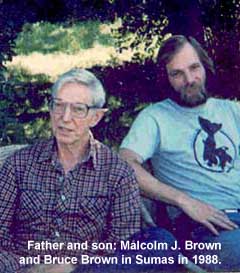
University of Washington Professor Malcolm J. Brown (1910 - 1992) with his son, Bruce Brown, in Sumas, WA, July 1988.
|
Additional reading -- Malcolm Brown's George Moore: A Reconsideration. Also see Bruce Brown's commentary on The History of the Corporation for Malcolm Brown's contribution to that work.
|
|
|

The Irish land dispute in 1880 presented two problems to the peasant. The chronic grievance was the clearances. The landlords, like their predecessors since 1815, still longed to eject the tenants, knock down their cabins, and turn tillage to pasture. The peasant's object was, as always, to hold his ground and to make his removal costly and dangerous. In 1880 an estimated one hundred thousand Irish tenants were in arrears on their rent and hence lived under the threat of summary eviction. The second dispute concerned the amount of the rent. With the world-wide collapse of agricultural prices in the late 1870s, the ordinary Irish tenant could no longer produce the rent at the going scale. He was thus forced to demand a sizable rent reduction, posing a conundrum: what constitutes a fair rent?
When the new House session convened, two parliamentary inquiries into the Irish land problem were already afoot, and it was Gladstone's intention to await the publication of their findings, due in one year, before taking any action. But he was forced by Irish pressure into introducing a modest stopgap measure called the Compensation for Disturbances bill, which proposed to allow those tenants evicted for nonpayment of rent to draw the regular compensation for disturbance-that is, for having to move on-using the money left over from the disestablishment of the Church of Ireland for funding the measure. Parnell subjected the bill to gentle obstruction to dramatize its inadequacy, then supported it on the third reading. It passed the House of Commons at the close of the 1880 session and went to the House of Lords. There it was rejected on August 3, 1880, by a vote of 282 to 51, a gratuitous insolence of the sort that perpetually inspired the murderous sarcasms of Irish Anglophobia.* But the veto was not strictly English. Most of the Irish peers also voted to reject the bill. In Yeats's famous phrase, they were "free to refuse," and refuse they did.
The Irish peasant's reply to the House of Lords was the land war in Mayo, "war to the knife" in Joe Biggar's melodramatic language. Directly after House adjournment, the executive of the Land League fanned out into all parts of Ireland to rouse the countryside. Parnell himself went to Ennis, county Clare, and on September 18, 1880 he issued the order of the day. Suppose, he asked his audience, one of you who cannot pay his rent should be evicted; and suppose another tenant should occupy the farm?
- "Now what are you going to do to a tenant who bids for a farm from which his neighbor has been evicted?"
- Here there was much excitement, and cries of "Kill him!" "Shoot him!" Parnell waited, with his hands clasped behind his back, looking quietly out upon the crowd until the tumult subsided, and then softly resumed: "Now I think I heard somebody say `Shoot him!' - (A voice: `Yes, quite right') - but I wish to point out to you a very much better way -- a more Christian and a more charitable way, which will give the lost sinner an opportunity of repenting....
- "When a man takes a farm from which another has been evicted, you must show him in the streets of the town-(A voice: `Shun him!')-you must show him at the shop counter, you must show him in the fair and in the marketplace, and even in the house of worship, by leaving him severely alone, by putting him into moral Coventry, by isolating him from his kind as if he was a leper of old-you must show him your detestation of the crime he has committed, and you may depend upon it that there will be no man so full of avarice, so lost to shame, as to dare the public opinion of all right-thinking men and to transgress your unwritten code of laws."
Parnell's advice was put into practice without hesitation, producing the famous rout of Captain Boycott.
III
Boycott was the land agent at Lough Mask House for one of the great Irish peers and, on the side, he ran a large herd of beef cattle of his own. George Moore, his neighbor and friend, described him as an accomplished horseman and fox hunter, the best shot with a bird gun in the neighborhood, and a charming host: "Kind in hall and fierce in fray." The tenants on the estate asked for a rent abatement. He refused with more than a touch of oldschool curtness. When they retaliated by not paying any rent at all, he went to court; and on the Wednesday following Parnell's Sunday speech at Ennis, the process server arrived to begin ejectment formalities. The tenants met him on the highroad, turned him about, and sent him home with his summonses unserved. Then they hinted to all the servants that they would be wise if they stayed away from work, so that the ladies of Lough Mask House were forced to cook the meals and carry out their own slops. Shopkeepers and blacksmiths "shunned" all members of the household. At harvest time no field hands appeared. Boycott sent out a distress call, and fifty Orangemen from the north volunteered "to save Captain Boycott's praties." But they required police protection, so Forster dispatched two thousand troops supported with field artillery. George Moore saw them camped in their tents among Boycott's flower beds, "amid the rustle of his planted hills." He saw, too, moving through the trees of the park, the anxious captain, armed with a repeating rifle and a pistol on each hip. The harvest lasted two weeks; and when the Orangemen and the army marched away, Boycott fled the country with them. He then began a long and futile correspondence with Gladstone and Forster, demanding further protection on the plea that "the circumstances which compelled me to leave Mayo prevent my return." In the end he ran up the white flag and settled on the league's terms, then returned to Lough Mask to live in amity with his tenants, who bore no grudges and acclaimed him an authentic celebrity of the neighborhood.
A revolutionary crisis grew from the rapid spread of the Land League boycott in October and November 1880 A year earlier Parnell had told his mass meeting audiences: "Stand to your guns, and there is no power on earth which can prevail against the hundreds of thousand of tenant farmers of this country"; and again, "if you are determined, I tell you, you have the game in your hands." As late as the speech at Ennis, he repeated the thought that "if the half million tenant farmers of Ireland struck against the ten thousand landlords," military force could never subdue them.$ Suddenly all that he had said proved true. The government's most earnest zeal and ingenuity were powerless to wrestle with this amorphous, ubiquitous adversary. Gladstone and Forster began to envy Wellington and Peel the simplicity of facing up to O'Connell's monster meetings, where at least there was somebody to shoot at. "With a political revolution we have ample strength to cope," Gladstone told the House. "But a social revolution is a very different matter." With a note of panic Forster reported, "Unless we can strike down the boycotting weapon Parnell will beat us."
A fascinating government statistical series called "Evictions (Number of Persons)" had registered a fivefold rise between 1877 and 1880. A companion series called "Agrarian Outrages (Number)" showed that outrages accelerated twice as rapidly, multiplying tenfold in the same period. The temptation of the landlords to force clearances was thus overmatched by rising peasant resistance, at first through spontaneous vengeance, but after the Ennis meeting, through boycotts organized by the local branches of the Land League. After two months of the most savage hostilities, the landlords were the first to flinch. The boycott campaign took hold, and the statistic for sitting ran twenty-six hours, and after a day to recuperate, the next ran twice around the clock to forty-six hours. The following day, the Speaker simply terminated the debate and called for a division on the motion. It was the final conflict and no mistake; and Irish parliamentary obstruction was suddenly a thing of the past. The next morning's session, on February 3, 1881, opened with a statement from the home secretary that Michael Davitt had just been sent back to prison for "violation of the ticket-of-leave." In the uproar that greeted this announcement, the entire Home Rule party got itself suspended for the rest of the day. The coercion bill then proceeded smoothly on its way, and it became law four weeks later.
V
Davitt argued afterward that those four weeks squandered the Irish opportunity of the century. The league was presented, he said, with a combination of favorable conjunctions that would never occur again, and just then it lost its boldness. On the day he was rearrested, these conditions prevailed: the anger of the peasants was at its highest pitch; the nationalist sentiment of the towns was inflamed by the state trials and the suspension of the Irish members in the House; the advanced leaders-himself excepted-were still out of jail, but certain not long to remain so; Gladstone's legislation on the land issue was still a vague unknown; the British army had just been defeated in its first skirmish with the Boers; and the Liberal party was not yet rent by the schism that was destined to wreck the future Home Rule bills. There had been talk in the Land League executive about certain counterblows held in reserve against the government's first hostile move. The last resource, the big gun, was to be a nationwide strike against rent. Davitt believed that on February 3, 1881, a general rent strike was feasible and should have been called. He knew that success required nothing less than total peasant support, but his contact with the countryside in the weeks leading up to his rearrest convinced him that the support was poised and ready.
Davitt's observation on the rent strike picked up a recurring pattern in Irish history, a tendency to refuse the bold stroke at the "right" instant, then to follow up with a belated stroke that required even more courage and was certainly hopeless. Like Devoy at the Fenian war council in Mrs. Butler's dressmaking shop, Davitt was in a position to know when the "right" instant was, and his expert judgment is difficult to dismiss out of hand.
Still, he saw the issue of the rent strike with a strong personal bias. When he found himself in handcuffs on a westbound train out of London, presumably to spend the next four years back in Dartmoor prison, he could be forgiven for sharing John Mitchel's dismay at the Dublin North Wall when he had learned that no attempt would be made to rescue him from his fetters and had muttered to himself, "Christ never died for this people." It was a relief to see from the train window that he was bound for Portland prison instead of Dartmoor. His pamphlet against the brutality of English prisons had won him that, in addition to a warm cell and relief from hard labor. He had the special privilege, too, of reading and writing as he wished, and the governor of the prison sent him a blackbird in a cage to share his cell.
VI
Armed with the extraordinary powers of the new coercion act, Forster lost no time in beginning the performance of his unpleasant duty. He had for his chief coercionist a seasoned Castle official, a nephew of Cardinal Wiseman's, Thomas Burke, who had opened his administrative career ten years earlier by ordering the police to charge with batons against one of Isaac Butt's peaceful Sunday afternoon Amnesty Association mass meetings in Phoenix Park. Davitt thought that Burke was Forster's "evil genius": "He personified the Castle system of rule, being an Irishman and a Catholic. He was credited with being the arch-coercionist of the administration, the employer of informers, the active antagonist of all revolutionary movements" - a man to reinforce Forster's evangelical zeal with Irish experience.
Forster explained in the House of Commons that the anarchy in Ireland was caused by the presence in every village of "dissolute ruffians," troublemakers who bullied their fellow villagers into defiance of the law of trespass and ejection. The Irish problem was so simple, he said, that at the instant the "ruffians" were placed behind bars, the unrest of the countryside would cease. He rounded up a couple of hundred men nominated by Thomas Burke and the Royal Irish Constabulary for imprisonment without trial. The first statistical fruit of his rural pacification scheme was, within three months, a sevenfold increase in evictions. Next, the countryside became decidedly less peaceful rather than more. Forster's careful plan, which Gladstone later called "this extraordinary illusion," had in no way solved the problem. Lord Cowper, the lord lieutenant, sent a memorandum to the cabinet protesting that the mass arrests had perhaps removed the wrong parties. The prisoners whom Forster had caught in his net were the Land League branch secretaries, the most earnest, hard-working, and sober leaders in each townland.** These "ruffians" were in fact the restraining influences in the countryside, and their imprisonment brought on uncontrolled Ribbon terror.
Under the new wave of agrarian outrages, crimes shaded into a more somber hue. Murder and arson increased, also "firings into dwellings" and "firings at persons," the near-miss shots on which official statistics were solemnly compiled. There was a parallel rise in the maiming of livestock by hocking (hamstringing) and the cutting off of tails.***
When Davitt and the imprisoned Ribbon Fenians had been allowed a month to meditate behind bars, Gladstone paired off his coercion with his conciliation in the classic Peelite manner and presented the House with his new Irish land bill. It was an equivocal measure. On the one hand it appeared to promise a good deal more than had been hoped for. Clean strokes dispensed with the indirection of the Land Act of 1870. Eviction was simply outlawed, except for cause. It also provided that the rent must be a "fair" rent, to be first determined and then frozen for a term of fifteen years by land courts established under the bill. This provision completed the count of the Three Fs, so that Gladstone appeared to have capitulated to the full schedule of the Irish agrarians' pre-Henry George demands.
It needed little study, though, to discover grave shortcomings in the bill. It did not protect the tenants currently in arrears and on the brink of ejection. It offered no definition of a fair rent, and the leading English members of the House had the impression that it meant the present rent. If that were the intent, the bill was simply a fifteen-year guarantee of the landlord's income in a collapsing market. One could not be sure; everything depended on the mysterious mental processes of future land commissioners. Parnell saw that their definition of the word "fair" would not be any sort of a Platonic essence, but a pragmatism that would emerge out of a new season of political warfare. That warfare now commenced.
Parnell's, behavior toward the bill oscillated enigmatically between support and attack. At one stage he appeared to be a saboteur but toward the close of debate, the Irish members began an earnest effort to improve the technical details of the bill through expert work on the floor, more than once staving off a defeat for Gladstone. Tim Healy made himself a hero by adding a crucial amendment, necessary for the successful operation of the measure, requiring that the valuation of land for purposes of rent determination could not include the value of improvements "for which the landlord has not paid." But on the bill's third reading, the thirty-five Parnellites ostentatiously walked out without voting, understanding that the bill would pass in any case. It also passed the Lords, much sobered after the catastrophic outcome of their 1880 veto.
The Land League had now to make up its mind whether to boycott the land act or to accept it. Opinion was split and very heated. The Americans sent cables from overseas proclaiming the necessity for revolutionary militancy. "Hold the harvest"-that is, pay no more rent-they said, quoting the title of a song by Fanny Parnell. The clergy on the other hand were strongly for accepting the act as it stood. The deeply troubled rank and file were torn between the fear of binding themselves for fifteen years to a bad bargain and the fear of losing benefits through delay. Parnell came to the league's convention with a solution to the impasse: let the members shun the new land courts until the league could bring "test cases" to "prove the mood" of the land commissioners. The convention accepted his plan unanimously, and Healy set about to find the choicest test cases, involving the most subtle and ambiguous points of interpretation.
VII
While the test cases were being prepared, the countryside became increasingly violent. Forster responded with more severe coercion. He intensified the search for firearms on the peasants' persons and premises. He authorized the constabulary to open fire at discretion, even against unarmed persons. In response to a complaint in the Commons, he announced that in the cause of humanitarianism, the constabulary engaged at close work would henceforth be issued the semideadly buckshot instead of the deadly ball cartridge, an order that earned him the nickname universal among Irishmen, "Buckshot" Forster. Parnell seized upon it, and spoke of "Buckshot" with the same relish that O'Connell had put into his intonation of "Orange Peel." As Forster grew more violent, the peasants replied with more violence still, and the familiar vicious cycle of retaliation against retaliation held the country in a tightening grip.
Parnell felt the sensation of riding a runaway. He effected his escape with striking ingenuity: he deliberately, as many believe, obliged Gladstone to arrest him. He thus forced his enemy into a difficult position. His arrest separated him conveniently from all further responsibility for the violence running out of control in the countryside, and at the same time it inflamed afresh the Irish and Irish-American sense of outrage. The fire would in time bum itself out, he thought, and demonstrate both to his own uncompromising agrarians and to Gladstone the need for a reasonable compromise.
The government was glad to accommodate him if arrest was what he wanted. In the frantic search to find some handle with which to take hold of the crisis, it was persuaded to try out the idea that Parnell must be a sole instigator, the very archetype of a "dissolute ruffian." Gladstone made a speech at Leeds on October 7, 1881, accusing him of inventing the land acts test cases for wanton sabotage, spurning a just law. He threatened unspecified revenge. Parnell replied in a speech the next day not with justification, but with insolence. The "masquerading knight-errant," he said, had claimed as a demand upon Irish gratitude the English nation's "long sustained efforts" on Ireland's behalf. With his best hauteur, he asked Gladstone:
- Long sustained efforts in what? Was it in evicting the two thousand tenants who have been evicted since the first of January last, in putting two hundred brave and noble men into Kilmainham and the other jails of the country; was it in issuing a police circular of a more infamous character than any which has ever been devised by any foreign despot; was it in sending out hundreds of thousands of rounds of ball cartridges and buckshot cartridges to his Bashi Bazouks; was it in sharpening the bayonets of the latest issue of the Royal Irish Constabulary?
The retort might have been made safely in England, where habeas corpus was not suspended. But Parnell chose to go into Wexford to make his provocation, to stay overnight afterward at Morrison's Hotel in Dublin, and to schedule for the next day a repeat performance at Naas. The hotel boots waked him at eight-thirty in the morning to warn that Director John Mallon of the Castle police was downstairs inquiring for him. The boy offered to lead him out by a kitchen exit to escape. Parnell declined, and in a few minutes he was in custody, bound over for a long stay in Kilmainham jail, Richmond jail being regarded as not fully escape-proof. Parnell did not think Kilmainham escape-proof either, and he wrote a friend: "They have let us off very easily. I fully expected that we should have been scattered in different jails through the country as a punishment, but they evidently think no other place safe enough for me. Indeed, this place is not safe, and I can get out whenever I like, but it is probably the best policy to wait to be released."
Parnell had been asked who would take his place if he were arrested. He answered, "Captain Moonlight will take my place." When a reporter from the Freeman's Journal came to Kilmainham on the day of his arrest to interview him, Parnell gave him a message to Irishmen: "I shall take it as evidence that the people of the country did not do their duty if I am speedily released," a transparent directive to step up the pace of rural disturbance. It was an order dutifully obeyed. The statistics on Irish agrarian outrages for January, February, and March in the three consecutive years of the land war were as follows: 294 in 1880, 769 in 1881, and 1,417 in 1882. Meanwhile, the Ladies' Land League marched to battle, distributing relief to the evicted, organizing boycotts against "land grabbers," and carrying on a violent propaganda, with Parnell's sisters in the forefront. Forster naturally read these signs as proof of the need for still more arrests, even of the ladies themselves if it came to that; but Gladstone was beginning to suspect that the remedy lay in the other direction.
The Land League's discipline and unity began to waver under the coercion. The league executive, most of them in Kilmainham with Parnell, debated whether to retaliate with their big weapon, the general strike against rent. There was disagreement. T. D. Sullivan believed it immoral, "against the law of God." John Dillon, who was among the leaders the most violent in public language, thought it a mistake in tactics. Parnell was apparently neutral. But the majority, mostly Ribbon Fenians, were in favor of it. A "No-Rent Manifesto" was therefore drafted inside Kilmainham, smuggled out, and issued to the country. It was an eloquent document in the style of Tom Paine, beginning, "Fellow-countrymen, the hour to try your souls and redeem your pledges has arrived."" Its eloquence was not sufficient. The rent strike merely added to the general disorder. But it was either too late or too soon, for it was a total failure.
All in all it was another of Dublin's famous weeks. In the midst of Parnell's arrest and the No-Rent Manifesto, the new land courts opened their doors for business. The weakest link in the boycott of the land act was in Ulster, for the Orange farmers were prompt to appear in the land courts to take what benefits they might. They observed that the new fifteen-year judicial rents always seemed somehow to come out at about four-fifths of the going rate. At last the Land Leaguers themselves stampeded, sauve qui peut, and flocked into the land courts without apology or remorse. Except for the Ladies' Land League, the organized agrarian offensive of 1878-81 had expired. Yet the major grievances were still unremedied. Evictions continued, and spontaneous agrarian outrage kept the pace.
With Parnell settled down in Kilmainham, both prisoner and jailer had each won a point: Parnell, in forcing the land courts to declare their hand in the tenants' favor with reduced judicial rents; Gladstone, in destroying the Land League. Yet each adversary was still in the other's power: Parnell was in jail; Gladstone could not cope with rural disorder. So the months passed, while Parnell played chess with the other imprisoned Land Leaguers, and Forster read each morning's Royal Irish Constabulary reports on the fresh outrages.
IX
In April 1882, after six months in jail, Parnell was released with elaborate courtesy for a one-week parole to visit a nephew dying in Paris. Passing through London, he let it be known privately that in his judgment peace negotiations with Gladstone might now commence. The government had made its overture already, selecting for intermediary Captain William O'Shea, the member for Clare, a Home Ruler who seemed some sort of a special friend and confidant of Parnell's. Appearances were deceiving; he was no friend. His surface political coloration was also deceptive. Though nominally a member of Parnell's party, he was actually attached to Joseph Chamberlain, a Liberal minister belonging to the "radical" wing of Gladstone's party. Chamberlain was principally engaged at the time in spinning a great web of personal and imperial dynastic ambition, into which Parnell was in due time to be entangled through the O'Shea connection; but we anticipate.
After Parnell was locked up again in Kilmainham, O'Shea went to work as a courier. Hurrying happily back and forth between Parnell in Dublin and Chamberlain in London, he arranged the armistice known in Irish history as the "Kilmainham treaty." Its major terms were that Gladstone should undertake to put an end to Irish coercion and give relief to the tenants in arrears. Parnell on his part accepted the Land Act of 1881 as approximately the final solution of Irish agrarian grievance and undertook to "slow down the agitation" and withdraw the No-Rent Manifesto. There was an added understanding by Parnell, conditional on the rest of the treaty working out as hoped, "to cooperate cordially for the future with the Liberal party in forwarding Liberal principles." Gladstone, on reading the last clause, exclaimed: "This is a hors d'oeuvre which we had no right to expect." The clause was private, but through malice or stupidity O'Shea showed it to Forster, who in due time publicized it on the floor of the House of Commons, to Parnell's intense embarrassment. The reason for the secrecy and for the embarrassment was plain enough: Parnell was fearful that his advanced wing was unready for the hors d'oeuvre, that indefatigable temptation, the Whig alliance.
Next chapter...
"The Politics of Irish Literature" © Copyright 1973 Malcolm Brown
* Ulysses carefully underscored the word "generous" in the Orangeman Deasy's foolish self-congratulation, "We are a generous people but we must also be just"; and it was Stephen Dedalus' retort to the freehanded Deasy that formulated the lost generation's banner slogan, "I fear those big words which make us so unhappy."
** The reader is familiar with their moral quality through Joyce's Mr. Casey in A Portrait of the Artist, modeled upon one of Forster's "ruffians," a rank-and-file Ribbon Fenian, a distant relation whom the Joyces adopted for a short while as a household pet. Forster had sent him to jail in 1881, and Arthur Balfour was about to send him to jail again in 1891 when Joyce was nine years old, apparently for illegal activity in the newest agrarianism.
*** This cruel contribution to the war of nerves particularly pained England's poet laureate. His Muse had been silent before the spectacle of the famine, which he had the chance to observe at first hand when he went to Killarney in 1848 to get local color for "The Splendor Falls on Castle Walls." But against the hocking of the Irish landlords' cattle he felt such an inspired wrath that he anticipated by forty years Joyce's pun, "demoncracy" "Celtic Demos rose a Demon, shrieked and slaked the light with blood." Marat and Davitt, both of them Celts, were two of a kind in Tennyson's opinion. This was a popular English sentiment toward the Irish during this terrorist phase of the land war. But anger was accompanied by perplexity and especially by a sense of helplessness.
| New CD-ROM LIBRARY EDITION |
|
|
 |
"Great book. Fascinating..."
-- Jack Weatherford,
author of
The History of Money
|
The History of the Corporation
by Bruce Brown
* READ free excerpts on astonisher.com
* BUY the complete book at the astonisher.com store
|
|
|
© Copyright 1973 - 2012 by Bruce Brown
and BF Communications Inc.
Astonisher and Astonisher.com
are trademarks of BF Communications Inc.
BF Communications Inc.
P.O. Box 393
Sumas, WA 98295 USA (360) 927-3234
Website by Running Dog  |